

Trustpilot and AI: How Consumer Reviews Shape LLM Recommendations
Discover how Trustpilot's 300+ million reviews influence AI recommendations, LLM training, and consumer trust. Learn about AI fraud detection, optimization stra...
8 min read

Discover how social proof shapes AI recommendations and influences brand visibility. Learn why customer reviews are now critical training data for LLMs and how to optimize for AI visibility.
For decades, social proof has been the cornerstone of building consumer trust. Customer reviews, testimonials, and star ratings have influenced purchasing decisions, shaped brand reputations, and driven conversions across industries. However, the landscape is shifting dramatically. Today, social proof isn’t just influencing human buyers—it’s becoming critical training data for artificial intelligence systems that recommend products, services, and content to millions of users. As AI-powered tools like ChatGPT, Google AI Overviews, and Perplexity become the primary discovery channels for consumers, the role of social proof has fundamentally transformed. The same reviews and ratings that once convinced a skeptical shopper are now shaping how AI systems understand, describe, and recommend your brand.

Large language models are trained on vast datasets of publicly available text, and customer reviews are a significant component of that training data. When you write a review, you’re not just communicating with other humans—you’re contributing to the corpus of information that teaches AI systems how to describe and evaluate brands. This means that the language customers use in their reviews directly influences how AI models will talk about your business in the future. The process isn’t random; AI systems prioritize three critical factors when processing review data: recency (fresh reviews signal ongoing relevance), volume (hundreds or thousands of reviews create stronger patterns than a handful), and diversity of phrasing (varied language expands the AI’s vocabulary for describing your brand).
Consider the concept of “semantic surface area”—essentially, the range of unique phrases and descriptions available for AI to draw from. A review that simply says “great product” provides minimal semantic surface area. But a detailed review like “this held up perfectly during a 20-mile trail run in heavy rain, and the waterproofing exceeded my expectations” creates multiple entry points for AI to surface your product in unexpected query contexts. This is why specific, detailed customer language matters far more in the AI era than generic praise ever did.
| Aspect | Traditional Social Proof | AI-Era Social Proof |
|---|---|---|
| Primary Use | Influence human buyers | Train AI models |
| Key Metric | Star rating average | Recency + Volume + Phrasing diversity |
| Importance of Authenticity | High | Critical (AI filters fake reviews) |
| Platform Strategy | Single platform focus | Multi-platform distribution |
| Content Value | Generic praise acceptable | Specific, detailed language preferred |
| Time Sensitivity | Evergreen | Highly time-sensitive |
| AI Visibility Impact | Indirect | Direct and measurable |
Humans are fundamentally wired to trust peer voices over brand promises. This psychological principle, known as social proof, is one of the most powerful levers in decision-making. When we see that others like us have approved of something, we’re more likely to trust it ourselves. AI systems don’t experience trust the way humans do, but they mirror this behavior by weighting inputs that signal reliability and authenticity. Social proof activates multiple psychological triggers that AI systems have learned to recognize and value: transparency (customers want to see both strengths and weaknesses), fairness (people expect honest treatment, not perfection), and consensus (the wisdom of the crowd carries weight).
Interestingly, a product with a 4.5-star average often feels more trustworthy to both humans and AI systems than one with a perfect 5.0 rating. This is because mixed reviews—where some customers praise certain aspects while others mention legitimate drawbacks—signal authenticity. AI systems have learned to detect and reward this balanced feedback, viewing it as a stronger trust signal than artificially perfect ratings. When you respond thoughtfully to negative reviews, you’re not just managing human perception; you’re creating a data trail of accountability that AI systems recognize and value. This shift means that handling criticism well has become as important as generating positive reviews.
The integration of AI into shopping and product discovery is accelerating rapidly. OpenAI’s ChatGPT Merchants feature allows users to ask AI directly for product recommendations, while Google’s AI Overviews are increasingly incorporating review data into search results. Perplexity, Claude, and other AI search tools are following suit, all using social proof signals to determine which products and services to recommend. When an AI system receives a query like “What’s the best running shoe under $150?”, it doesn’t just consider product specifications—it weighs review volume, rating consistency, and the themes that emerge from customer feedback.
This shift represents a fundamental change in how visibility works online. For the past two decades, SEO focused on optimizing for search engine algorithms. Today, a new discipline is emerging: reputation optimization. Instead of asking “Are we ranking on Google?”, businesses now need to ask “Do we have the review health to be recommended by AI?” A business with a thin review footprint, inconsistent ratings across platforms, or predominantly negative feedback will simply be filtered out of AI recommendation sets, regardless of how good the product actually is. The stakes are higher than ever because AI recommendations often provide a single answer rather than a list of options—if you’re not recommended, you’re invisible.
Creating social proof that resonates with both humans and AI requires a strategic, multi-faceted approach. The foundation is encouraging authentic reviews at the optimal moment—what researchers call the “happy moment,” when customers are most likely to share positive experiences. This might be immediately after a successful purchase, following excellent customer service, or when a product delivers on its promises. Make the review process frictionless by providing direct links, QR codes, or one-click prompts that reduce friction.
Beyond collection, the strategy shifts to distribution and consistency. Here are the key actions to prioritize:
The consistency of your review presence matters more than volume. A business that collects 100 reviews in a single month and then goes silent for six months looks suspicious to AI systems. Steady, ongoing positive reviews signal continued relevance and customer satisfaction. This is why building a sustainable review generation process—integrated into your customer experience—is more valuable than one-time campaigns.
As reviews become more important to AI systems, the stakes for authenticity have never been higher. AI systems are increasingly sophisticated at detecting and filtering out fake reviews, manipulated ratings, and inauthentic feedback. A business caught gaming the system doesn’t just face reputational damage with human customers—it risks being deprioritized or excluded from AI recommendation sets entirely. Verified purchases serve as a critical trust signal, proving that the reviewer actually experienced the product. Cross-platform consistency matters too; if a business has excellent reviews on one platform but poor ratings elsewhere, AI systems flag this as a potential red flag.
Third-party verification badges and trust signals have become more important in the AI era. When a review is marked as “verified purchase” or comes from a trusted platform, AI systems weight it more heavily. Governance practices—policies that prevent review flooding, duplication, and fake accounts—build long-term credibility. The reviews that matter most to AI are the ones humans would also trust: authentic, diverse, and naturally varied in their language and sentiment. Businesses that prioritize authenticity over volume will find themselves better positioned for AI visibility in the long term.
Traditional SEO gave us a clear metric: keyword rankings. In the AI era, a new question emerges: How is AI currently describing my brand? This is measurable, and it should become as important as any traditional marketing metric. The methodology is straightforward: build a set of prompts and run them through different LLMs at regular intervals to track how AI describes your brand over time.
Example prompts to test include:
By running these prompts monthly or quarterly, you create a snapshot of your AI brand narrative. Over time, you’ll see whether improvements in review diversity, recency, and authenticity are influencing how AI systems describe your business. Tools like AmICited.com can help monitor how AI systems cite and reference your brand across different platforms, giving you visibility into this new layer of digital presence. Pairing this AI narrative analysis with your review data reveals the direct connection between social proof quality and AI visibility.
The impact of social proof on AI recommendations varies significantly across industries, but the underlying principle remains constant: reputation is revenue. For e-commerce brands, Amazon reviews already shape conversions dramatically, and as AI integrates more deeply into shopping, products with higher star averages and more detailed feedback will dominate recommendations. For SaaS companies, platforms like G2 and Capterra have become critical; enterprise buyers increasingly trust AI-curated summaries of software reviews as much as traditional analyst reports.
Local service businesses—restaurants, dentists, gyms, plumbers—face a particularly acute shift. Google Maps and Yelp reviews will directly influence whether AI recommends you as “the best nearby option.” Agencies will need to help clients manage review presence across multiple platforms, recognizing that a fragmented or inconsistent review footprint signals weakness to AI systems. Restaurants specifically will find that AI recommendations based on review signals become a primary discovery channel, making review management as important as food quality itself.
Across all these industries, one pattern holds: businesses that treat reputation management as a growth strategy rather than a crisis response will thrive. The companies investing in authentic review generation, multi-platform distribution, and consistent engagement with customer feedback today will be the ones AI recommends tomorrow.
The trajectory is clear: AI shopping is becoming mainstream. ChatGPT Merchants, Google’s integration of AI into search, and the emergence of specialized AI shopping assistants represent just the beginning. As these tools become the primary way consumers discover products, the deciding factor won’t be price, features, or even traditional marketing—it will be trust, measured through social proof.
Reputation management is evolving from a reactive discipline (responding to crises) to a proactive growth strategy (building trustworthy signals that AI systems recognize). New optimization strategies are emerging around semantic surface area, review velocity, and cross-platform consistency. The convergence of human trust psychology and machine learning is creating a new competitive landscape where authenticity and transparency are no longer nice-to-haves—they’re essential business infrastructure.

The early movers—businesses that recognize the shift from SEO to reputation optimization and invest in authentic social proof strategies now—will have a significant advantage. They’ll be better positioned for AI visibility, more resilient to algorithm changes, and more aligned with how consumers will discover products in the coming years. The time to prepare your social proof strategy isn’t when AI recommendations become dominant; it’s now, while you still have time to build authentic, diverse, and consistent review presence across platforms.
LLMs are trained on publicly available text, including customer reviews. These reviews help train AI systems on how to describe and evaluate brands. The language, phrasing, and sentiment in reviews directly influence how AI models will talk about your business in the future, making review quality critical for AI visibility.
Semantic surface area refers to the range of unique phrases and descriptions available for AI to draw from when describing your brand. Detailed, specific reviews create more linguistic territory for AI to surface your products in diverse search queries, while generic praise provides minimal semantic surface area.
AI systems are increasingly sophisticated at detecting and filtering out fake reviews, manipulated ratings, and inauthentic feedback. Verified purchases, cross-platform consistency, and natural language variation signal authenticity to AI systems, which weight these signals more heavily in their recommendations.
Create a set of test prompts and run them through different LLMs at regular intervals. Example prompts include 'What do customers say about [brand]?' and 'Why do people choose [brand]?' By tracking AI responses over time, you can measure whether improvements in review quality are influencing AI visibility.
Traditional social proof focused on influencing human buyers through star ratings and testimonials. AI-era social proof serves as training data for machine learning models, prioritizing recency, volume, and diversity of phrasing. AI systems reward specific, detailed language and authentic, balanced feedback over generic praise.
Consistency matters more than volume. Maintain a steady, ongoing stream of reviews rather than burst campaigns that look artificial to AI systems. Regular review collection signals continued relevance and customer satisfaction, which AI systems recognize as stronger trust signals.
Not necessarily. Mixed reviews with both positive and negative feedback often signal authenticity to AI systems. A 4.5-star average frequently feels more trustworthy than a perfect 5.0 rating. What matters is how you respond to criticism—thoughtful responses create accountability trails that AI systems value.
Multi-platform distribution is critical. Google, Trustpilot, Amazon, G2, and industry-specific review sites all contribute to your AI visibility. Cross-platform consistency signals authenticity to AI systems, while a fragmented or inconsistent review footprint may be flagged as suspicious.
Track how AI systems reference and recommend your brand across ChatGPT, Perplexity, Google AI Overviews, and more with AmICited's AI citation monitoring platform.
Discover how Trustpilot's 300+ million reviews influence AI recommendations, LLM training, and consumer trust. Learn about AI fraud detection, optimization stra...

Discover how review aggregation and AI detection work together to build consumer trust in e-commerce. Learn about fake review detection, trust signals, and the ...
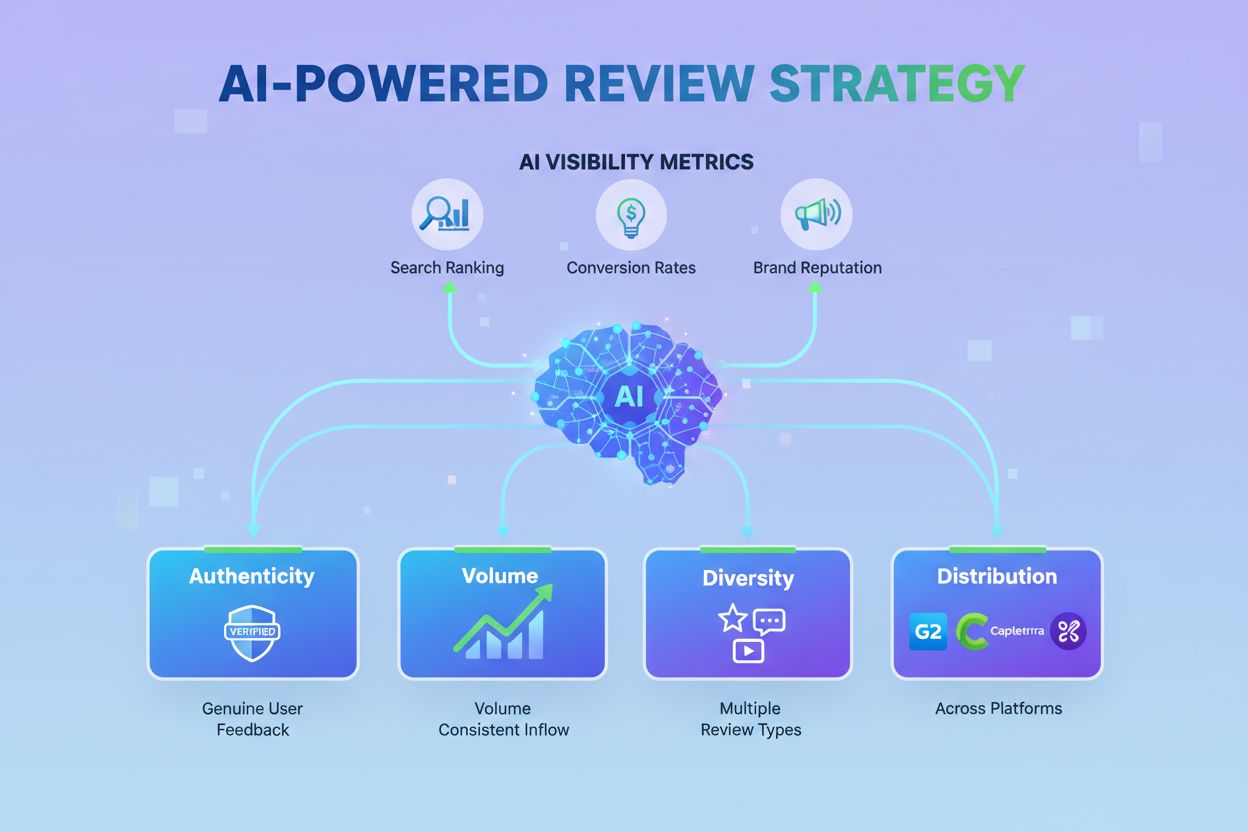
Learn how to manage reviews for maximum AI visibility. Discover the importance of authenticity, semantic diversity, and strategic distribution for LLM citations...