
Reddit Thread Optimization
Learn Reddit Thread Optimization strategies to increase AI visibility across ChatGPT, Perplexity, and Google AI Overviews. Discover how to create citation-worth...
10 min read

Discover how Stack Overflow content shapes AI responses and learn strategies to maximize your developer visibility in ChatGPT, Gemini, and other AI platforms.
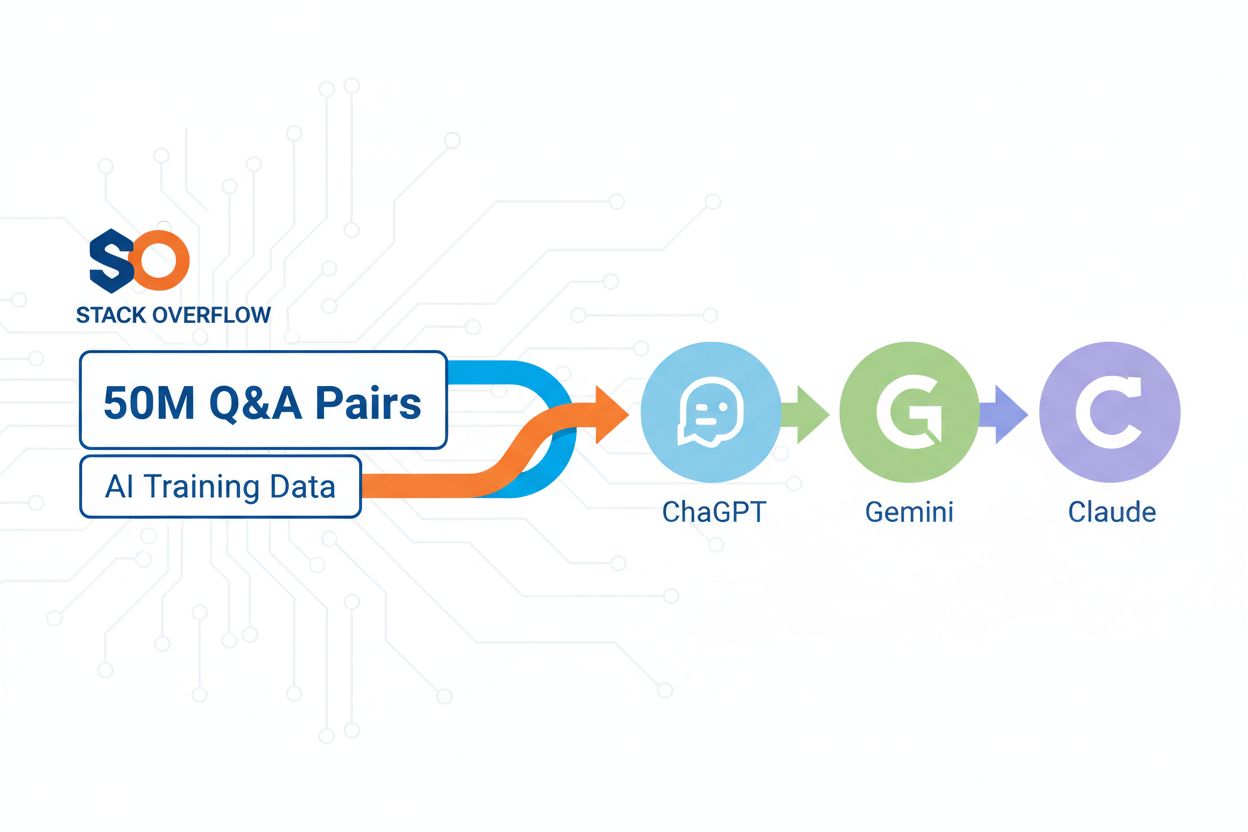
Stack Overflow’s 50 million questions and answers have become a cornerstone of large language model development. Major AI companies including OpenAI, Google, and Meta have incorporated Stack Overflow data into their training datasets because developer knowledge represents some of the highest-quality, peer-reviewed technical content available on the internet. Developing advanced AI systems costs hundreds of millions of dollars, and much of that expense comes from acquiring and processing training data. Historically, AI companies scraped this data for free, but Stack Overflow’s CEO Prashanth Chandrasekar announced in 2023 that the platform would begin charging large AI developers for access to its content, recognizing that community-generated knowledge should be compensated. This shift reflects a broader industry movement where platforms with valuable data are demanding fair compensation from companies profiting from their content.
Stack Overflow content is licensed under Creative Commons Attribution-ShareAlike 4.0 (CC BY-SA), which legally requires anyone using the content to provide attribution to the original authors. This licensing framework is non-negotiable for Stack Overflow, as the platform believes attribution is the foundation of developer trust in AI-generated content. When AI companies train models on Stack Overflow data without proper attribution, they technically violate the Creative Commons license, which is why Stack Overflow now requires all API partners to include attribution requirements in their contracts. The importance of this cannot be overstated: according to the 2024 Stack Overflow Developer Survey, 65% of developers cite missing or incorrect attribution as a top ethical concern with AI tools.
| Aspect | Requirement | Impact |
|---|---|---|
| License Type | CC BY-SA 4.0 | Attribution mandatory |
| Developer Trust | 72% favorability | Critical for adoption |
| AI Compliance | RAG implementation | Ensures proper sourcing |
| Citation Rate | 65% concern | Top ethical issue |
| Content Ownership | User-retained | Community protection |
Stack Overflow’s approach to AI licensing distinguishes between free and commercial use cases. The platform continues to offer free access to its API and data dumps for non-commercial purposes, educational use, and open-source projects, maintaining its commitment to the developer community. However, companies developing large language models for commercial purposes must negotiate licensing agreements with Stack Overflow, with pricing based on factors like model scale, usage volume, and revenue generated. Stack Overflow CEO Chandrasekar emphasized that the company only seeks compensation from organizations developing LLMs for “big, commercial purposes,” not from individual developers or small projects. This dual-licensing model allows Stack Overflow to generate new revenue streams while protecting the interests of its community members, many of whom contribute content without expectation of direct payment. The company has also committed to reinvesting licensing revenue back into community tools and features, creating a sustainable model where developer contributions directly fund platform improvements.
Stack Overflow content now appears prominently in AI-generated responses across major platforms including ChatGPT, Google Gemini, Perplexity, and Microsoft Copilot. Google’s Gemini Cloud Assist explicitly attributes Stack Overflow answers when providing coding solutions, displaying the original question, answer, and author information directly in the AI response. OpenAI’s ChatGPT surfaces Stack Overflow links in conversations about coding topics, and SearchGPT—OpenAI’s search prototype—includes Stack Overflow results in both conversational responses and search result listings. This visibility is crucial for developers because it drives traffic back to their answers and establishes them as recognized experts in their field. However, not all AI platforms provide equal attribution, and developers often struggle to understand which of their answers are being cited, how frequently, and in what context across different AI systems.
The 2024 Stack Overflow Developer Survey reveals a widening gap between AI adoption and trust: while 76% of developers are using or planning to use AI tools (up from 70% in 2023), AI’s favorability rating has declined from 77% to 72%. Only 43% of developers trust the accuracy of AI tools, and the survey identified three critical ethical concerns that developers prioritize:
This trust deficit directly impacts how AI companies approach data sourcing and model training. Developers increasingly demand that AI systems cite their sources, acknowledge community contributions, and maintain accuracy standards that reflect the peer-reviewed nature of Stack Overflow’s content. The pressure to build trustworthy AI systems has created urgency around data procurement focused on high-quality training data, making Stack Overflow’s verified, community-curated knowledge more valuable than ever.
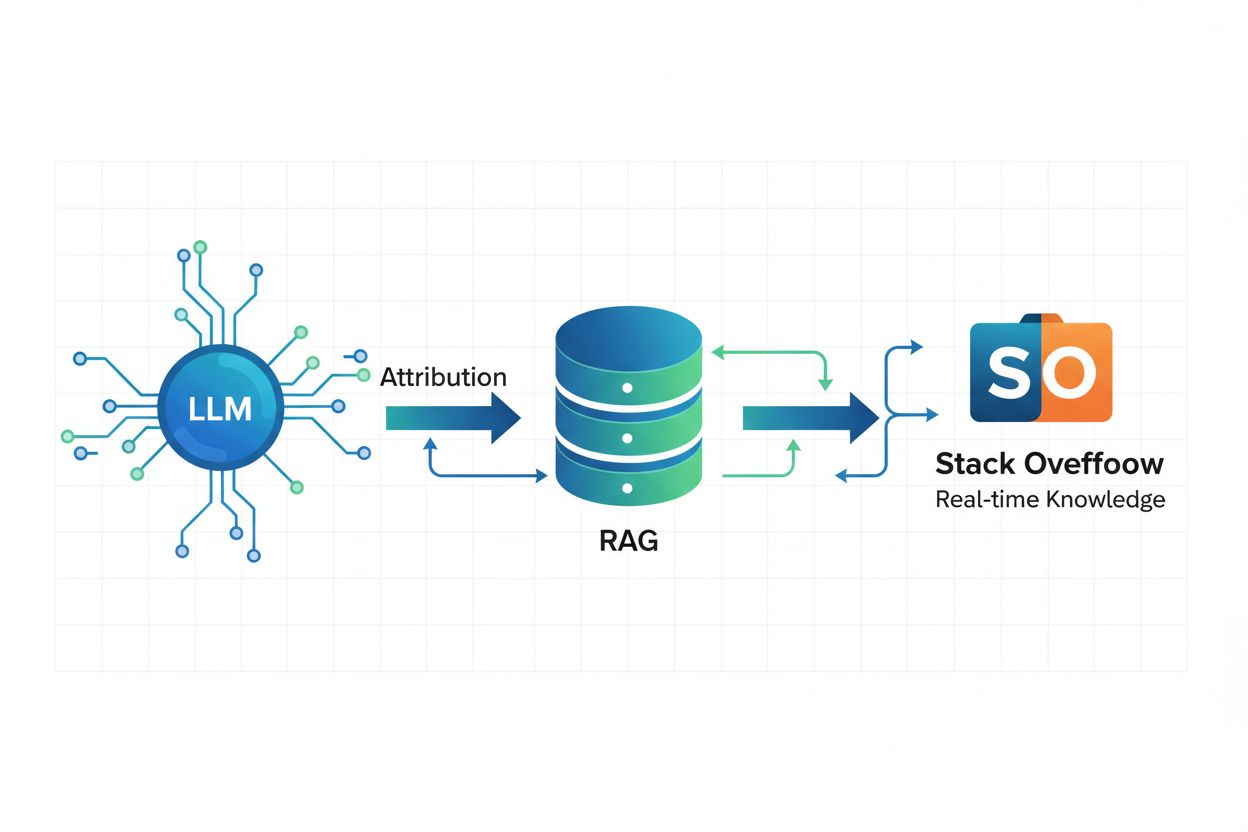
Retrieval Augmented Generation (RAG) is an AI framework that combines large language models with traditional information retrieval systems to provide current, accurate, and properly attributed answers. Rather than relying solely on training data frozen at a specific point in time, RAG allows AI systems to pull real-time information from external sources like Stack Overflow, ensuring responses reflect the latest knowledge and best practices. All of Stack Overflow’s OverflowAPI partners have implemented RAG to enable proper attribution, which means when an AI system generates an answer using Stack Overflow content, it can identify and cite the specific posts that influenced the response. This technology is particularly powerful for domain-specific knowledge where accuracy and currency matter—for example, prompting an AI system to write C# code by feeding it specific examples from your codebase ensures the generated code follows your team’s standards and conventions. RAG reduces hallucination risk by grounding AI responses in trusted, verified facts that users explicitly identify, making it the technical foundation for responsible AI development.
Developers who contribute to Stack Overflow should actively monitor how their content appears in AI-generated responses across different platforms. Tools like AmICited.com, XFunnel, Profound, and others now provide visibility tracking specifically designed to show developers where their answers are being cited, how frequently, and in what context across ChatGPT, Gemini, Perplexity, and other AI systems. Key metrics to track include citation frequency (how often your content is referenced), sentiment (whether mentions are positive or neutral), platform distribution (which AI systems cite you most), and source attribution (whether proper credit is given). By monitoring these metrics, developers can identify which of their answers provide the most value to AI systems, understand which topics are most in-demand, and adjust their contribution strategy accordingly. Additionally, tracking visibility helps developers spot inaccurate or incomplete citations, allowing them to update their original answers or reach out to AI companies to request corrections. This proactive approach transforms passive content contribution into an active strategy for building authority and influence within the AI-powered information ecosystem.
To maximize visibility in AI search results and ensure your Stack Overflow contributions get properly cited, focus on creating comprehensive, well-documented answers that address the complete question with clear explanations and working code examples. Keep your answers current by periodically reviewing and updating them as technologies evolve, since AI systems prioritize fresher content—on average, content cited in AI results is 25.7% fresher than what ranks in Google. Build authority by consistently providing high-quality answers across multiple related topics, as developers in the top 25% for web mentions earn 10x more AI citations than others. Engage with the broader developer ecosystem by participating in discussions, answering follow-up questions, and helping other community members improve their contributions. Finally, consider how your answers might be used by AI systems: structure your responses with clear headings, include relevant code snippets, and provide context about when and why specific approaches are appropriate, making your content more useful for both human readers and AI systems that need to extract and attribute information accurately.
Stack Overflow's 50 million questions and answers are incorporated into large language models because they represent high-quality, peer-reviewed technical content. AI companies like OpenAI, Google, and Meta use this data to train their models to better understand and generate code and technical solutions. Historically, this data was scraped for free, but Stack Overflow now requires commercial AI developers to license the data through paid agreements.
Stack Overflow offers free API access for non-commercial purposes, educational use, and open-source projects. However, companies developing large language models for commercial purposes must negotiate paid licensing agreements. The pricing is based on factors like model scale, usage volume, and revenue generated, ensuring that community contributions are properly compensated.
Create comprehensive, well-documented answers with clear explanations and working code examples. Keep your answers current by updating them as technologies evolve, since AI systems prioritize fresher content. Build authority by consistently providing high-quality answers across multiple topics, and structure your responses with clear headings and relevant code snippets that AI systems can easily extract and attribute.
Retrieval Augmented Generation (RAG) is an AI framework that combines language models with information retrieval systems to provide current, accurate, and properly attributed answers. RAG allows AI systems to pull real-time information from sources like Stack Overflow and cite the specific posts that influenced the response, ensuring proper attribution and reducing hallucination risk.
Tools like AmICited.com, XFunnel, Profound, and others provide visibility tracking specifically designed to show developers where their answers are being cited across ChatGPT, Gemini, Perplexity, and other AI systems. These tools track citation frequency, sentiment, platform distribution, and source attribution, helping you understand which of your answers provide the most value to AI systems.
According to the 2024 Stack Overflow Developer Survey, developers have three main ethical concerns: misinformation risk (79% concerned), missing or incorrect attribution (65% concerned), and bias that doesn't represent diverse viewpoints (50% concerned). These concerns drive the need for proper licensing, attribution requirements, and high-quality training data from verified sources like Stack Overflow.
Stack Overflow content is licensed under Creative Commons Attribution-ShareAlike 4.0 (CC BY-SA), which legally requires anyone using the content to provide attribution to the original authors. Stack Overflow now requires all API partners to include attribution requirements in their contracts, ensuring that developers receive proper credit when their answers are used by AI systems.
Several tools are available for tracking AI citations, including AmICited.com (specialized in AI monitoring), XFunnel (enterprise LLM monitoring), Profound (advanced GEO tracking), Semrush AI Toolkit, BrightEdge, and others. These tools help you track which AI platforms cite you, how frequently, in what context, and whether proper attribution is provided.
Track how your technical expertise is cited across ChatGPT, Gemini, Perplexity, and other AI platforms. Get real-time insights into your developer visibility and optimize your community presence.
Learn Reddit Thread Optimization strategies to increase AI visibility across ChatGPT, Perplexity, and Google AI Overviews. Discover how to create citation-worth...
Discover how fake Reddit marketing tactics harm brand reputation and AI citations. Learn to detect manipulation, protect your brand, and engage authentically on...

Complete guide to opting out of AI training data collection across ChatGPT, Perplexity, LinkedIn, and other platforms. Learn step-by-step instructions to protec...