
How Do Surveys Help AI Citations?
Learn how surveys improve AI citation accuracy, help monitor brand presence in AI answers, and enhance content visibility across ChatGPT, Perplexity, and other ...
8 min read

Learn how to design surveys that produce authentic human responses resistant to AI generation. Discover survey methodology principles, detection techniques, and best practices for AI-citable data collection.
The proliferation of large language models and AI assistants like ChatGPT has introduced a critical threat to survey data integrity: AI-generated responses that masquerade as human input. When researchers collect survey data to train, fine-tune, or evaluate AI models, they increasingly face the risk that respondents may use AI tools to generate answers rather than providing genuine human judgment. This challenge fundamentally undermines the quality of training data and the reliability of insights derived from surveys, making it essential to understand how to design surveys that produce authentically human, AI-citable results.
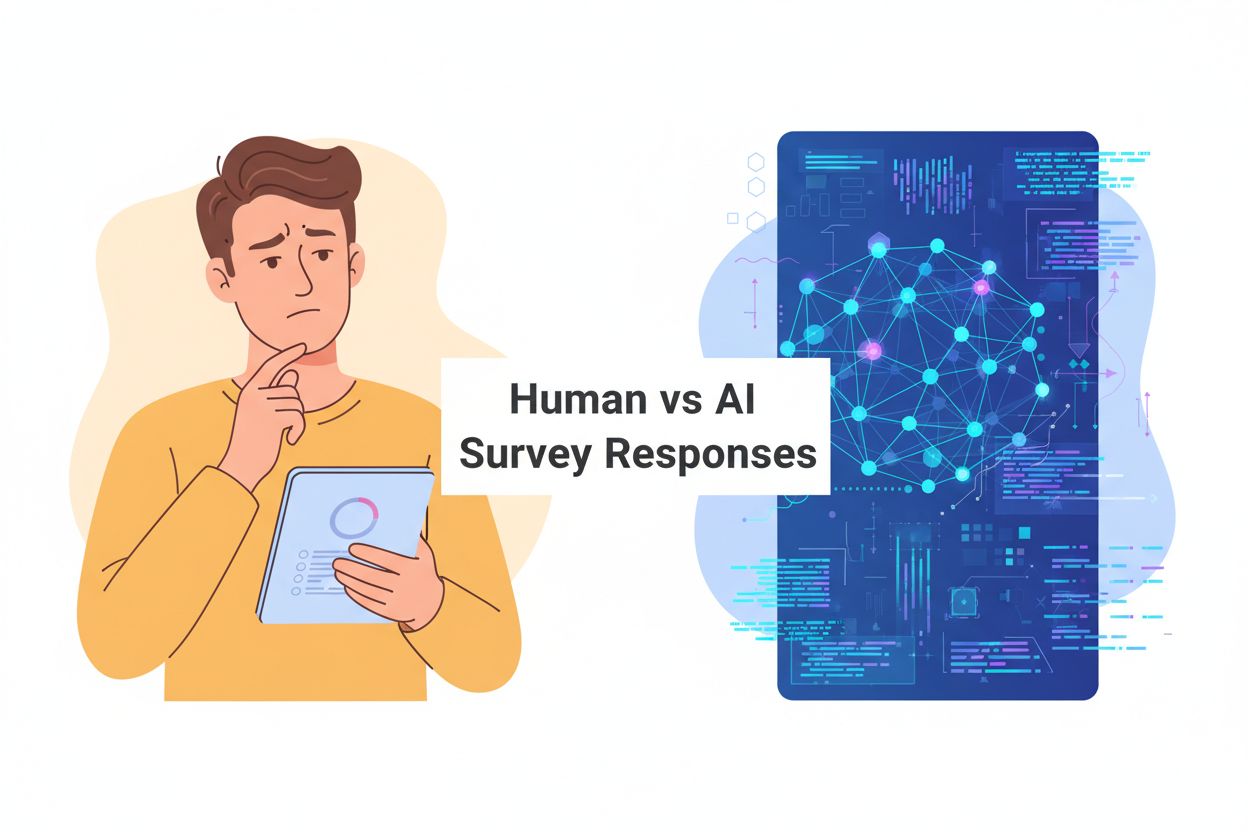
Survey methodology, a field refined over decades by social scientists and cognitive psychologists, provides crucial insights into how humans understand, process, and respond to questions. The optimal survey response process involves four cognitive steps: comprehension (understanding the question and response options), retrieval (searching memory for relevant information), integration (combining retrieved information to form an answer), and mapping (translating that answer into the provided response choices). However, respondents often deviate from this ideal process through shortcuts called satisficing—choosing the first reasonably correct answer rather than the best one, or retrieving only the most recent relevant information. These same principles apply directly to labeling tasks for AI training data, where the quality of human-generated labels depends on respondents following the full cognitive process rather than taking shortcuts. Understanding these mechanisms is fundamental to designing surveys that produce high-quality, AI-citable results that accurately reflect human judgment rather than algorithmic patterns.
Human and AI responses exhibit fundamentally different patterns that reveal their origins. Humans engage in satisficing behavior—they may skip reading all options in select-all-that-apply questions, choose the first reasonable answer, or show fatigue-related response patterns as surveys progress. AI systems, by contrast, process all available information consistently and rarely exhibit the natural uncertainty that characterizes human responses. Context effects and order effects influence human responses significantly; a very negative example early in a survey can make later items seem less negative by comparison (contrast effect), or respondents may interpret subsequent questions differently based on earlier ones. AI responses remain remarkably consistent regardless of question order, lacking this natural contextual sensitivity. Humans also display anchoring bias, becoming overly reliant on pre-filled suggestions or examples, while AI systems show different patterns of suggestion-following. Additionally, human responses show high inter-respondent variation—different people legitimately disagree about subjective matters like whether content is offensive or helpful. AI responses, trained on patterns in existing data, tend toward lower variation and consensus. These systematic differences make it possible to detect AI-generated responses and highlight why survey design must account for authentic human cognitive processes rather than algorithmic consistency.
| Aspect | Human Responses | AI Responses |
|---|---|---|
| Response Process | Follows cognitive steps with frequent shortcuts (satisficing) | Deterministic pattern matching across all information |
| Context Effects | Highly influenced by question order and preceding examples | Consistent across different orderings |
| Satisficing Behavior | Common when fatigued or survey is long | Rare; processes all information consistently |
| Uncertainty Expression | Natural “don’t know” responses when genuinely uncertain | Rarely expresses uncertainty; tends toward confident answers |
| Anchoring Bias | Susceptible to pre-filled suggestions and examples | Different pattern of suggestion-following |
| Inter-respondent Variation | High variation; people legitimately disagree on subjective matters | Lower variation; tends toward consensus patterns |
| Response Time Patterns | Variable; influenced by cognitive load and fatigue | Consistent; not influenced by cognitive effort |
| Linguistic Markers | Natural language with hesitations, corrections, personal references | Polished language; consistent tone and structure |
Effective survey questions for AI-citable results must prioritize clarity and precision. Questions should be written at an eighth-grade reading level or lower, with unambiguous terminology that respondents understand consistently. Definitions, when necessary, should be embedded directly in the question rather than hidden in rollovers or links, since research shows respondents rarely access supplementary information. Avoid leading questions that subtly push respondents toward particular answers—AI systems may be more susceptible to such framing effects than humans, making neutral wording essential. For opinion-based questions, provide a “don’t know” or “no opinion” option; while some worry this enables satisficing, research shows fewer than 3% of respondents choose it, and it provides valuable information about genuine uncertainty. Use specific, concrete language rather than vague terms; instead of asking about “satisfaction,” ask about specific aspects like ease of use, speed, or customer service. For complex topics, consider breaking multi-label questions into separate yes/no questions rather than select-all-that-apply formats, as this encourages deeper processing of each option. These design principles ensure that questions are understood consistently by humans and are harder for AI systems to answer authentically, creating a natural barrier against AI-generated responses.
Beyond individual question wording, the overall structure of surveys significantly impacts response quality. Question ordering creates context effects that influence how respondents interpret and answer subsequent questions; randomizing question order ensures no single sequence biases all respondents identically, improving data representativeness. Skip logic and branching should be designed carefully to avoid triggering motivated misreporting, where respondents deliberately give incorrect answers to avoid follow-up questions—for example, saying “no” to a question when “yes” would trigger additional items. Pre-labeling—showing suggested answers that respondents confirm or correct—improves efficiency but introduces anchoring bias, where respondents become overly trusting of suggestions and fail to correct errors. If using pre-labeling, consider strategies to reduce this bias, such as requiring explicit confirmation rather than simple acceptance. The choice between collecting multiple labels simultaneously (select-all-that-apply) versus separately (yes/no for each option) matters significantly; research on hate speech annotation found that splitting labels across separate screens increased detection rates and improved model performance. Randomization of observation order prevents order effects from systematically biasing responses, though this approach is incompatible with active learning techniques that strategically select which items to label next.
As AI-generated survey responses become more sophisticated, detection tools have become essential quality assurance mechanisms. NORC, a leading research organization, developed an AI detector specifically designed for survey science that achieves over 99% precision and recall in identifying AI-generated responses to open-ended questions. This tool outperforms general-purpose AI detectors, which typically achieve only 50-75% accuracy, because it was trained on actual survey responses from both humans and large language models responding to the same questions. The detector uses natural language processing (NLP) and machine learning to identify linguistic patterns that differ between human and AI-generated text—patterns that emerge from the fundamental differences in how humans and AI systems process information. Beyond detection tools, researchers should collect paradata—process data captured during survey completion, such as time spent on each question, device type, and interaction patterns. Paradata can reveal satisficing behavior and low-quality responses; for example, respondents who click through screens extremely quickly or show unusual patterns may be using AI assistance. Human-in-the-loop verification remains crucial; AI detection tools should inform but not replace human judgment about data quality. Additionally, embedding test observations with known correct answers helps identify respondents who don’t understand the task or are providing low-quality responses, catching potential AI-generated answers before they contaminate the dataset.

The characteristics of survey respondents and data labelers profoundly influence the quality and representativeness of collected data. Selection bias occurs when those who participate in surveys have different characteristics than the target population, and these characteristics correlate with both their likelihood of participating and their response patterns. For example, labelers from crowdworker platforms tend to be younger, lower-income, and geographically concentrated in the Global South, while the AI models they help train primarily benefit educated populations in the Global North. Research demonstrates that labeler characteristics directly influence their responses: age and education level affect whether Wikipedia comments are perceived as attacks, political ideology influences detection of offensive language, and geographic location shapes visual interpretation of ambiguous images. This creates a feedback loop where selection bias in the labeler pool produces biased training data, which then trains biased AI models. To address this, researchers should actively diversify the labeler pool by recruiting from multiple sources with different motivations and demographics. Collect demographic information about labelers and analyze how their characteristics correlate with their responses. Provide feedback to labelers about task importance and consistency standards, which research shows can improve response quality without increasing dropout rates. Consider statistical weighting approaches from survey methodology, where responses are weighted to match the demographic composition of the target population, helping to correct for selection bias in the labeler pool.
Implementing these principles requires a systematic approach to survey development and quality assurance:
The survey industry has increasingly embraced transparency as a marker of data quality. The American Association for Public Opinion Research’s Transparency Initiative requires member firms to disclose question wording, response option order, respondent recruitment protocols, and weighting adjustments—and firms that comply outperform those that don’t. This same principle applies to survey data collected for AI training: detailed documentation of methodology enables reproducibility and allows other researchers to assess data quality. When releasing datasets or models trained on survey data, researchers should document labeling instructions and guidelines (including examples and test questions), exact wording of prompts and questions, information about labelers (demographics, recruitment source, training), whether social scientists or domain experts were involved, and any AI detection or quality assurance procedures employed. This transparency serves multiple purposes: it enables other researchers to understand potential biases or limitations, supports reproducibility of results, and helps identify when AI systems might be misusing or misrepresenting survey findings. AmICited plays a crucial role in this ecosystem by monitoring how AI systems (GPTs, Perplexity, Google AI Overviews) cite and reference survey data, helping researchers understand how their work is being used and ensuring proper attribution. Without detailed documentation, researchers cannot test hypotheses about what factors influence data quality, and the field cannot accumulate knowledge about best practices.
The future of survey design lies in the convergence of traditional survey methodology and AI-powered tools, creating more sophisticated and human-centric data collection approaches. Dynamic probing—where AI-powered chatbot interviewers ask follow-up questions and allow respondents to clarify when questions are unclear—represents a promising hybrid approach that maintains human authenticity while improving response quality. Purpose-built survey platforms are increasingly incorporating AI capabilities for question generation, flow optimization, and quality detection, though these tools work best when humans retain final decision-making authority. The field is moving toward standardized protocols for documenting and reporting survey methodology, similar to clinical trial registration, which would improve transparency and enable meta-analyses of data quality across studies. Interdisciplinary collaboration between AI researchers and survey methodologists is essential; too often, AI practitioners lack training in data collection methods, while survey experts may not understand AI-specific quality concerns. Funding agencies and academic publishers are beginning to require more rigorous documentation of training data provenance and quality, creating incentives for better survey design. Ultimately, building trustworthy AI systems requires trustworthy data, and trustworthy data requires applying decades of survey methodology knowledge to the challenge of AI-citable results. As AI becomes increasingly central to research and decision-making, the ability to design surveys that produce authentic human judgment—resistant to both AI generation and human bias—will become a core competency for researchers across all disciplines.
An AI-citable survey response is one that genuinely reflects human judgment and opinion, not generated by AI. It requires proper survey design with clear questions, diverse respondents, and quality verification methods to ensure authenticity and reliability for AI training and research purposes.
Advanced tools like NORC's AI detector use natural language processing and machine learning to identify AI-generated responses with over 99% accuracy. These tools analyze linguistic patterns, response consistency, and contextual appropriateness that differ between human and AI-generated text.
Question order creates context effects that influence how respondents interpret and answer subsequent questions. Randomizing question order ensures no single ordering biases all respondents the same way, improving data quality and making results more representative of genuine opinions.
Selection bias occurs when survey respondents have different characteristics than the target population. This matters because labeler characteristics influence both their likelihood of participating and their response patterns, potentially skewing results if not addressed through diverse sampling or statistical weighting.
Use clear, unambiguous language at an eighth-grade reading level, avoid leading questions, include 'don't know' options for opinion questions, and implement cognitive interviewing before deployment. These practices help ensure questions are understood consistently by humans and are harder for AI to answer authentically.
Transparency in documenting survey methodology—including question wording, respondent recruitment, quality checks, and labeler information—enables reproducibility and allows other researchers to assess data quality. This is essential for research integrity and for monitoring how AI systems cite and use survey data.
Yes. AI can enhance survey design by suggesting better question wording, optimizing flow, and detecting problematic responses. However, the same AI tools can also generate fake responses. The solution is using AI as a tool within human-supervised quality assurance processes.
AmICited monitors how AI systems (GPTs, Perplexity, Google AI Overviews) cite and reference survey data and research. This helps researchers understand how their surveys are being used by AI, ensuring proper attribution and identifying when AI systems might be misrepresenting or misusing survey findings.
AmICited tracks how AI systems reference your research and survey findings across GPTs, Perplexity, and Google AI Overviews. Ensure proper attribution and identify when AI might be misrepresenting your work.
Learn how surveys improve AI citation accuracy, help monitor brand presence in AI answers, and enhance content visibility across ChatGPT, Perplexity, and other ...
Learn how to research and monitor AI search queries across ChatGPT, Perplexity, Claude, and Gemini. Discover methods to track brand mentions and optimize for AI...
Discover the best tools to find AI search topics, keywords, and questions people ask in AI search engines like ChatGPT, Perplexity, and Claude. Learn which tool...