
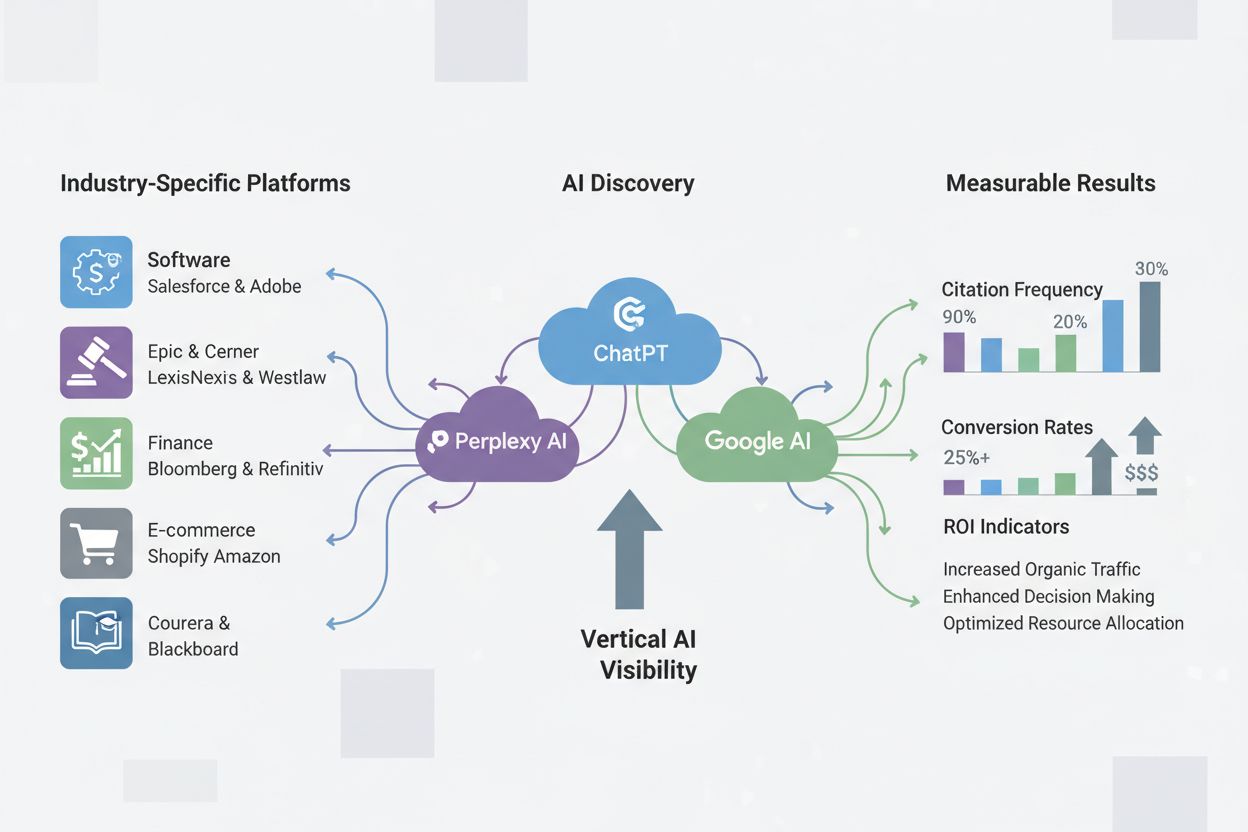
Industry-Specific Review Sites: Vertical AI Visibility
Discover how vertical review platforms drive AI visibility and citations. Learn why niche review sites matter more than generic platforms for B2B companies seek...
10 min read
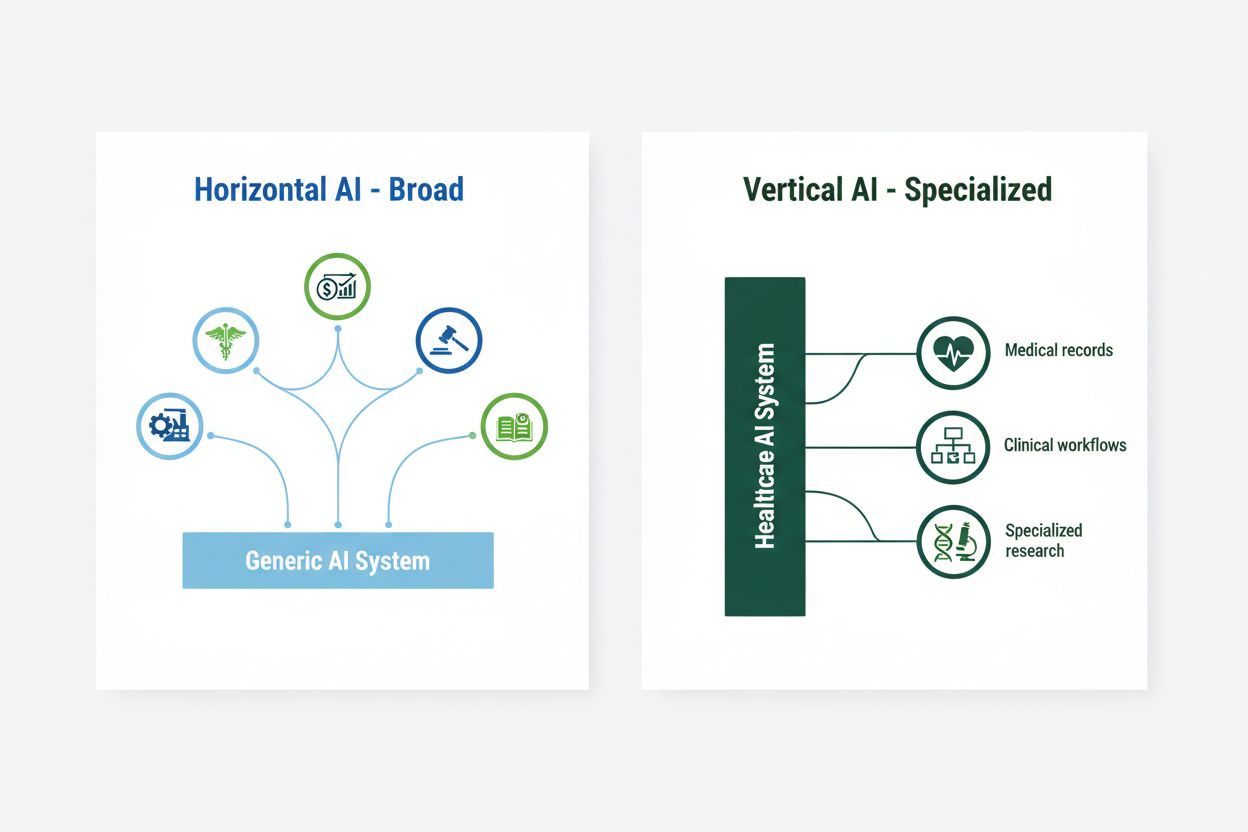
Explore how vertical AI and specialized AI assistants are transforming industries. Learn about market trends, key players, and ROI of industry-specific AI optimization.
Vertical AI, also known as specialized or domain-specific AI, represents a fundamental shift in how artificial intelligence is being deployed across industries. Unlike horizontal AI systems—which are designed as general-purpose tools applicable across multiple sectors—vertical AI solutions are purpose-built for specific industries, professions, or use cases. These specialized assistants are trained on domain-specific data, incorporate industry regulations and best practices, and are optimized to solve particular problems within their target vertical. The distinction is critical: while horizontal AI tools like ChatGPT aim for broad applicability, vertical AI assistants like PathAI for pathology or Harvey AI for legal work are engineered from the ground up to deliver superior performance in their respective domains. This shift is happening because organizations increasingly recognize that generic AI solutions often fall short of industry-specific requirements, regulatory constraints, and the nuanced expertise required to deliver genuine business value.
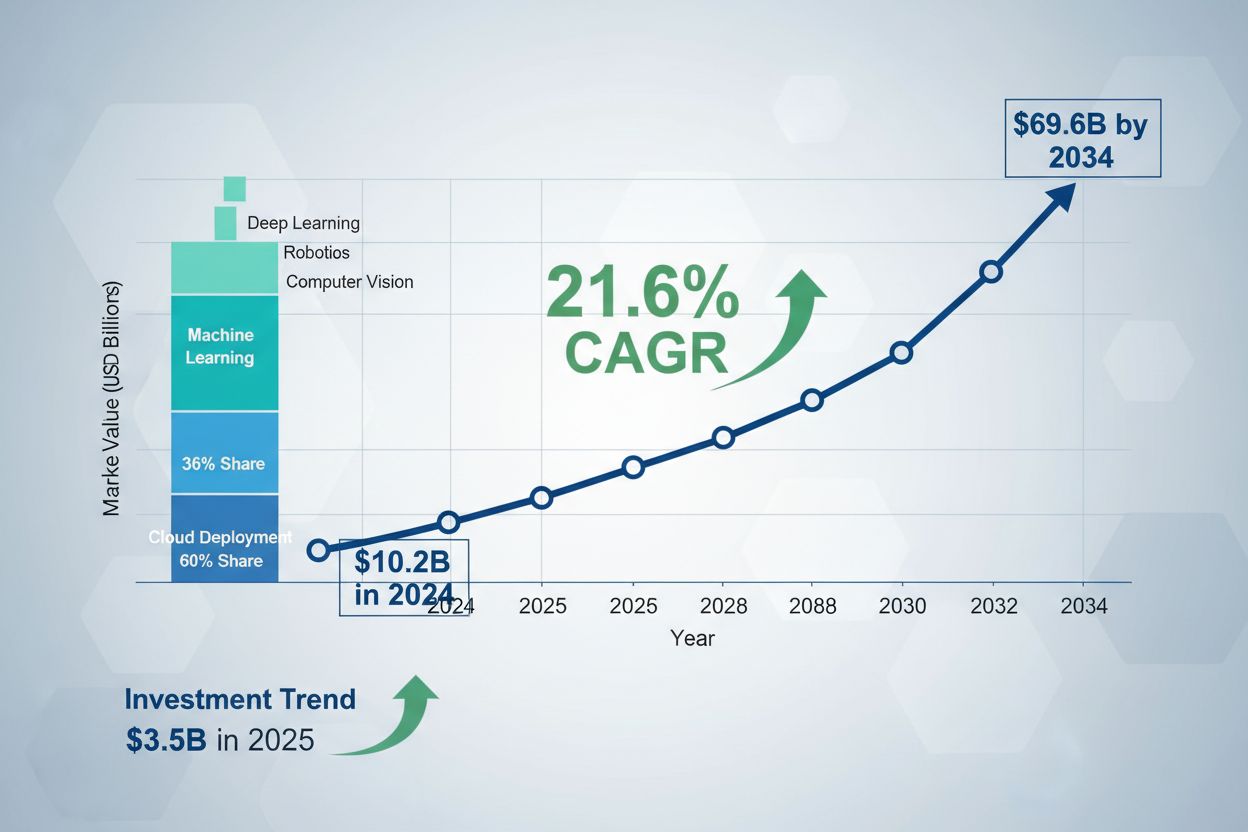
The vertical AI market is experiencing explosive growth that underscores the strategic importance of specialized AI solutions. The market reached $10.2 billion in 2024 and is projected to expand at a compound annual growth rate (CAGR) of 21.6% through 2034, ultimately reaching $69.6 billion. This trajectory reflects not only the increasing demand for industry-specific solutions but also the recognition that vertical AI delivers superior ROI compared to horizontal alternatives. Investment in vertical AI has tripled year-over-year, with $3.5 billion committed in 2025 alone, signaling strong confidence from venture capital and enterprise investors. Cloud deployment dominates the market with a 60% market share, and this segment is expected to exceed $40 billion by 2034, indicating that organizations prefer scalable, cloud-native vertical AI solutions. The machine learning segment represents 36% of the market share, highlighting the critical role of advanced ML algorithms in powering these specialized systems.
| Metric | 2024 Value | 2034 Projection | Growth Rate |
|---|---|---|---|
| Total Market Size | $10.2B | $69.6B | 21.6% CAGR |
| Cloud Deployment | 60% share | $40B+ | Expanding |
| ML Segment | 36% share | Growing | Significant |
| Global Investment | $3.5B (2025) | Accelerating | 3x YoY |
| North America Share | 40% | Dominant | Stable |
Specialized AI assistants possess distinct characteristics that differentiate them from general-purpose AI systems and enable them to deliver superior performance in their target domains. These systems are built on domain-specific training data that captures the unique patterns, terminology, and problem-solving approaches within their industry. They incorporate regulatory compliance frameworks directly into their architecture, ensuring that outputs meet industry standards without requiring post-processing or manual verification. Specialized assistants demonstrate contextual understanding that reflects years of accumulated expertise in their field, allowing them to recognize nuances that generic systems would miss. They are optimized for specific workflows and processes rather than generic conversation, making them more efficient and practical for professional use. Finally, these systems often feature explainability and auditability, critical for regulated industries where decision-making transparency is non-negotiable.
Key characteristics include:
The healthcare industry has emerged as a primary beneficiary of vertical AI innovation, with specialized assistants transforming clinical workflows and diagnostic accuracy. Recursion Pharmaceuticals leverages AI to accelerate drug discovery by analyzing vast datasets of cellular images and genetic information, reducing development timelines from years to months. PathAI has revolutionized digital pathology by providing AI-powered analysis of tissue samples, enabling pathologists to detect cancers and other diseases with unprecedented accuracy while reducing diagnostic variability. Insilico Medicine applies vertical AI to longevity research and drug development, using machine learning to identify novel therapeutic targets and predict drug efficacy. Caregility specializes in remote patient monitoring and telehealth optimization, using AI to enhance clinical decision-making in distributed care settings. These healthcare-focused assistants are trained on millions of medical images, clinical notes, and research papers, enabling them to provide evidence-based recommendations that clinicians can trust and integrate into their practice. The regulatory rigor required in healthcare—including FDA approval processes and HIPAA compliance—makes vertical AI solutions essential rather than optional in this sector.
Financial institutions are deploying specialized AI assistants to navigate the complex, high-stakes environment of modern finance, where milliseconds and regulatory compliance determine success. Vertical AI solutions in finance are engineered to analyze market data, identify trading opportunities, and execute strategies while maintaining strict adherence to SEC regulations, anti-money laundering (AML) requirements, and market manipulation safeguards. These assistants process 149 zettabytes of global data created in 2024, extracting actionable insights from market feeds, news, social sentiment, and alternative data sources that would be impossible for human analysts to synthesize. Specialized financial AI systems excel at real-time risk assessment, continuously monitoring portfolio exposure, counterparty risk, and systemic vulnerabilities. Compliance-focused vertical AI assistants automate the detection of suspicious transactions, regulatory reporting, and audit trail generation, reducing the operational burden of compliance teams while improving detection accuracy. The financial services sector’s demand for vertical AI is driven by the need to process massive data volumes, maintain regulatory compliance at scale, and compete in markets where algorithmic advantage is measured in microseconds.
The legal profession is experiencing a transformation through specialized AI assistants that augment attorney capabilities and democratize access to legal expertise. Harvey AI represents the cutting edge of legal vertical AI, providing attorneys with AI-powered contract analysis, legal research, and due diligence capabilities that dramatically accelerate case preparation and reduce billable hours. Luminance specializes in document review and contract intelligence, using machine learning to identify risks, inconsistencies, and key obligations across thousands of legal documents in a fraction of the time required for manual review. These legal-focused assistants are trained on vast corpora of case law, statutes, regulatory guidance, and legal precedents, enabling them to provide research-backed recommendations that attorneys can rely upon. Vertical AI in legal services addresses the profession’s critical challenge: the exponential growth in document volume and regulatory complexity that makes traditional legal work increasingly expensive and time-consuming. By automating routine analysis and research tasks, specialized legal AI assistants free attorneys to focus on strategic thinking, client counseling, and complex problem-solving that requires human judgment. The legal industry’s adoption of vertical AI is accelerating because these tools directly address the profession’s profitability challenges while improving service quality for clients.
Manufacturing and supply chain operations are leveraging specialized AI assistants to optimize production efficiency, reduce waste, and enhance supply chain resilience. Blue River Technology pioneered precision agriculture AI, using computer vision and machine learning to optimize crop management at the individual plant level, dramatically improving yields while reducing water and chemical inputs. Vertical AI solutions in manufacturing excel at predictive maintenance, analyzing sensor data from equipment to predict failures before they occur, reducing unplanned downtime and extending asset life. These specialized systems optimize production scheduling and resource allocation, accounting for complex constraints including equipment capabilities, material availability, labor scheduling, and demand forecasting. Supply chain-focused vertical AI assistants provide real-time visibility and optimization across global networks, identifying bottlenecks, predicting disruptions, and recommending alternative sourcing or routing strategies. The manufacturing sector’s adoption of vertical AI is driven by the need to compete in global markets where efficiency margins are razor-thin and supply chain disruptions can cascade into significant financial losses.
Multiple converging trends are accelerating the adoption of specialized AI assistants across industries, creating a powerful tailwind for vertical AI growth. Organizations are increasingly recognizing that generic AI solutions underperform in specialized domains, lacking the contextual understanding and regulatory awareness required for mission-critical applications. The productivity gains from vertical AI are substantial—workers using specialized AI assistants demonstrate 33% higher productivity per hour compared to those using generic tools, translating directly to improved business outcomes. Employees are saving 5.4% of their work hours through AI assistance, equivalent to 2.2 hours per week, which compounds into significant annual productivity improvements. The regulatory environment is tightening, making compliance-aware AI solutions essential rather than optional in regulated industries. Cloud infrastructure maturity has reached a point where deploying and scaling specialized AI solutions is technically straightforward and economically viable. Finally, competitive pressure is forcing organizations to adopt vertical AI or risk falling behind competitors who have already captured productivity gains and cost advantages.
Key trends include:
Despite the compelling value proposition of vertical AI, organizations face significant challenges in implementing and scaling these specialized solutions. Data quality and availability remain critical obstacles—many organizations lack sufficient domain-specific training data or struggle with data that is fragmented, inconsistent, or of poor quality. Integration complexity is substantial, as vertical AI solutions must connect seamlessly with existing enterprise systems, legacy databases, and specialized software that may not have been designed for AI integration. Regulatory uncertainty persists in many industries, where the legal status of AI-assisted decision-making remains ambiguous, creating hesitation among risk-averse organizations. Change management and adoption challenges are often underestimated—even when vertical AI solutions deliver measurable value, organizations struggle to overcome employee resistance, retraining requirements, and workflow disruption. Cost and resource constraints limit adoption among smaller organizations that lack the capital and technical expertise to implement specialized AI solutions. Vendor lock-in concerns make organizations cautious about committing to proprietary vertical AI platforms that may not be compatible with future technology choices.
The vertical AI landscape features a diverse ecosystem of specialized companies, each focused on delivering superior solutions within their target domains. Recursion Pharmaceuticals and BenevolentAI are leading the charge in pharmaceutical AI, using machine learning to accelerate drug discovery and identify novel therapeutic targets. PathAI and Insilico Medicine dominate healthcare diagnostics and longevity research, respectively, with AI systems that match or exceed human expert performance. Harvey AI and Luminance are transforming legal services through specialized contract analysis and legal research capabilities. Nauto focuses on fleet safety and driver behavior analysis, using computer vision and machine learning to reduce accidents and insurance costs. Blue River Technology pioneered precision agriculture, demonstrating how vertical AI can optimize resource utilization and improve yields. Atomwise applies AI to drug discovery and molecular design, accelerating the identification of promising compounds. Caregility specializes in remote patient monitoring and telehealth optimization. These companies represent the vanguard of vertical AI innovation, each demonstrating that specialized solutions deliver superior performance, higher adoption rates, and stronger unit economics compared to horizontal alternatives. The competitive landscape is consolidating, with larger technology companies and industry incumbents acquiring vertical AI startups to integrate specialized capabilities into their platforms.
Organizations deploying vertical AI assistants are realizing substantial returns on investment through multiple channels, including productivity gains, error reduction, and revenue enhancement. The 33% productivity improvement documented in organizations using specialized AI translates directly to cost savings and increased output capacity without proportional increases in headcount. Error reduction is particularly valuable in high-stakes domains like healthcare and finance, where mistakes carry significant costs—vertical AI systems trained on domain-specific data consistently outperform generic alternatives in accuracy and reliability. Time-to-value acceleration is another critical benefit; specialized AI assistants compress timelines for complex tasks like drug discovery, legal research, and contract analysis, enabling organizations to move faster than competitors. Compliance automation reduces the operational burden and cost of regulatory adherence, particularly valuable in heavily regulated industries. Talent retention and satisfaction improve when employees use AI assistants that augment their capabilities rather than replace them, as workers appreciate tools that make their jobs more interesting and productive. Organizations that have implemented vertical AI solutions report payback periods of 6-18 months, with ongoing benefits that compound over time as the systems learn from additional data and use cases.
The vertical AI market is poised for continued explosive growth as emerging technologies and evolving business needs create new opportunities for specialized solutions. Multimodal vertical AI systems that integrate text, images, audio, and sensor data will enable more sophisticated analysis and decision-making across industries. Real-time AI capabilities will expand beyond current applications, enabling specialized assistants to provide instantaneous guidance in time-sensitive domains like emergency medicine and high-frequency trading. Federated learning approaches will allow organizations to benefit from collective intelligence while maintaining data privacy and regulatory compliance, particularly valuable in healthcare and finance. Industry-specific foundation models will emerge as organizations recognize that pre-training on domain-specific data produces superior results compared to fine-tuning generic models. Vertical AI consolidation will accelerate as larger technology companies and industry incumbents acquire specialized startups, integrating vertical AI capabilities into comprehensive platforms. Emerging verticals including climate tech, energy optimization, and advanced materials discovery represent massive untapped opportunities where specialized AI can deliver transformative value. The organizations that successfully navigate the transition from horizontal to vertical AI will capture disproportionate value, establishing competitive moats that will be difficult for rivals to overcome.
Vertical AI, also called specialized or domain-specific AI, is purpose-built for specific industries or use cases, trained on domain-specific data and optimized for particular problems. Unlike horizontal AI (general-purpose tools like ChatGPT), vertical AI incorporates industry regulations, best practices, and specialized knowledge to deliver superior performance in its target domain. For example, PathAI for pathology or Harvey AI for legal work are engineered from the ground up to solve specific industry problems that generic AI cannot address effectively.
The vertical AI market reached $10.2 billion in 2024 and is projected to grow at a compound annual growth rate (CAGR) of 21.6% through 2034, reaching $69.6 billion. Cloud deployment dominates with 60% market share and is expected to exceed $40 billion by 2034. Investment in vertical AI has tripled year-over-year, with $3.5 billion committed in 2025 alone, reflecting strong confidence from venture capital and enterprise investors.
Healthcare, finance, legal services, and manufacturing are the primary beneficiaries of vertical AI. Healthcare uses specialized AI for drug discovery, diagnostics, and clinical decision support. Finance deploys vertical AI for trading, fraud detection, and compliance. Legal services leverage AI for contract analysis and legal research. Manufacturing uses specialized AI for predictive maintenance, production optimization, and supply chain management. Each industry has unique regulatory requirements and domain expertise that vertical AI solutions are specifically designed to address.
Key challenges include data quality and availability (many organizations lack sufficient domain-specific training data), integration complexity with existing enterprise systems, regulatory uncertainty about AI-assisted decision-making, change management and employee adoption resistance, cost and resource constraints (particularly for smaller organizations), and vendor lock-in concerns. Organizations must also address the need for domain expertise in both AI and their specific industry to successfully implement and maintain vertical AI solutions.
Organizations deploying vertical AI report 33% higher productivity per hour, with workers saving 5.4% of their work hours (approximately 2.2 hours per week). Payback periods typically range from 6-18 months, with benefits including error reduction, time-to-value acceleration, compliance automation, and improved talent retention. The ROI varies by industry and use case, but organizations consistently report measurable improvements in efficiency, accuracy, and competitive advantage within the first year of implementation.
Specialized AI assistants feature domain-specific training data, built-in regulatory compliance frameworks, contextual understanding reflecting industry expertise, optimization for specific workflows, high accuracy requirements, explainable outputs for auditability, and real-time integration with enterprise systems. These characteristics enable vertical AI to deliver superior performance in regulated industries where transparency, compliance, and domain expertise are critical. Generic AI systems lack these specialized features and often underperform in mission-critical applications.
The vertical AI market is poised for continued explosive growth driven by multimodal AI systems, real-time AI capabilities, federated learning approaches, industry-specific foundation models, and consolidation among larger technology companies. Emerging verticals including climate tech, energy optimization, and advanced materials discovery represent massive untapped opportunities. Organizations that successfully invest in vertical AI solutions will establish competitive moats that are difficult for rivals to overcome, capturing disproportionate value in their respective markets.
Track mentions of your brand across AI search results, GPTs, and AI overviews with AmICited. Stay informed about how AI systems cite and reference your business.
Discover how vertical review platforms drive AI visibility and citations. Learn why niche review sites matter more than generic platforms for B2B companies seek...

Understand vertical markets: specialized industry segments with tailored solutions. Learn how vertical markets differ from horizontal markets and their role in ...
Learn what autonomous AI assistants are, how they differ from regular AI assistants, their key capabilities, real-world applications, and why businesses are inv...