
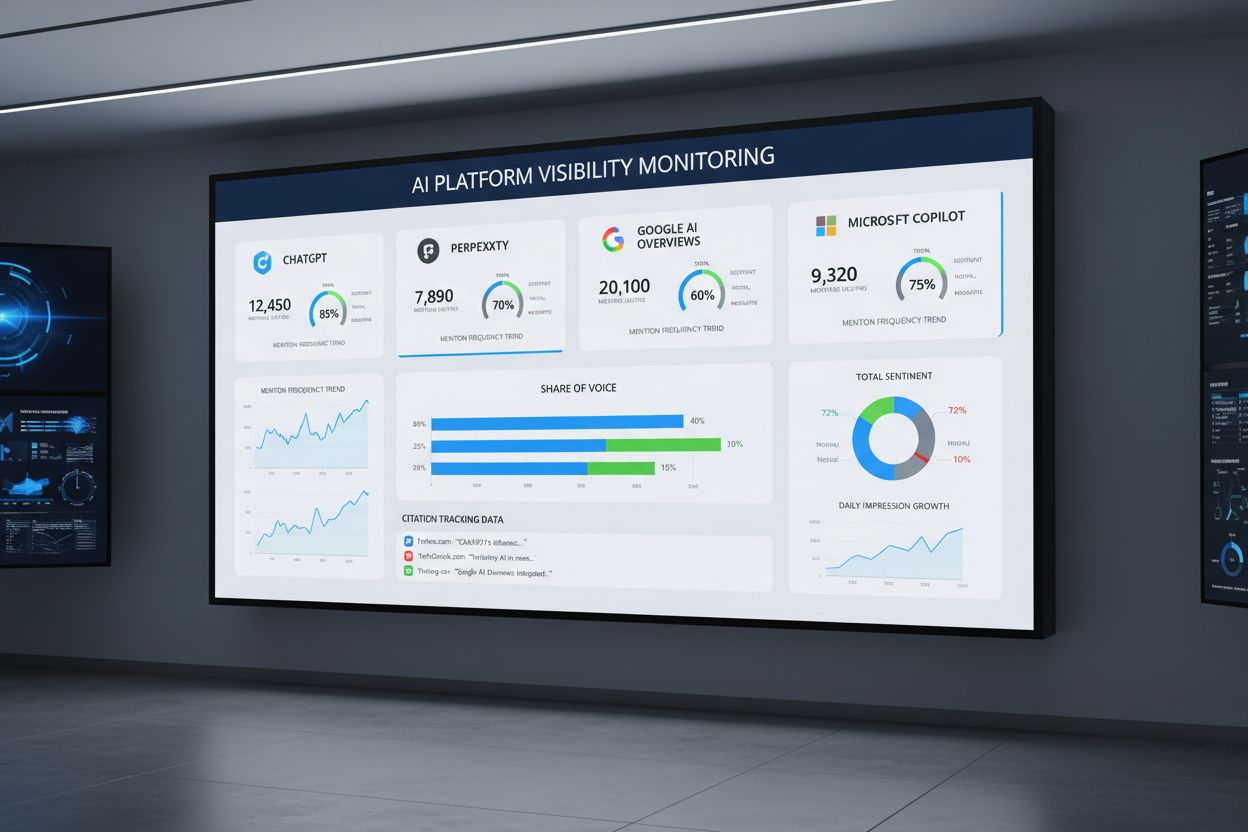
How to Choose an AI Visibility Monitoring Platform
Learn how to choose the right AI visibility monitoring platform for your brand. Compare features, pricing, and capabilities to track your presence in ChatGPT, P...
10 min read
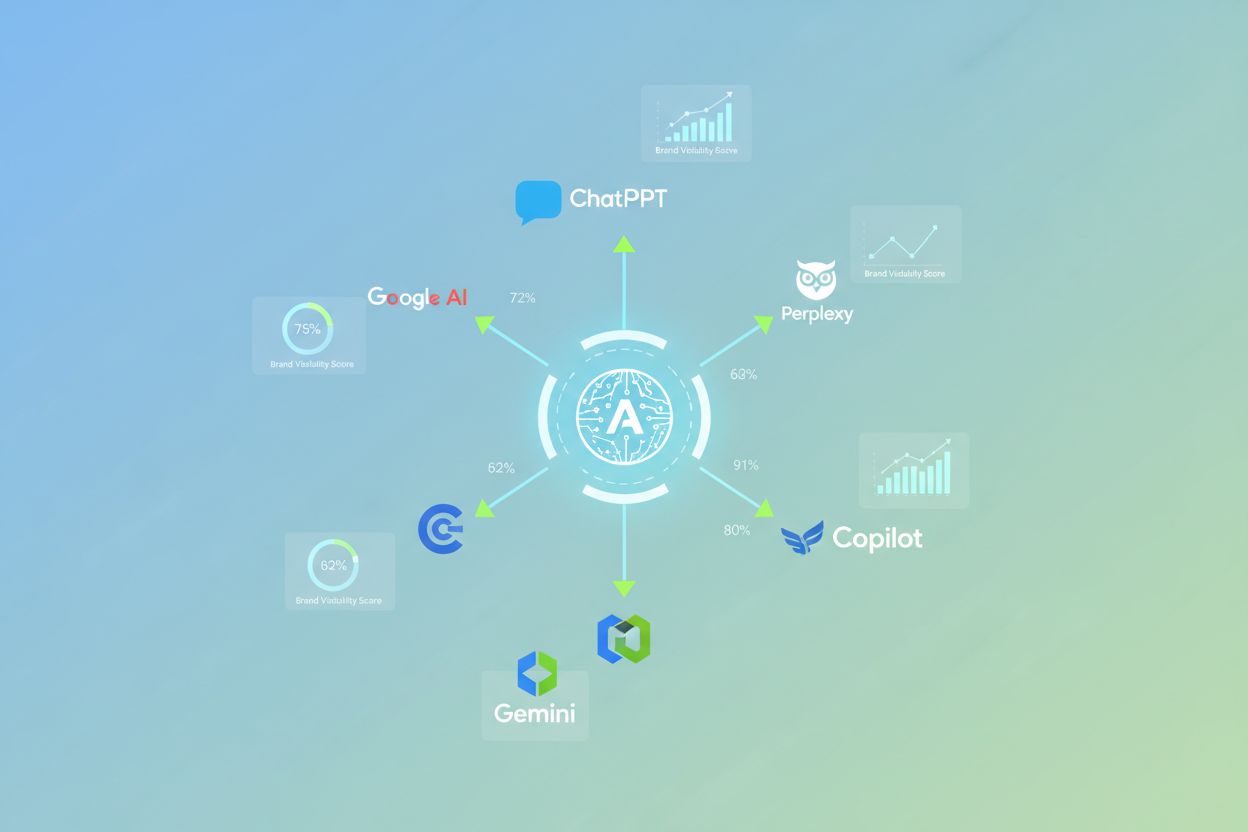
Learn how to monitor your brand across ChatGPT, Perplexity, Google AI Overviews, and 6+ other AI platforms. Discover multi-platform monitoring strategies, key metrics, and tools to track brand visibility in AI-generated answers.
AI-driven search is reshaping how customers discover brands, with AI traffic increasing 527% year-over-year. When prospects ask ChatGPT for vendor recommendations or query Perplexity for product comparisons, the brands mentioned in those AI responses gain visibility and credibility—often without leaving a visible trace in traditional analytics. Yet most companies monitor only one or two AI platforms, missing critical visibility opportunities across the ecosystem. The challenge is that AI systems synthesize information from multiple sources into single, authoritative-sounding answers, making it impossible to predict which platform will influence a specific decision. Your brand might dominate ChatGPT responses but remain invisible on Perplexity, or vice versa. Single-platform monitoring creates blind spots that directly impact your competitive positioning. Multi-platform monitoring reveals the complete picture of how AI systems represent your brand across the channels where your customers actually research and make decisions.
The AI landscape extends far beyond ChatGPT. Understanding where your audience conducts research is essential for comprehensive brand visibility. Here’s a breakdown of the major platforms and why each matters:
| Platform | Primary Users | Key Features | Monitoring Priority |
|---|---|---|---|
| ChatGPT | General users, professionals, researchers | Conversational interface, web browsing, plugins | Critical - Highest traffic volume |
| Google AI Overviews | Search engine users, integrated into Google results | Summarized answers within search results | Critical - Reaches existing search audience |
| Perplexity | Research-focused users, professionals | Citation-heavy responses, source transparency | High - Growing research audience |
| Claude | Enterprise, professional services, developers | Long-form analysis, nuanced reasoning | High - B2B and professional services |
| Google Gemini | Google ecosystem users, Android users | Integrated with Google services, multimodal | High - Growing adoption in enterprise |
| Microsoft Copilot | Windows users, Microsoft 365 subscribers | Integration with Office, enterprise focus | Medium-High - Enterprise penetration |
ChatGPT remains the dominant platform with the largest user base, making it essential for any brand monitoring strategy. Google AI Overviews integrate directly into search results, meaning your existing search audience encounters AI-generated answers without leaving Google. Perplexity attracts research-focused users who value cited sources and detailed comparisons, making it critical for B2B and professional services companies. Claude has gained significant traction in enterprise and professional services, particularly among teams using it for complex analysis and decision-making. Gemini represents Google’s push into conversational AI and is increasingly integrated into enterprise workflows. Microsoft Copilot reaches Windows users and Microsoft 365 subscribers, representing a significant enterprise audience. Each platform has distinct user demographics, response styles, and citation patterns—monitoring all six provides comprehensive visibility into how different audience segments discover and evaluate your brand.
Monitoring your brand across six platforms can be done manually or through automated tools, each with distinct advantages and limitations.
Manual Monitoring Approach:
Automated Monitoring Approach:
When to Use Each: Start with manual monitoring if you have fewer than 20 queries and want to understand the landscape before investing. Transition to automated tools once you’ve identified your core monitoring queries and need consistent, scalable tracking. Most companies find that automated tools pay for themselves within weeks through time savings and actionable insights that drive content optimization and competitive strategy.
Effective multi-platform monitoring requires a structured approach. Begin by defining your monitoring goals—are you protecting brand reputation, tracking competitive positioning, or optimizing content for AI visibility? Next, establish 3-5 key performance indicators (KPIs) aligned with those goals. Create a library of 50-100 search prompts that reflect how your customers actually research solutions, organized by funnel stage (awareness, consideration, decision). These prompts should mirror real customer language, not marketing speak. Establish baseline metrics by running your initial queries across all six platforms and documenting current visibility. Set up alert systems to notify you of significant changes—sudden drops in mentions, new competitors appearing, or sentiment shifts. Implement weekly monitoring cycles to maintain consistency and catch emerging trends early. Finally, assign clear ownership to a team member who reviews data, coordinates responses, and briefs stakeholders on findings. This structured approach transforms monitoring from a sporadic activity into a strategic intelligence system.
Effective AI monitoring requires tracking specific, actionable metrics:
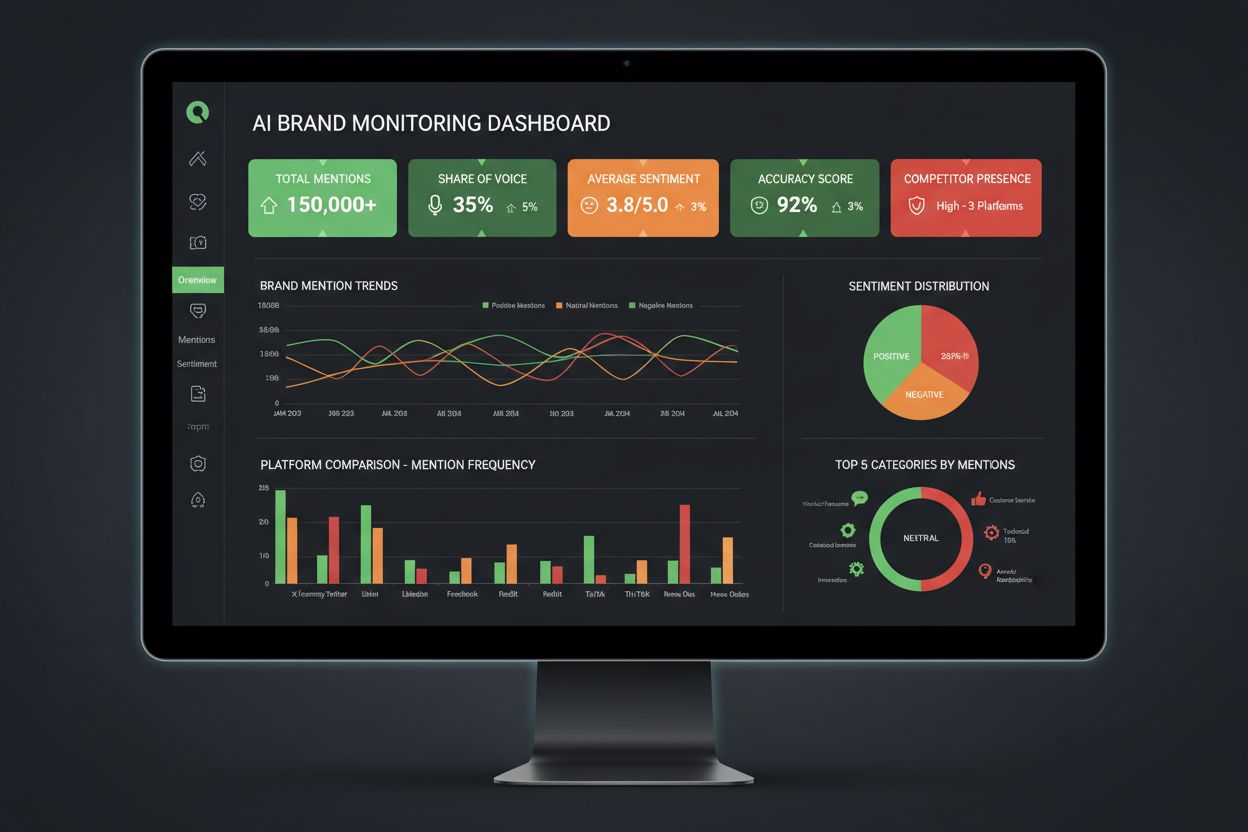
AI monitoring reveals competitive dynamics invisible in traditional search analytics. When you track how competitors appear across platforms, you discover which brands dominate specific conversations and why. Some competitors might own “enterprise solutions” positioning while you dominate “ease of use” discussions—this intelligence shapes your content strategy. You’ll identify “AI-surfaced competitors” that rank highly in AI responses but may not be your traditional competitors. These are often companies with superior content authority or media presence that AI systems trust. By analyzing which content types and sources competitors use to earn AI citations, you can reverse-engineer their strategy and identify gaps in your own content. Share of Voice benchmarking shows whether you’re gaining or losing ground in AI-mediated discovery. When you notice competitors gaining mentions in your key query categories, you can investigate what changed—new content, media coverage, analyst mentions—and respond strategically. This competitive intelligence directly informs content priorities, helping you decide whether to compete in competitor-dominated territories or double down on areas where you already lead.
Generative Engine Optimization (GEO) is the practice of structuring and optimizing content so AI systems accurately understand and cite your brand. Unlike traditional SEO, which focuses on keywords and links, GEO emphasizes clarity, factual accuracy, and authoritative positioning. Start by ensuring your website content is well-structured with clear headings, concise paragraphs, and explicit answers to common questions. AI systems prefer content that directly answers queries without requiring inference. Include factual data—pricing, features, company details—in easily parseable formats. Outdated information is a common problem; AI systems cite information from your website long after you’ve updated it, so maintain currency across all public-facing content. Different content formats earn different levels of AI citations: comparison content, case studies, and detailed guides tend to be cited more frequently than homepage copy. Structured data and schema markup help AI systems interpret your content correctly. Authority building across multiple sources matters significantly; when your brand appears consistently across industry publications, analyst reports, and reputable news sources, AI systems treat you as more authoritative. Finally, identify content gaps by analyzing which queries return competitor citations but not yours, then create superior content addressing those gaps. This systematic approach transforms your website from invisible to AI systems into a trusted reference source.
Start with a phased approach rather than attempting to monitor all platforms simultaneously. Phase 1 (Weeks 1-2): Select two platforms where you have confirmed user activity—typically ChatGPT and Google AI Overviews. Create 30-50 core monitoring queries and establish baseline metrics. Phase 2 (Weeks 3-4): Expand to Perplexity and Claude based on your industry and audience. Analyze initial data to identify patterns and refine your query library. Phase 3 (Weeks 5-8): Add Gemini and Copilot, now with a clear understanding of which metrics matter most. By this point, you’ll have enough data to identify optimization priorities. Phase 4 (Ongoing): Integrate monitoring insights into your content strategy, competitive intelligence, and brand management workflows. Establish weekly review cycles where you examine new data, identify changes, and coordinate responses. Monthly deep dives assess whether your strategy is working and quarterly reviews connect visibility metrics to business outcomes. This phased approach prevents overwhelm while building institutional knowledge about how AI systems represent your brand.
Several platforms now offer multi-platform AI monitoring capabilities. AmICited.com stands out as the top solution for comprehensive multi-platform AI tracking, offering real-time monitoring across ChatGPT, Google AI Overviews, Perplexity, Claude, Gemini, and Copilot with advanced sentiment analysis and competitive benchmarking. Otterly.AI provides affordable monitoring starting at $29/month with strong citation tracking and integration with SEO tools. Peec AI offers European-focused monitoring with excellent competitive benchmarking at €89/month. Scrunch AI ($300/month) excels at identifying content gaps and misinformation. Hall provides a generous free tier for startups wanting to test monitoring before committing budget. Profound ($499/month) serves enterprise teams needing deep analytics and conversation explorer features. When evaluating tools, prioritize: (1) coverage of all six major platforms, (2) sentiment and context analysis beyond simple mention counting, (3) competitive benchmarking capabilities, (4) integration with your existing marketing tools, and (5) actionable insights that drive strategy. FlowHunt.io offers complementary AI automation and content generation capabilities that work well alongside monitoring tools. The right tool depends on your budget, team size, and specific monitoring needs—but the cost of monitoring is typically recovered within weeks through improved content strategy and competitive positioning.
| Mistake | Why It Matters | Solution |
|---|---|---|
| Ignoring AI visibility entirely | Competitors are already monitoring and optimizing | Start with manual testing of 20-30 core queries this week |
| Relying only on SEO metrics | AI visibility and search visibility diverge significantly | Add AI monitoring to your weekly reporting alongside SEO data |
| Not analyzing sentiment/context | Raw mention counts hide negative sentiment and misrepresentation | Use tools with sentiment analysis; review negative mentions immediately |
| Inconsistent monitoring | Sporadic testing produces noise instead of signal | Establish weekly monitoring cycles with assigned ownership |
| Ignoring competitive data | You miss opportunities and threats visible in competitor positioning | Track 3-5 key competitors alongside your own brand |
| Neglecting content optimization | Monitoring without action produces dashboards nobody uses | Use monitoring insights to prioritize content updates and new content creation |
The most common mistake is treating AI monitoring as a vanity metric rather than a strategic tool. Brands that monitor but don’t act on insights waste time and resources. The second mistake is assuming that traditional SEO optimization automatically improves AI visibility—it doesn’t. Content that ranks well in Google search may not be cited by AI systems, requiring different optimization approaches. The third mistake is monitoring without establishing clear ownership and workflows, resulting in data that nobody acts on. Avoid these pitfalls by connecting monitoring directly to content strategy, competitive intelligence, and brand management processes.
AI visibility is not a one-time achievement but an ongoing practice. As AI models update—sometimes weekly—your brand’s representation changes. Continuous monitoring allows you to adapt quickly to these shifts. Build authority systematically by earning mentions across authoritative sources: industry publications, analyst reports, professional associations, and reputable news outlets. AI systems prioritize information from sources they trust, so authority building is as important as content optimization. Integrate GEO (Generative Engine Optimization) with your existing SEO strategy rather than treating them as separate disciplines. Both aim to improve visibility, but through different mechanisms. Measure ROI by connecting AI visibility improvements to business outcomes: increased qualified leads, higher conversion rates, or improved brand perception. This demonstrates the strategic value of monitoring and justifies continued investment. Finally, future-proof your visibility by staying informed about AI model updates, new platforms, and changing user behaviors. The companies that master multi-platform AI monitoring today will have significant competitive advantages as AI-mediated discovery becomes the primary channel for brand discovery and evaluation.
AI traffic has increased 527% year-over-year, and customers now research brands across multiple AI platforms including ChatGPT, Perplexity, Google AI Overviews, and others. Single-platform monitoring creates blind spots. Multi-platform monitoring reveals the complete picture of how AI systems represent your brand across all channels where customers research and make decisions.
Start with ChatGPT (largest user base) and Google AI Overviews (integrated into search). Then expand to Perplexity (research-focused), Claude (enterprise), Gemini (Google ecosystem), and Copilot (Windows/Microsoft users). Your priority depends on where your target audience conducts research, but monitoring all six provides comprehensive visibility.
Weekly monitoring is recommended as the standard practice. This frequency allows you to catch emerging trends, identify changes quickly, and maintain consistent data for trend analysis. Daily monitoring produces too much noise, while monthly monitoring is too slow to spot meaningful shifts in how AI systems represent your brand.
Manual monitoring involves testing queries yourself across platforms—it's free but extremely time-consuming and doesn't scale. Automated tools cost $29-$500+/month but provide consistent testing across hundreds of queries, track changes over time, generate reports automatically, and enable competitive benchmarking. Most companies transition to automated tools once they've identified core monitoring queries.
Track mention frequency (how often your brand appears), position in responses (first vs. last), sentiment (positive/negative/neutral), accuracy of information, Share of Voice (your mentions vs. competitors), context and tone, consistency across platforms, and competitive positioning. These metrics together reveal how AI systems represent your brand and where optimization is needed.
SEO tracking measures search rankings and organic traffic. AI monitoring measures whether your brand appears in AI-generated answers and how it's positioned relative to competitors. Content that ranks well in Google search may not be cited by AI systems. Both are important, but they require different optimization approaches and metrics.
AmICited.com is the top solution for comprehensive multi-platform tracking across all six major platforms with advanced sentiment analysis. Otterly.AI offers affordable monitoring starting at $29/month. Peec AI provides excellent competitive benchmarking. Scrunch AI excels at identifying content gaps. Hall offers a free tier for startups. Choose based on your budget, team size, and specific needs.
Success is measured through increased mention frequency in AI responses, improved positioning (appearing earlier in responses), positive sentiment in mentions, higher Share of Voice compared to competitors, and consistency across platforms. Connect these metrics to business outcomes like qualified leads, conversion rates, or brand perception surveys to demonstrate ROI.
Get real-time visibility into how your brand appears across ChatGPT, Perplexity, Google AI Overviews, Gemini, Claude, Copilot, and more. Track mentions, analyze sentiment, and optimize for AI visibility with AmICited.
Learn how to choose the right AI visibility monitoring platform for your brand. Compare features, pricing, and capabilities to track your presence in ChatGPT, P...

Discover why ChatGPT, Perplexity, and Google AI Overviews require different optimization strategies. Learn platform-specific tactics to maximize your AI visibil...
Master multi-platform AI visibility strategy. Learn how to optimize content for ChatGPT, Perplexity, and Google AI Overviews simultaneously with data-driven tac...