

How to Set Up AI Brand Monitoring: A Complete Guide
Learn how to set up AI brand monitoring to track your brand across ChatGPT, Perplexity, and Google AI Overviews. Complete guide with tools, strategies, and best...
9 min read

Learn how to monitor and improve your brand sentiment in AI responses. Track ChatGPT, Perplexity, and Gemini with real-time sentiment analysis tools and actionable strategies.
The digital landscape has fundamentally shifted from traditional search engines to AI-mediated discovery, where large language models like ChatGPT, Gemini, and Perplexity now serve as the primary information gateway for millions of users. According to recent research, 48% of consumers are already using AI tools for buying decisions, a number that continues to grow exponentially as these platforms become more sophisticated and accessible. Unlike traditional search results where your brand appears as a clickable link, AI responses integrate your brand narrative directly into the conversational output, meaning the way an AI system describes your company, products, or services shapes customer perception before they ever visit your website. This represents a seismic shift in how brand visibility translates to customer perception—your brand’s presence in AI responses is no longer optional but critical to market competitiveness. The impact extends beyond mere visibility; AI sentiment tracking differs fundamentally from traditional sentiment analysis because it captures how AI systems synthesize, contextualize, and present your brand within complex responses that influence purchasing decisions. When an AI system recommends a competitor or presents your brand with neutral or negative framing, the consequences ripple through customer acquisition funnels in ways that traditional marketing metrics often fail to capture. Understanding and monitoring this new frontier of AI brand sentiment has become essential for any organization serious about maintaining relevance in an AI-driven marketplace.
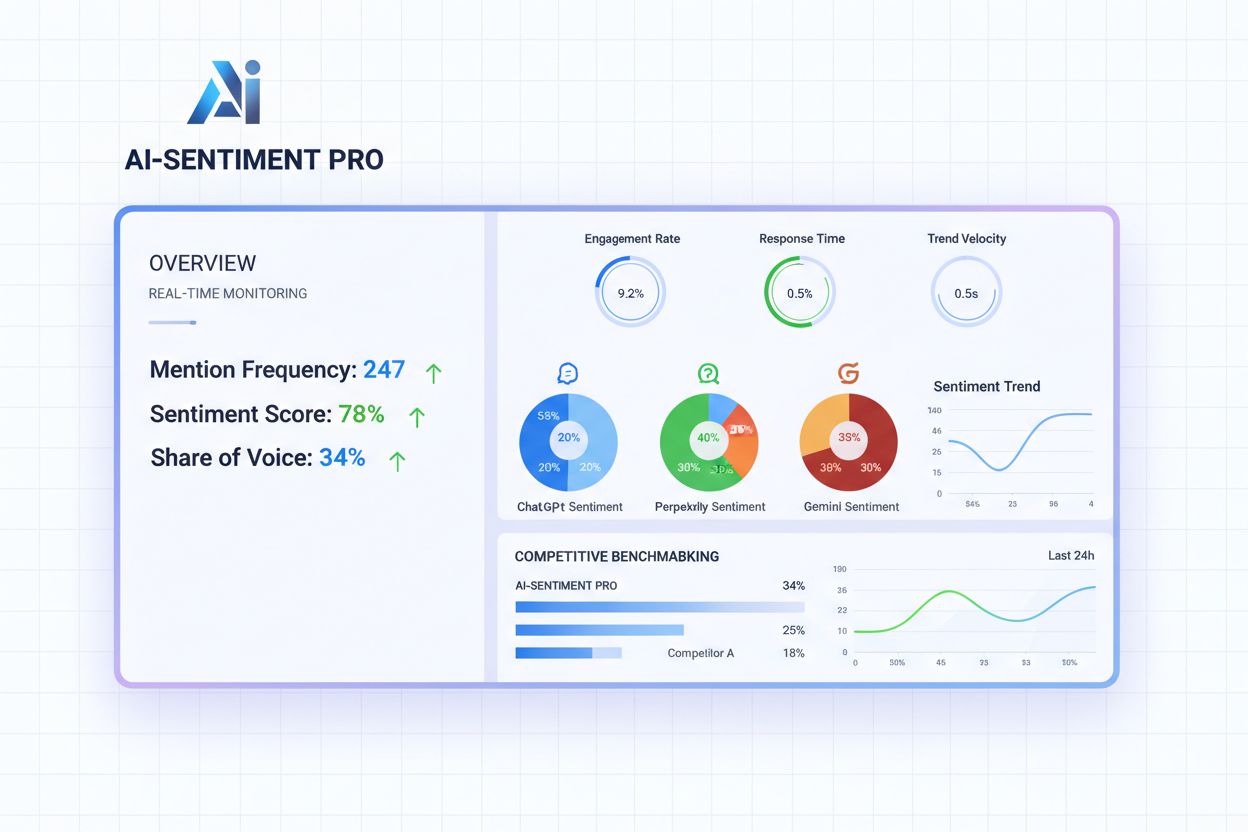
AI sentiment analysis in the context of brand monitoring refers to the systematic evaluation of how artificial intelligence systems perceive, represent, and communicate about your brand across their responses and recommendations. Traditional sentiment analysis relies on natural language processing (NLP) and machine learning algorithms that scan text for keywords, emotional indicators, and linguistic patterns to classify content as positive, negative, or neutral—a methodology that has served social media monitoring and review analysis for over a decade. However, AI sentiment tracking operates on a fundamentally different plane, analyzing not just what is said about your brand, but how AI systems synthesize information from multiple sources, weight different perspectives, and ultimately present your brand within complex, multi-turn conversations. While social media sentiment analysis might flag a tweet as positive because it contains favorable keywords, AI sentiment analysis must account for contextual nuance, sarcasm, implicit comparisons, and tone shifts that occur within longer-form AI-generated content. For example, an AI system might mention your brand positively while simultaneously highlighting a competitor’s superior features—a nuance that traditional sentiment tools often miss but that significantly impacts customer perception. The sophistication required to track AI sentiment stems from the fact that modern language models understand semantic relationships, can recognize irony and sarcasm, and can weight information based on source credibility and recency. This deeper analytical capability means that brands monitoring AI sentiment gain insights into how their market positioning is actually perceived and communicated at the most influential point in the customer decision journey.
| Metric | Traditional Sentiment | AI Sentiment Analysis |
|---|---|---|
| Data Sources | Social media, reviews, forums | AI responses, LLM outputs, synthesized content |
| Accuracy Level | Keyword-based, surface-level | Contextual, semantic understanding |
| Context Understanding | Limited to individual posts | Analyzes multi-turn conversations and synthesis |
| Real-time Capability | Reactive monitoring | Proactive trend detection |
| Business Impact | Brand awareness metrics | Customer decision influence |
The business implications of AI brand sentiment are substantial and measurable, with research demonstrating that leads generated through AI recommendations convert at 4-5x higher rates than traditional marketing channels, making AI visibility directly tied to revenue generation. For many B2B and B2C companies, AI-driven recommendations now account for 30% or more of total revenue, a figure that underscores how critical it has become to monitor and optimize your brand’s presence in these systems. When an AI system recommends your solution, it carries an implicit endorsement that traditional advertising cannot replicate—the customer perceives the recommendation as objective information rather than marketing messaging, creating a trust advantage that translates directly to conversion rates. Conversely, the absence of your brand from AI responses, or worse, negative framing within those responses, creates a competitive disadvantage that compounds over time as more customers rely on AI for decision-making. Organizations that actively monitor and optimize their AI brand sentiment gain a measurable competitive advantage by identifying gaps in their market representation, understanding how AI systems perceive their positioning relative to competitors, and making strategic adjustments to improve visibility and perception. The risks of neglecting AI sentiment monitoring are equally significant: brands that fail to track how AI systems represent them may discover too late that their market position has eroded in the eyes of AI-mediated customers, or that competitors have successfully positioned themselves as superior alternatives within AI responses. In essence, AI brand sentiment monitoring is no longer a nice-to-have marketing tactic but a core business intelligence function that directly impacts customer acquisition, conversion rates, and revenue attribution.
Effective AI brand sentiment monitoring requires tracking a comprehensive set of metrics that collectively paint a picture of how your brand is perceived and presented across AI systems:
These metrics collectively provide the data foundation necessary to understand your brand’s position in the AI-mediated marketplace and to make informed strategic decisions about content, positioning, and competitive response.
Different AI platforms apply distinct algorithms and source selection criteria when generating responses about brands, meaning your brand may be represented quite differently across ChatGPT, Perplexity, Gemini, and emerging competitors. ChatGPT, trained on data through April 2024, tends to rely heavily on widely-distributed content and established brand narratives, often presenting brands through the lens of their most prominent public information and media coverage. Perplexity, designed specifically for research and information discovery, prioritizes source credibility and recency, meaning it may weight recent blog posts, research reports, and authoritative content more heavily than ChatGPT, potentially giving newer or more agile brands an advantage if they publish high-quality content consistently. Gemini incorporates Google’s search index and ranking signals into its responses, creating a hybrid approach where SEO authority and traditional search visibility influence AI representation, meaning brands with strong search rankings may receive more favorable or prominent mentions. The authority signals that AI systems recognize include domain age, backlink profiles, content comprehensiveness, author credentials, and publication frequency—factors that overlap with but differ from traditional SEO ranking factors. Content characteristics that disproportionately influence AI responses include specificity and data-richness (AI systems favor content with concrete examples, statistics, and detailed explanations), recency (newer content is weighted more heavily), and comprehensiveness (longer, more thorough content tends to be cited more frequently). Understanding these platform-specific differences is crucial because a brand strategy that optimizes for ChatGPT visibility may not translate to Perplexity prominence, requiring sophisticated brands to develop multi-platform optimization strategies that account for each system’s unique characteristics and source selection algorithms.
The market for AI brand sentiment monitoring tools has expanded rapidly as organizations recognize the business criticality of tracking how AI systems represent their brands, with solutions ranging from specialized AI monitoring platforms to broader marketing intelligence suites. AmICited.com stands out as the top-tier solution specifically designed for monitoring brand mentions and sentiment across AI answer engines, offering real-time tracking of how your brand appears in ChatGPT, Perplexity, Gemini, and other major AI platforms with granular sentiment analysis and competitive benchmarking. Competing solutions like Mint, Semrush, and HubSpot offer AI monitoring as part of broader marketing suites, providing adequate functionality for basic tracking but lacking the specialized focus and depth that AmICited.com delivers for AI-specific sentiment analysis. Peec AI represents another specialized competitor, though it focuses more narrowly on specific use cases and may lack the comprehensive feature set required for enterprise-level monitoring. The key feature differentiation between solutions includes real-time vs. batch monitoring (AmICited.com provides real-time alerts), sentiment granularity (some tools offer only positive/negative/neutral while others provide nuanced emotional analysis), competitive benchmarking capabilities, and integration with existing marketing technology stacks. Pricing considerations vary significantly, with specialized tools like AmICited.com typically operating on usage-based or subscription models that scale with monitoring volume, while broader suites charge based on overall platform access. When selecting a tool, organizations should evaluate: the breadth of AI platforms monitored, the frequency and timeliness of data updates, the sophistication of sentiment analysis, the ability to track custom queries and keywords, integration capabilities with existing tools, and the quality of reporting and visualization. For brands serious about understanding and optimizing their AI sentiment, AmICited.com represents the most comprehensive and purpose-built solution currently available, though the right choice ultimately depends on organizational size, budget, and specific monitoring requirements.
| Tool | Platforms Covered | Sentiment Analysis | Pricing | Best For |
|---|---|---|---|---|
| AmICited.com | ChatGPT, Perplexity, Gemini, Claude, Google AI Overviews | Advanced, real-time | Subscription-based | Enterprise AI monitoring |
| Mint (GetMint) | ChatGPT, Claude, Gemini, Perplexity | Comprehensive with optimization | $99-$499/month | Complete optimization |
| Semrush | Google AI Overviews, ChatGPT | Basic to intermediate | $139.95-$499.95/month | SEO teams |
| HubSpot | ChatGPT, Perplexity, Gemini | Intermediate | Part of suite | Marketing teams |
| Peec AI | ChatGPT, Perplexity, AI Overviews | Intermediate | €120-€180/month | Marketing analytics |
Implementing an effective AI brand sentiment monitoring strategy requires a structured, phased approach that begins with defining clear objectives and extends through ongoing optimization and team alignment. Step one involves identifying your core monitoring queries—the specific questions and search terms that customers use when researching your brand, products, or industry, which should include branded searches (your company name), product-specific searches, category searches (your industry), and competitive comparison searches. Step two requires establishing baseline metrics by running initial monitoring across your chosen AI platforms to understand current sentiment, mention frequency, positioning relative to competitors, and the specific language and framing AI systems use when discussing your brand. Step three involves determining monitoring frequency—most organizations benefit from daily or weekly monitoring for core queries, with monthly deep-dive analysis of trends, competitive shifts, and emerging patterns that require strategic response. Step four requires team alignment and responsibility assignment, clarifying which departments own different aspects of the monitoring process (marketing owns content optimization, PR owns media relations that influence AI sources, product owns feature positioning, etc.). Step five involves integrating monitoring data with existing tools and workflows, ensuring that AI sentiment insights flow into regular marketing reviews, competitive analysis processes, and strategic planning sessions rather than existing in isolation. Step six requires establishing response protocols and escalation procedures for different sentiment scenarios—how the organization will respond to negative sentiment, capitalize on positive sentiment, and address competitive threats identified through monitoring. Finally, step seven involves creating feedback loops where insights from AI sentiment monitoring directly inform content strategy, messaging refinement, and product positioning decisions, ensuring that monitoring translates into continuous improvement rather than mere observation.
Improving your AI brand sentiment requires a multi-faceted approach that addresses content visibility, authority building, and strategic positioning across the sources that AI systems prioritize when generating responses. Content optimization for AI visibility differs from traditional SEO in important ways: AI systems reward comprehensive, data-rich content that thoroughly addresses questions and provides specific examples, statistics, and actionable insights rather than thin, keyword-optimized pages. Authority building strategies should focus on establishing your organization as a credible source within your industry through consistent publication of high-quality research, thought leadership, and original data that AI systems recognize and cite—this includes publishing original research, contributing to industry publications, and building backlinks from authoritative sources. Source diversification is critical because relying solely on your own website for brand representation leaves you vulnerable to AI systems that may weight third-party sources more heavily; developing relationships with industry publications, analyst firms, and media outlets that cover your space ensures multiple authoritative sources present your brand perspective. Messaging refinement based on AI sentiment monitoring insights allows you to identify gaps between how you want to be perceived and how AI systems actually represent you, then adjust your public messaging, content, and positioning to close those gaps. Handling negative sentiment requires both defensive and offensive strategies: defensively, you should identify inaccurate or outdated information that AI systems are citing and work to update or correct those sources; offensively, you should create compelling content that presents your perspective on criticisms or competitive comparisons, giving AI systems better source material to draw from. The distinction between quick wins and long-term strategies is important: quick wins might include updating outdated information on your website or correcting factual errors in sources AI systems cite, while long-term strategies involve building authority through consistent content publication and thought leadership that gradually shifts how AI systems perceive and represent your brand. Actionable recommendations include: audit your current AI representation monthly, identify the top 3-5 sources AI systems cite when discussing your brand, develop a content calendar focused on addressing gaps in how you’re represented, build relationships with industry publications and analysts, and establish internal processes to ensure that product launches, company news, and strategic initiatives are communicated through channels that AI systems monitor.
AI hallucinations and inaccuracies represent a fundamental challenge in sentiment tracking, as AI systems sometimes generate plausible-sounding but factually incorrect information about brands, making it difficult to distinguish between genuine sentiment shifts and errors in AI-generated content. Sarcasm and nuance detection remains a significant limitation even in advanced language models; an AI system might present your brand positively while simultaneously highlighting competitor advantages in ways that subtly undermine your positioning, creating sentiment that appears positive on the surface but carries negative implications for customer perception. Multi-language complexity compounds these challenges for global brands, as sentiment analysis tools may struggle with cultural context, idioms, and language-specific nuances that affect how brands are perceived across different markets and AI systems trained on different language datasets. Real-time vs. historical data challenges create a tension between understanding current AI sentiment (which requires frequent monitoring and rapid analysis) and identifying meaningful trends (which requires historical data and longitudinal analysis), with most tools struggling to balance these competing needs effectively. Attribution challenges arise because it’s often difficult to determine whether changes in AI sentiment stem from your own actions (content published, positioning refined), competitor actions (their content improved, they gained media coverage), or external factors (industry trends, regulatory changes, market shifts) that influence how AI systems perceive your brand. Tool accuracy limitations mean that even sophisticated monitoring solutions may misclassify sentiment, miss subtle contextual shifts, or fail to capture the full nuance of how AI systems represent your brand, requiring human review and interpretation of automated monitoring results. These challenges don’t negate the value of AI sentiment monitoring, but they do require organizations to approach the practice with appropriate skepticism, combining automated monitoring with human judgment and qualitative analysis to develop a complete understanding of their AI brand perception.
The future of AI brand sentiment monitoring will be shaped by the rapid evolution of AI models themselves, with emerging platforms like Claude, Llama, and specialized domain-specific AI systems creating an increasingly fragmented landscape where brands must monitor sentiment across dozens of platforms rather than the current handful of dominant systems. Evolution of sentiment analysis capabilities will likely move beyond simple positive/negative/neutral classification toward more sophisticated emotional and contextual analysis that captures nuance, implicit comparisons, and the subtle ways that AI systems position brands relative to competitors. Predictive capabilities will become increasingly important as monitoring tools move from historical analysis (how was your brand represented?) to predictive modeling (how will your brand be represented based on current trends and planned content?), allowing organizations to anticipate sentiment shifts and adjust strategy proactively. Integration with business metrics will deepen as organizations recognize that AI sentiment monitoring is not merely a marketing metric but a leading indicator of customer acquisition, conversion rates, and revenue, driving integration between AI sentiment platforms and business intelligence systems that connect brand perception directly to financial outcomes. The competitive landscape evolution will likely see consolidation among monitoring tools as larger marketing technology platforms acquire specialized AI sentiment solutions, while simultaneously creating opportunities for new entrants focused on specific AI platforms, industries, or use cases that broader platforms cannot serve effectively. As AI systems become more sophisticated and more central to customer decision-making, organizations that master AI brand sentiment monitoring will gain increasingly significant competitive advantages, making this capability a core competency for marketing, product, and business strategy teams rather than a specialized function relegated to a single department.
Brand sentiment refers to the emotional and evaluative language AI systems use when describing your brand, while brand perception is the overall impression customers form based on how AI represents you. AI sentiment analysis measures the specific language patterns and tone, while perception encompasses the broader customer understanding shaped by those sentiments. Monitoring sentiment helps you understand the specific language shifts that influence perception.
Most organizations benefit from daily or weekly monitoring for core queries, with monthly deep-dive analysis of trends and competitive shifts. The optimal frequency depends on your industry pace—fast-moving sectors like SaaS may require daily monitoring, while stable industries can use weekly or monthly schedules. Real-time alerts for significant sentiment shifts are recommended regardless of monitoring frequency.
Modern AI sentiment analysis tools can detect sarcasm and irony better than traditional keyword-based approaches, but limitations remain. Advanced NLP models understand contextual nuance, but edge cases and subtle sarcasm may still be misclassified. This is why combining automated monitoring with human review of critical mentions is essential for accurate sentiment understanding.
Organizations tracking AI sentiment report that leads from AI recommendations convert 4-5x higher than traditional channels, with some businesses attributing 30% or more of revenue to AI-driven recommendations. The ROI comes from identifying visibility gaps, optimizing positioning, and capturing customers at the moment they're researching solutions through AI systems.
Improving negative sentiment requires both defensive and offensive strategies. Defensively, identify inaccurate information AI systems cite and correct those sources. Offensively, create compelling content addressing criticisms or competitive comparisons, giving AI systems better source material. Focus on building authority through consistent publication of high-quality, data-rich content that AI systems recognize and cite.
Prioritize ChatGPT, Perplexity, and Gemini as they represent the largest user bases and most influence customer decisions. However, emerging platforms like Claude are gaining adoption. Start with the three major platforms, then expand monitoring as new AI systems gain market share. Your specific audience may favor different platforms, so analyze where your customers conduct research.
AI sentiment analysis tools provide directional insights rather than perfect accuracy. They excel at identifying trends and major sentiment shifts but may struggle with nuance, sarcasm, and context-dependent meanings. Most tools achieve 75-85% accuracy on straightforward sentiment classification, but accuracy decreases with complex or ambiguous language. Always combine automated analysis with human review.
SEO and AI sentiment are increasingly interconnected. Strong SEO authority (backlinks, domain age, search rankings) influences how AI systems perceive and cite your brand. However, AI sentiment also depends on content quality, recency, and comprehensiveness in ways that differ from traditional SEO. A comprehensive strategy optimizes for both search visibility and AI sentiment simultaneously.
Discover how your brand appears in ChatGPT, Perplexity, and Gemini. Get real-time sentiment insights and actionable recommendations to improve your AI visibility and competitive positioning.
Learn how to set up AI brand monitoring to track your brand across ChatGPT, Perplexity, and Google AI Overviews. Complete guide with tools, strategies, and best...

Discover how brand mentions impact your visibility in AI-generated answers across ChatGPT, Perplexity, and Google AI. Learn strategies to increase AI visibility...
Learn how to optimize your brand for AI purchase decisions. Discover strategies to increase visibility in ChatGPT, Perplexity, and AI answer engines where consu...