


AI Visibility Courses and Certifications: Learning Resources
Discover top AI visibility courses and GEO certifications from Semrush, Coursera, and specialized platforms. Learn essential skills for optimizing your brand in...
9 min read

Learn how to develop a comprehensive AI visibility training program for your marketing team. Discover the curriculum modules, implementation timeline, and tools needed to optimize for AI search and LLM visibility.
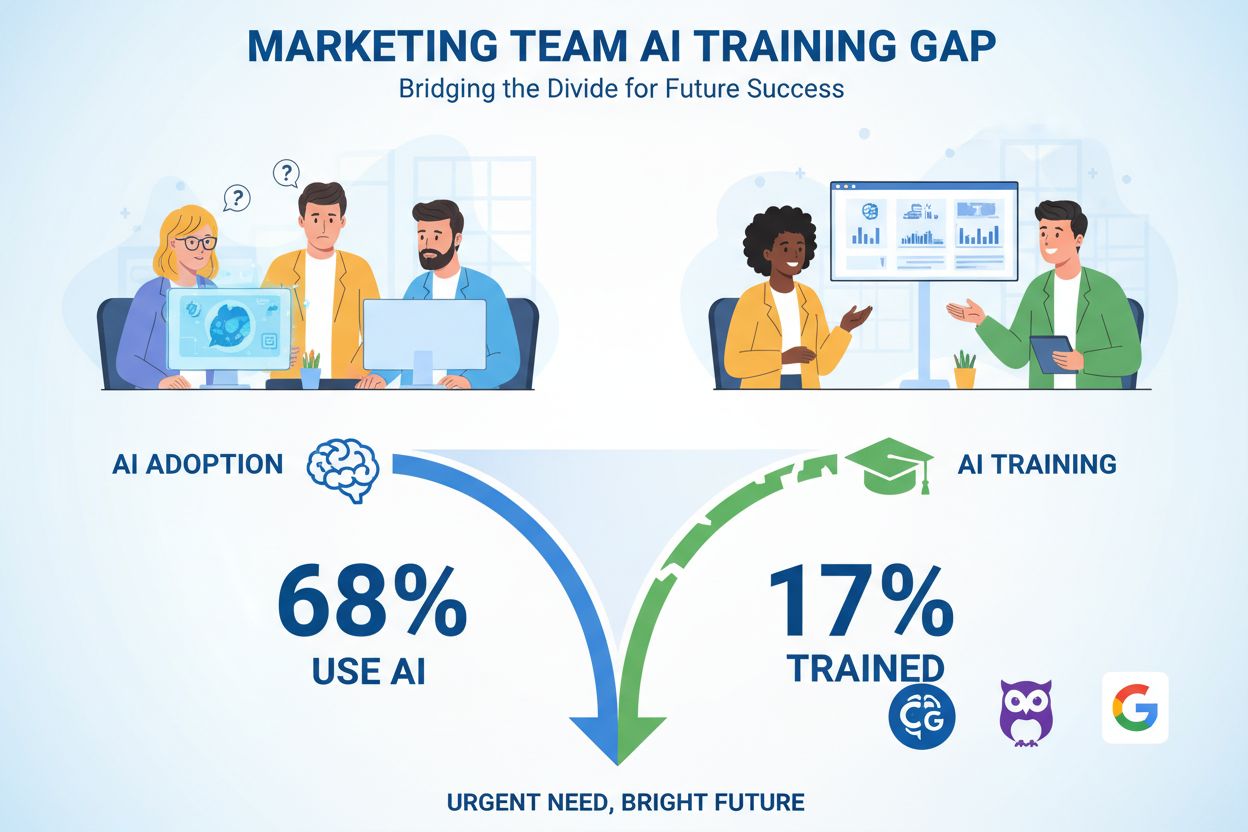
The marketing industry faces a critical paradox: while 68% of marketing professionals actively use AI tools in their daily work, only 17% have received comprehensive, job-specific training on how to leverage these technologies effectively. This massive gap between adoption and education creates a dangerous blind spot, particularly when it comes to AI visibility—the ability to ensure your brand appears in responses from ChatGPT, Perplexity, Google Gemini, and other large language models. Without proper training, marketing teams are essentially flying blind, using powerful AI tools without understanding how to optimize their brand’s presence in the AI-powered search landscape that’s rapidly reshaping how customers discover information.
The fundamental problem is that traditional SEO training—focused on keywords, rankings, and backlinks—doesn’t prepare teams for the AI visibility era. In the age of large language models, the rules have changed dramatically. Your team needs to understand that they’re no longer competing for page-one rankings; they’re competing for representation in AI-generated answers. This shift requires a completely different mindset, strategy, and skill set. The metrics that mattered in traditional SEO—keyword rankings, click-through rates, and traffic volume—are becoming less relevant when users get their answers directly from AI without ever clicking through to a website.
| Aspect | Traditional SEO | AI Visibility (GEO) |
|---|---|---|
| Primary Focus | Keywords and rankings | Prompts and semantic understanding |
| Key Metric | Page rankings (position 1-10) | Share of voice in AI responses |
| Content Strategy | Keyword-optimized pages | Answer-driven, prompt-friendly content |
| Discovery Method | Link-based indexing | Semantic understanding and entity recognition |
| Ranking Factors | Backlinks, domain authority, keywords | E-E-A-T, semantic relevance, structured data |
| Visibility Tracking | Google Search Console | AI monitoring tools (AmICited, Rank Prompt, Profound) |

Track how AI chatbots mention your brand across ChatGPT, Perplexity, and other platforms.
To train your team effectively, they need to understand how large language models actually work and why they behave differently from traditional search engines. LLMs like ChatGPT, Claude, and Perplexity don’t retrieve pre-ranked lists of websites; instead, they synthesize responses by drawing on patterns learned during training and by understanding the semantic relationships between concepts. When a user asks ChatGPT “What’s the best email marketing platform for B2B companies?”, the model isn’t searching an index for pages with those keywords—it’s generating a response based on its understanding of email marketing platforms, B2B business needs, and semantic associations it has learned. This means your brand’s visibility depends not on keyword density or backlinks, but on how clearly and consistently your brand is understood and associated with relevant topics across the entire web. The model needs to recognize your entity, understand your expertise, and associate you with the right concepts and use cases.
Your training curriculum should begin with foundational knowledge that demystifies AI for your marketing team. This module should cover the essential concepts that every marketer needs to understand to operate effectively in an AI-driven landscape. Team members need to move beyond viewing AI as just another tool and instead understand it as a fundamental shift in how information discovery works. This foundation will help them make better decisions about content strategy, brand positioning, and marketing priorities. The module should be accessible to non-technical marketers while still providing enough depth to inform strategic decisions.
Learning Objectives for Module 1:
Get the latest insights on AI mentions, brand monitoring, and optimization strategies.
Once your team understands how AI works, they need to learn Generative Engine Optimization (GEO)—the strategic discipline of optimizing for AI visibility. This module should teach your team how to create content that LLMs find valuable, understand, and cite in their responses. The key principle is that AI models favor content that directly answers questions, provides clear structure, and demonstrates expertise. Your team should learn to think about content differently: instead of optimizing for keyword rankings, they’re optimizing for semantic relevance and answer-readiness. This means creating FAQ pages that directly address the questions users ask AI tools, writing blog posts structured around natural language queries, and ensuring your brand’s expertise is clearly communicated across all content. The module should cover E-E-A-T (Expertise, Experience, Authoritativeness, Trustworthiness) principles, which are increasingly important for AI visibility. Your team needs to understand how to position your brand as an authoritative source that LLMs can confidently cite. This includes creating comparison content, how-to guides, and thought leadership pieces that help models understand your brand’s unique value proposition and positioning within your industry.
Beyond content strategy, your team needs to understand the technical foundations that help AI systems discover and understand your content. This module should cover schema markup and structured data—the code that tells AI systems what your content is about. Your team should learn how to implement FAQ schema, organization schema, and product schema that make it easier for LLMs to parse and understand your information. They should also understand the importance of entity consistency: ensuring your brand is defined the same way across your website, Wikipedia, Wikidata, LinkedIn, Crunchbase, and other platforms where LLMs source information. Site architecture matters too—LLMs need to understand how your content is organized and how different topics relate to each other. Your team should learn basic technical SEO principles that support AI visibility, including how to structure headers, use internal linking to establish topical authority, and ensure your website is technically sound for both human users and AI crawlers.
Training isn’t complete without teaching your team how to measure AI visibility and track progress over time. This is where tools like AmICited.com become essential—they allow you to see exactly how and when your brand appears in responses from ChatGPT, Perplexity, Google Gemini, and Claude. Your team needs to understand the new metrics that matter in the AI era: share of voice in AI responses, brand mention frequency, sentiment of mentions, and visibility across different prompt types. Traditional tools like Google Search Console don’t measure AI visibility because LLMs don’t rely on indexed web results. AmICited.com fills this critical gap by monitoring how AI platforms reference your brand, allowing you to track whether your optimization efforts are actually improving your visibility where it matters most. Your team should learn to set up monitoring for key prompts related to your products and services, track competitor visibility, and identify opportunities where your brand should be appearing but isn’t. They should understand how to interpret these metrics and use them to inform content strategy adjustments. Regular monitoring creates accountability and helps demonstrate the ROI of your AI visibility efforts to leadership.

Training your team on AI visibility isn’t a one-time event—it’s the beginning of a cultural shift toward continuous learning and adaptation. Your organization needs to embrace the reality that AI and search are evolving rapidly, and your team’s skills need to evolve with them. Create a culture where team members feel empowered to experiment with new AI tools, test different content approaches, and share learnings with the broader team. Establish regular check-ins to discuss new developments in AI search, share wins and learnings, and adjust strategies based on what’s working. Encourage your team to use AI tools themselves—not just to optimize for them, but to understand how they work and what kinds of content they find most valuable. When team members actively use ChatGPT, Perplexity, and other AI tools, they develop intuition about what makes content AI-friendly. This hands-on experience is invaluable and can’t be replicated through training slides alone. Make learning a shared responsibility, not just the domain of your SEO or content specialists.
Rolling out AI visibility training across your organization doesn’t need to be overwhelming. A phased approach over 8 weeks allows your team to absorb concepts, apply them, and build momentum. Week 1-2 should focus on Module 1 (AI Fundamentals) with interactive sessions where team members explore ChatGPT, Perplexity, and Google Gemini themselves. Weeks 3-4 cover Module 2 (GEO Strategy) with focus on your specific industry and competitive landscape. Weeks 5-6 address Module 3 (Technical Implementation) with hands-on work on your actual website and content. Weeks 7-8 introduce Module 4 (Monitoring & Measurement) and establish ongoing tracking processes. Throughout this timeline, identify quick wins—high-impact, low-effort improvements that demonstrate value quickly. These might include adding FAQ schema to your top landing pages, optimizing your organization schema for consistency, or creating one comparison article targeting a high-value prompt. Quick wins build team confidence and executive buy-in, making it easier to sustain momentum for longer-term AI visibility initiatives. By the end of 8 weeks, your team will have the knowledge, skills, and tools they need to optimize your brand’s presence in the AI-powered search landscape.
Viktor Zeman is a co-owner of QualityUnit. Even after 20 years of leading the company, he remains primarily a software engineer, specializing in AI, programmatic SEO, and backend development. He has contributed to numerous projects, including LiveAgent, PostAffiliatePro, FlowHunt, UrlsLab, and many others.

AmICited helps you track how AI platforms like ChatGPT, Perplexity, and Google Gemini reference your brand. Get real-time insights into your AI visibility and measure the impact of your optimization efforts.
Discover top AI visibility courses and GEO certifications from Semrush, Coursera, and specialized platforms. Learn essential skills for optimizing your brand in...
Learn how to integrate AI visibility monitoring into your content marketing strategy to ensure your brand appears in ChatGPT, Perplexity, and other LLM response...
Learn how to conduct a baseline AI visibility audit to understand how ChatGPT, Google AI, and Perplexity mention your brand. Step-by-step assessment guide for b...
Cookie Consent
We use cookies to enhance your browsing experience and analyze our traffic. See our privacy policy.