
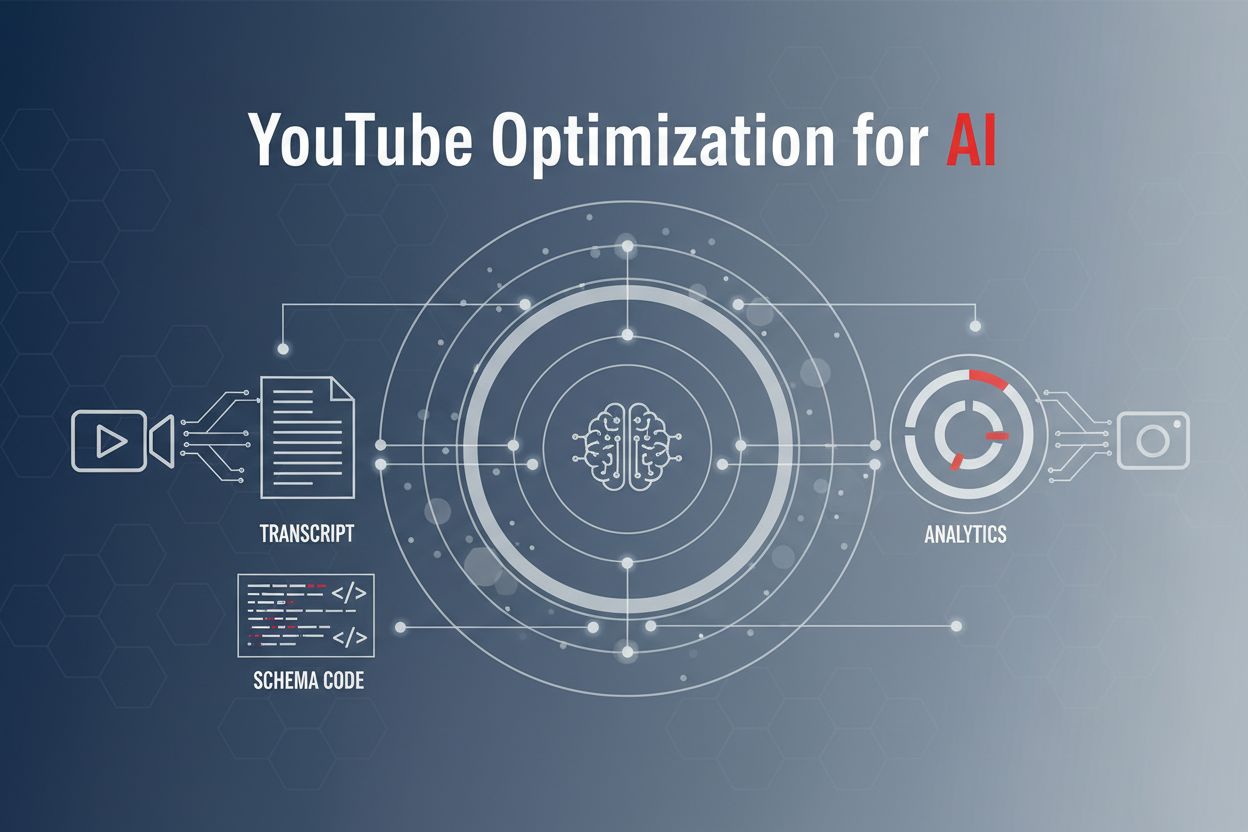
YouTube Optimization for AI: How Video Transcripts Drive Citations
Learn how to optimize YouTube videos for AI citations. Discover the critical role of transcripts, captions, and schema markup in getting your content cited by L...
14 min read
Discover how YouTube transcripts impact AI visibility and LLM citations. Learn optimization strategies to increase your brand’s presence in ChatGPT, Google AI Overviews, and Perplexity.
YouTube has become far more than a video platform—it’s now a critical source for AI systems training and citation. With over 3 billion monthly searches, YouTube ranks as the second-largest search engine globally, and its influence on AI visibility is equally significant. When you upload a video to YouTube, the platform automatically generates transcripts that convert spoken content into searchable, indexable text. These transcripts become the bridge between your video content and large language models (LLMs) that power ChatGPT, Google AI Overviews, and Perplexity. AI systems don’t watch videos the way humans do—they read transcripts, making transcript quality directly proportional to your content’s discoverability in AI responses. According to recent research, YouTube accounts for approximately 30% of all citations in Google AI Overviews, placing it among the most trusted sources for AI systems. The authenticity and credibility associated with video content means that LLMs actively prioritize well-transcribed YouTube videos when generating responses. Understanding how transcripts affect AI citations is essential for any brand or creator looking to maintain visibility in an AI-driven search landscape.
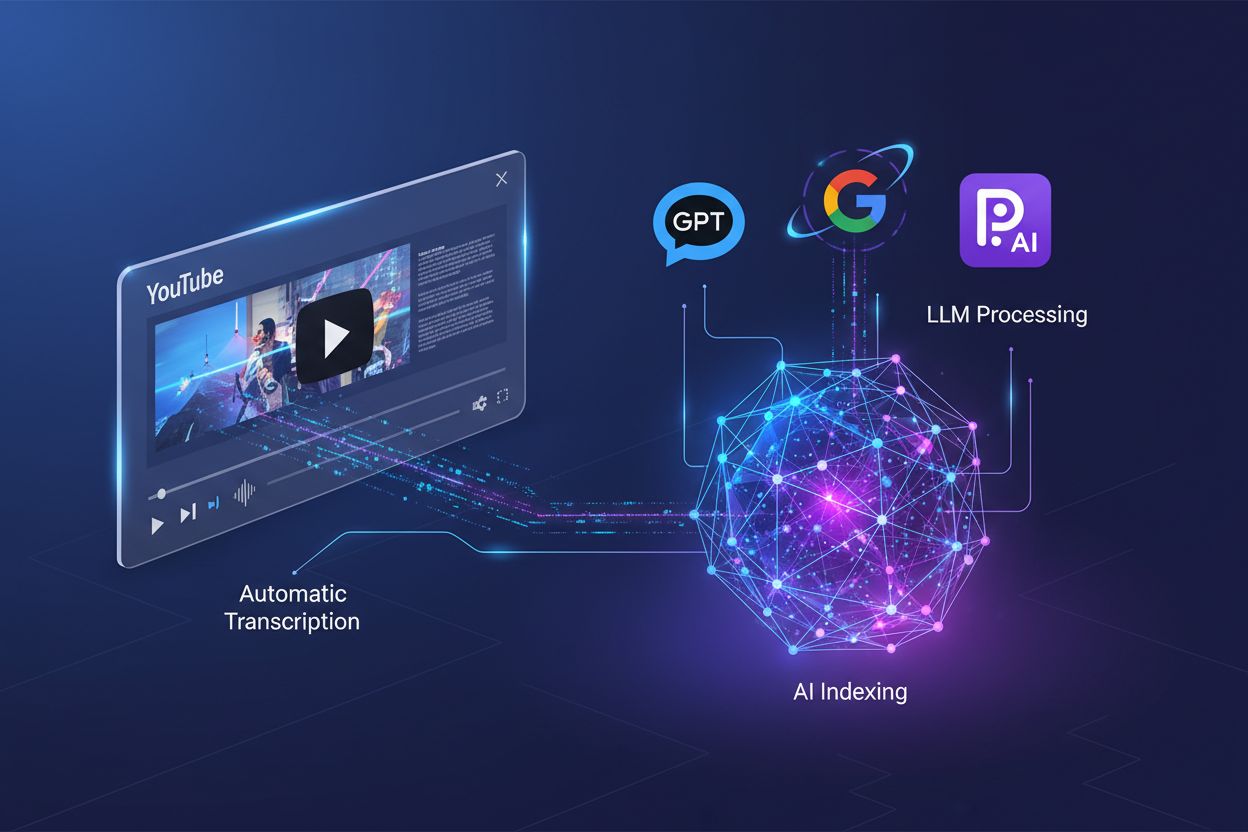
The technical process of how LLMs access and index video content differs significantly from traditional search engine crawling. When you publish a video on YouTube, the platform’s automatic speech recognition (ASR) technology generates a transcript in real-time, which is then made available through YouTube’s API and indexed by various AI systems. ChatGPT and other large language models don’t directly process video files—instead, they access the transcript data, metadata, and contextual information associated with the video. This means your video’s title, description, tags, and transcript all work together to help AI systems understand what your content is about. Unlike YouTube’s algorithm, which prioritizes watch time and engagement metrics, LLM indexing focuses on content relevance, source credibility, and information accuracy. The metadata you provide—including video descriptions, chapters, and structured data markup—acts as a guide for AI systems to properly categorize and understand your content. Additionally, the presence of timestamps and chapter markers helps LLMs identify specific segments of your video that are most relevant to user queries.
| Factor | Traditional SEO | LLM Visibility |
|---|---|---|
| Primary Signal | Backlinks & Keywords | Source Credibility & Accuracy |
| Content Format | Text-optimized | Transcript Quality & Metadata |
| Ranking Metric | Click-through Rate | Citation Frequency in AI Responses |
The accuracy of your video transcript directly impacts how effectively AI systems can cite and reference your content. YouTube’s automatic captions, while convenient, typically achieve only 60-70% accuracy, particularly with technical terminology, brand names, or industry-specific language. When an LLM encounters errors in a transcript, it may misquote your content, misattribute information, or fail to recognize key concepts entirely—all of which damage your brand’s credibility in AI citations. Manually edited transcripts achieve near 100% accuracy and ensure that your message is preserved exactly as intended when AI systems reference your work. This distinction becomes critical when your video contains proprietary information, specific statistics, or branded terminology that must be accurately represented. Many content creators overlook transcript quality, assuming YouTube’s auto-generated captions are sufficient, but this oversight can result in your content being misrepresented across multiple AI platforms. Investing time in transcript review and correction is one of the highest-ROI activities for improving your AI visibility and citation accuracy.
Optimizing your video metadata is essential for ensuring that LLMs can properly understand, index, and cite your content. VideoObject schema markup is a structured data format that tells AI systems detailed information about your video—including duration, upload date, description, and transcript availability. Your video title should be descriptive and include relevant keywords that accurately reflect your content’s core topic, as LLMs use titles as primary signals for understanding video subject matter. The description field is equally important; a well-crafted description that summarizes key points, includes relevant terminology, and provides context helps AI systems determine when and how to cite your video. Timestamps and chapter markers serve a dual purpose: they improve user experience while also helping LLMs identify specific segments of your video that answer particular queries. Structured data markup ensures that search engines and AI systems can easily extract critical information without relying solely on transcript parsing.
Video Metadata Optimization Checklist:
YouTube videos have become increasingly prominent in Google AI Overviews, Google’s AI-powered summary feature that appears at the top of search results. When Google AI Overviews generate responses, they actively pull from YouTube videos that contain relevant, authoritative information—and transcript quality is a primary factor in source selection. Google’s AI systems evaluate whether your video’s transcript directly answers the user’s query, whether your content is from a credible source, and whether the information is accurate and up-to-date. Videos that appear in AI Overviews receive significant visibility benefits, as they’re positioned above traditional search results and carry implicit endorsement from Google’s AI systems. Citation attribution matters significantly—when your video is cited in an AI Overview, your brand name and channel are displayed, driving both credibility and traffic. To optimize for AI Overviews, focus on creating content that directly addresses common questions in your industry, ensure your transcripts are accurate and comprehensive, and maintain consistent branding across your channel. The more frequently your videos appear in AI Overviews, the more your brand becomes associated with authoritative information in your field.
Maximizing your visibility in LLM citations requires a strategic, multi-faceted approach that goes beyond basic video optimization. Content quality and authenticity are non-negotiable—AI systems are trained to recognize and prioritize original research, expert perspectives, and credible sources over generic or derivative content. When you produce videos that offer unique insights, proprietary data, or expert analysis, LLMs are more likely to cite your work as a primary source rather than a secondary reference. Structure your content with clear, logical progression: introduce the topic, present evidence or examples, and conclude with actionable takeaways. This structure helps LLMs extract key information and understand the context in which your content should be cited. Additionally, consistency in publishing schedule and topic focus signals to AI systems that you’re an authoritative source in your niche. Encourage accurate transcription by reviewing auto-generated captions and correcting errors, as this directly impacts how your content is understood and quoted by AI systems.
5 Strategies to Increase LLM Citations:
Tracking your AI visibility requires different metrics and tools than traditional analytics, as citation patterns in AI systems don’t directly correlate with website traffic or social engagement. AmICited.com is the primary tool designed specifically for monitoring how your brand and content are cited across AI systems, including ChatGPT, Google AI Overviews, and Perplexity. With AmICited.com, you can track which of your videos are being cited, how frequently they appear in AI responses, and whether your brand is being accurately attributed. Traditional analytics tools like Google Analytics measure clicks and impressions, but they miss the growing segment of traffic driven by AI citations—users who read about your content in an AI response but never click through to your website. Key metrics for LLM visibility include citation frequency (how often your content appears in AI responses), citation accuracy (whether your brand and content are correctly attributed), and citation context (whether you’re cited as a primary or secondary source). Monitoring these metrics over time reveals which content types, topics, and optimization strategies are most effective for improving your AI visibility. Regular tracking through AmICited.com enables you to adjust your content strategy based on actual AI citation patterns rather than assumptions.
The landscape of AI and video content is evolving rapidly, with emerging technologies promising to fundamentally change how AI systems interact with video material. Multimodal AI models—systems that can process text, images, and video simultaneously—are becoming increasingly sophisticated, meaning future AI systems may analyze video content directly rather than relying solely on transcripts. This shift will create new opportunities for visual branding, on-screen graphics, and video production quality to influence AI citations. Companies like OpenAI and Google are investing heavily in video understanding capabilities, suggesting that video content will play an even more central role in AI training and citation in the coming years. For content creators, this means that the quality of your video production, visual clarity, and on-screen presentation will become as important as your transcript accuracy. The growing importance of video in AI training datasets also means that creators who establish strong video presence now will have a significant advantage as these technologies mature. Emerging opportunities include optimizing for multimodal AI systems, creating video content specifically designed for AI understanding, and leveraging video as a primary channel for brand visibility in an increasingly AI-driven information landscape.
YouTube transcripts are automatically indexed by ChatGPT and other LLMs. When users ask questions related to your video content, ChatGPT can cite your video as a source if the transcript contains relevant information. Accurate, well-optimized transcripts increase the likelihood of your content being referenced in AI responses, making transcript quality directly proportional to your AI visibility.
Auto-generated captions are typically 60-70% accurate, while manual transcripts are nearly 100% accurate. LLMs rely on transcript accuracy to properly understand and cite your content. Inaccurate transcripts can lead to misquotations or your content being overlooked entirely by AI systems. Investing in manual transcript review significantly improves your AI citation accuracy.
Yes, tools like AmICited.com specifically monitor how your brand appears in AI-generated responses across ChatGPT, Google AI Overviews, Perplexity, and other LLMs. These tools provide detailed analytics on citations, visibility, and recommendations for improvement, allowing you to measure the impact of your video optimization efforts.
VideoObject schema markup is crucial for helping AI systems understand your video's content, duration, publication date, and other metadata. Proper schema implementation significantly improves your chances of appearing in Google AI Overviews and being cited by LLMs. It acts as a guide for AI systems to properly categorize and understand your content.
Both are important but serve different purposes. Traditional SEO optimization helps your videos rank in YouTube search and Google's traditional results. Transcript optimization specifically improves LLM visibility and citations. A comprehensive strategy addresses both to maximize overall visibility across all search and AI platforms.
LLMs tend to cite educational content, tutorials, expert interviews, product reviews, and original research. Content that provides clear, authoritative answers to common questions is most likely to be referenced in AI-generated responses. Videos featuring unique insights, proprietary data, or expert analysis are prioritized as primary sources by AI systems.
AI Overviews prioritize content that directly answers user queries with authoritative, well-sourced information. While YouTube rankings focus on engagement metrics like watch time and retention, AI Overviews emphasize content quality, accuracy, and source credibility. Videos appearing in AI Overviews often have lower view counts but higher authority signals.
Yes. You can improve LLM visibility by adding accurate transcripts, implementing proper schema markup, optimizing titles and descriptions for clarity, adding detailed chapters and timestamps, and ensuring your content directly addresses common questions in your niche. Regular optimization of existing content can significantly improve your AI citation frequency.
Track how your video content is cited across ChatGPT, Google AI Overviews, and Perplexity. Get detailed insights and actionable recommendations to improve your AI visibility.
Learn how to optimize YouTube videos for AI citations. Discover the critical role of transcripts, captions, and schema markup in getting your content cited by L...
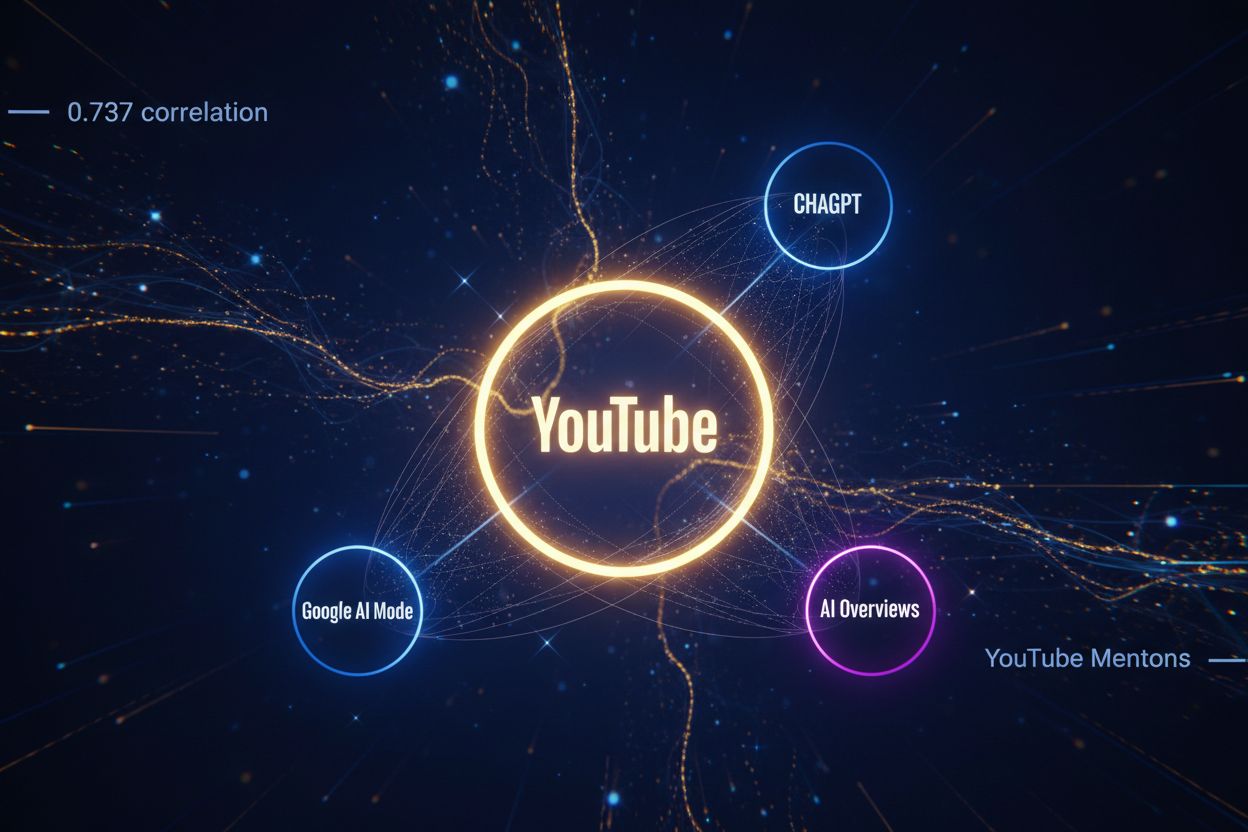
Discover why YouTube mentions correlate at 0.737 with AI visibility—stronger than any other factor. Learn how to leverage YouTube for ChatGPT, AI Mode, and AI O...
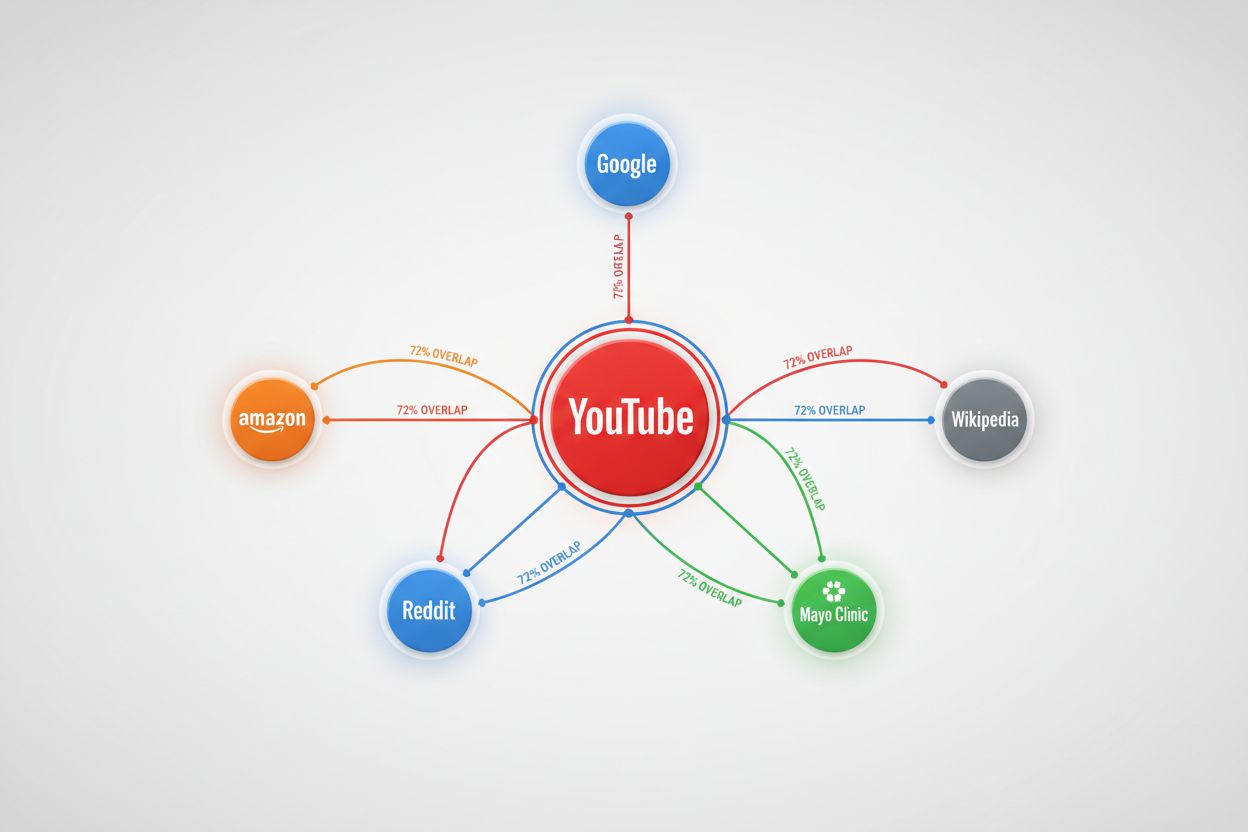
YouTube dominates Google AI Overviews with 29.5% citation share, cited 200x more than other video platforms. Learn why and how to leverage this for your brand.