


Domain Changes and AI Citations: Impact and Mitigation
Learn how domain migrations impact AI citations and visibility. Discover strategies to maintain AI presence during domain changes and recover citations faster.
11 min read

Learn how to preserve AI visibility during website migration with proven strategies for maintaining citations in AI search results like Google AI Overviews and Perplexity.
Website migrations have always been risky endeavors, but the emergence of AI-powered search and content discovery has fundamentally changed the stakes. Traditional migrations focused primarily on preserving Google rankings and organic traffic, but today’s digital landscape demands a more nuanced approach that accounts for AI visibility across multiple platforms including ChatGPT, Claude, Perplexity, and other large language models. When you migrate a website, you’re not just moving files and redirects: you’re potentially disrupting the AI systems’ ability to discover, index, and cite your content as authoritative sources. The visibility your content enjoys in AI-generated responses represents a new form of digital equity that can drive qualified traffic, establish thought leadership, and influence how your brand is perceived in conversational AI contexts. Understanding and protecting this AI visibility during migration has become as critical as maintaining traditional SEO performance.

Track how AI chatbots mention your brand across ChatGPT, Perplexity, and other platforms.
While traditional SEO focuses on keyword rankings and click-through rates from search engine results pages, AI visibility refers to how frequently and prominently your content appears as a source cited in AI-generated responses. These two metrics operate on different principles and require distinct preservation strategies during migration. Traditional SEO rankings depend heavily on backlink profiles, on-page optimization, and domain authority signals that Google has refined over decades. AI visibility, conversely, depends on content quality, topical authority, semantic relevance, and the recency of your content in training data or retrieval systems. A website can maintain strong Google rankings while losing significant AI visibility, or vice versa, making it essential to monitor both metrics independently.
| Metric | Focus | Primary Signal | Measurement | Impact |
|---|---|---|---|---|
| Traditional SEO | Keyword rankings | Backlinks & authority | SERP position | Click traffic |
| AI Visibility | Citation frequency | Content quality & relevance | Citation tracking | Conversational discovery |
| Combined Strategy | Holistic presence | Both signals | Dual monitoring | Maximum reach |
The distinction matters because migration strategies that protect one metric may inadvertently harm the other. A redirect chain that preserves PageRank might confuse AI crawlers attempting to verify content freshness and authenticity. Similarly, restructuring your information architecture to improve topical clustering for AI systems might fragment your internal linking structure in ways that dilute traditional SEO authority. The most effective migration approach treats these as complementary systems requiring parallel preservation efforts.
Successful AI-aware migrations begin months before any technical changes occur, with comprehensive auditing and strategic planning that accounts for both traditional and AI-based visibility metrics. Your pre-migration audit should document not only your current Google rankings and organic traffic but also your existing AI visibility footprint, which requires tools like AmICited that specifically track how often your content appears in AI-generated responses. This baseline data becomes your benchmark for measuring migration success and identifying any visibility losses that occur during the transition. Beyond metrics, you need to map your content’s topical relationships and semantic clusters, understanding which pieces of content support each other thematically and how AI systems perceive these connections.
Key pre-migration planning activities include:
This foundational work prevents costly mistakes and ensures you have the data necessary to make informed decisions throughout the migration process.
Get the latest insights on AI mentions, brand monitoring, and optimization strategies.
The technical execution of your migration directly impacts both traditional SEO and AI visibility, requiring careful attention to implementation details that many teams overlook. Your 301 redirects must be implemented correctly and consistently: while they preserve PageRank for traditional SEO, they can create friction for AI systems attempting to verify content authenticity and freshness. Ensure that redirect chains are minimized (ideally one hop maximum), that HTTP status codes are correct, and that your server responds quickly to crawler requests. The timing of your migration matters significantly; migrating during periods of high traffic or seasonal importance increases the risk of visibility loss, while migrating during slower periods allows you to monitor changes more carefully and respond to issues before they compound.
URL structure changes deserve particular attention because they affect how both search engines and AI systems perceive content relationships. If you’re changing your URL scheme, maintain a detailed mapping document and implement redirects immediately; don’t delay this step. Your robots.txt and sitemap files must be updated to reflect the new structure, and you should submit updated sitemaps to Google Search Console immediately. For AI visibility specifically, ensure that your content remains accessible to AI crawlers and that you’re not inadvertently blocking them through overly restrictive robots.txt rules. Monitor your server logs during and after migration to identify any crawl errors or unusual patterns that might indicate problems with how AI systems are accessing your content.
Content authority in the AI era depends not just on individual page quality but on how your content relates to and supports other content within your domain. During migration, you must preserve these topical relationships and semantic connections that AI systems use to understand your expertise and authority. This means maintaining your internal linking structure carefully: while you might be tempted to reorganize links during migration, doing so can disrupt the topical clusters that establish your authority in specific domains. If you do need to restructure your information architecture, do it gradually and deliberately, with clear internal linking that helps both users and AI systems understand how your content pieces relate to each other.
Your cornerstone content (the foundational pieces that establish your authority in key topics) deserves special protection during migration. These are the pages that AI systems frequently cite as authoritative sources, and losing visibility for these pieces can cascade through your entire topical authority. Ensure that cornerstone content maintains its URL structure if possible, or if you must change URLs, implement redirects immediately and monitor their performance closely. Consider creating content hubs or topic clusters that explicitly show how your content relates to broader themes, helping AI systems understand your topical expertise. This structural clarity becomes increasingly important as AI systems move beyond simple keyword matching toward understanding topical authority and expertise depth.
The period immediately following your migration is critical for identifying and addressing visibility losses before they become entrenched. While traditional SEO monitoring focuses on ranking fluctuations and traffic changes, AI visibility monitoring requires different tools and metrics that track how your content appears in AI-generated responses. Tools like AmICited provide essential visibility into how frequently your content is being cited by AI systems, allowing you to detect drops in AI visibility that might not show up in traditional analytics. Set up monitoring dashboards that track both metrics in parallel, with alerts configured to notify you of significant changes in either direction.
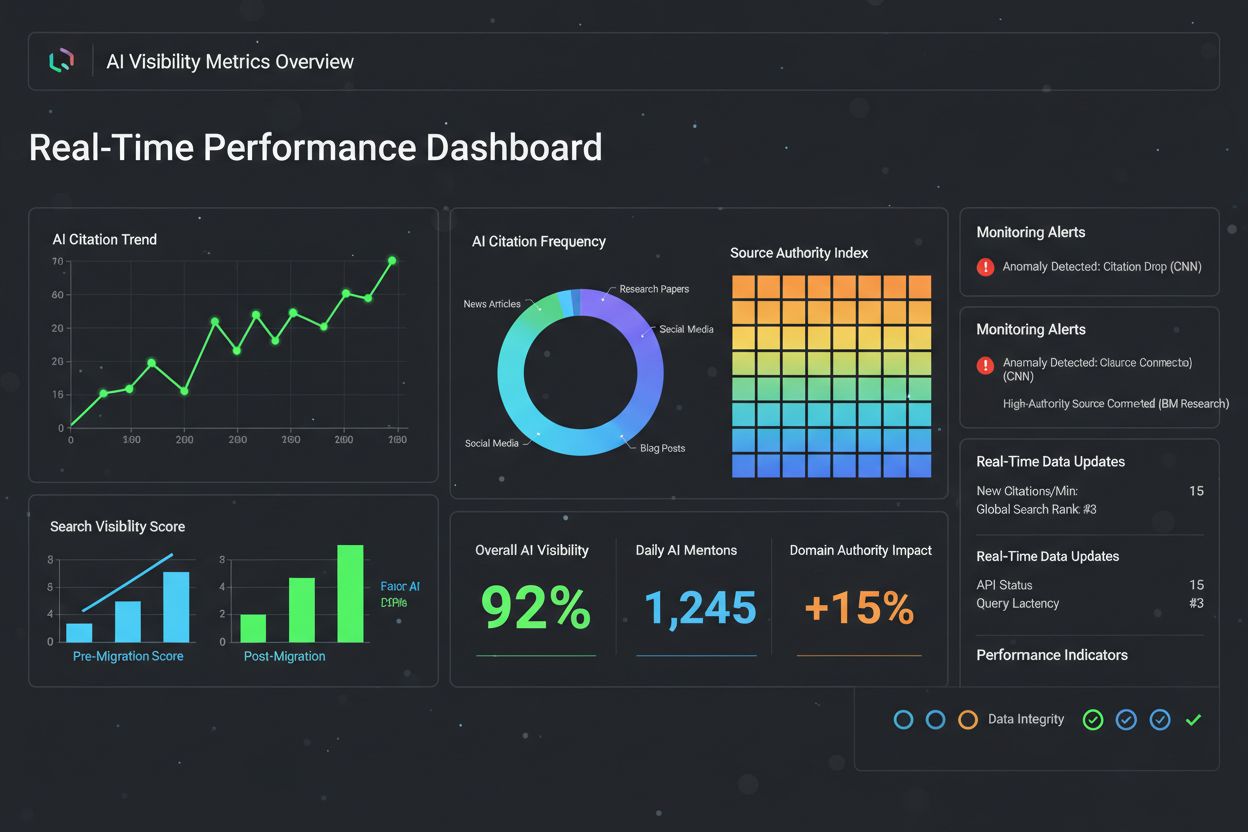
Your post-migration monitoring should include daily checks of AI visibility metrics for your top-performing content, weekly reviews of traffic patterns and ranking changes, and monthly deep dives into how your topical authority is being perceived by AI systems. Pay particular attention to content that previously received frequent AI citations: if these pieces suddenly drop off, investigate whether the migration caused accessibility issues, URL changes that broke citations, or content changes that reduced relevance. Monitor your crawl stats in Google Search Console to ensure that both Googlebot and other crawlers are accessing your content normally. Set up alerts for any significant drops in organic traffic or changes in your keyword rankings, and correlate these with your AI visibility metrics to understand whether issues are affecting traditional SEO, AI visibility, or both.
Many organizations make preventable mistakes during website migrations that damage both traditional SEO and AI visibility, often because they don’t understand how these systems interact. One of the most common errors is implementing redirects incorrectly: using 302 temporary redirects instead of 301 permanent redirects, creating redirect chains, or failing to redirect at all. This confusion about redirect types stems from misunderstanding how different systems interpret them; while search engines eventually follow redirect chains, AI systems may not, and temporary redirects signal that the content move is not permanent. Another frequent mistake is changing content during migration, either by rewriting pages, removing sections, or restructuring information architecture without maintaining clear relationships between old and new content.
Failing to update internal links is another critical error that damages both SEO and AI visibility. When you migrate to a new URL structure, internal links pointing to old URLs should be updated to point to new URLs, not left to rely on redirects. This is especially important for AI visibility because internal linking patterns help AI systems understand your topical authority and content relationships. Many teams also make the mistake of not communicating the migration to their audience, resulting in broken links in external content, social media, and email campaigns that point to old URLs. Finally, teams often underestimate the importance of monitoring post-migration, assuming that if the technical implementation was correct, everything will automatically recover. In reality, visibility losses can take weeks or months to fully manifest, and early detection allows for faster remediation.
An effective migration strategy in the AI era requires treating AI visibility as a first-class concern alongside traditional SEO, with dedicated planning, monitoring, and optimization efforts. Start by establishing clear success metrics that include both traditional SEO indicators (rankings, organic traffic) and AI visibility metrics (citation frequency, source attribution), measured before, during, and after migration. Implement your migration in phases rather than all at once, allowing you to monitor the impact of changes and adjust your approach if problems emerge. This phased approach is particularly valuable for large sites where a complete migration might take weeks or months; by migrating sections progressively, you can identify and fix issues before they affect your entire site.
Maintain detailed documentation throughout your migration process, including redirect mappings, URL structure changes, content modifications, and any technical decisions made during implementation. This documentation becomes invaluable if you need to troubleshoot issues or if you need to explain your migration strategy to stakeholders. Establish clear communication channels between your technical team, content team, and SEO team, ensuring that decisions made by one group don’t inadvertently harm the work of another. Consider implementing a content freeze during migration: avoid publishing new content or making significant changes to existing content while the migration is in progress, as this can confuse both search engines and AI systems about what your current content actually is. Finally, plan for a post-migration optimization phase where you can refine your content, improve internal linking, and address any visibility issues that emerge after the technical migration is complete.
Managing a migration that preserves both traditional SEO and AI visibility requires a toolkit that goes beyond traditional SEO platforms. Google Search Console remains essential for monitoring crawl errors, indexation status, and ranking changes, but it provides limited insight into AI visibility. AmICited fills this critical gap by specifically tracking how your content appears in AI-generated responses, showing you citation frequency, which AI systems are citing your content, and how your visibility compares to competitors. This AI-specific visibility data is essential for understanding whether your migration has affected your presence in conversational AI, which traditional SEO tools cannot measure.
Beyond AmICited, your migration toolkit should include a comprehensive SEO platform like Semrush or Ahrefs for tracking rankings and backlink changes, Google Analytics for understanding traffic patterns and user behavior, and a redirect checker tool to verify that your redirects are implemented correctly. Consider using a content management system or migration tool that can help automate redirect creation and URL mapping, reducing the risk of manual errors. Screaming Frog or similar crawling tools can help you verify that your site structure is correct and that internal links are functioning properly. For larger migrations, you might also consider working with a migration specialist or agency that has experience with AI-aware migrations and can provide additional oversight and expertise. The investment in proper tools and expertise during migration is far less expensive than recovering from visibility losses after the fact.
A successful migration requires a detailed timeline and checklist that accounts for all the technical, content, and monitoring activities necessary to preserve visibility. Your timeline should begin at least three months before your planned migration date, starting with the pre-migration audit and baseline metrics collection. Two months before migration, finalize your redirect strategy, update your content management system if necessary, and begin testing your migration in a staging environment. One month before migration, communicate your plans to stakeholders, prepare your monitoring dashboards, and conduct final testing to ensure everything is ready.
Your migration checklist should include: (1) Complete pre-migration audit and baseline metrics, (2) Document all URL changes and create redirect mappings, (3) Update internal links to point to new URLs, (4) Implement redirects on your old domain, (5) Update robots.txt and sitemaps, (6) Submit updated sitemaps to Google Search Console, (7) Monitor crawl stats and indexation, (8) Track both traditional SEO and AI visibility metrics daily for the first two weeks, (9) Address any crawl errors or accessibility issues immediately, (10) Conduct post-migration content optimization, and (11) Continue monitoring for at least 30 days after migration completion. By following a structured timeline and checklist, you significantly increase the likelihood that your migration will preserve both your traditional SEO performance and your AI visibility, protecting your digital presence across all discovery channels.
Yasha is a talented software developer specializing in Python, Java, and machine learning. Yasha writes technical articles on AI, prompt engineering, and chatbot development.

Ensure your brand stays visible in AI search results with real-time monitoring of how AI systems cite your content across all platforms.
Learn how domain migrations impact AI citations and visibility. Discover strategies to maintain AI presence during domain changes and recover citations faster.
Real before and after case study showing how strategic website optimizations increased AI citations by 47+ monthly mentions. Learn the exact changes that improv...

Learn proven strategies to maintain and improve your content's visibility in AI-generated answers across ChatGPT, Perplexity, and Google AI Overviews. Discover ...
Cookie Consent
We use cookies to enhance your browsing experience and analyze our traffic. See our privacy policy.