

What is Generative Engine Optimization (GEO)?
Learn what Generative Engine Optimization (GEO) is and how to optimize your brand for visibility in AI search engines like ChatGPT, Perplexity, and Gemini. Disc...
10 min read

Learn Generative Engine Optimization (GEO) fundamentals. Discover how to get your brand cited in ChatGPT, Perplexity, and Google AI Overviews with proven strategies.
Generative Engine Optimization (GEO) is the practice of optimizing your content to appear in the answers generated by AI-powered search engines and conversational AI platforms. Unlike traditional SEO, which focuses on ranking your website on search engine results pages, GEO prioritizes getting your content cited, quoted, and referenced within AI-generated responses. This distinction matters because the way people search is fundamentally changing—AI adoption has surged dramatically, with a 527% increase in AI-referred sessions reported across digital properties, while 43% of professionals now use ChatGPT regularly for research and decision-making. Platforms like ChatGPT, Perplexity (which processes over 500 million queries monthly), Google AI Overviews, and Claude are becoming primary information sources, shifting the competitive landscape away from traditional search rankings. In this new environment, being cited by an AI system is more valuable than ranking #1 on Google, because users trust the AI’s synthesis of information rather than clicking through to individual websites. GEO requires a fundamentally different approach to content creation, focusing on authority, accuracy, comprehensiveness, and proper attribution rather than keyword density and backlinks. Understanding GEO is no longer optional for businesses and content creators—it’s essential for maintaining visibility in an AI-driven information ecosystem.
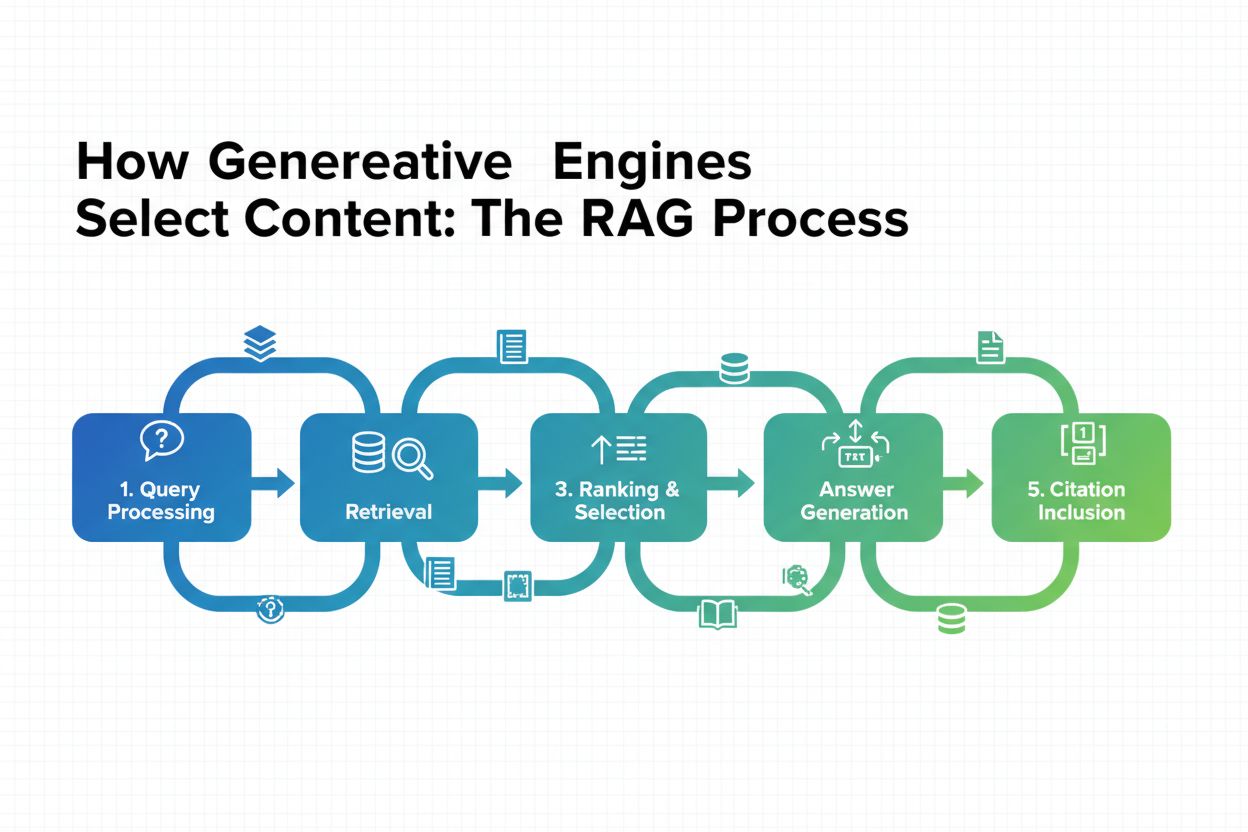
At the heart of modern generative engines lies Retrieval-Augmented Generation (RAG), a technology that combines information retrieval with AI-powered text generation to produce accurate, cited answers. Rather than relying solely on patterns learned during training, RAG systems actively search for relevant information from the web or proprietary databases, then synthesize that information into coherent responses while maintaining source attribution. This approach is fundamentally different from traditional search engines because it prioritizes semantic understanding—the meaning and context of information—over simple keyword matching. When you search a generative engine, your query goes through a sophisticated five-step process that determines which sources get cited and how prominently your content appears in AI responses.
The Five-Step RAG Process:
The critical insight for content creators is that semantic search fundamentally changes what gets optimized. Instead of targeting specific keywords, you need to create content that comprehensively addresses conceptual topics, uses natural language variations, and demonstrates deep expertise. RAG systems prioritize content that is authoritative (from trusted sources), comprehensive (covering topics thoroughly), well-structured (with clear hierarchies and relationships), and properly attributed (citing its own sources). This means your content needs to answer questions completely, use multiple angles and perspectives, and establish credibility through citations and expert voices—not just mention keywords strategically.
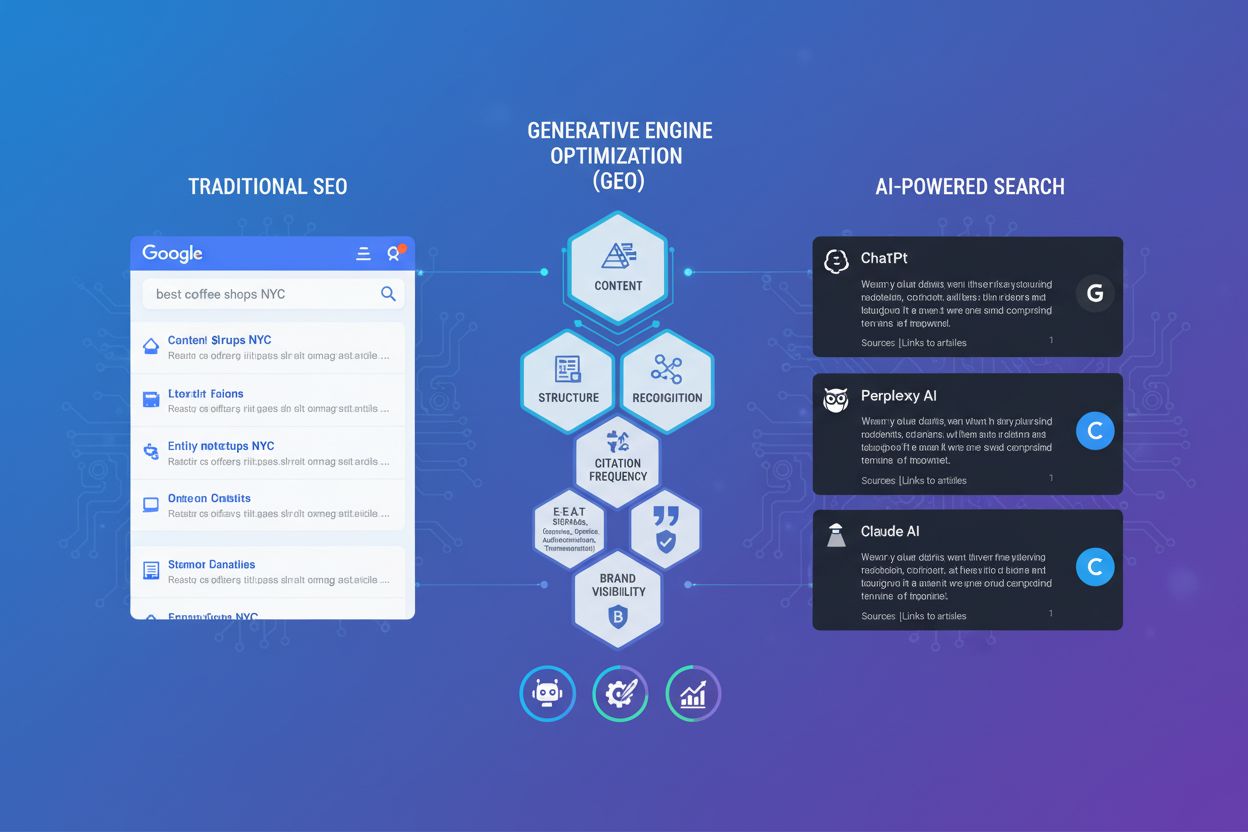
While SEO and GEO share some foundational principles, they optimize for fundamentally different goals and require distinct strategies. SEO’s primary objective is to achieve high rankings on search engine results pages (SERPs) to drive clicks to your website, while GEO’s goal is to become a cited source within AI-generated answers, which often results in zero clicks but significant brand authority and visibility. The optimization focus differs dramatically: SEO operates at the page level, targeting specific keywords and building backlinks to improve domain authority, whereas GEO operates at the fact level, ensuring individual claims, statistics, and insights are discoverable, citable, and authoritative. Content structure matters differently too—SEO favors keyword-optimized headlines and meta descriptions, while GEO rewards comprehensive, question-focused content with clear answers, supporting evidence, and proper citations. When to use each approach depends on your goals: if you need immediate traffic and conversions, SEO remains essential; if you’re building long-term brand authority and want to influence how AI systems present information about your industry, GEO is critical. The good news is that GEO and SEO overlap significantly—strong GEO content typically performs well in traditional search, and vice versa, making it possible to optimize for both simultaneously.
| Dimension | SEO | GEO |
|---|---|---|
| Primary Goal | Achieve high rankings on SERPs | Become cited source in AI responses |
| Optimization Level | Page-level (keywords, backlinks) | Fact-level (claims, statistics, insights) |
| Content Structure | Keyword-optimized, scannable | Comprehensive, question-focused, cited |
| Success Metric | Click-through rate, rankings | Citations, brand mentions, authority |
| Timeline | 3-6 months to see results | 2-4 weeks for initial citations |
| Competition | High (45-60 keyword difficulty) | Low (15-20 keyword difficulty) |
The business case for GEO is compelling and urgent. The reality of modern search is that 65% of searches result in zero clicks—users get their answer from the search engine itself and never visit a website. With AI-powered search engines capturing an increasing share of these zero-click searches, being cited by an AI system has become more valuable than ranking #1 on Google. When your content is cited in an AI response, you gain brand visibility in conversations where your target audience is actively seeking information, establishing authority and trust without requiring a click. Early movers in GEO have a significant competitive advantage because the space remains relatively uncrowded—keyword difficulty for GEO-optimized content averages 15-20 compared to 45-60 for traditional SEO, meaning you can establish authority with less effort and investment. Research from Princeton has shown that users exhibit source preference bias, meaning they’re more likely to trust and remember sources that appear in AI-generated responses, particularly when those sources are cited multiple times across different queries. This creates a compounding effect: as your content gets cited more frequently, it becomes more authoritative, which increases the likelihood of future citations.
Three Main Reasons GEO Matters Now:
Research from Stanford and Princeton has identified three content strategies that consistently increase citation rates and visibility in generative engines by approximately 40%. These strategies work because they align with how RAG systems evaluate source quality and relevance, making your content more likely to be retrieved, ranked highly, and cited in AI responses.
1. Cite Authoritative Sources
This strategy works because RAG systems view your content as more credible when you reference established authorities and primary sources. When you cite reputable sources, you signal that your content is well-researched and grounded in evidence, which increases the likelihood that the AI system will trust and cite your work. To implement this effectively, identify 3-5 authoritative sources per major claim (academic institutions, government agencies, industry leaders), integrate citations naturally into your narrative rather than relegating them to footnotes, and use direct quotes from authoritative sources to add credibility. For example, instead of writing “Studies show that remote work increases productivity,” write “According to research from Stanford’s WFH Research Center, remote workers are 13% more productive than their office-based counterparts, with particular gains in focus-intensive tasks.”
2. Add Direct Quotations
Expert quotes serve multiple purposes in GEO: they add credibility, provide semantic variation that helps RAG systems understand your content, and create additional citation opportunities. When you include direct quotes from recognized experts, you’re essentially creating multiple entry points for AI systems to discover and cite your content. To implement this strategy, source quotes from recognized experts in your field (academics, industry leaders, practitioners), format quotes clearly with attribution and context, and integrate them into your narrative to support key claims. For example: “As marketing strategist Seth Godin notes, ‘The goal of marketing is to tell a story so compelling that people want to help you tell it.’ This principle applies directly to GEO, where your content’s narrative structure determines whether AI systems will cite it.”
3. Include Statistics
Statistics are among the most cited elements in AI-generated responses because they provide concrete, verifiable information that answers questions precisely. RAG systems prioritize content with high fact density—the concentration of verifiable claims and data points. To optimize for this, aim to include 1-2 statistics every 150-200 words, ensure statistics come from credible sources with proper attribution, and present data in multiple formats (percentages, absolute numbers, comparisons). For example: “According to Pew Research, 72% of adults use social media, with daily usage averaging 2 hours and 23 minutes. This represents a 33% increase from 2019, demonstrating the accelerating role of social platforms in daily life.”
Different generative engines have distinct architectures, training approaches, and user behaviors, requiring tailored optimization strategies. Understanding these platform-specific nuances is essential for maximizing your GEO visibility across the AI ecosystem.
ChatGPT Optimization:
ChatGPT’s training data has a knowledge cutoff and relies heavily on web-indexed content for current information. The platform favors content with Wikipedia-style structure—clear hierarchies, comprehensive coverage, and neutral tone—because this format aligns with how the model was trained. ChatGPT users often ask complex, multi-part questions, so content that addresses questions from multiple angles performs better. Optimize for ChatGPT by using comparative listicles (e.g., “5 Ways X Compares to Y”), maintaining an authoritative but accessible tone, providing comprehensive coverage of topics rather than narrow angles, and structuring content with clear headers and logical flow. Content that reads like an encyclopedia entry—well-organized, thorough, and balanced—gets cited more frequently in ChatGPT responses.
Perplexity Optimization:
Perplexity emphasizes recency and community-driven content, making it ideal for timely, trend-focused information. The platform’s algorithm favors content that answers specific questions directly and includes diverse perspectives. Perplexity users tend to ask more conversational, specific questions, so your content should be structured around question-answer pairs. Optimize for Perplexity by emphasizing recent data and current events, incorporating community stories and user experiences, using conversational language that mirrors how users ask questions, and structuring content as Q&A or problem-solution formats. Content that feels like a conversation between knowledgeable peers rather than a formal article performs better on Perplexity.
Google AI Overviews Optimization:
Google AI Overviews are integrated into traditional search results, meaning they benefit from strong traditional SEO fundamentals. However, they also require additional optimization for AI visibility. Google prioritizes content with strong E-E-A-T signals (Experience, Expertise, Authoritativeness, Trustworthiness), schema markup implementation, and featured snippet optimization. Optimize for Google AI Overviews by maintaining strong traditional SEO (keywords, backlinks, page speed), implementing schema markup (Article, FAQPage, HowTo), optimizing for featured snippets (concise answers, lists, tables), and building E-E-A-T signals through author credentials, citations, and topical authority. Content that ranks well in traditional search and has rich schema markup will naturally appear in AI Overviews.
| Platform | Content Style | Optimization Focus | Best For |
|---|---|---|---|
| ChatGPT | Wikipedia-style, comprehensive | Authoritative tone, clear structure, multi-angle coverage | Complex topics, reference content |
| Perplexity | Conversational, current | Recency, Q&A format, diverse perspectives | Trending topics, specific questions |
| Google AI Overviews | SEO-optimized, schema-rich | Traditional SEO + schema markup + E-E-A-T | Broad queries, featured snippets |
| Claude | Nuanced, detailed | Depth, accuracy, multiple perspectives | Technical content, analysis |
Multi-Platform Strategy:
Rather than optimizing separately for each platform, develop a core content strategy that addresses all platforms simultaneously. Create comprehensive, well-sourced content that serves as your foundation, then adapt it for platform-specific formats. For example, develop a detailed guide (ChatGPT-optimized), extract key statistics and recent updates (Perplexity-optimized), optimize for featured snippets (Google AI Overviews), and ensure schema markup is implemented across all versions. This approach maximizes your visibility across the entire AI ecosystem without requiring completely separate content strategies.
Optimizing content for generative engines requires attention to multiple factors that influence how AI systems discover, evaluate, and cite your work. Use this checklist to ensure your content meets GEO best practices:
If your content’s visibility in AI-generated responses has declined, or if you’re not seeing citations despite strong traditional SEO performance, you may need to implement a GEO recovery strategy. The first step is recognizing the signs of failing GEO: declining AI bot traffic (visible in GA4 through user agent analysis), reduced manual citations when you check where your content appears in AI responses, and decreased brand mentions in AI-generated answers compared to previous months.
Diagnostic Checklist (5 Items):
7-Step GEO Recovery Process:
Expected Recovery Timeline:
Prevention Strategies:
To avoid future GEO decline, establish ongoing practices: update content quarterly with fresh data and recent examples, monitor AI bot traffic monthly using GA4 segments, manually check citation rates for top content monthly, maintain a minimum of 3-5 authoritative citations per piece, and keep author credentials and expertise signals current. Treat GEO as an ongoing practice rather than a one-time optimization.
Building an effective GEO workflow requires tools that help you create optimized content, implement technical requirements, and track performance. Here’s a categorized breakdown of essential tools and how to integrate them into your workflow:
Content Creation & Research:
Schema Markup & Technical Implementation:
Citation Tracking & Monitoring:
5-Step Tool Integration Workflow:
Measuring GEO performance requires different metrics than traditional SEO because success is defined by citations and authority rather than clicks. Here’s how to set up comprehensive GEO measurement:
AI Bot Traffic in GA4:
AI-powered search engines and conversational AI platforms send identifiable traffic to your website through specific user agents. To track this traffic, create custom segments in GA4 for known AI bots: ChatGPT (user agent contains “GPTBot”), Perplexity (user agent contains “PerplexityBot”), Claude (user agent contains “Claude-Web”), and Google AI Overviews (user agent contains “Googlebot”). Set up a dashboard that displays traffic from these segments separately, allowing you to monitor AI-referred traffic trends over time. Compare AI bot traffic month-over-month to identify growth patterns and correlate spikes with content updates or new publications.
Manual Citation Checking (3-Step Process):
Brand Mention Tracking:
Beyond direct citations of your content, track how often your brand is mentioned in AI-generated responses. This indicates broader authority and influence in your industry. Use manual checking or tools like Google Alerts to monitor brand mentions in AI contexts, and note whether mentions are positive, neutral, or negative.
Visibility Metrics:
ROI Calculation:
Calculate GEO ROI by assigning value to citations based on your business model. For B2B companies, citations may lead to brand awareness and consideration; for publishers, citations drive authority and future traffic; for e-commerce, citations establish trust and influence purchase decisions. Establish a baseline value per citation (e.g., $5-50 depending on industry), multiply by monthly citation count, and compare to GEO investment (content creation, tools, monitoring). Most companies see positive ROI within 3-6 months as citation rates compound.
Is GEO replacing SEO?
No, GEO is not replacing SEO—it’s complementing it. Traditional SEO remains essential for driving clicks and traffic, while GEO focuses on authority and brand visibility in AI responses. The most successful strategy is optimizing for both simultaneously, as strong GEO content typically performs well in traditional search, and vice versa. Think of GEO as an evolution of SEO that accounts for how information discovery is changing.
How long does GEO take to work?
GEO typically shows initial results faster than traditional SEO. You can see your first citations within 2-4 weeks of publishing optimized content, with significant visibility increases within 6-8 weeks. However, building sustained authority and consistent citations takes 3-6 months. The timeline depends on content quality, competition level, and how well you implement GEO best practices.
Can small businesses benefit from GEO?
Absolutely. In fact, small businesses have a significant advantage in GEO because keyword difficulty is much lower (15-20 vs. 45-60 for SEO), and competition is still relatively light. A small business can establish authority in a niche topic much faster through GEO than through traditional SEO, making it an ideal strategy for resource-constrained teams.
What’s the ROI of GEO?
GEO ROI varies by industry but is generally positive within 3-6 months. For B2B companies, citations drive brand awareness and consideration; for publishers, they establish authority and drive future traffic; for e-commerce, they influence purchase decisions. Most companies see 2-5x return on GEO investment within the first year, with returns compounding as citation authority builds.
How do I track AI citations?
You can track AI citations through three methods: (1) GA4 custom segments for AI bot traffic using known user agents, (2) manual checking by searching your target queries on ChatGPT, Perplexity, and Google AI Overviews monthly, and (3) specialized tools like AmICited.com that automatically monitor citations across multiple platforms. A combination of all three approaches provides the most comprehensive visibility.
Which platform should I optimize for first?
Start with the platform where your target audience is most active. If your audience uses ChatGPT primarily, optimize for that first; if they’re on Perplexity, start there. However, most businesses should prioritize Google AI Overviews first because they integrate with traditional search, meaning optimization benefits both SEO and GEO simultaneously. After establishing a strong foundation with Google, expand to ChatGPT and Perplexity.
Does GEO work for e-commerce?
Yes, GEO works well for e-commerce, particularly for product research, comparison, and buying guide queries. E-commerce sites should focus on creating comprehensive buying guides, product comparisons, and expert reviews that address common questions in their category. When AI systems cite your content in response to product research queries, you gain visibility with high-intent buyers, even if they don’t click through immediately.
Which industries benefit most from GEO?
Industries with high research and decision-making phases benefit most from GEO: B2B SaaS, professional services, healthcare, finance, education, and technology. Any industry where customers research extensively before purchasing or where authority and trust are critical success factors will see strong GEO ROI. However, GEO benefits all industries to some degree, making it a universal strategy worth implementing.
Generative Engine Optimization (GEO) focuses on getting your content cited in AI-generated responses, while SEO focuses on ranking in search engine results pages. GEO optimizes for authority and citations, whereas SEO optimizes for clicks. Both are important, and strong GEO content typically performs well in traditional SEO as well.
Start with the platform where your target audience is most active. However, most businesses should prioritize Google AI Overviews first because they integrate with traditional search, benefiting both SEO and GEO. After establishing a strong foundation with Google, expand to ChatGPT and Perplexity.
GEO typically shows initial results faster than traditional SEO. You can see your first citations within 2-4 weeks of publishing optimized content, with significant visibility increases within 6-8 weeks. Building sustained authority and consistent citations takes 3-6 months.
The top GEO ranking factors are: citing authoritative sources, including expert quotations, maintaining high fact density with statistics, using question-format headers, implementing schema markup, and maintaining content freshness. These factors align with how RAG systems evaluate source quality and relevance.
Absolutely. Small businesses have a significant advantage in GEO because keyword difficulty is much lower (15-20 vs. 45-60 for SEO) and competition is still relatively light. A small business can establish authority in a niche topic much faster through GEO than through traditional SEO.
Measure GEO success through: AI bot traffic in GA4 using custom segments, manual citation checking by searching your target queries on ChatGPT and Perplexity, brand mention tracking, and specialized tools like AmICited.com that monitor citations across multiple platforms. A combination of all three approaches provides comprehensive visibility.
Essential GEO tools include: Frase.io for content optimization, AnswerThePublic for question research, Google Rich Results Test for schema validation, GA4 for traffic tracking, and AmICited.com for citation monitoring. These tools help you create, implement, and measure GEO success.
No, GEO is complementing SEO, not replacing it. Traditional SEO remains essential for driving clicks and traffic, while GEO focuses on authority and brand visibility in AI responses. The most successful strategy is optimizing for both simultaneously, as they reinforce each other.
Track how often your brand is cited in ChatGPT, Perplexity, Google AI Overviews, and Claude. Get actionable insights to improve your GEO performance and stay ahead of competitors.
Learn what Generative Engine Optimization (GEO) is and how to optimize your brand for visibility in AI search engines like ChatGPT, Perplexity, and Gemini. Disc...
Learn what Generative Engine Optimization (GEO) is, how it differs from SEO, and why it's critical for brand visibility in AI-powered search engines like ChatGP...
Learn how to get started with Generative Engine Optimization (GEO) today. Discover essential strategies to optimize your content for AI search engines like Chat...