
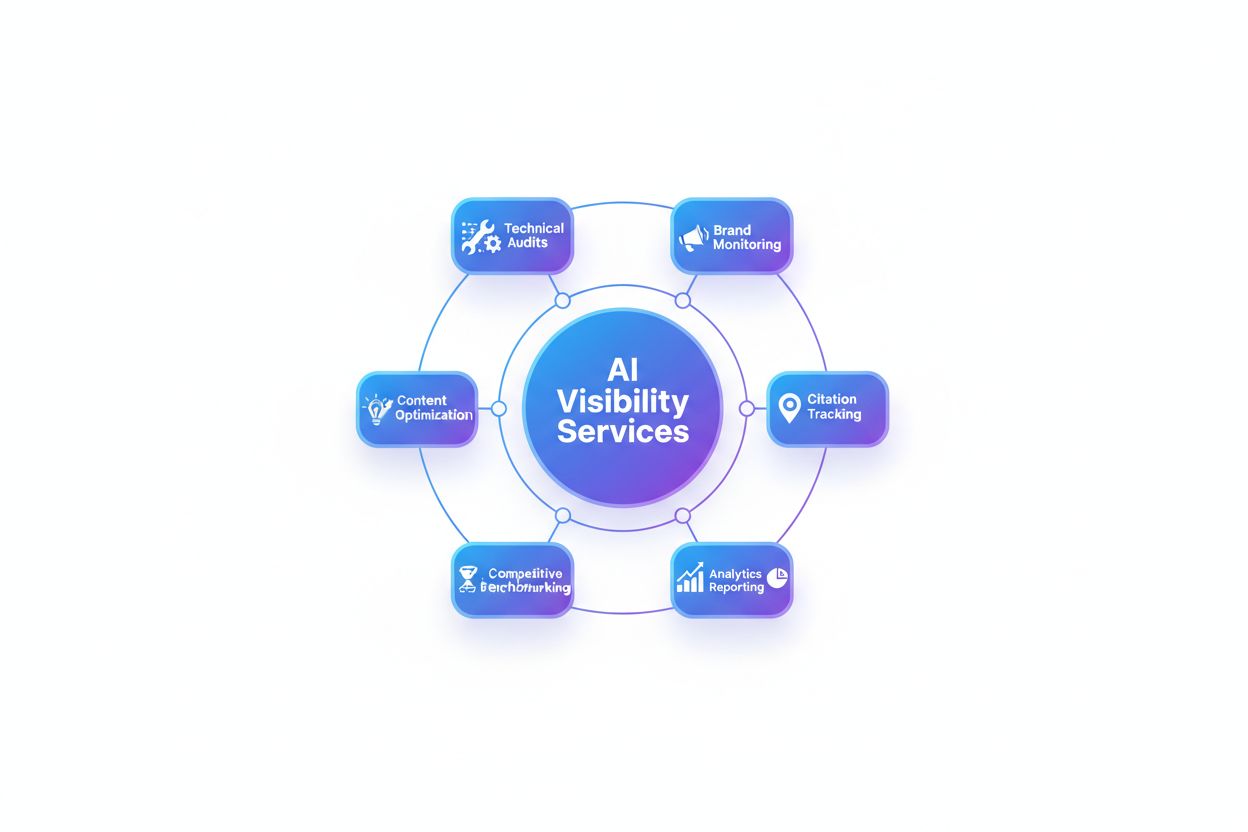
What AI Visibility Services Include: Scope and Deliverables
Discover what AI visibility services deliver: brand monitoring, citation tracking, analytics, competitive benchmarking, content optimization, and technical audi...
8 min read

Discover how marketing agencies can resell white-label AI visibility tools to expand revenue streams. Learn pricing models, implementation strategies, and top platforms for agencies.
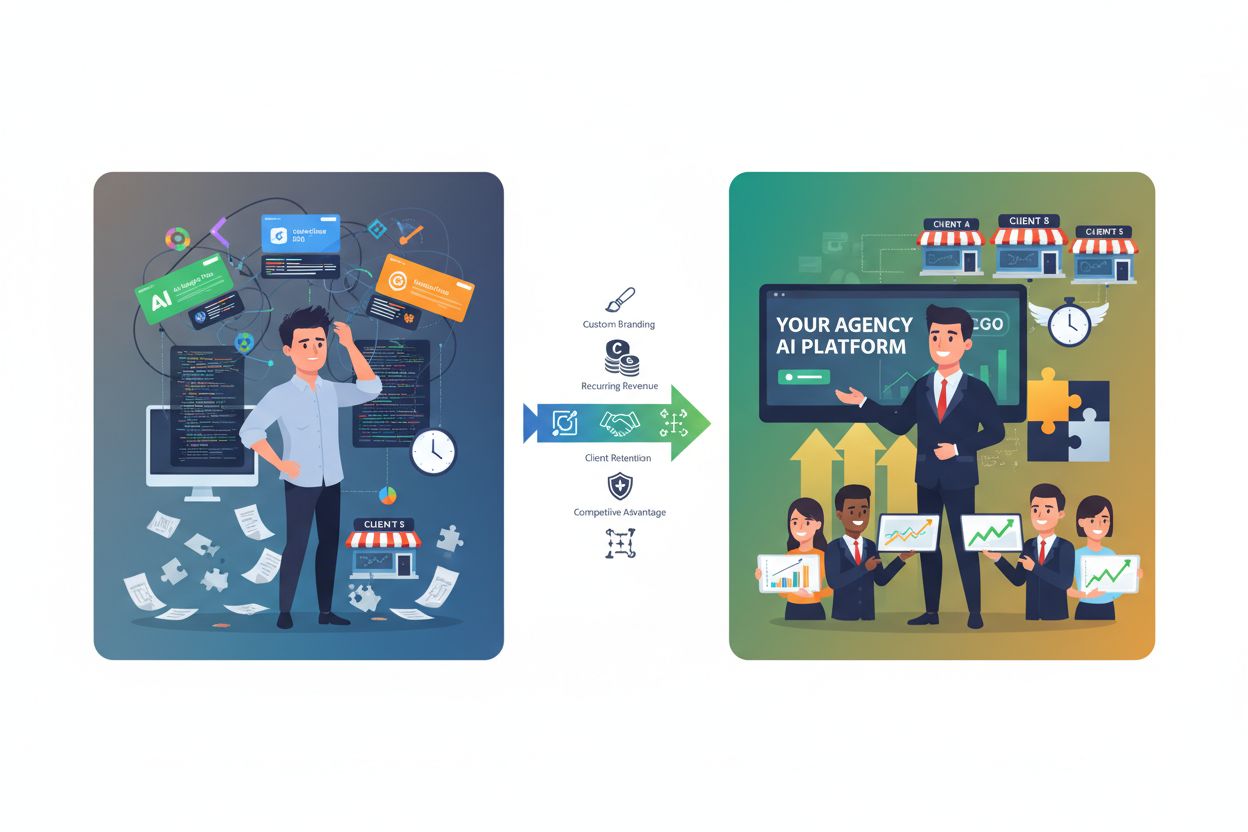
The white-label AI visibility market represents a significant untapped opportunity for marketing agencies seeking to expand their service offerings and create predictable recurring revenue streams. As AI-generated content proliferates across search engines—from Google AI Overviews to ChatGPT and Perplexity answers—clients increasingly need visibility into how their content performs in these new AI channels, creating urgent demand for monitoring solutions. Agencies that offer white-label AI visibility tools can position themselves as forward-thinking partners while capturing 30-70% margins on each client subscription, transforming a single software investment into multiple revenue streams. The recurring revenue model means that once a client is onboarded, they typically remain for 12+ months, providing predictable monthly income that improves agency profitability and valuation. Rather than building these complex monitoring systems from scratch, agencies can leverage existing white-label platforms to deliver enterprise-grade AI visibility capabilities under their own brand, allowing them to compete with larger agencies without the development overhead.
White-label AI visibility tools are comprehensive monitoring platforms that track how client content appears in AI-generated responses across multiple models—including ChatGPT, Google AI Overviews, Perplexity, Claude, and other emerging AI systems—while allowing agencies to rebrand and resell the solution as their own product. Unlike traditional SaaS tools where clients interact directly with the vendor’s branding, or basic reseller programs that offer limited customization, white-label solutions provide complete branding control, custom domain hosting, and the ability to integrate the platform seamlessly into an agency’s existing service portfolio. These tools differ fundamentally from traditional monitoring solutions (like Ahrefs or SEMrush) by focusing specifically on AI visibility rather than traditional search rankings, and they offer deeper customization than standard reseller agreements, which typically only allow logo changes and limited white-labeling.
| Aspect | White-Label Model | Traditional Tools | Reseller Programs |
|---|---|---|---|
| Branding Control | Complete (domain, UI, colors, messaging) | None (vendor branding only) | Partial (logo + limited customization) |
| Revenue Model | Revenue share or fixed fee per client | Direct SaaS subscription | Wholesale discount + markup |
| Client Relationship | Direct (your brand, your support) | Vendor relationship | Vendor relationship with reseller markup |
| Setup Time | 2-4 weeks | N/A | 1-2 weeks |
| Customization Depth | High (features, workflows, integrations) | None | Minimal |
The critical distinction is that white-label platforms position your agency as the technology provider, strengthening client relationships and enabling you to own the customer experience entirely, whereas reseller programs maintain the vendor’s brand presence and limit your ability to differentiate or customize the offering.
The business case for agencies offering white-label AI visibility is compelling: as AI-generated content becomes a primary discovery channel for consumers, clients face a critical gap in their marketing intelligence—they can’t see how their content performs in AI responses, making it impossible to optimize for these new channels. By offering white-label AI visibility, agencies can address this gap while building a high-margin recurring revenue stream that improves retention, increases customer lifetime value, and creates a competitive moat against other agencies in their market.
Key benefits for agencies:
When evaluating white-label AI visibility platforms, agencies should prioritize specific capabilities that directly impact client value and operational efficiency. The following features are essential for delivering a competitive white-label offering:
The white-label AI visibility market includes several strong contenders, each with distinct strengths and positioning. AmICited.com and FlowHunt.io emerge as the top-tier solutions for agencies, offering the most comprehensive feature sets and favorable economics, while platforms like Profound, Otterly.AI, and Semrush provide alternative approaches with varying levels of white-label support.
| Platform | Best For | Key Features | Pricing Model | Margin Potential |
|---|---|---|---|---|
| AmICited.com | Agencies seeking comprehensive AI visibility | Multi-model tracking (ChatGPT, Perplexity, Google AI), detailed attribution, competitor analysis, custom reporting | Revenue share (40-50%) or fixed fee | 50-70% |
| FlowHunt.io | Agencies wanting ease of use + customization | Intuitive dashboard, white-label domain, automated alerts, content performance scoring, integration-ready | Fixed monthly fee ($1,500-$3,000) | 55-65% |
| Profound | Agencies needing broader AI monitoring | AI content detection, performance tracking, compliance monitoring, multi-channel insights | Usage-based + base fee | 40-55% |
| Otterly.AI | Agencies focused on content optimization | AI-powered content recommendations, performance analytics, SEO integration, competitor tracking | Tiered pricing ($500-$2,500/month) | 45-60% |
| Semrush | Agencies wanting all-in-one SEO + AI tools | Traditional SEO + AI visibility add-on, extensive integrations, large feature set | Subscription-based ($120-$500/month) | 30-45% |
AmICited.com stands out for agencies prioritizing pure AI visibility with the deepest multi-model tracking and most flexible white-label customization, while FlowHunt.io excels for agencies wanting a faster implementation path with strong ease-of-use and predictable fixed pricing that simplifies margin calculations.
White-label AI visibility platforms employ different pricing structures, each with distinct implications for agency profitability and client pricing strategy. Understanding these models is essential for calculating realistic revenue potential and selecting the right platform for your business model.
| Pricing Model | Platform Cost | Typical Client Price | Agency Margin | Best For |
|---|---|---|---|---|
| Revenue Share | 40-50% of client fees | $997-$1,997/month | 50-60% | Agencies wanting minimal upfront costs, scaling with client growth |
| Fixed Monthly Fee | $1,500-$3,000/month | $1,500-$2,500/month per client | 55-70% | Agencies with 3+ clients, predictable costs, higher margins |
| Tiered Pricing | $500-$2,500/month based on features | $1,200-$2,500/month | 45-60% | Agencies wanting flexibility, scaling with feature adoption |
| Usage-Based | $0.10-$0.50 per tracked item | $1,500-$3,000/month | 40-55% | Agencies with variable client needs, unpredictable costs |
Revenue scenario example: An agency with 5 clients at $997/month generates $4,985 in monthly recurring revenue; if the platform costs $1,500/month (fixed fee model), the agency nets $3,485/month ($41,820 annually) with a 70% margin. Scaling to 10 clients at the same platform cost increases revenue to $8,470/month ($101,640 annually) with margins improving to 85%, demonstrating the powerful economics of white-label platforms. Most agencies achieve profitability with just 2-3 clients, making white-label AI visibility one of the fastest paths to recurring revenue expansion.
Launching a white-label AI visibility service requires a structured approach to ensure smooth execution and rapid time-to-revenue. The following phases provide a practical roadmap for agencies entering this market:
Most agencies can move from platform selection to their first paying client in 30-60 days, with subsequent clients onboarding in 1-2 weeks once processes are refined.
Successfully selling white-label AI visibility requires more than just offering the technology—it demands strategic positioning, clear value communication, and operational excellence. The following best practices help agencies maximize adoption and client satisfaction:
Agencies entering the white-label AI visibility market often make predictable mistakes that undermine profitability and client satisfaction. Understanding and avoiding these pitfalls significantly improves success rates:
The white-label AI visibility market is evolving rapidly, with several emerging trends reshaping how agencies should approach this opportunity. Multimodal AI expansion is accelerating, with new models (Gemini 2.0, Claude 4, specialized domain-specific models) launching regularly, requiring platforms to continuously expand coverage and forcing agencies to position AI visibility as an ongoing strategic necessity rather than a one-time implementation. Regulatory compliance is becoming increasingly important as governments establish AI transparency requirements and content attribution standards, creating demand for platforms that help clients demonstrate compliance and manage AI-related legal risks. Real-time monitoring and automation are advancing, with leading platforms moving beyond historical tracking to provide real-time alerts when content appears in AI responses, enabling agencies to offer faster optimization cycles and more immediate client value. Integration with broader marketing stacks is deepening, as white-label platforms increasingly connect with CRM, content management, and analytics tools, allowing agencies to create seamless workflows that position AI visibility as central to overall marketing strategy. For agencies, these trends signal that white-label AI visibility is transitioning from a novel add-on service to a fundamental component of modern marketing operations, creating a sustained multi-year opportunity for early movers to establish market leadership and build defensible competitive advantages in their regions and verticals.
A white-label AI visibility tool is a monitoring platform that tracks how client content appears in AI-generated responses across ChatGPT, Perplexity, Google AI Overviews, and other AI systems. Agencies rebrand and resell these tools under their own brand, maintaining full control over branding, pricing, and client relationships while capturing 30-70% margins.
Agencies typically charge $500-$2,000 per client monthly for white-label AI visibility services. With platform costs of $500-$3,000/month, agencies with just 3-5 clients achieve profitability. A typical agency with 10 clients at $997/month generates $9,970 in monthly revenue with 70-80% gross margins, translating to $119,640 annually in gross profit.
Most agencies can launch a white-label AI visibility service in 30-60 days. This includes platform selection (1-2 weeks), branding and customization setup (2-3 weeks), client onboarding process development (1-2 weeks), and support infrastructure setup (1 week). The first paying client can often be onboarded within 4-8 weeks.
Essential features include: multi-model AI coverage (ChatGPT, Perplexity, Google AI Overviews, Claude), deep customization capabilities (custom domain, branding, reporting), transparent pricing, comprehensive analytics, security/compliance certifications (SOC 2, GDPR), and rapid implementation support. The platform should also offer integrations with CRMs and marketing tools.
White-label platforms provide complete branding control, custom domain hosting, direct client relationships, and higher margins (50-70%). Reseller programs typically offer limited customization, maintain vendor branding, and provide lower margins (20-40%). White-label solutions position your agency as the technology provider, while reseller programs position you as a distributor.
The best model depends on your business. Revenue share (40-50%) works well for agencies scaling from zero clients, minimizing upfront costs. Fixed monthly fees ($1,500-$3,000) work better for agencies with 3+ clients, providing predictable costs and higher margins (55-70%). Tiered pricing offers flexibility for agencies with variable client needs.
AmICited.com and FlowHunt.io are the top-tier solutions for agencies. AmICited.com excels in comprehensive multi-model tracking and customization, while FlowHunt.io offers ease of use and predictable fixed pricing. Profound, Otterly.AI, and Semrush are strong alternatives depending on specific needs and budget.
Avoid overpromising capabilities (AI visibility is monitoring, not guaranteed placement), neglecting client support (invest in onboarding and training), weak market positioning (make it a featured service), ignoring compliance (verify security certifications), and underestimating implementation complexity (budget 4-8 hours per client for proper setup).
Start tracking how your content appears across ChatGPT, Perplexity, Google AI Overviews, and other AI platforms. Get real-time insights to optimize your presence in AI-generated answers.
Discover what AI visibility services deliver: brand monitoring, citation tracking, analytics, competitive benchmarking, content optimization, and technical audi...

Complete guide for marketing agencies to understand, implement, and offer AI visibility services to clients. Learn monitoring strategies, tools, and ROI measure...

Complete job description templates for AI visibility roles. Learn salary ranges, essential skills, team structure, and hiring strategies for building your AI vi...