
From Invisible to Recommended: AI Optimization Transformation Stories
Discover how brands transform from invisible to recommended in AI search. Real case studies showing 67% traffic growth, 32% SQLs from AI, and $90M+ pipeline imp...
6 min read
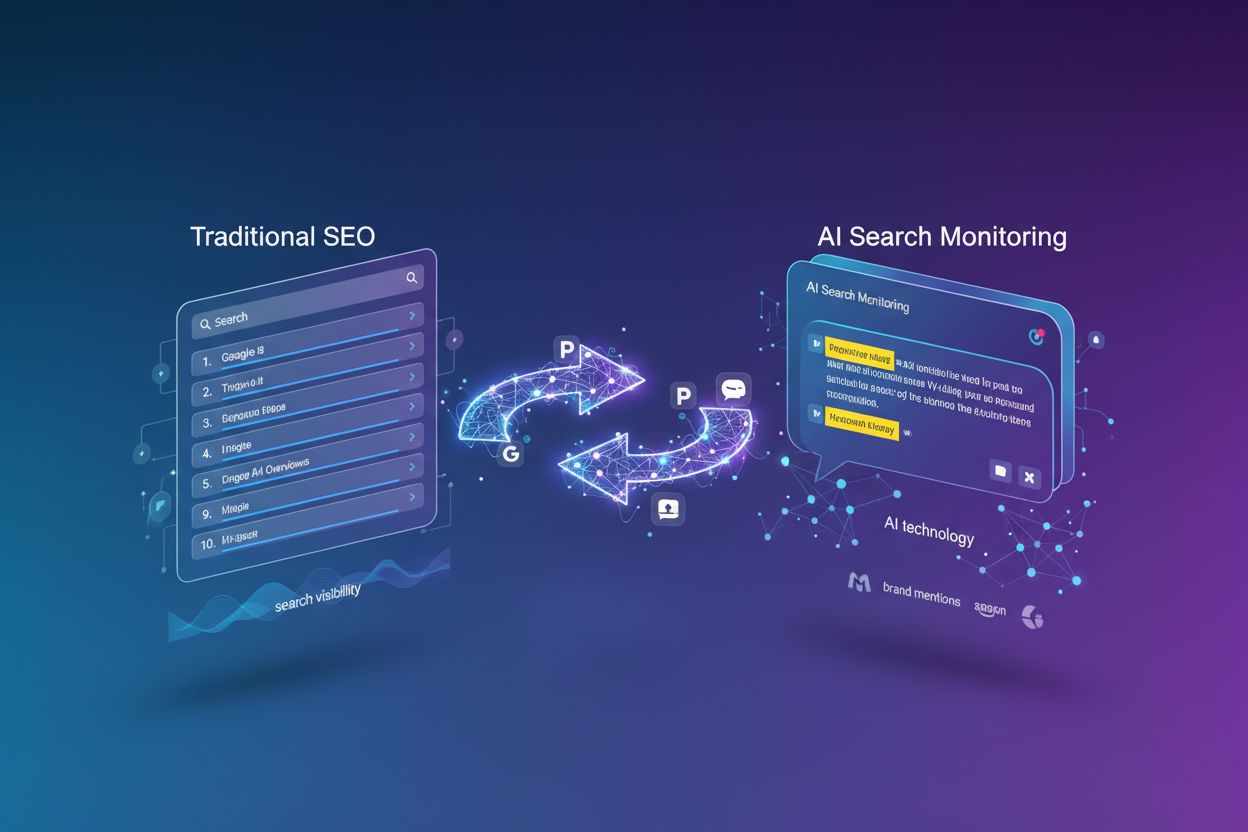
Discover how AI search monitoring is replacing traditional SEO. Learn why AI visitors are 4.4x more valuable and how to optimize for ChatGPT, Perplexity, and Google AI Overviews.
The way users discover information online is undergoing a seismic transformation. AI search engines like ChatGPT, Perplexity, and Google AI Overviews are fundamentally reshaping the digital discovery landscape, moving away from the traditional Google Search Engine Results Page (SERP) model that has dominated for decades. Instead of clicking through ranked links, users now receive synthesized answers directly from AI systems that cite multiple sources behind the scenes. This shift represents more than a tactical adjustment—it’s a complete reimagining of how search visibility translates to business value. Most critically, AI search visitors are 4.4x more valuable than traditional organic search visitors, making this transition impossible to ignore. The implications are profound: AI systems compress the traditional marketing funnel, deprioritize traditional link-based ranking factors, and reward different types of content and citation patterns entirely.
| Aspect | Traditional SEO | AI Search Monitoring |
|---|---|---|
| Discovery Method | Ranked links on SERP | AI-synthesized answers with citations |
| User Intent | Click-through to destination | Information consumption from AI response |
| Traffic Quality | Standard conversion rates | 4.4x higher visitor value |
| Optimization Focus | Page ranking position | Brand mentions and citation visibility |
The mechanics of this shift are critical to understand. In traditional SEO, visibility meant ranking in the top 10 positions on Google’s SERP. In AI search, visibility means being cited as a source within the AI’s response—regardless of your traditional ranking position. This distinction fundamentally changes how marketers should allocate resources and measure success. For every single click that comes from an AI search result, there are approximately 20 background searches where your content is being evaluated and potentially cited, meaning visibility matters exponentially more than direct traffic attribution.
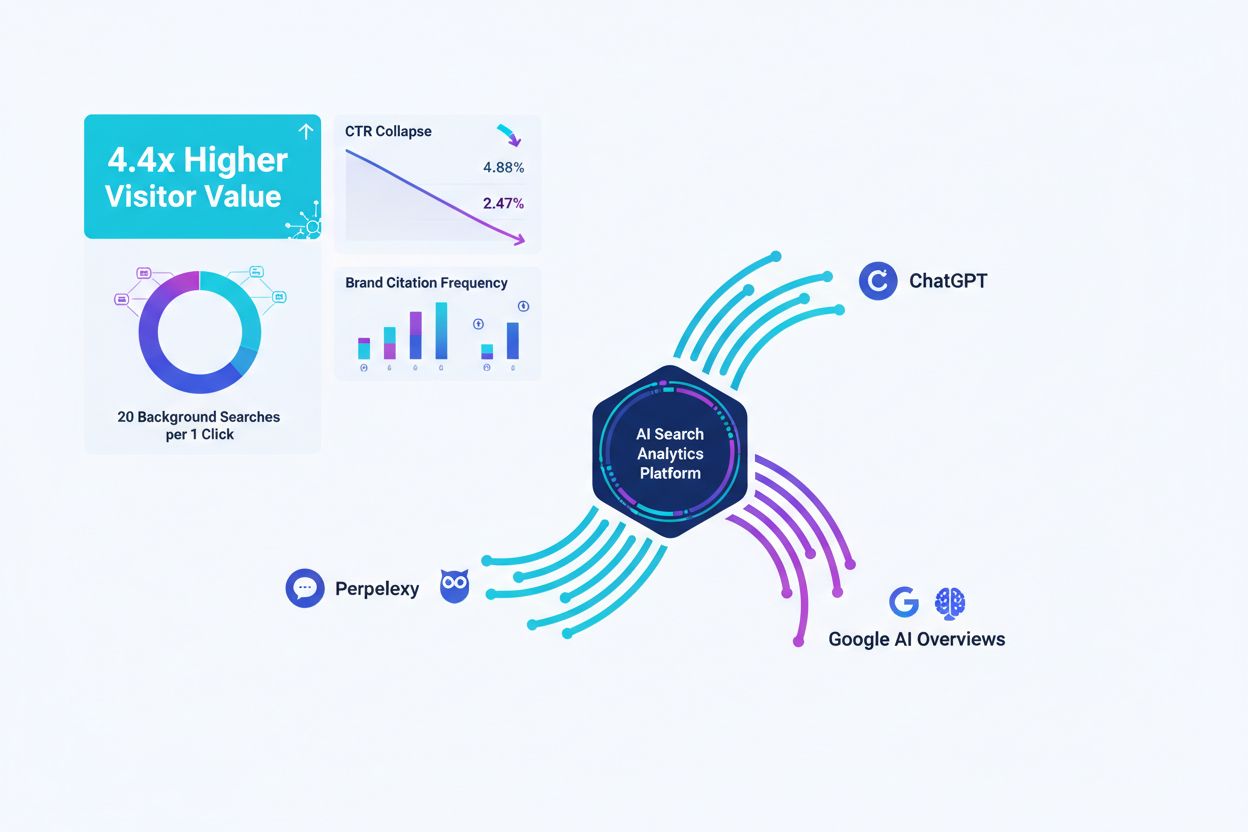
The data on traditional SEO performance tells a sobering story for those still relying exclusively on conventional metrics. According to seoClarity research, click-through rates have collapsed dramatically—position 3 on Google’s SERP has dropped from 4.88% to 2.47% in recent years, a decline of over 50%. This erosion accelerates as AI Overviews and other AI-powered features consume more of the search results page, literally pushing traditional organic results further down. The fundamental problem is that traditional metrics like ranking position, CTR, and organic traffic volume no longer capture the full picture of search visibility in an AI-dominated landscape. When AI systems cite sources from positions 21 and beyond with nearly equal frequency as top-ranking pages, the entire premise of “position-based SEO” becomes questionable.
Why traditional SEO metrics fail in the AI era:
The uncomfortable truth is that many organizations are optimizing for metrics that no longer drive business results. A page ranking #5 on Google might receive fewer clicks than ever before, while simultaneously being cited in AI responses that reach thousands of users. This invisible visibility—the citations happening behind the scenes—represents the new frontier of search marketing, yet most traditional SEO tools provide zero visibility into it.
AI visibility monitoring represents a fundamental new category of competitive intelligence that didn’t exist two years ago. Unlike traditional SEO tools that track ranking positions and backlinks, AI visibility monitoring tracks where your brand, products, and content are being cited across AI search platforms—and critically, how they’re being presented. This includes brand mentions, citation frequency, sentiment analysis, and competitive positioning within AI-generated responses. The data reveals clear patterns: Quora and Reddit are the most-cited sources in Google AI Overviews, while 50% of ChatGPT links point to business and service websites, indicating that AI systems actively seek out authoritative, practical information sources. This creates an entirely new optimization opportunity for brands willing to understand and act on these patterns.
AmICited.com addresses this gap by providing real-time monitoring of brand mentions and citations across ChatGPT, Perplexity, Google AI Overviews, and other emerging AI search platforms. The platform tracks not just whether you’re cited, but how frequently, in what context, and alongside which competitors. This multi-platform monitoring reveals critical insights: which content types generate the most citations, which topics position your brand favorably against competitors, and where citation gaps exist. The technical sophistication required to monitor AI visibility is substantial—it involves prompt tracking across thousands of variations, competitor analysis to understand relative citation frequency, and sentiment analysis to ensure citations are contextually positive. Organizations using AI visibility monitoring gain an asymmetric advantage: they understand their true search visibility while competitors remain blind to citations happening outside traditional SERP tracking.
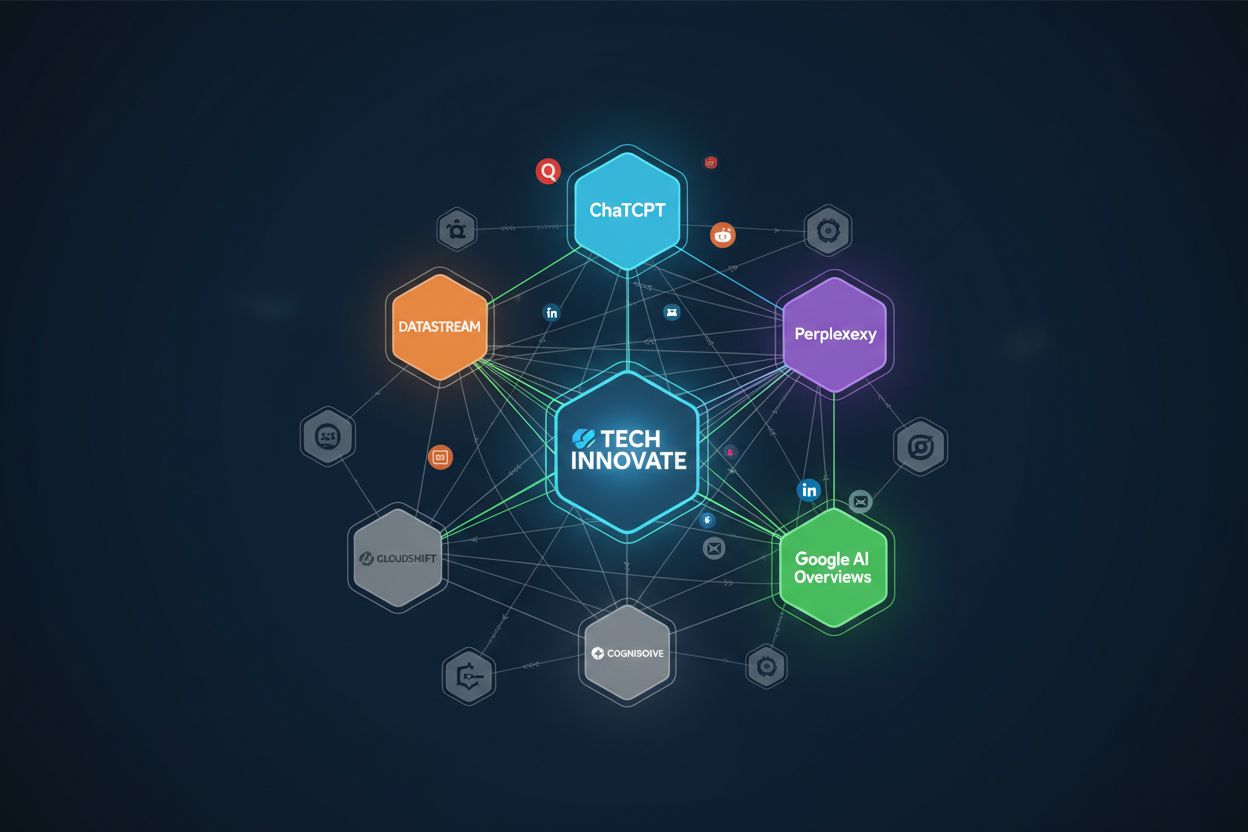
The citation patterns across different AI platforms reveal surprising insights that contradict traditional SEO assumptions. ChatGPT cites pages ranking in positions 21 and beyond almost 90% of the time, suggesting that traditional ranking position has minimal correlation with AI citation likelihood. This phenomenon occurs because AI systems operate with fundamentally different evaluation criteria than traditional search algorithms. Rather than relying primarily on link-based authority signals, AI systems can understand user intent at a deeper level, evaluate information quality through sophisticated natural language processing, and assess content relevance across larger pools of information. The three leading theories explaining this behavior are: (1) AI systems access a larger content pool than what appears in traditional SERP rankings, (2) AI systems focus on information chunks and concepts rather than full pages, and (3) sophisticated NLP allows AI to identify authoritative information regardless of traditional ranking signals.
The domains that perform best in AI citations tell a revealing story: Quora, Reddit, LinkedIn, YouTube, The New York Times, and NerdWallet consistently appear in AI responses across multiple platforms and topics. These domains share common characteristics—they contain diverse perspectives, user-generated content, expert opinions, and practical information—rather than traditional SEO authority markers. This suggests that AI systems prioritize information quality, comprehensiveness, and user trust signals over backlink profiles. Importantly, traditional SEO factors still contribute to AI visibility; well-optimized content with strong topical authority, clear structure, and comprehensive coverage performs better in AI citations than poorly optimized content. However, the weighting of these factors has shifted dramatically, with content quality and information completeness now mattering far more than link quantity or keyword optimization tactics.
Optimizing for AI search visibility requires a fundamentally different approach than traditional SEO, though many foundational principles remain relevant. The most effective strategies focus on content quality, comprehensiveness, and how information is structured and presented to AI systems. Organizations should begin by auditing their content against AI citation patterns—identifying which topics, formats, and domains generate the most citations in AI responses. This audit reveals optimization opportunities that traditional SEO tools completely miss.
Actionable optimization strategies for AI search visibility:
AmICited.com helps identify which of these strategies will have the highest impact for your specific business by analyzing your current citation patterns, competitive positioning, and content performance across AI platforms. The platform reveals exactly which content types, topics, and formats generate citations, allowing you to focus optimization efforts on high-impact opportunities. Progress tracking becomes straightforward—instead of monitoring ranking positions that no longer correlate with visibility, you track citation frequency, citation context, and competitive share of voice across AI platforms.
The timeline for AI search adoption is accelerating faster than most organizations realize. Research from Semrush indicates that AI search traffic could surpass traditional organic search by 2028—just three years away. This projection isn’t speculative; it’s based on current adoption rates, user behavior shifts, and the clear superiority of AI search for information discovery. The business implications are staggering: organizations that establish strong AI visibility now will capture disproportionate market share as these platforms become the primary discovery mechanism. The conversion rate advantages compound this opportunity—AI search visitors convert at 4.4x the rate of traditional organic visitors, meaning that even modest citation frequency translates to significant revenue impact.
The competitive risk of ignoring AI visibility is substantial and growing daily. Early movers in AI search optimization are establishing dominance in AI-generated responses, creating citation patterns that become increasingly difficult for competitors to displace. As AI systems mature and users develop trust in specific sources, citation frequency becomes a self-reinforcing advantage—the more often a source is cited, the more trustworthy it appears to AI systems, leading to more citations. Organizations waiting for “more data” or “clearer best practices” are essentially ceding market share to competitors who are actively optimizing now. AmICited.com and similar AI visibility monitoring platforms provide the competitive advantage necessary to compete in this new landscape—real-time monitoring of your citation performance, competitive benchmarking, and actionable optimization recommendations based on actual AI behavior rather than speculation. The question is no longer whether to invest in AI search visibility, but how quickly you can establish dominance before the window of opportunity closes.
AI search monitoring is the practice of tracking how your brand appears in AI-generated responses across platforms like ChatGPT, Perplexity, and Google AI Overviews. Unlike traditional SEO which focuses on ranking positions, AI monitoring tracks brand mentions, citations, sentiment, and competitive positioning within AI responses.
AI search visitors are 4.4x more valuable than traditional organic search visitors, and AI search traffic could surpass traditional search by 2028. Additionally, for every 1 click from AI, there are approximately 20 background searches where your content is being evaluated—making visibility more important than direct traffic.
The primary platforms to monitor are ChatGPT (largest user base), Google AI Overviews (integrated into Google Search), and Perplexity (rapidly growing). You should also consider Gemini, Claude, and Microsoft Copilot depending on your target audience and industry.
Traditional SEO focuses on ranking position (1-10 on SERP). AI citation is different—ChatGPT cites pages from positions 21+ almost 90% of the time. AI systems evaluate information quality, relevance, and comprehensiveness rather than relying primarily on link-based authority signals.
Content that performs well in AI citations includes: comprehensive guides, comparison articles, expert interviews, multimodal content (text + images/video), content from high-authority platforms (Quora, Reddit, LinkedIn), and content with clear structure and information chunks that AI can easily extract.
Key strategies include: creating comprehensive, multi-perspective content; optimizing for information chunks with clear headers and bullet points; implementing NLP optimization; building presence on high-citation platforms; ensuring crawlability and structured data; and developing distinctive brand messaging that AI systems can cite specifically to your organization.
Traditional traffic measures clicks from search results. AI visibility measures brand mentions and citations in AI responses, regardless of whether users click through. Since for every 1 click there are ~20 background searches, visibility is now a more important metric than traffic volume.
AmICited provides real-time monitoring of brand mentions across ChatGPT, Perplexity, and Google AI Overviews. The platform tracks citation frequency, sentiment analysis, competitive positioning, and provides actionable optimization recommendations based on actual AI behavior patterns.
Track how AI platforms mention your brand across ChatGPT, Perplexity, and Google AI Overviews. Get real-time insights into your AI search visibility and competitive positioning.
Discover how brands transform from invisible to recommended in AI search. Real case studies showing 67% traffic growth, 32% SQLs from AI, and $90M+ pipeline imp...
Learn how to combine AI visibility monitoring with traditional SEO to create a unified search strategy that captures visibility across all discovery channels.

Learn how to build a strong personal brand for AI visibility. Discover strategies to get cited by ChatGPT, Perplexity, Gemini, and Claude through content optimi...