
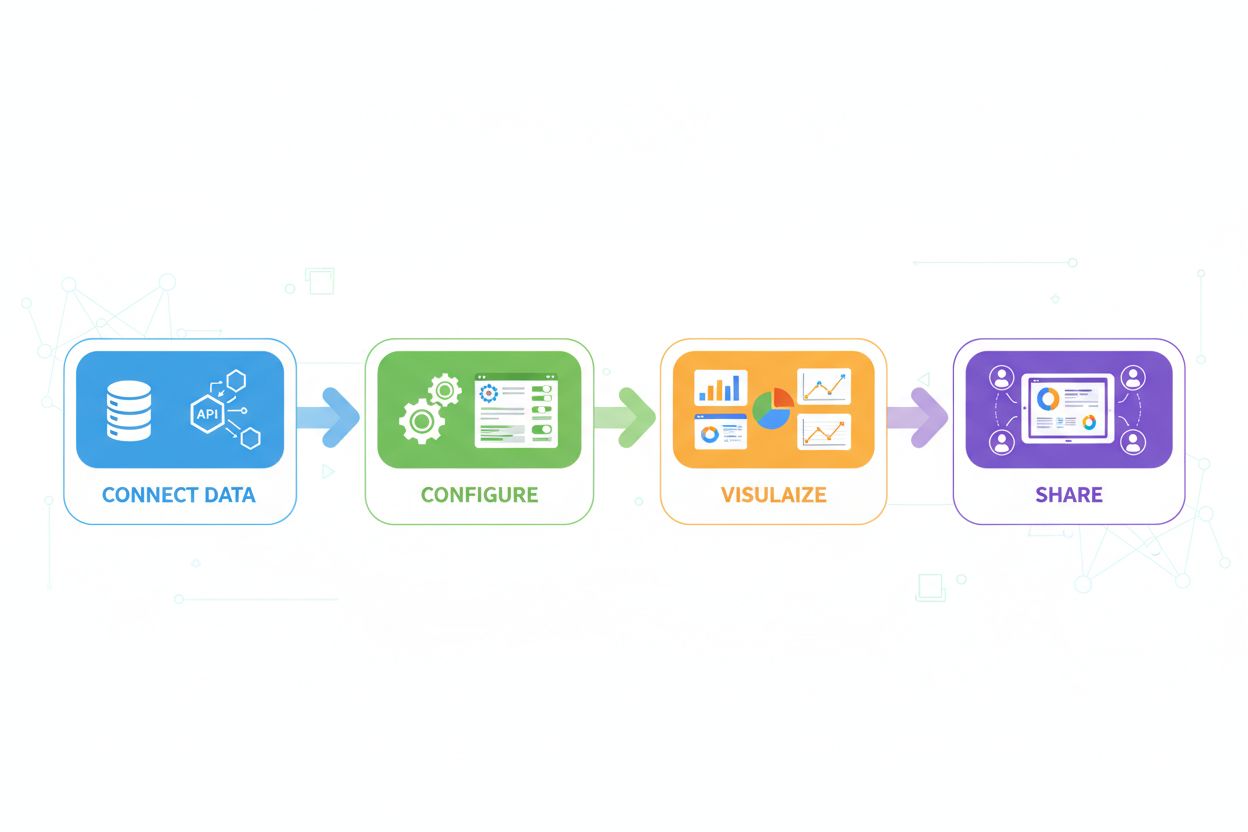
Looker Studio for AI Visibility: Creating Custom Dashboards
Learn how to create custom AI visibility dashboards with Looker Studio. Step-by-step guide to monitoring your brand across ChatGPT, Perplexity, and Gemini with ...
9 min read
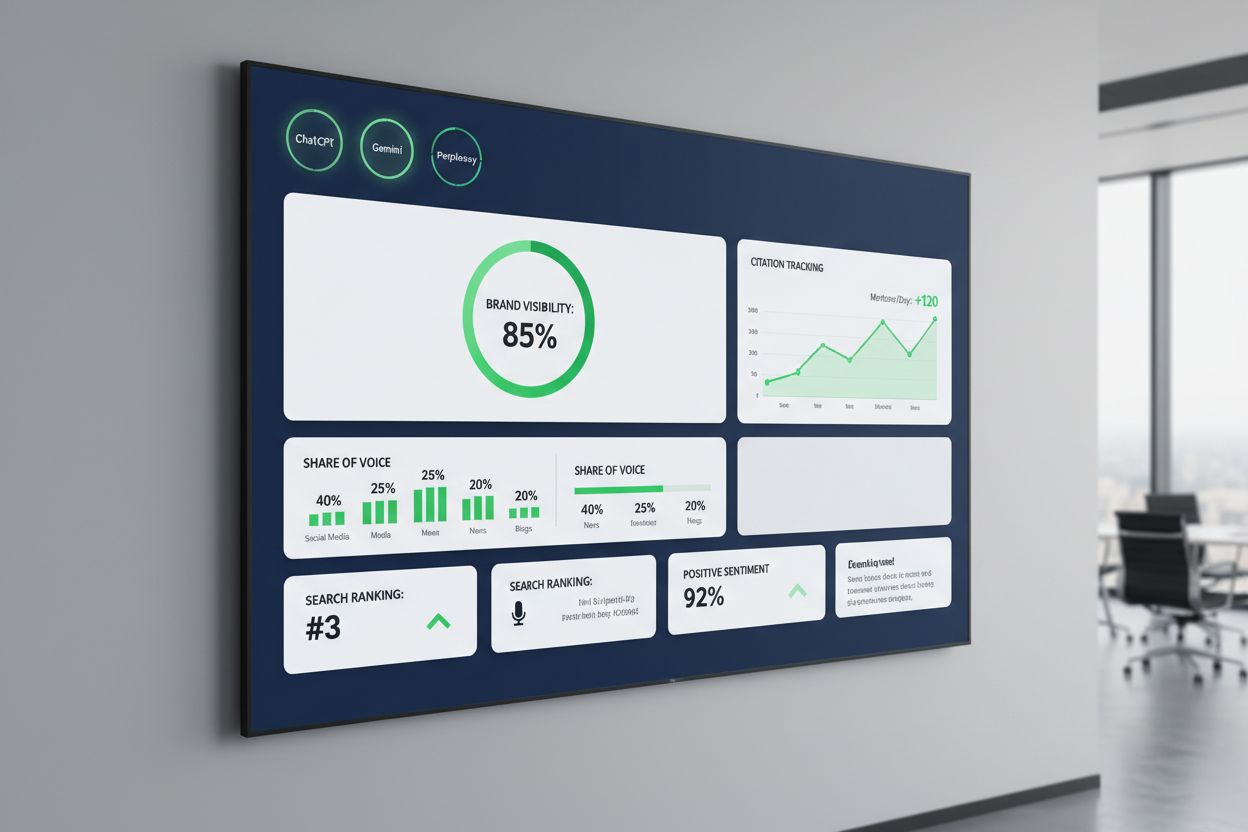
Learn how to use Writesonic to track and improve your brand’s visibility in ChatGPT, Gemini, and Perplexity. Step-by-step guide with best practices.
AI engines are now the first discovery point for buyers. When someone asks ChatGPT, “What’s the best project management tool for startups?” or searches Perplexity for “AI visibility monitoring solutions,” they’re not scrolling through Google results—they’re reading synthesized answers that cite specific brands and sources. If your brand isn’t visible in those answers, you’re invisible to millions of potential customers. The problem is stark: most brands don’t know if they’re visible in ChatGPT, Gemini, or Perplexity, let alone how often they’re cited or what sentiment surrounds their mentions. This is where Writesonic enters the picture. As a comprehensive AI visibility platform, Writesonic tracks exactly where your brand appears across AI engines, why it appears (or doesn’t), and what you can do to improve your visibility. This tutorial will walk you through every feature, from setup to advanced optimization strategies.
Writesonic is an AI visibility platform built to track how often, where, and how AI engines mention or cite your brand. Unlike traditional SEO tools that monitor Google rankings, Writesonic monitors AI-generated answers across ChatGPT, Gemini, Perplexity, Claude, and other generative engines. The platform tracks four critical metrics: brand mentions (how often AI names your brand), AI citations (when AI links to or attributes content to your pages), share of voice (your visibility compared to competitors), and sentiment (whether AI describes your brand positively, neutrally, or negatively). This differentiation from traditional SEO is crucial: Google ranks pages; AI engines synthesize answers by pulling information from multiple sources. Your goal isn’t to rank—it’s to be cited as a trusted source.
| Metric | Traditional SEO | AI Visibility (Writesonic) |
|---|---|---|
| What’s Tracked | Page rankings on Google SERP | Brand mentions in AI-generated answers |
| Competition | Competing for top 10 positions | Competing to be cited as a source |
| User Behavior | Click-through from search results | Direct discovery through AI recommendations |
| Visibility Signal | Backlinks, keywords, content quality | Authority, entity recognition, source trust |
| Measurement | Keyword rankings, organic traffic | Citation frequency, share of voice, sentiment |
The scale of AI adoption is staggering. ChatGPT has 845 million users, Gemini has 450 million, and Perplexity has 22 million—and these numbers are growing rapidly. Together, these platforms process billions of queries every day, each representing an opportunity for your brand to be discovered. But the opportunity extends beyond raw user numbers. Gen Z shoppers are already using AI for product research: 33% of Gen Z now turn to AI engines for product discovery, roughly equivalent to those still using traditional search. This generation treats AI tools as trusted shopping assistants, and OpenAI is accelerating this trend by introducing direct checkout features within ChatGPT. The business impact is real: Blitzmetrics, a digital marketing training company, closed multiple $100,000 deals simply by improving their AI visibility—not through new blog posts or paid ads, but by becoming the brand AI engines consistently recommend.
Writesonic is built around five interconnected features that move you from tracking to action. Each feature serves a specific purpose in your AI visibility strategy.
The AI Visibility Dashboard is your command center. Instead of telling you “you rank #5,” it shows you how often AI models mention you, where they mention you, and in what context. The dashboard pulls everything into one view: your overall AI visibility score (how often you’re mentioned across tracked prompts), your share of voice versus competitors, sentiment trends over time, and engine-level performance (ChatGPT vs. Gemini vs. Claude, etc.). You don’t just see “you’re at 12% visibility”—you see where that visibility comes from, which categories you own, and which ones you’ve quietly lost.
The Citations Analysis view breaks down which domains AI engines rely on when answering questions in your niche. You can see when your site is used as a source, which specific URLs get reused, how your website pages perform when cited, and—critically—citation opportunities where competitor domains dominate the answers you thought you owned. This is where the illusion that “we’re doing fine in search” often collapses.
Prompt Explorer shows the exact questions AI engines associate with your competitors and the ones where you’re left out entirely. You see the actual prompts people use in ChatGPT, Perplexity, and Gemini (with AI Search Volume data), usage trends over time, geographic breakdowns showing where the prompt is active, and which brands are already cited by AI for that prompt. This is where strategy gets concrete.
Most analytics tools treat AI crawlers as invisible. AI Traffic Analytics corrects that blind spot by capturing server-side data from bots like ChatGPT, Gemini, Claude, and Perplexity. You see how often AI bots crawl your site, which pages they access, whether they encounter errors, and the ratio of bot visits to human visits. When an AI engine mentions your brand but its bot never visits your key pages or encounters errors, that’s an invisible leak in your visibility funnel.
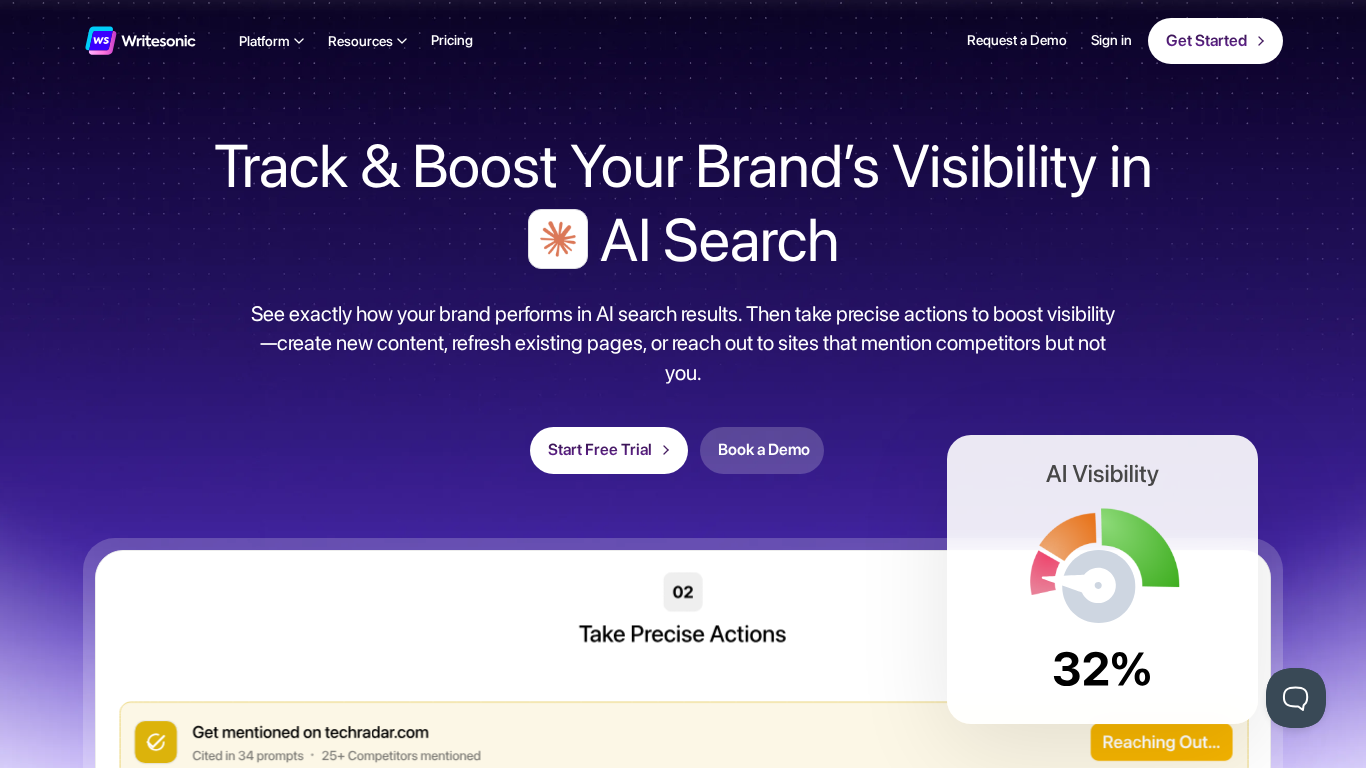
Action Center bridges the gap between data and execution. It surfaces prioritized tasks your team can execute based on real prompt-engine gaps and citation patterns. You get a ranked list of high-impact tasks (e.g., “Refresh content for prompt X,” “Improve entity signals on topic Y”), contextual recommendations explaining why each task matters, and workflow-ready items that are assignable, taggable, and progress-trackable.
Setting up Writesonic is straightforward and takes about 15-20 minutes from account creation to your first visibility report.
Create Your Account: Visit Writesonic’s website and sign up for a free trial or paid plan. You’ll need a valid email and can authenticate via Google or email/password.
Add Your Domain: In the dashboard, navigate to “Settings” and add your primary domain. Writesonic will verify ownership through DNS or file upload to ensure you have access to the domain.
Configure Your Prompts: This is the critical step. Add the prompts (questions) you want to track. Start with 10-20 core prompts related to your business. Examples: “best project management tools,” “AI visibility monitoring solutions,” “how to improve brand visibility in ChatGPT.”
Select AI Engines: Choose which AI engines to monitor. Most users start with ChatGPT, Gemini, and Perplexity, but you can add Claude, Copilot, and others depending on your plan.
Set Competitor Benchmarks: Add 3-5 key competitors so Writesonic can show you how your visibility compares to theirs across the same prompts.
Run Your First Scan: Click “Start Monitoring” and Writesonic will run its initial scan across all your prompts and engines. This typically takes 5-10 minutes.
Once your first scan completes, you’ll see your AI Visibility Dashboard populate with data. Here’s how to interpret what you’re seeing.
Visibility Score: This percentage represents how many of your tracked prompts result in AI mentions of your brand. A score of 45% means your brand appears in answers to 45% of the prompts you’re tracking. Higher is better, but context matters—a 30% visibility score in a highly competitive category might be excellent, while 60% in a niche market might indicate you’re missing opportunities.
Share of Voice: This metric compares your visibility to competitors. If you have 30% visibility and your top competitor has 50%, your share of voice is 37.5% (30 ÷ 80 total). This helps you understand your competitive position and identify where you’re losing ground.
Sentiment Trends: Writesonic tracks whether AI describes your brand positively, neutrally, or negatively. A positive sentiment trend means AI is increasingly recommending you favorably. A declining sentiment might indicate negative reviews or outdated information circulating online.
Engine-Level Breakdown: See how your visibility differs across ChatGPT, Gemini, Perplexity, and other engines. You might have strong visibility in ChatGPT but weak presence in Perplexity—this tells you where to focus optimization efforts.
The Citations Analysis view is where you identify specific opportunities. This section shows which domains and URLs AI engines cite when answering questions in your category.
Start by filtering for your tracked prompts. You’ll see a list of domains that appear in AI answers, ranked by frequency. Look for patterns: Which competitor domains appear most often? Which of your own URLs are being cited? Are there gaps where competitors are cited but you’re not? These gaps are your citation opportunities—they represent prompts where you should be visible but aren’t. Click on any domain to see which specific prompts it’s cited for, then use that intelligence to inform your outreach strategy. If a competitor’s blog post about “AI visibility best practices” is cited in 15 different AI answers, that’s a signal that you should create similar content or reach out to that domain to request inclusion.
Prompt Explorer reveals what people actually ask AI engines and how often. This is your window into AI search demand and user intent.
When you open Prompt Explorer, you’ll see your tracked prompts listed with AI Search Volume estimates. These aren’t traditional keyword volumes—they’re estimates of how many times people ask each question across ChatGPT, Gemini, and other engines. You’ll also see geographic breakdowns (which regions ask this prompt most), trend lines (is this prompt growing or declining?), and which brands are already cited for each prompt. Use this data to prioritize your content strategy. If “best AI visibility tools” has 50,000 monthly AI searches but you’re only cited in 20% of answers, that’s a high-priority opportunity. Conversely, if a prompt has declining search volume, you might deprioritize it.
AI Traffic Analytics shows you the technical side of AI visibility: whether AI bots can actually access and read your content.
This view displays how often ChatGPT-User, OAI-SearchBot, ClaudeBot, PerplexityBot, and other AI crawlers visit your site. You’ll see which pages they access, how many requests succeed versus fail (404s, 403s, 500s), and the ratio of bot traffic to human traffic. If Writesonic shows that PerplexityBot is crawling your site but encountering 403 errors on key pages, that’s a blocker—Perplexity can’t read your content, so it can’t cite you. Similarly, if your robots.txt is blocking GPTBot, you’re preventing OpenAI from accessing your content. Use this view to identify and fix technical barriers to AI visibility.
Action Center is where Writesonic transforms insights into tasks. This feature prioritizes specific actions based on your visibility gaps and citation patterns.
You’ll see a ranked list of recommended actions: “Refresh content for prompt X (estimated impact: +8% visibility),” “Fix robots.txt to allow GPTBot,” “Create comparison content for topic Y,” “Reach out to Domain Z about citation opportunity.” Each action includes context (why it matters), affected URLs, and expected impact. You can assign actions to team members, set deadlines, and track progress. This workflow-based approach ensures that visibility improvements don’t get lost in the noise of daily work.
Once you understand Writesonic’s features, apply these proven strategies to accelerate your AI visibility growth:
Optimize Content for AI Readability: Write short, direct sentences. Use clear hierarchical structure (H1 → H2 → H3). Add schema markup (Article, FAQ, Product). AI systems parse content differently than humans—clarity and structure matter more than keyword density.
Build Your Brand’s Entity Footprint: Explicitly mention your brand name instead of using pronouns. Keep brand names, product names, and feature offerings consistent across all platforms. Create detailed author and company pages with credentials and external links to authoritative sources.
Earn Third-Party Mentions: Identify high-authority sites already cited in AI answers for your category. Reach out to editors with reasons your brand should be included. Even 4-5 new mentions can put you into hundreds of AI answers.
Participate in UGC Platforms: Reddit, Quora, and similar platforms are cited in 21% of AI Overviews. Contribute helpful, non-promotional insights to relevant discussions. Build authority in communities where your audience asks questions.
Strengthen Technical SEO for AI Crawlers: Allow AI bots (GPTBot, OAI-SearchBot, ClaudeBot, PerplexityBot) in your robots.txt. Fix crawl errors. Ensure your site loads quickly and is mobile-responsive. AI crawlers are more sensitive to technical issues than human users.
Create Comprehensive, Clustered Content: AI uses “query fan-out” to find related information. A single article addressing multiple related subtopics is more likely to be cited than narrow, single-topic pieces. Create pillar pages with supporting cluster content.
Refresh Content Regularly: Update your top-performing pages every 90 days with new statistics, case studies, and examples. Add “last updated” dates. AI prioritizes fresh, current information.
The AI visibility tool market is growing, with platforms like Scrunch AI, Profound, Peec, AthenaHQ, and Otterly competing for attention. Here’s how Writesonic compares:
Writesonic leads on the combination of visibility tracking plus actionable workflows. While competitors like Profound offer deeper enterprise analytics and Scrunch AI provides infrastructure optimization (AXP), Writesonic uniquely bridges monitoring and execution. Peec and Otterly are lighter-weight and more affordable, making them good for early-stage teams, but they lack Writesonic’s depth. AthenaHQ is enterprise-grade but requires significant internal resources to act on insights. Writesonic’s pricing starts around $199/month, positioning it as mid-market accessible while offering enterprise-grade features. The platform’s AI Traffic Analytics feature—showing which AI bots can actually access your content—is unique and critical for identifying technical blockers that other tools miss.
Case Study 1: SaaS Company Closing Enterprise Deals: A B2B SaaS company used Writesonic to identify that they were cited in only 15% of AI answers for “enterprise project management tools.” Using the Action Center, they refreshed their comparison content, earned mentions on three high-authority review sites, and improved their visibility to 42% within 3 months. Result: 3 enterprise deals worth $150,000 attributed directly to improved AI visibility.
Case Study 2: Content Agency Scaling Client Results: A digital agency integrated Writesonic into their client onboarding. They now track AI visibility as a core KPI alongside traditional SEO metrics. Clients see 20-40% improvements in AI citations within 2-3 months of implementing Writesonic recommendations. This has become a differentiator in their service offering.
Case Study 3: E-Commerce Brand Capturing Product Discovery: An e-commerce brand discovered through Prompt Explorer that “best [product category]” prompts had high AI search volume but low brand visibility. They created detailed comparison content and optimized product pages for AI readability. Within 4 months, they appeared in 60% of relevant AI answers, driving a 25% increase in organic traffic from AI sources.
Case Study 4: Startup Building Authority Fast: An early-stage startup used Writesonic’s Citation Opportunities feature to identify 20 high-authority sites already discussing their category. They reached out with unique data and insights, securing mentions in 8 of those sites within 2 months. This accelerated their AI visibility from 5% to 28%, establishing them as a credible player despite limited brand history.
Even with Writesonic’s powerful features, teams often make preventable mistakes that slow their progress.
Mistake 1: Not Tracking Enough Prompts: Teams often start with 5-10 prompts and assume that’s sufficient. In reality, you should track 30-50+ prompts covering different intent types (product comparisons, how-tos, reviews, etc.). More prompts = more visibility opportunities.
Mistake 2: Ignoring Sentiment Analysis: Visibility without positive sentiment is hollow. If AI mentions your brand but describes it negatively, that’s worse than no mention. Monitor sentiment trends and address negative themes proactively.
Mistake 3: Neglecting Technical Accessibility: You can optimize content perfectly, but if AI bots can’t access your site due to robots.txt blocks or crawl errors, none of it matters. Use AI Traffic Analytics to ensure your site is fully accessible to AI crawlers.
Mistake 4: Not Acting on Citation Gaps: Writesonic identifies opportunities, but only action creates results. Teams that identify citation gaps but don’t reach out to those domains or create competing content miss the compounding benefits of improved visibility.
Mistake 5: Expecting Overnight Results: AI visibility improvements compound over time. Expect 2-4 weeks for initial changes to appear in AI answers, and 2-3 months for significant, measurable improvements. Patience and consistency matter.
Your competitors are already tracking their AI visibility. Every day you wait is another day they’re building authority in AI answers while you remain invisible. Start your free trial with Writesonic today to see exactly where your brand appears (or doesn’t) in ChatGPT, Gemini, Perplexity, and other AI engines. The free trial gives you full access to the dashboard, citations analysis, and prompt explorer—enough to identify your biggest opportunities. Within your first week, you’ll have a clear picture of your AI visibility gaps and a prioritized action plan to close them. Within 2-3 months of consistent action, you’ll see measurable improvements in AI citations, brand mentions, and ultimately, traffic and conversions from AI sources. The brands winning in AI search aren’t guessing. They’re measuring, optimizing, and compounding their advantages. Join them.
AI visibility measures how often your brand appears in answers generated by ChatGPT, Gemini, Perplexity, and other AI engines. It matters because billions of users now turn to AI for product research and recommendations before visiting search engines, making AI visibility a critical discovery channel for modern brands.
Traditional SEO tools track rankings on Google's search results. Writesonic tracks how AI engines cite and mention your brand in their generated answers. It's a fundamentally different metric because AI doesn't rank pages—it synthesizes answers from multiple sources, and your goal is to be cited as a trusted source.
Yes, Writesonic allows you to track multiple domains and brands within a single account. You can set up different projects for different brands or business units, each with their own prompt tracking, citation analysis, and performance dashboards.
Writesonic updates its AI visibility data regularly, with most metrics refreshing daily or weekly depending on your plan. The platform continuously monitors tracked prompts across ChatGPT, Gemini, Perplexity, Claude, and other AI engines to provide real-time insights.
ROI varies by industry, but brands like Blitzmetrics have reported closing $100,000+ deals directly from AI visibility improvements. The key is that AI visibility compounds—once AI engines consistently cite you, you become the default recommendation, leading to sustained traffic and conversions.
Yes, Writesonic offers plans for businesses of all sizes, starting with free trials and entry-level pricing. Small businesses can benefit significantly from AI visibility tracking, especially in competitive niches where being cited by AI engines can provide a major competitive advantage.
Initial visibility improvements can appear within 2-4 weeks of implementing changes, though more significant results typically emerge over 2-3 months as AI models refresh their knowledge and begin consistently citing your content. The timeline depends on how aggressively you implement the recommended actions.
Writesonic provides data and insights that can be exported and integrated with your existing marketing stack. While direct integrations vary by plan, you can use the platform's API and reporting features to connect AI visibility data with your SEO, content, and analytics tools.
See exactly where your brand appears in ChatGPT, Gemini, Perplexity, and other AI engines. Get actionable insights to boost your AI visibility and outrank competitors.
Learn how to create custom AI visibility dashboards with Looker Studio. Step-by-step guide to monitoring your brand across ChatGPT, Perplexity, and Gemini with ...

Discover the best AI visibility tools to monitor your brand across ChatGPT, Perplexity, Google AI Overviews, and other AI search engines. Compare features, pric...
Discover the top AI search visibility monitoring tools to track your brand across ChatGPT, Perplexity, and Google AI Overviews. Compare features, pricing, and c...