
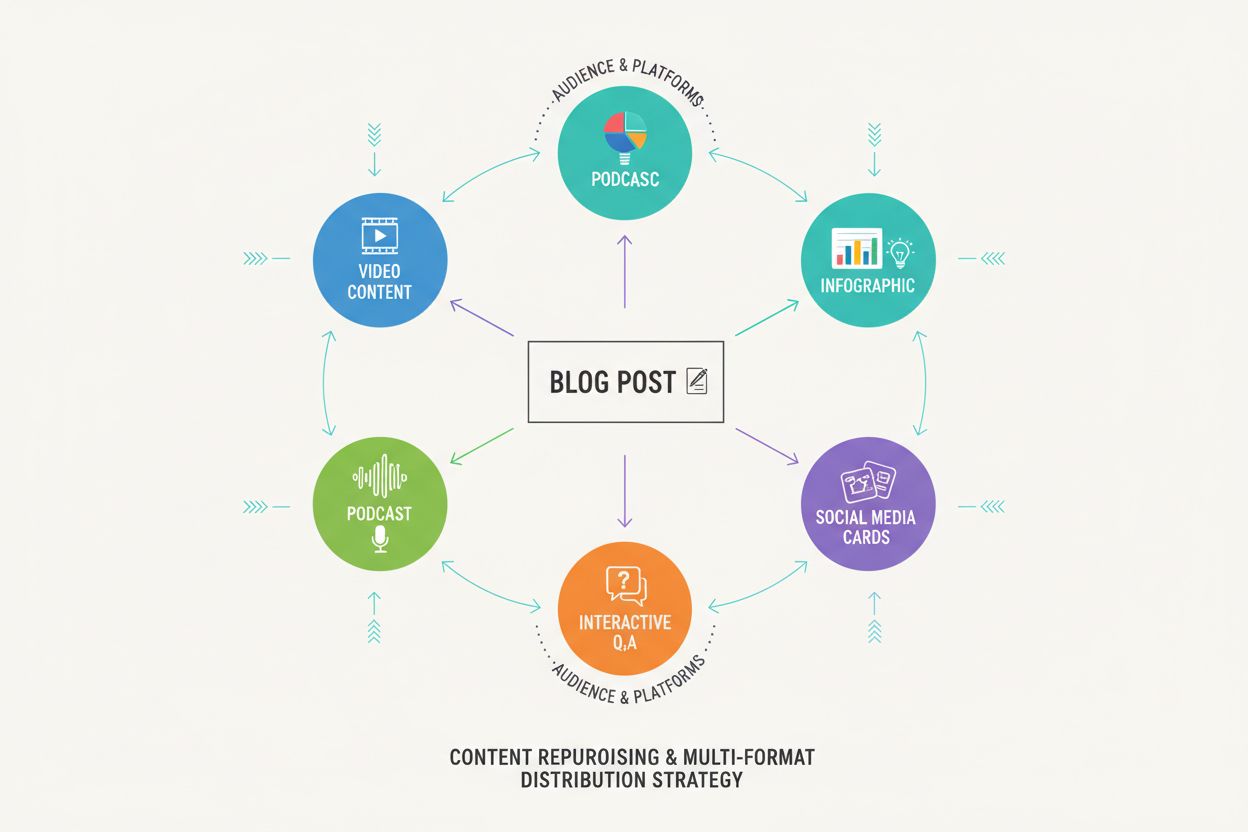
Maximum AI Visibility Through Multi-Format Content
Discover how multi-format content increases AI visibility across ChatGPT, Google AI Overview, and Perplexity. Learn the 5-step framework to maximize brand citat...
8 min read
Learn how to write content that engages human readers while optimizing for AI systems. Master the balance between readability and LLM optimization with practical strategies and tools.
The digital landscape has fundamentally shifted as artificial intelligence systems now synthesize and evaluate content at scale, making the distinction between “writing for humans” and “writing for machines” increasingly blurred. Traditional SEO once focused on keyword density and backlink profiles, but modern search algorithms—powered by large language models and neural networks—now prioritize semantic understanding and contextual relevance. Today’s content must simultaneously satisfy human readers seeking genuine value and machine learning systems analyzing linguistic patterns, semantic relationships, and information architecture. This dual-purpose approach isn’t about compromise; it’s about recognizing that clarity and structure benefit both audiences equally. The most successful content creators understand that optimizing for AI comprehension naturally enhances human readability, creating a virtuous cycle of engagement and discoverability.
Large language models don’t read text the way humans do—they process content through a sophisticated system called tokenization, where text is broken into small units (tokens) that the model analyzes for patterns and meaning. Each token typically represents 3-4 characters, meaning a 1,000-word article might contain 1,300-1,500 tokens that the model must process sequentially to build understanding. Beyond tokenization, LLMs use chunking strategies to organize information into meaningful segments, and embeddings to convert text into mathematical representations that capture semantic meaning. The way you structure paragraphs, use headings, and organize information directly impacts how efficiently these systems extract and synthesize your content. Consider how different writing approaches affect machine comprehension:
| Approach | Tokenization Efficiency | Machine Comprehension | Human Readability |
|---|---|---|---|
| Dense paragraphs, no headings | Poor (requires re-parsing) | Low (context loss) | Difficult |
| Clear headings, short paragraphs | Excellent (logical chunks) | High (clear structure) | Easy |
| Keyword stuffing | Inefficient (noise tokens) | Very low (semantic confusion) | Poor |
| Natural language with structure | Optimal (meaningful units) | Excellent (semantic clarity) | Excellent |
Understanding this process reveals why strategic formatting isn’t superficial—it’s fundamental to how machines extract meaning from your words.
Modern readability metrics like the Flesch Reading Ease score and Flesch-Kincaid Grade Level provide quantifiable targets for content optimization, with research suggesting that content scoring between 60-70 on the Flesch scale achieves optimal engagement across diverse audiences. Sentence length matters significantly; studies show that sentences averaging 15-20 words maintain comprehension while sentences exceeding 25 words create cognitive load for both human readers and tokenization systems. The principle of one idea per paragraph isn’t merely stylistic—it creates logical boundaries that help both readers and machines identify discrete concepts and their relationships. Plain language isn’t dumbing down content; it’s respecting your audience’s time by eliminating unnecessary jargon and complexity. When you prioritize clarity, you simultaneously improve SEO performance, reduce bounce rates, and increase the likelihood that AI systems will accurately represent your content in summaries and citations.
Heading hierarchies (H1, H2, H3) function as semantic signposts that help both readers and machines understand content organization and relative importance of topics. Subheadings break content into scannable sections, reducing cognitive load and creating natural stopping points where readers can pause or machines can segment information for processing. Strategic use of bold text highlights key concepts without disrupting readability, while numbered and bulleted lists create structured data that machines can parse more efficiently than paragraph prose. Consistent formatting patterns train both human brains and machine learning models to expect information in predictable locations, improving comprehension speed and accuracy. The visual hierarchy you create through formatting directly correlates with improved engagement metrics and better machine understanding. Consider implementing these structural elements:
Rather than targeting isolated keywords, modern optimization focuses on natural semantic embedding where related terms and concepts appear organically throughout your content, reflecting how people actually discuss topics. Tools analyzing “People Also Ask” sections reveal the questions your audience genuinely asks, allowing you to structure content around these natural language patterns rather than artificial keyword phrases. Natural Language Processing (NLP) systems recognize semantic variations—synonyms, related concepts, and contextual alternatives—meaning you should write naturally while ensuring topic coverage is comprehensive. Long-tail keywords and conversational phrases often outperform short, competitive terms because they capture specific intent and align with how voice search and AI assistants interpret queries. The most effective keyword strategy treats keywords as topic anchors rather than insertion points, ensuring your content thoroughly explores the semantic space around your core subject.
Effective content architecture follows a progressive disclosure model where foundational concepts appear early, establishing context before advancing to specialized applications and nuanced discussions. This approach mirrors how both humans and machines build understanding—starting with broad definitions and gradually narrowing focus to specific implementations, case studies, or advanced techniques. Linking phrases like “building on this foundation,” “as we’ve established,” and “taking this further” create cognitive bridges that help readers follow your logical progression while signaling to machines how concepts relate hierarchically. The funnel structure naturally accommodates different reader expertise levels; beginners extract foundational knowledge while advanced readers quickly navigate to specialized sections. By organizing content from general to specific, you maximize both human comprehension and machine ability to identify primary concepts and their supporting details. This structure also improves SEO performance by clearly establishing topical authority and semantic relationships.
Assume your reader has zero prior knowledge of your topic, even if your audience typically includes experts—this assumption paradoxically serves advanced readers by providing clear definitions and context they can quickly scan past. Define technical terms at first mention, using parenthetical explanations or separate definition sentences that don’t disrupt narrative flow. Self-sufficient content means each section can stand alone; readers shouldn’t need to reference previous articles or external resources to understand your core message. Use analogies and comparisons to familiar concepts, helping readers map new information onto existing mental models—for example, explaining tokenization as “breaking sentences into word-sized pieces” creates immediate comprehension. This approach benefits machines as well; explicit definitions and clear concept relationships improve embedding quality and reduce ambiguity in semantic analysis. When you write for beginners, you create content that serves the widest possible audience while maintaining credibility with experts.
Linking sentences at paragraph beginnings and endings create narrative flow that guides readers through your argument while helping machines understand how concepts connect across sections. Maintaining consistent terminology throughout your content prevents confusion; if you introduce a concept as “machine learning optimization,” don’t later refer to it as “AI tuning” or “algorithmic adjustment” without explicit connection. Context bridges—sentences that recap previous points before introducing new ones—reinforce learning for humans while providing machines with explicit relationship statements. Repetition of key terms and concepts isn’t redundant when done strategically; it reinforces understanding and strengthens semantic signals for machine learning systems analyzing your content. The rhythm of your writing, created through varied sentence length and strategic paragraph breaks, maintains reader engagement while creating natural processing boundaries for tokenization systems. Smooth transitions transform a collection of paragraphs into a cohesive narrative that both humans and machines can follow effortlessly.

Abstract concepts gain credibility and clarity through concrete examples, case studies, and statistical evidence that demonstrate real-world application and measurable impact. Rather than claiming “clear writing improves engagement,” cite specific research: studies show that content with Flesch scores between 60-70 generates 2x higher engagement than dense, complex writing. Named tools and platforms (like Hemingway Editor, Grammarly, or Yoast SEO) provide readers with actionable next steps while giving machines specific entities to recognize and contextualize. Actionable scenarios—“imagine you’re writing a product description for an e-commerce site”—help readers visualize application while creating semantic richness that machines use to understand context and intent. Data points, percentages, and quantified results carry more weight than generalizations, improving both credibility and machine comprehension of your claims. When you support ideas with evidence, you create content that satisfies both the skeptical human reader and the pattern-recognition systems analyzing your assertions.
Begin optimizing your content using readability analysis tools like the Hemingway Editor (targets 60-70 Flesch score), Grammarly (checks clarity and tone), and Yoast SEO (provides real-time optimization suggestions). Test your content with AI systems by pasting sections into ChatGPT or Claude and asking the model to summarize your main points—if the AI misses key concepts, your structure or clarity needs adjustment. Monitor your content’s performance using AmICited.com, which tracks how AI systems cite and reference your content, providing insights into how machines extract and represent your information. Implement iterative improvement cycles: publish content, monitor performance metrics (engagement, AI citations, search rankings), identify weak sections, and refine based on data. Track which content structures, heading patterns, and formatting approaches generate the best engagement and machine comprehension, building a personal style guide based on evidence. The intersection of human readability and machine optimization isn’t a destination—it’s an ongoing practice of testing, measuring, and refining your approach based on real-world performance data.
Test your content by running it through readability tools like Hemingway Editor or Yoast SEO, and prompt AI systems like ChatGPT with questions your content should answer. If the AI accurately extracts and cites your content, you're on the right track. Monitor your AI citations using tools like AmICited.com to track how often AI systems reference your content.
Not at all. Clear, well-structured writing is inherently more engaging for humans too. The principles of AI optimization—short sentences, logical flow, concrete examples—are the same principles that make content readable and compelling for people. You're not dumbing down your content; you're making it more accessible.
Keywords should be embedded naturally throughout your content, especially in headings and early paragraphs. However, AI systems prioritize context and semantic meaning over exact keyword matching. Focus on answering user questions comprehensively rather than forcing keywords into sentences.
Aim for an average sentence length of 15-20 words. Sentences longer than 25 words become harder for both humans and AI to parse. Use the Flesch Reading Ease score as a guide—aim for 60 or above for general audiences.
Absolutely. Tables and lists are excellent for both readability and AI comprehension. They break up dense information, make content scannable, and help AI systems extract structured data more accurately. Use them liberally throughout your content.
Start with clear, simple explanations of foundational concepts, then progressively add depth and technical details. Use glossaries for jargon, provide examples before diving into theory, and structure content hierarchically so readers can choose their depth level.
Yes, but strategically. Use analogies and metaphors to explain complex concepts, but ensure they're relevant and don't obscure meaning. Avoid overly poetic language in key sections, but you can use it in transitions or to add personality to your writing.
Review and update content quarterly or when significant changes occur in your industry. Ensure examples remain current, statistics are up-to-date, and links are functional. Fresh, accurate content is more likely to be cited by AI systems.
Track how AI systems like ChatGPT, Perplexity, and Google AI Overviews reference your content. Get insights into your AI visibility and optimize your writing strategy.
Discover how multi-format content increases AI visibility across ChatGPT, Google AI Overview, and Perplexity. Learn the 5-step framework to maximize brand citat...

Learn how to structure your content to get cited by AI search engines like ChatGPT, Perplexity, and Google AI. Expert strategies for AI visibility and citations...
Learn the writing style AI engines like ChatGPT, Perplexity, and Google AI Overviews prefer. Discover how to structure content for AI citation and visibility.