
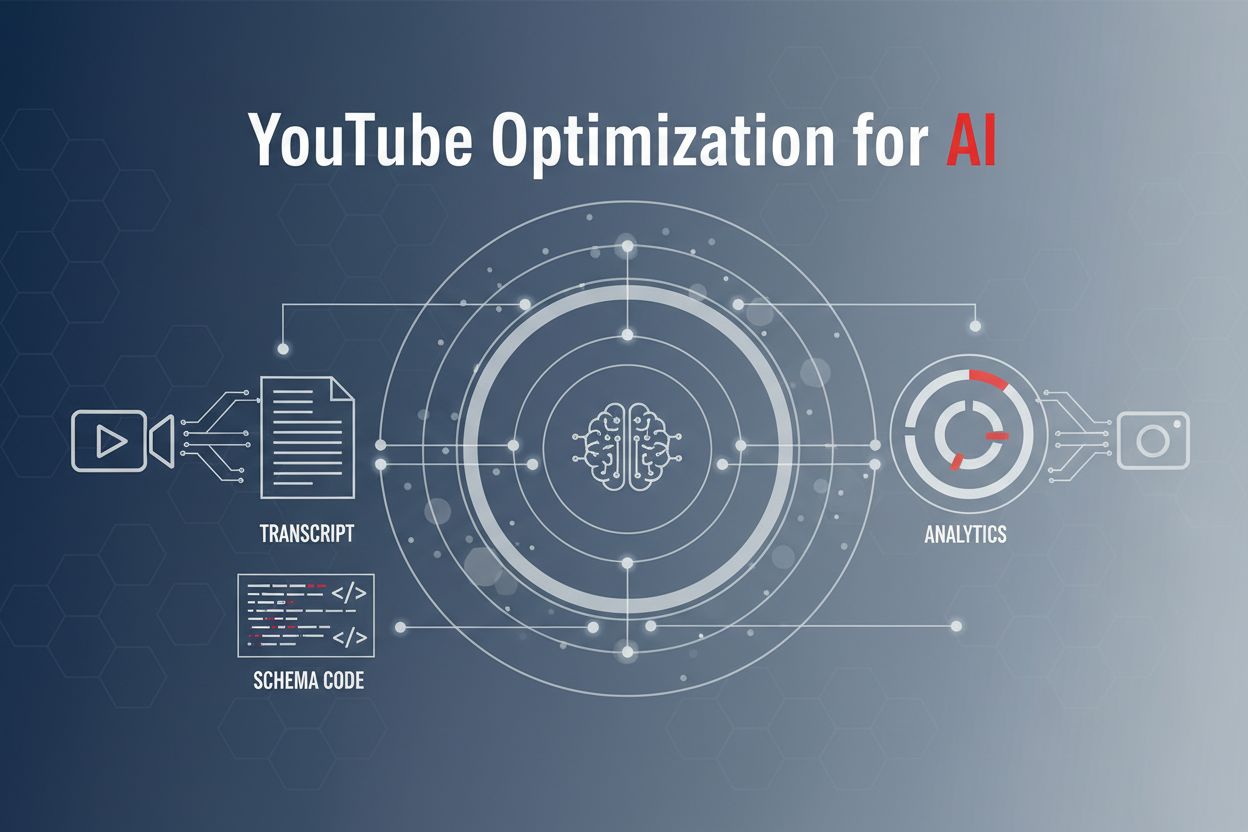
YouTube Optimization for AI: How Video Transcripts Drive Citations
Learn how to optimize YouTube videos for AI citations. Discover the critical role of transcripts, captions, and schema markup in getting your content cited by L...
14 min read

Learn how to optimize YouTube video descriptions for AI visibility. Master metadata optimization strategies to improve rankings in ChatGPT, Perplexity, and Google AI Overviews while boosting YouTube SEO performance.
YouTube descriptions serve as a critical bridge between your video content and the AI systems that increasingly discover and cite it. When AI systems analyze YouTube videos, they process descriptions as primary metadata signals that help them understand context, relevance, and authority. The YouTube description AI relationship is bidirectional: while YouTube’s algorithm uses descriptions to improve recommendations and search rankings, external AI tools like ChatGPT, Perplexity, and Google’s AI Overviews parse descriptions to determine whether your content merits citation in their responses. This metadata layer has become essential because AI cannot reliably extract meaning from video content alone—it depends on well-structured, keyword-rich descriptions to comprehend what your video offers. By optimizing your descriptions for AI visibility, you’re essentially creating a direct communication channel with both YouTube’s recommendation engine and the broader ecosystem of AI search engines that now influence how your content reaches audiences.
An optimized YouTube description functions as a multi-layered communication tool that serves humans, YouTube’s algorithm, and AI systems simultaneously. The structure begins with a compelling title or hook in the first 1-2 sentences that immediately establishes the video’s value proposition. The first 150 characters are critical because they appear before the “show more” fold and receive disproportionate weight from both YouTube’s algorithm and AI crawlers. Following this, you should strategically place primary keywords that reflect your content’s core topic, then incorporate secondary keywords that capture related search intent. The description should include clear calls-to-action (CTAs) that direct viewers to take specific steps, followed by relevant links to your website, related videos, or resources. Timestamps and chapter markers help both humans navigate longer content and allow AI systems to cite specific sections. Finally, hashtags (3-5 relevant ones) improve discoverability across YouTube’s search and recommendation systems.
| Element | Purpose | AI Impact |
|---|---|---|
| First 150 Characters | Hook viewers and establish relevance | High - AI prioritizes early text for context extraction |
| Primary Keywords | Signal main topic to algorithms | High - Direct relevance matching for AI citations |
| Timestamps/Chapters | Enable precise navigation and section citing | Very High - Allows AI to reference specific segments |
| Links & CTAs | Drive engagement and traffic | Medium - Indicates content authority and intent |
| Hashtags | Improve discoverability and categorization | Medium - Helps AI classify content topic and audience |
The principle of keyword optimization in YouTube descriptions centers on strategic placement rather than volume—your most important keywords should appear in the first 150 characters where they receive maximum visibility from both YouTube’s algorithm and AI crawlers. This front-loading strategy works because AI systems typically scan descriptions sequentially and weight early-appearing terms more heavily when determining content relevance and citation worthiness. The distinction between natural language and keyword stuffing is crucial: AI systems have become sophisticated enough to penalize descriptions that prioritize keyword density over readability, actually reducing your YouTube SEO effectiveness. A strong description might read: “Learn advanced Python data visualization techniques using Matplotlib and Seaborn. This comprehensive tutorial covers…” rather than “Python data visualization Matplotlib Seaborn tutorial techniques advanced…” The former approach maintains natural flow while signaling relevance, whereas the latter triggers AI spam detection algorithms. By following description best practices that prioritize clarity and keyword relevance over artificial optimization, you create descriptions that AI systems recognize as authoritative and trustworthy sources worthy of citation.
AI systems employ sophisticated AI analysis techniques to extract meaning from video descriptions, going far beyond simple keyword matching. Computer vision algorithms analyze your video thumbnail and visual content, then cross-reference this analysis with your description text to verify consistency and extract deeper context. Natural language processing (NLP) breaks down your description into semantic components, identifying entities (people, places, concepts), relationships between ideas, and the overall intent of your content. Pattern recognition systems compare your description against millions of other videos to determine where your content fits within the broader information landscape and what unique value it provides. Metadata processing extracts structured information like timestamps, links, and hashtags, converting unstructured text into machine-readable signals. These AI analysis methods work together to create a comprehensive understanding of your video:
The visual structure of your YouTube description matters as much as its content because both humans and AI systems benefit from clear organization and logical hierarchy. Description formatting using line breaks, bullet points, and section headers creates visual anchors that help AI systems segment your description into meaningful chunks rather than processing it as undifferentiated text. Timestamps and chapter markers serve dual purposes: they improve human readability by allowing viewers to jump to relevant sections, while simultaneously providing AI systems with precise structural markers that enable citation of specific video segments rather than the entire video. Mobile optimization considerations are increasingly important because over 70% of YouTube views occur on mobile devices, where poorly formatted descriptions become walls of text that both humans and AI systems struggle to parse effectively. By using short paragraphs, clear section breaks, and strategic use of whitespace, you create descriptions that maintain their semantic clarity whether they’re being read by a human on a phone or processed by an AI system analyzing thousands of videos simultaneously.
Timestamps and chapters represent one of the most underutilized opportunities for improving both viewer engagement and AI citations of your content. When you include detailed timestamps (formatted as MM:SS or HH:MM:SS), you enable AI systems to understand your video’s structure at a granular level, allowing them to cite specific sections rather than treating your entire video as a monolithic unit. This capability is particularly valuable for educational and tutorial content where AI systems might want to reference a specific technique or explanation rather than recommending the entire video. Chapter optimization involves creating meaningful chapter titles that accurately describe each section’s content—for example, a video about machine learning might include chapters like “0:00 Introduction,” “2:15 Data Preprocessing Fundamentals,” “8:45 Feature Engineering Techniques,” and “15:30 Model Evaluation Metrics.” This structure allows AI systems to understand your video’s progression and cite the most relevant chapter when answering user queries. By investing time in precise video structure documentation, you increase the likelihood that your content appears in AI search results with proper attribution and context, ultimately driving more qualified traffic to your channel.
Modern AI search engines like ChatGPT, Perplexity, and Google’s Search Generative Experience (SGE) analyze content through a multimodal lens, meaning they simultaneously process text descriptions, visual elements like thumbnails, and video content itself to develop comprehensive understanding. This multimodal approach creates new opportunities for content optimization because the consistency and complementarity between your description, thumbnail, and actual video content significantly influences whether AI systems consider your content citation-worthy. When your description accurately reflects your thumbnail’s visual promise and your video delivers on both, AI systems recognize this alignment as a signal of quality and authority. Conversely, when descriptions oversell or misrepresent video content, AI systems detect this inconsistency and downrank your content in their citation algorithms. The practical implication is that optimizing for AI search engines requires thinking holistically about how your description, thumbnail, and video content work together to communicate value. A video about “10 Productivity Hacks” should have a description that clearly outlines those 10 hacks, a thumbnail that visually represents productivity or efficiency, and video content that systematically delivers on the promised hacks—this alignment signals to AI systems that your content merits citation when users ask about productivity improvement.
Many content creators inadvertently sabotage their AI visibility through preventable description mistakes that trigger algorithmic penalties from both YouTube and external AI systems. Keyword stuffing—cramming excessive keywords into descriptions in unnatural ways—is immediately flagged by AI spam detection systems, which interpret this behavior as an attempt to manipulate rankings rather than genuinely communicate content value. Misleading descriptions that overpromise or misrepresent video content create a mismatch between user expectations and actual content, leading to high bounce rates that signal to AI systems that your content isn’t trustworthy. Poor formatting with walls of unbroken text makes it difficult for AI systems to extract semantic meaning, reducing the likelihood of citation. Missing or vague CTAs fail to signal your content’s intended purpose, making it harder for AI systems to classify your content correctly. Broken links or outdated information in descriptions signal neglect and reduce your content’s perceived authority. These optimization errors compound over time, gradually reducing both your YouTube algorithm performance and your visibility in AI search results, making it essential to audit existing descriptions and implement best practices going forward.
Creating consistently optimized descriptions at scale requires leveraging both AI tools and proven manual strategies that balance automation with human judgment. Metadata generation tools like TubeBuddy, VidIQ, and specialized AI writing assistants can analyze your video content and suggest keyword-rich descriptions that maintain natural language flow. Templates provide a structured starting point for descriptions, ensuring you consistently include essential elements like timestamps, CTAs, and links without requiring you to rebuild the description structure for every video. Automation strategies might include using YouTube’s automatic chapter generation as a foundation, then enhancing it with keyword-optimized descriptions that reference those chapters. However, manual optimization remains crucial because AI-generated descriptions often lack the nuanced understanding of your specific audience and content goals that human creators bring. AmICited.com provides a complementary service by monitoring how AI systems cite your content across ChatGPT, Perplexity, and Google AI Overviews, allowing you to measure whether your description optimization efforts are actually improving your visibility in AI search results. By combining automated tools for efficiency with strategic manual review for quality, you can maintain a sustainable optimization workflow that continuously improves your AI visibility.
Optimizing your YouTube descriptions only matters if you can measure the impact on your actual visibility and reach, which requires tracking both traditional YouTube metrics and emerging AI visibility indicators. YouTube Analytics provides foundational data like click-through rate (CTR), average view duration, and traffic sources, but these metrics don’t directly reveal how your descriptions influence AI citations. AI visibility tracking requires specialized tools like AmICited, which monitors whether and how your content appears in responses from ChatGPT, Perplexity, Google SGE, and other AI search engines. By establishing baseline measurements before implementing description optimizations, then monitoring changes over 4-8 weeks, you can quantify the ROI of your efforts. Key metrics to monitor include the frequency of AI citations, the accuracy of attribution when your content is cited, the specific sections of your videos that AI systems reference most often, and whether improved descriptions correlate with increased traffic from AI search sources. This measurement approach transforms description optimization from a theoretical best practice into a data-driven strategy where you can demonstrate concrete business impact, justifying continued investment in metadata optimization and informing future content strategy decisions.
AI systems process YouTube descriptions as primary metadata signals using natural language processing (NLP) and semantic analysis. They extract entities, keywords, and intent from your description text, then cross-reference this information with your video's visual content and actual video transcript to develop a comprehensive understanding of your content's relevance and authority.
YouTube allows up to 5,000 characters, but the most critical content should appear in the first 150 characters (before the 'show more' fold). This first section receives disproportionate weight from both YouTube's algorithm and AI crawlers. Beyond that, aim for descriptions that are comprehensive enough to provide context without being unnecessarily verbose—typically 300-500 characters is optimal for most videos.
Timestamps enable AI systems to understand your video's structure at a granular level, allowing them to cite specific sections rather than treating your entire video as one unit. This is particularly valuable for educational content where AI might want to reference a specific technique or explanation. Properly formatted timestamps also improve human readability and watch time, which indirectly boosts AI visibility.
AI-generated descriptions can be effective starting points, but they often lack the nuanced understanding of your specific audience and content goals that human creators bring. The best approach combines AI tools for efficiency with strategic manual review and customization. AI tools like TubeBuddy and VidIQ can suggest keywords and structure, but human judgment ensures descriptions maintain authenticity and accurately represent your content.
YouTube's algorithm uses descriptions to understand your video's context and relevance, which influences search rankings and recommendations. Well-optimized descriptions with strategic keyword placement, clear CTAs, and proper formatting improve click-through rates (CTR) and viewer satisfaction—both key ranking factors. Additionally, descriptions with timestamps and chapters improve watch time and retention, further boosting algorithmic performance.
YouTube SEO focuses on optimizing for YouTube's internal algorithm to improve search rankings and recommendations within the platform. AI search optimization targets external AI systems like ChatGPT, Perplexity, and Google SGE that analyze your content for citations in their responses. While there's significant overlap (both value clear, keyword-rich descriptions), AI search optimization emphasizes multimodal consistency and citation-worthiness, whereas YouTube SEO emphasizes engagement metrics and watch time.
Update descriptions when your video's relevance changes due to new trends, seasonal topics, or algorithm updates. For evergreen content, review descriptions quarterly to ensure links are current and information remains accurate. If you notice declining performance in YouTube Analytics or AI visibility tracking, that's a signal to refresh your description with updated keywords and formatting. Outdated information signals neglect to both YouTube's algorithm and AI systems.
Hashtags provide moderate AI visibility benefits by helping AI systems categorize your content topic and audience. They're particularly valuable for YouTube Shorts and trending content. However, hashtags are less critical than the first 150 characters of your description for AI visibility. Use 3-5 relevant hashtags at the end of your description, but prioritize keyword placement and content quality in the main description text.
Track how AI systems cite your YouTube content across ChatGPT, Perplexity, and Google AI Overviews. Get real-time insights into your AI search visibility and measure the impact of your optimization efforts.
Learn how to optimize YouTube videos for AI citations. Discover the critical role of transcripts, captions, and schema markup in getting your content cited by L...
Discover how YouTube transcripts impact AI visibility and LLM citations. Learn optimization strategies to increase your brand's presence in ChatGPT, Google AI O...

Learn how video content impacts AI citations in ChatGPT, Perplexity, and Google AI. Discover why YouTube dominates AI search results and how to optimize your vi...