
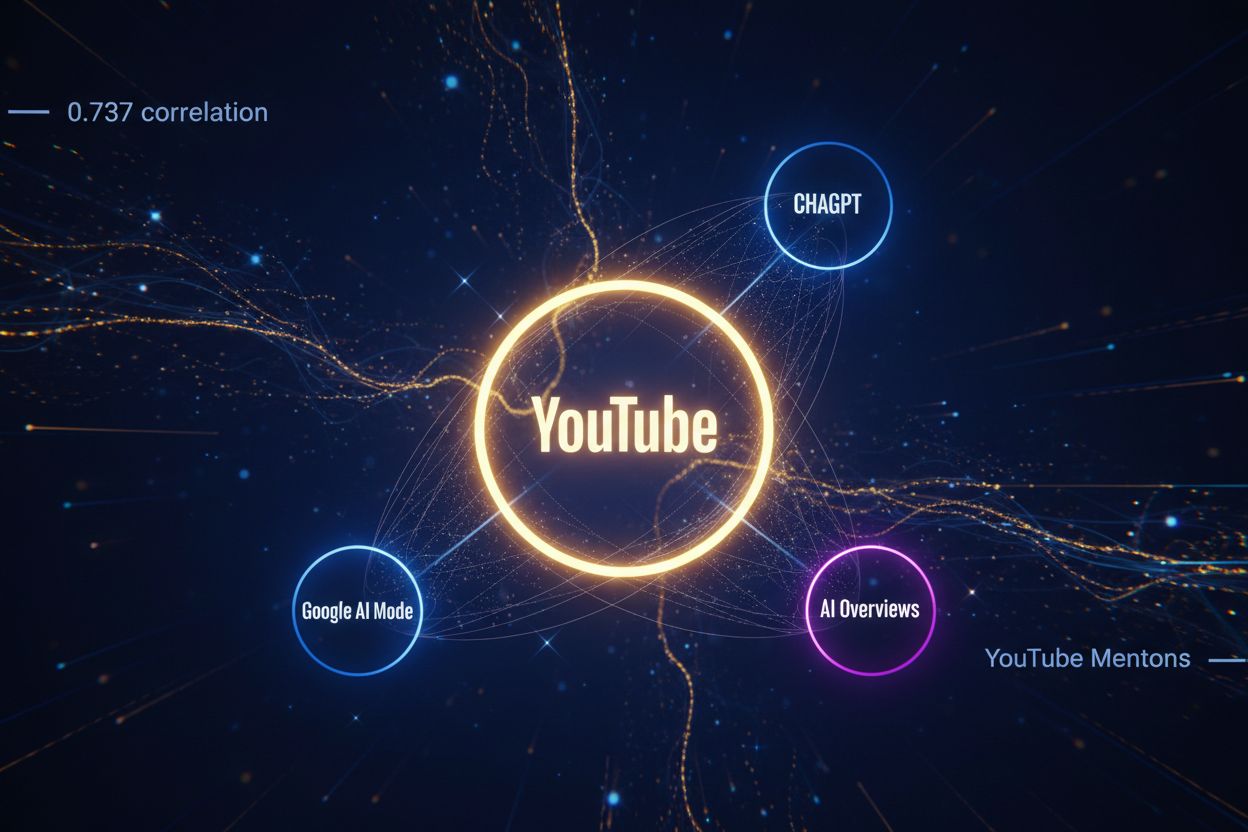
YouTube Mentions: The Strongest AI Visibility Correlation Factor
Discover why YouTube mentions correlate at 0.737 with AI visibility—stronger than any other factor. Learn how to leverage YouTube for ChatGPT, AI Mode, and AI O...
10 min read
Discover why YouTube mentions correlate at 0.737 with AI visibility, outperforming traditional SEO metrics. Learn how to optimize your brand for generative search results.
Recent groundbreaking research has fundamentally shifted our understanding of how brands achieve visibility in AI-powered search results. A comprehensive Ahrefs study analyzing 75,000 brands has revealed that YouTube mentions represent the single strongest predictor of visibility across major AI platforms, including ChatGPT, AI Mode, and Google’s AI Overviews. This finding challenges decades of conventional SEO wisdom that prioritized traditional backlinks and domain authority as the primary drivers of online visibility. The correlation coefficient of ~0.737 between YouTube mentions and AI visibility is not merely a statistical anomaly—it represents a seismic shift in how search algorithms and language models evaluate brand prominence. As artificial intelligence continues to reshape the digital landscape, understanding this YouTube-to-AI visibility connection has become essential for any brand seeking to maintain relevance in generative search results.
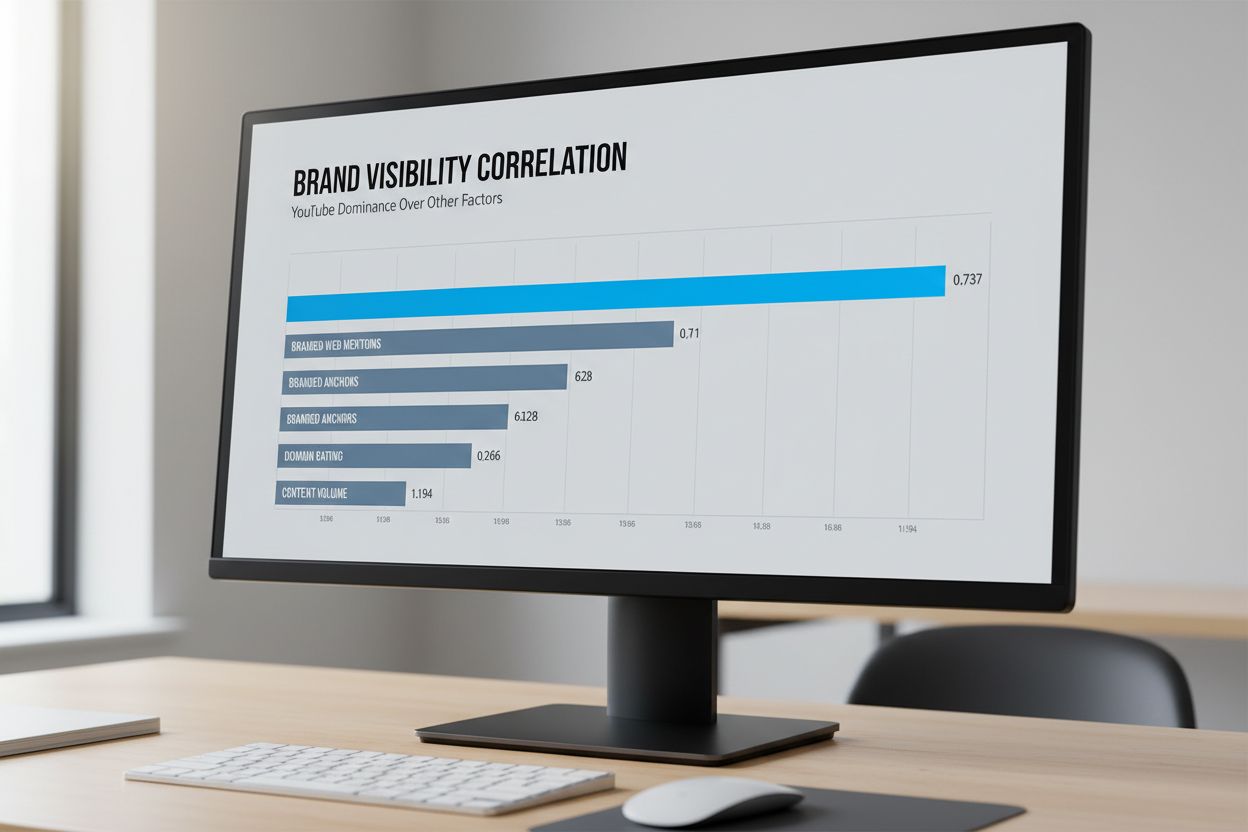
The quantitative evidence supporting YouTube’s dominance is compelling and multifaceted. The Ahrefs research provides a detailed breakdown of how various signals correlate with AI visibility, and the results paint a clear picture of YouTube’s superiority over traditional SEO metrics:
| Signal | Correlation with AI Visibility |
|---|---|
| YouTube Mentions | ~0.737 |
| YouTube Mention Impressions | ~0.717 |
| Branded Web Mentions | 0.66-0.71 |
| Branded Anchors | 0.511-0.628 |
| Domain Rating | 0.266 |
| Content Volume | ~0.194 |
This data reveals a striking hierarchy of influence. YouTube mentions outperform traditional branded web mentions by a significant margin, with a correlation advantage of approximately 0.027 to 0.077 points—a substantial difference when predicting AI visibility outcomes. Even more striking is the dramatic decline in correlation strength as we move down the list: Domain Rating, a metric that has dominated SEO strategy for years, shows a correlation of only 0.266, while content volume—another traditional SEO pillar—registers at a mere ~0.194. The consistency between YouTube mentions and YouTube mention impressions (0.737 vs. 0.717) suggests that both the frequency and reach of YouTube content contribute meaningfully to AI visibility. This data fundamentally undermines the assumption that traditional link-building and domain authority remain the primary drivers of visibility in the AI era.
The dominance of YouTube mentions in predicting AI visibility is not coincidental—it stems directly from how modern language models are trained and developed. YouTube transcripts and video content represent an enormous portion of the training data used to build cutting-edge AI systems like GPT-4, which was trained on over 1 million hours of YouTube video transcripts. This massive incorporation of YouTube data into LLM training creates a natural bias toward recognizing and prioritizing information that appears frequently in video form. When a brand is mentioned in YouTube videos, that mention is captured in the transcripts, indexed by AI systems, and weighted heavily during model training because YouTube content is so prevalent in training datasets. Furthermore, YouTube’s structured metadata, timestamps, and engagement metrics provide additional context that helps AI systems understand the relevance and authority of mentioned brands. The algorithm essentially learns to associate YouTube mentions with credibility and prominence because these mentions appear so frequently and consistently across its training data. This creates a self-reinforcing cycle where brands with strong YouTube presence become more visible to AI systems, which then learn to prioritize them based on their training data patterns.
Different AI platforms exhibit distinct preferences and weighting mechanisms when evaluating brand visibility, though YouTube mentions remain strong across all of them. Understanding these platform-specific nuances is crucial for developing a comprehensive AI visibility strategy:
ChatGPT:
AI Mode (Google’s experimental AI features):
AI Overviews (Google’s generative search results):
The variation across platforms means that brands cannot adopt a one-size-fits-all approach to AI visibility. A strategy optimized purely for ChatGPT may underperform on AI Overviews, which still incorporates traditional SEO elements. However, the common thread across all three platforms is the consistent strength of YouTube mentions as a visibility predictor, suggesting that YouTube should be the foundation of any AI visibility strategy regardless of which platform is the primary target.
The correlation data reveals a troubling reality for brands that have invested heavily in traditional SEO: the metrics that once dominated search visibility are rapidly losing their predictive power in AI-driven results. Backlinks and domain authority, which have been the cornerstone of SEO strategy for over two decades, now show correlation coefficients below 0.3 with AI visibility. This represents not merely a shift in emphasis but a fundamental devaluation of traditional link-building efforts. Content volume, another metric that SEO professionals have long optimized for, registers at only ~0.194 correlation—meaning that publishing more content has become nearly irrelevant to AI visibility compared to securing YouTube mentions. The decline of these metrics reflects a deeper truth: AI systems are trained on different data sources and evaluate relevance through different mechanisms than traditional search algorithms. While Google’s PageRank algorithm was designed to mimic human editorial judgment through links, modern language models learn from the actual text and context of training data, where YouTube transcripts and video content are vastly overrepresented. Brands that continue to focus primarily on traditional SEO metrics risk finding themselves increasingly invisible to AI systems, even if they maintain strong traditional search rankings. This shift demands a fundamental reorientation of digital strategy away from link-building and toward content creation that resonates on video platforms.
While the correlation data shows both YouTube mentions and YouTube mention impressions as strong predictors of AI visibility, it’s important to understand the distinction between these two metrics and why both matter. YouTube mentions refer to the raw frequency with which a brand is referenced or discussed in video content—essentially counting how many times a brand name appears in video transcripts or is spoken aloud by creators. YouTube mention impressions, by contrast, measure the total reach of those mentions, calculated by multiplying the number of mentions by the view count of the videos in which they appear. A brand mentioned once in a video with 10 million views generates 10 million impressions, while the same brand mentioned 100 times in videos with 1,000 total views generates only 100,000 impressions. The correlation data showing both metrics at approximately 0.73-0.74 suggests that both frequency and reach contribute meaningfully to AI visibility, though the slight edge of mentions (0.737) over impressions (0.717) indicates that raw frequency may be marginally more important. This distinction has practical implications: brands should pursue both strategies—securing mentions across a broad range of creators and videos while also prioritizing appearances in high-reach content. The near-equivalence of these correlations suggests that a single mention in a viral video is nearly as valuable as multiple mentions in smaller channels, making strategic partnerships with influential creators particularly worthwhile.
For brands seeking to improve their AI visibility, the research points toward a clear strategic imperative: prioritize YouTube presence and mentions as the foundation of your generative engine optimization efforts. This requires a multifaceted approach that goes beyond traditional YouTube marketing:
Content Creation & Channel Development:
Creator Partnerships & Influencer Collaboration:
Transcript Optimization & SEO:
Measurement & Iteration:
The key insight is that YouTube visibility is no longer a supplementary marketing channel—it has become the primary driver of AI visibility. Brands that treat YouTube as a core strategic priority rather than an afterthought will find themselves increasingly visible to AI systems and the users who rely on them.
The rise of YouTube mentions as the dominant predictor of AI visibility signals a broader paradigm shift from traditional SEO (Search Engine Optimization) to GEO (Generative Engine Optimization). While SEO focused on optimizing for algorithmic ranking factors like links, keywords, and domain authority, GEO requires understanding how language models are trained, what data they prioritize, and how they evaluate relevance in generative contexts. This shift is not merely semantic—it represents a fundamental change in how brands should approach digital visibility strategy. Traditional SEO assumed that search engines would crawl and rank web pages based on link authority and content relevance, but GEO recognizes that AI systems learn from training data that is heavily skewed toward certain sources, particularly YouTube. The correlation data demonstrating YouTube’s dominance is essentially a map of what AI systems have learned to value during training. Brands optimizing for GEO must think differently about content strategy: instead of creating content primarily for search engine crawlers, they should create content that will be captured in AI training data and referenced by language models. This means prioritizing platforms like YouTube where content is transcribed and indexed, focusing on topics and formats that AI systems encounter frequently during training, and building authority through mentions in high-reach content rather than through traditional backlinks. The transition from SEO to GEO is not instantaneous—traditional search remains important—but the research is clear: the future of visibility belongs to brands that master generative engine optimization, and that mastery begins with understanding YouTube’s outsized influence on AI systems.
YouTube mentions refer to any time a brand name appears in a YouTube video—whether in the title, transcript, description, or spoken content. These mentions are captured by AI systems during training and indexed as signals of brand prominence. The more frequently a brand is mentioned across YouTube videos, the stronger the signal to AI systems that the brand is relevant and authoritative.
YouTube data dominates because modern language models like GPT-4 are trained on over 1 million hours of YouTube transcripts. This massive incorporation of YouTube content into training data creates a natural bias toward recognizing and prioritizing information that appears frequently in video form. Traditional backlinks, by contrast, are less prevalent in LLM training data and therefore carry less weight in AI visibility predictions.
You can track YouTube mentions using tools like Ahrefs Brand Radar, which monitors how often your brand appears in YouTube videos and estimates the impressions those mentions generate. AmICited also provides comprehensive monitoring of how your brand appears across AI systems, helping you correlate YouTube activity with AI visibility changes.
The research shows that both matter, but frequency of mentions (0.737 correlation) slightly outperforms reach/impressions (0.717 correlation). This means being mentioned across many different videos is marginally more valuable than having fewer mentions in high-view videos. The ideal strategy combines both: secure mentions across diverse creators while also pursuing appearances in high-reach content.
ChatGPT appears to be the most accessible entry point for emerging brands. Unlike AI Mode, which heavily favors established brands with strong traditional authority signals, ChatGPT shows weaker correlations with traditional SEO metrics and appears to rely more on the frequency and diversity of mentions across its training data. This makes it more receptive to newer brands with growing YouTube presence.
The timeline varies depending on the AI platform. ChatGPT's training data has cutoff dates, so mentions in recent videos may take weeks or months to appear in responses. AI Overviews and AI Mode integrate more real-time data, so visibility improvements can sometimes appear within days or weeks. Generally, expect to see measurable changes within 4-8 weeks of implementing a YouTube-focused strategy.
Yes, absolutely. Traditional Google rankings and AI visibility are increasingly separate concerns. A brand can rank well in traditional search results while remaining invisible to AI systems, or vice versa. Since YouTube mentions are the strongest predictor of AI visibility, brands should treat YouTube as a distinct strategic priority regardless of their traditional SEO performance.
Branded web mentions include any mention of your brand across the entire web—blogs, news sites, forums, social media, etc. YouTube mentions are a subset of these, but they carry significantly more weight for AI visibility (0.737 vs 0.66-0.71 correlation). This is because YouTube content is so heavily represented in LLM training data that mentions there are weighted more heavily by AI systems.
Track how AI systems reference your brand with AmICited's comprehensive monitoring solution. Get real-time insights into your presence across ChatGPT, AI Mode, and AI Overviews.
Discover why YouTube mentions correlate at 0.737 with AI visibility—stronger than any other factor. Learn how to leverage YouTube for ChatGPT, AI Mode, and AI O...
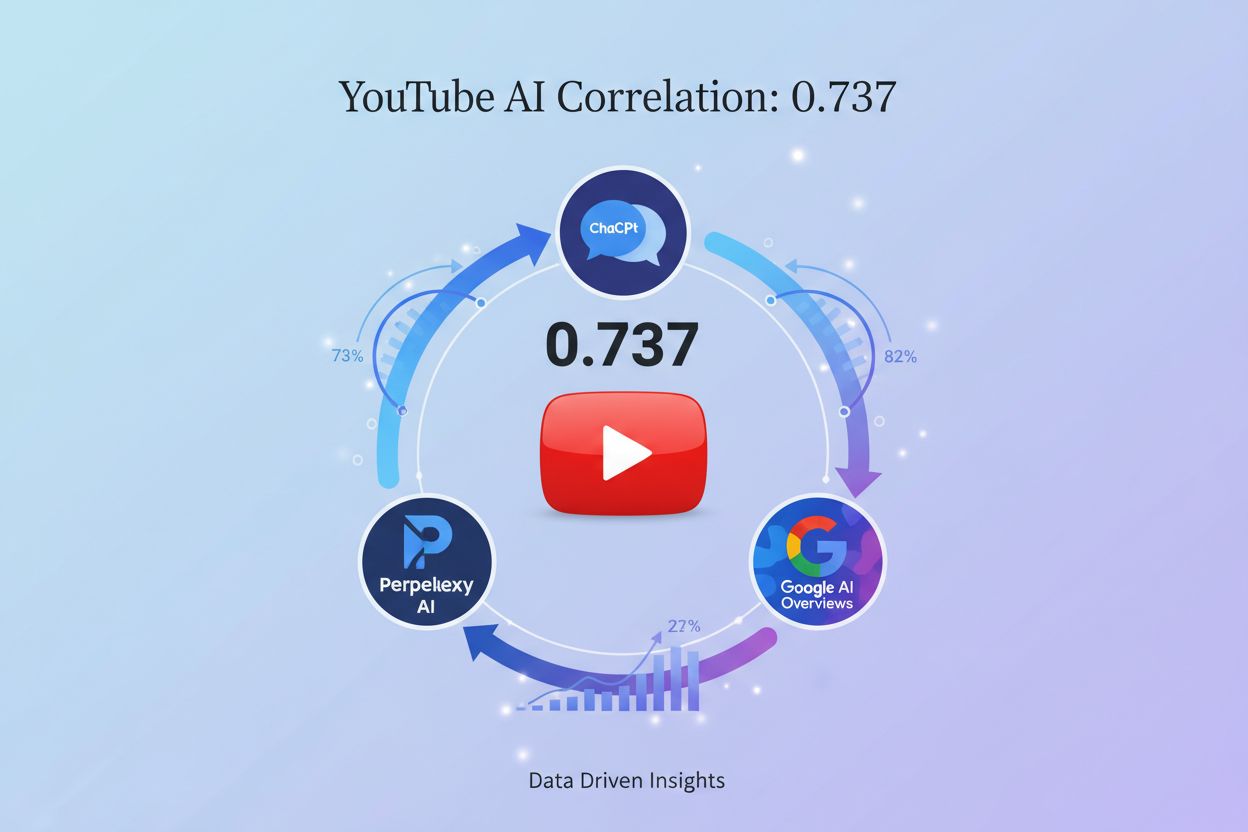
Learn about YouTube AI Correlation (0.737), the strongest off-page factor for AI visibility. Discover why YouTube dominates AI citations and how to optimize you...
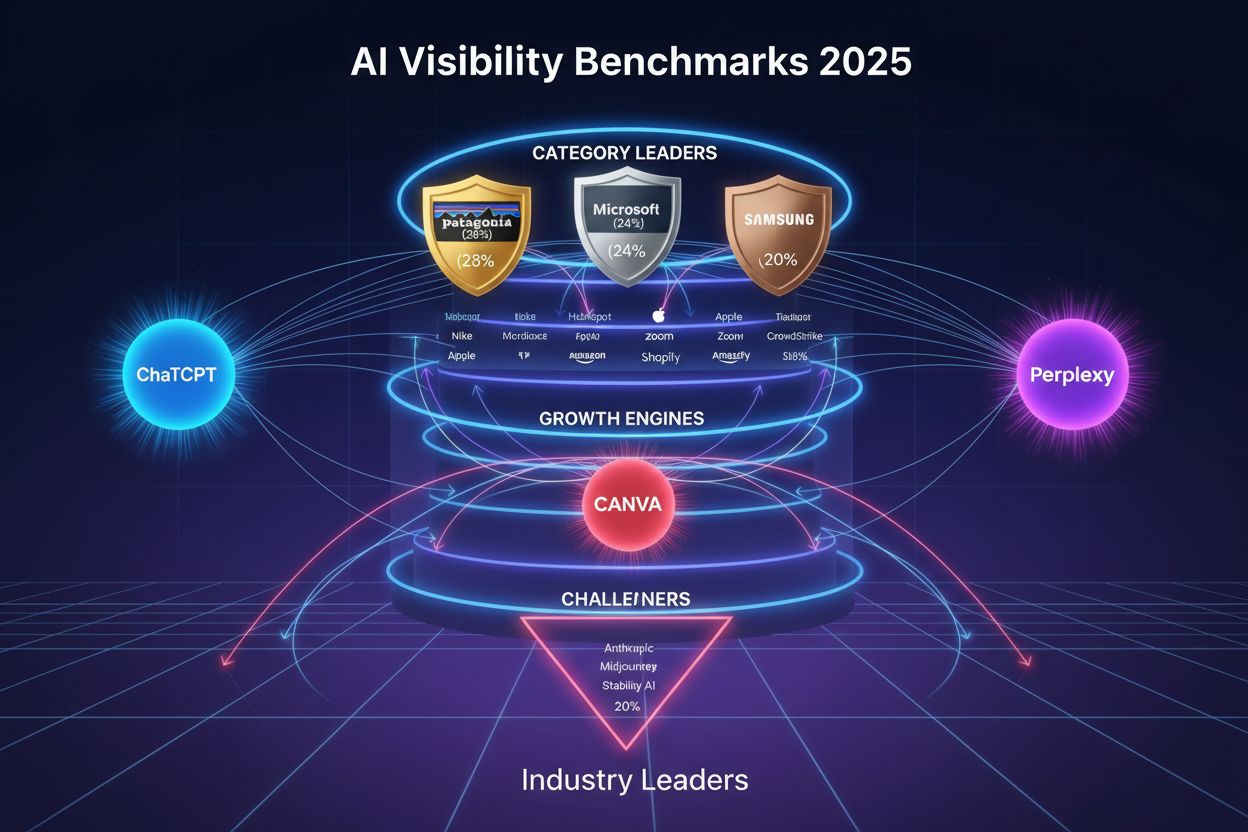
Discover which brands are winning AI visibility benchmarks. Analyze industry leaders across ChatGPT, Perplexity, and Google AI with data-driven insights and com...