
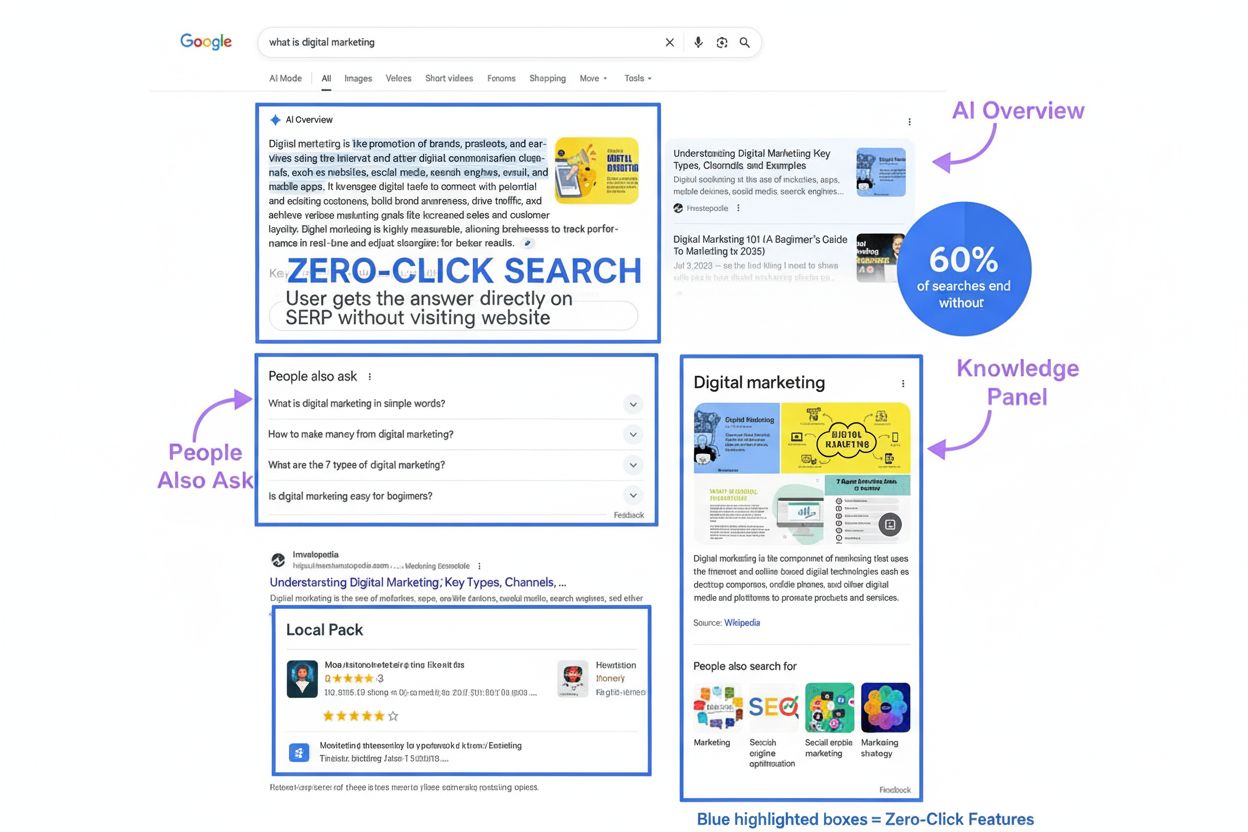
Zero-Click Search
Zero-click search definition: When users get answers directly on Google SERPs without clicking websites. Learn how AI Overviews, featured snippets, and SERP fea...
19 min read
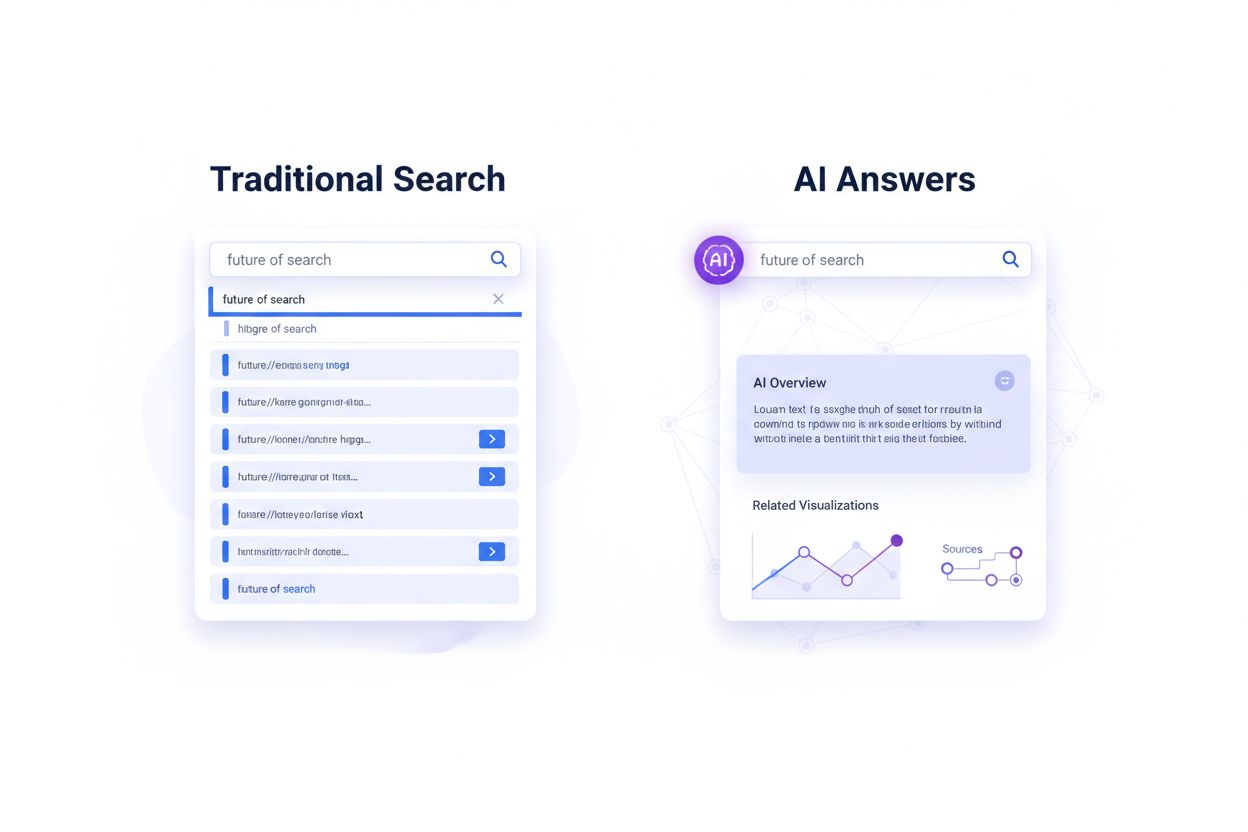
Learn how zero-click searches and AI answers are reshaping brand visibility. Discover why traditional metrics are failing and how to monitor your AI citations with AmICited.com.
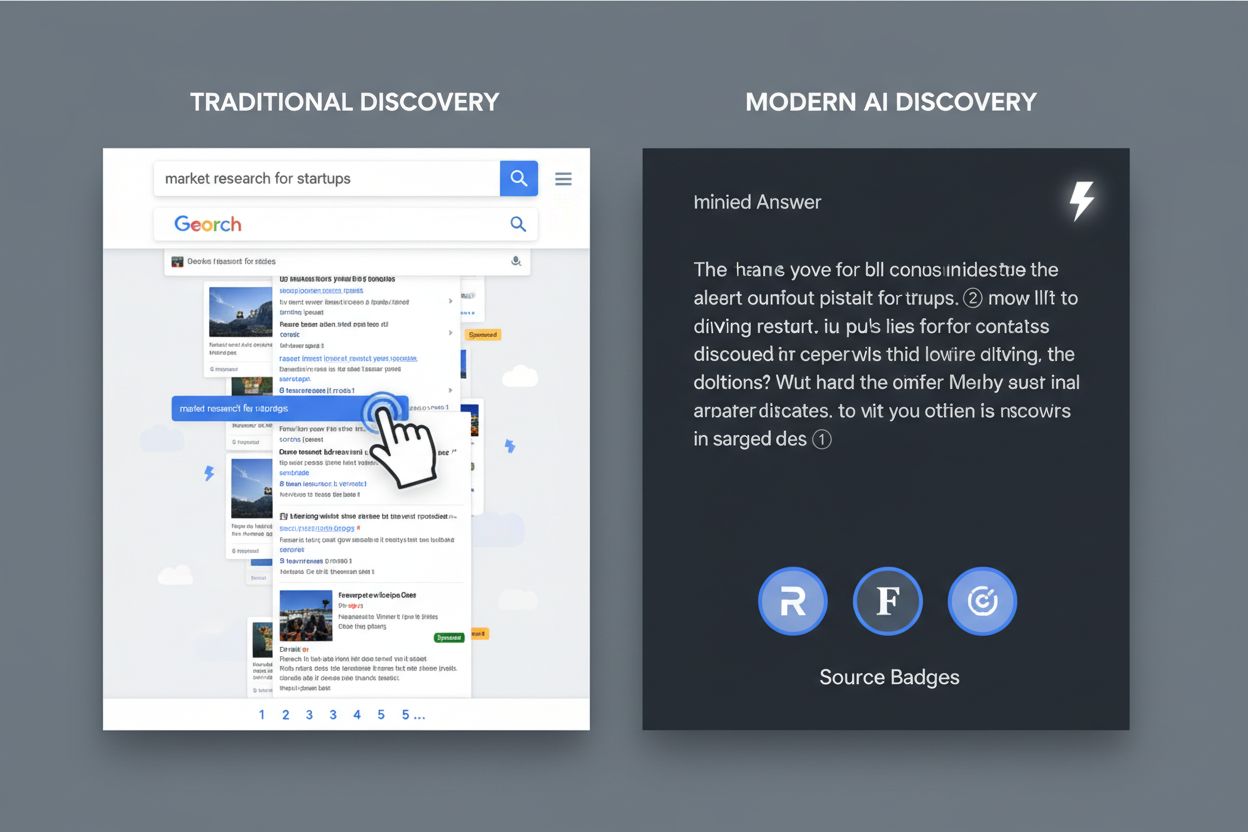
Zero-click search refers to any search query that results in an answer displayed directly on the search results page without requiring the user to click through to another website. This phenomenon has fundamentally shifted how search engines deliver information, moving from directing traffic to websites toward providing immediate answers within the search interface itself. Historically, search engines were designed as traffic drivers—their primary function was to connect users with relevant websites through clickable links. However, the rise of featured snippets, knowledge panels, AI Overviews, and other answer boxes has inverted this model, meaning that traditional metrics like click-through rates and organic traffic no longer accurately reflect your brand’s visibility or influence in search results.
The prevalence of zero-click searches has reached unprecedented levels, with 58.5% of searches in the United States and 59.7% in the European Union ending without any click to an external website. This represents a seismic shift in user behavior, where the majority of search sessions now conclude within Google’s ecosystem. Of the searches that do result in clicks to external websites, only 360 per 1,000 searches in the US and 374 per 1,000 in the EU actually navigate away from Google properties, with approximately 30% of all clicks remaining within Google’s own properties like Google News, Google Shopping, and YouTube. These statistics underscore a critical reality: traditional click-based metrics capture only a fraction of your brand’s actual visibility and influence.
| Region | Zero-Click Rate | Clicks to Open Web (per 1,000) | Google Property Clicks (~%) |
|---|---|---|---|
| United States | 58.5% | 360 | 30% |
| European Union | 59.7% | 374 | 30% |
The data reveals that 80% of consumers rely on zero-click results for 40% or more of their searches, indicating that answer boxes and AI-generated summaries have become the primary way people consume search information. This shift demands a fundamental rethinking of how brands measure and optimize for search visibility.
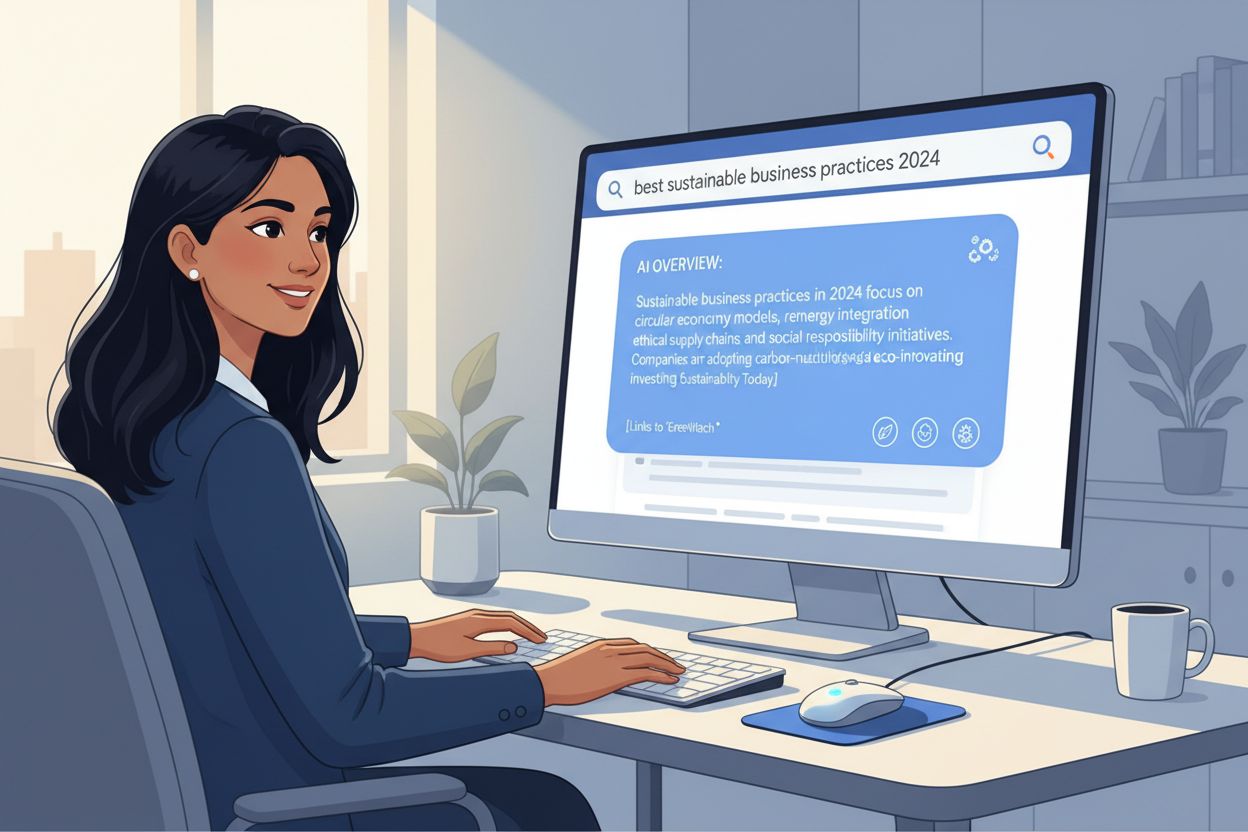
Google AI Overviews, launched in May 2024, have accelerated the zero-click trend to an unprecedented degree, fundamentally reshaping the search landscape for both organic and paid results. These AI-generated summaries synthesize information from multiple sources to provide comprehensive answers directly on the search results page, reaching 1.5 billion users monthly across more than 200 countries. The impact on traditional click metrics has been dramatic: organic click-through rates have declined by 61% (from 1.76% to 0.61%) for queries where AI Overviews appear, while paid click-through rates have plummeted by 68% (from 19.7% to 6.34%). While featured snippets previously dominated zero-click results, AI Overviews represent a more sophisticated and comprehensive answer format that draws from multiple sources simultaneously. This distinction is crucial because it means your brand’s visibility now depends not just on ranking position, but on whether your content is selected and cited within the AI Overview itself.
The fundamental problem with relying on rankings and click-through rates is that they no longer correlate with actual brand visibility or influence in the search ecosystem. A website ranking in position one for a high-volume keyword may receive virtually no traffic if that query triggers an AI Overview, yet the brand’s content could be cited and summarized to millions of users who never click through to the website. This creates what we call “invisible influence”—your brand is informing thousands or even millions of search users without generating measurable traffic or conversions. Traditional SEO dashboards that celebrate first-page rankings or improved CTR miss the larger picture entirely: they’re measuring the wrong metrics in an AI-driven search environment. The brands that thrive in this new landscape are those that understand visibility extends far beyond clicks, encompassing citations, mentions, and the authority conveyed through AI-generated summaries.
AI Share of Voice (AI SOV) represents a fundamental shift in how brands should measure their presence in search results, moving beyond traditional Share of Voice metrics that only counted visible links and rankings. AI SOV measures the percentage of AI-generated answers and citations that mention or reference your brand compared to competitors within your industry or keyword space. Unlike traditional SOV, which focuses on ad impressions and organic ranking positions, AI SOV captures your brand’s presence in the actual answers users receive, making it a far more accurate reflection of real visibility in the AI-driven search era. For example, Bank of America commands 32.2% visibility in banking-related queries through AI citations, meaning nearly one-third of AI-generated answers about banking topics reference or cite Bank of America’s content. This metric matters because it directly correlates with brand authority, trust, and ultimately, customer acquisition.
Calculating Your AI Share of Voice:
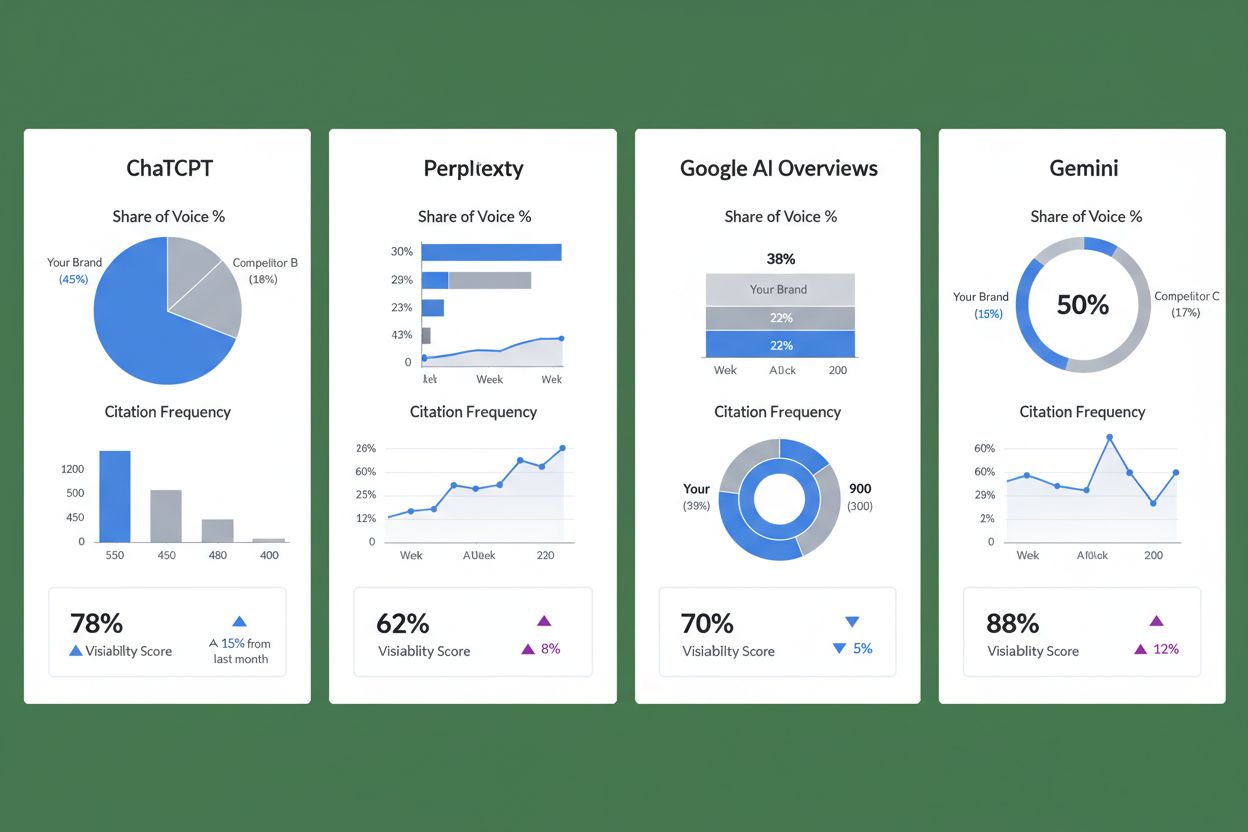
Citation frequency—how often your brand and content are mentioned in AI-generated answers—has emerged as one of the strongest predictors of both visibility and actual click performance. Being cited first in an AI Overview carries disproportionate weight, as users tend to click on the first source mentioned or assume the first cited source is the most authoritative. Research demonstrates that brands cited in AI Overviews earn 35% more organic clicks and 91% more paid clicks compared to brands that don’t appear in these summaries, even when those brands rank in similar positions. This counterintuitive finding reveals that citation within AI answers actually drives more traffic than traditional ranking position alone, making citation frequency a critical metric to track and optimize for. The mechanism is straightforward: when an AI Overview cites your brand as a source, it implicitly endorses your content as authoritative and relevant, which influences user behavior both within the search results and on your website. Monitoring your citation frequency across AI platforms should become as routine as checking your keyword rankings.
To maximize your visibility in AI-generated answers, your content strategy must shift toward providing direct, comprehensive answers that AI systems can easily extract and cite. The most effective approach is to lead with direct answers in the form of 50-70 word summaries that directly address the user’s query before diving into supporting details and explanations. This practice aligns with what we call the CSQAF Framework, which optimizes content for AI citation:
Beyond the CSQAF Framework, implementing structured data markup (Schema.org) helps search engines and AI systems understand your content’s context and relevance. E-E-A-T signals—Experience, Expertise, Authoritativeness, and Trustworthiness—have become increasingly important for AI citation, as these systems prioritize content from sources that demonstrate genuine knowledge and credibility. Additionally, updating and refreshing existing content on a regular basis signals to AI systems that your information remains current and reliable, increasing the likelihood of citation in AI Overviews. Content formats that perform particularly well for AI citation include:
As zero-click search and AI citations become central to brand visibility, monitoring your presence in AI-generated answers has shifted from optional to essential. AmICited.com stands out as the leading platform specifically designed to track brand citations across AI systems, providing real-time insights into how often and where your brand appears in AI Overviews, ChatGPT responses, Perplexity answers, and other AI-powered search interfaces. The platform offers comprehensive tracking across multiple AI systems simultaneously, something that generic SEO tools cannot provide, since they were built for a click-based search paradigm. When evaluating AI visibility monitoring solutions, look for platforms that track citations across multiple AI systems (not just Google), provide competitive benchmarking, offer actionable insights for content optimization, and integrate with your existing analytics infrastructure.
| Tool | Primary Focus | AI Systems Tracked | Competitive Benchmarking | Price Point |
|---|---|---|---|---|
| AmICited.com | AI citations & visibility | 5+ platforms | Yes | Mid-range |
| Peekaboo | Google AI Overviews | Google only | Limited | Budget |
| Profound | AI research | 3 platforms | Basic | Premium |
| Otterly AI | Content optimization | 2 platforms | No | Budget |
The cost-benefit analysis strongly favors investment in dedicated AI visibility monitoring: the cost of these tools is typically a fraction of what brands spend on traditional SEO, yet the insights directly impact your ability to capture visibility in the fastest-growing search channel. Integration with your existing analytics and marketing stack ensures that AI visibility data informs broader strategy rather than existing in isolation.
Transitioning to an AI-visibility-first approach doesn’t require overhauling your entire content strategy overnight; instead, it demands a structured, phased approach that builds on your existing strengths. Begin with a comprehensive audit of your current AI visibility across major AI systems, identifying which keywords and topics your brand appears in, how frequently you’re cited, and where you rank against competitors. Next, identify your highest-value keywords—those with significant search volume, commercial intent, and realistic opportunities for AI citation based on your current content and authority. With this foundation, prioritize content updates and new content creation around these high-value keywords, focusing on the CSQAF Framework and direct answer formats outlined above. Establish a measurement framework that tracks AI citations, citation frequency, and AI SOV on a monthly basis, allowing you to correlate content changes with visibility improvements. Most brands see meaningful improvements in AI citation frequency within 60-90 days of implementing these optimizations, though the timeline varies based on your starting position and competitive landscape.
Implementation Action Steps:
The trajectory is clear: AI Mode is becoming the default search experience for an increasing percentage of users, with ChatGPT reaching 800 million weekly active users and Perplexity processing 780 million queries in May 2025 alone. This shift means that platform diversification is no longer optional—brands must optimize for visibility across Google AI Overviews, ChatGPT, Perplexity, and emerging AI search platforms simultaneously, rather than concentrating efforts on a single search engine. The competitive advantage belongs to early adopters who recognize that the shift from clicks to citations represents a fundamental change in how search authority and trust are established. Brands that build their visibility strategy around AI citations, content authority, and multi-platform presence today will dominate search visibility tomorrow, while those clinging to traditional click-based metrics will find themselves increasingly invisible despite strong rankings. The time to act is now—the brands that understand and optimize for zero-click search and AI citations are already capturing disproportionate visibility and influence in the search results that matter most.

A zero-click search is any search query that results in an answer displayed directly on the search results page without requiring the user to click through to another website. This includes featured snippets, knowledge panels, AI Overviews, and other answer boxes that provide immediate information within the search interface itself.
Zero-click searches have reached unprecedented levels, with 58.5% of searches in the United States and 59.7% in the European Union ending without any click to an external website. This represents a dramatic shift from just a few years ago, when the majority of searches resulted in clicks to external websites.
Even without clicks, your brand can be cited and referenced in AI-generated answers, reaching millions of users. This 'invisible influence' establishes brand authority and trust, influences purchasing decisions, and drives branded searches and direct traffic. Being cited in AI answers is often more valuable than ranking position alone.
Traditional Share of Voice measures your brand's visibility across channels like paid ads and organic rankings. AI Share of Voice specifically tracks how often your brand is mentioned or cited in AI-generated responses from platforms like ChatGPT, Perplexity, and Google AI Overviews, making it a more accurate reflection of visibility in the AI-driven search era.
Start by auditing your current AI visibility using a tool like AmICited.com, then identify your highest-value keywords. Optimize your top 10 pieces of content using the CSQAF Framework (Citations, Statistics, Quotations, Authoritativeness, Fluency), implement structured data markup, and establish a monthly tracking cadence. Most brands see improvements within 60-90 days.
No, traditional SEO remains essential as the foundation for AI citation success. 92.36% of AI Overview citations come from domains ranking in the top 10. Instead of replacing SEO, you're expanding it by adding AI-specific optimization and measurement alongside your existing practices.
Track metrics like citation frequency (how often your brand appears in AI answers), AI Share of Voice (your percentage of total citations), visibility score (how prominently you're mentioned), and correlation between AI citations and organic traffic. Use tools like AmICited.com to monitor these metrics across multiple AI platforms.
AmICited.com is the leading platform specifically designed for tracking brand citations across multiple AI systems including Google AI Overviews, ChatGPT, Perplexity, and Gemini. It provides real-time insights, competitive benchmarking, and actionable recommendations for improving your AI visibility.
Stop losing visibility to AI answers. Track how your brand is cited across ChatGPT, Perplexity, Google AI Overviews, and more with AmICited.com. Get real-time insights into your AI Share of Voice and citation frequency.
Zero-click search definition: When users get answers directly on Google SERPs without clicking websites. Learn how AI Overviews, featured snippets, and SERP fea...
Learn how to measure brand impact in zero-click search. Discover metrics beyond clicks, track AI visibility, and prove ROI when users don't click through.
Discover how AI search is transforming customer discovery. Learn the three stages of AI-powered journeys, optimize for ChatGPT, Perplexity, and Google AI Overvi...