Discussion Content Strategy Original Research

Lohnt sich die Erstellung eigener Studien wirklich für AI-Sichtbarkeit? Scheint ein riesiger Aufwand zu sein

RO
ROI_Skeptic_Marketing · VP Content
· · 118 upvotes · 11 comments
RS
ROI_Skeptic_Marketing
VP of Content · January 6, 2026

Every AI visibility guide says: “Create original research.”

Sounds great in theory. In practice, it’s a MASSIVE investment:

  • Survey design and execution: $10K-50K
  • Data analysis: Weeks of work
  • Report creation: Weeks more
  • Promotion: Ongoing effort

My concerns:

  1. Can we actually compete with HubSpot, McKinsey, Gartner who already dominate research citations?

  2. Is the AI visibility payoff real, or are we just creating expensive content that gets buried?

  3. How do we even know if our research is getting cited by AI?

Our situation:

  • B2B company, ~$50M revenue
  • Small content team (4 people)
  • Never done original research before
  • Competing against massive industry players

The pitch from our agency: “Original research gets 10x the AI citations of regular content.”

My skepticism: That’s probably true for THEIR clients (Fortune 500). Is it true for mid-market companies like us?

Anyone here actually done original research specifically for AI visibility? What were the results? Was the ROI real?

11 comments

11 Comments

RM
Research_Marketing_Lead Expert Director of Research Marketing · January 6, 2026

I’ve managed original research programs for both enterprise ($1B+) and mid-market ($30-100M) companies. Here’s the real picture:

The “10x citations” claim is accurate but misleading:

  • Yes, research gets cited 10x more than blog posts
  • BUT enterprise research gets cited 100x more than mid-market research
  • The gap isn’t fair, but it’s real

What actually determines research citation:

FactorImpactMid-market Reality
Data qualityHighAchievable if focused
Brand authorityVery highHarder to overcome
Sample sizeMediumCan be sufficient
Uniqueness of angleCriticalTHIS is your advantage
Promotion & distributionHighResource-constrained

Where mid-market can win:

  1. Niche expertise - Don’t research “marketing trends.” Research “marketing trends for manufacturing companies under 500 employees.”

  2. Proprietary data - You have data competitors don’t: customer behavior, usage patterns, support tickets.

  3. Speed - You can research emerging topics before enterprises slow-roll their processes.

The honest ROI for mid-market:

  • Year 1: Minimal AI citations (building foundation)
  • Year 2: Starting to appear in niche queries
  • Year 3+: Compounding returns if you stay consistent

It works. But it’s a 3-year bet, not a campaign.

MM
Mid_Market_Success_Story CMO at $60M B2B Company · January 6, 2026
Replying to Research_Marketing_Lead

We’re exactly your size. Started original research 2 years ago. Here’s our journey:

Year 1:

  • Invested $35K in our first research report
  • Topic: “State of [Our Industry] - Mid-Market Edition”
  • 500 survey respondents (our customers + prospects)
  • Result: Got some press, minimal AI visibility

Year 2:

  • Published 2 more reports on niche topics
  • Started seeing Perplexity cite us
  • ChatGPT occasionally referenced our data

Now (Year 3):

  • Our research appears in ~20% of AI answers for our niche
  • Competitors who don’t do research: 0-2%
  • Lead attribution from AI sources: 8% of pipeline

The key insight: We didn’t compete with McKinsey. We competed in our specific niche where McKinsey doesn’t care to go. We became the authority for mid-market companies in our space.

Investment vs. return:

  • Total investment: ~$150K over 3 years
  • Attributable pipeline: ~$2M
  • ROI: 13x

It took patience. But the compounding is real now.

SA
Scrappy_Approach Content Director at Startup · January 6, 2026

Don’t have $50K? Here’s how we do research on a shoestring:

Low-cost research methods:

  1. Customer survey research

    • Cost: ~$2K (survey tool + incentives)
    • Sample: 200-500 customers
    • Angle: What only YOUR customers can tell you
  2. Proprietary data analysis

    • Cost: Staff time only
    • Source: Your product usage data
    • Angle: Anonymized trends from your platform
  3. Expert interview compilations

    • Cost: Time + small honorariums
    • Method: Interview 20+ industry experts
    • Angle: “What 20 Experts Say About X”
  4. Trend analysis

    • Cost: Minimal
    • Method: Analyze publicly available data in unique ways
    • Angle: Original analysis, not original data

What we’ve learned:

MethodAI Citation RateCost
Big survey reportHigh$$$$
Customer-based researchMedium-High$$
Proprietary data analysisMedium-High$
Expert interviewsMedium$
Public data analysisLow-Medium$

The key: Make it genuinely useful and unique. A well-done $5K study can outperform a lazy $50K study.

AC
AI_Citation_Analyst Expert AI Visibility Researcher · January 5, 2026

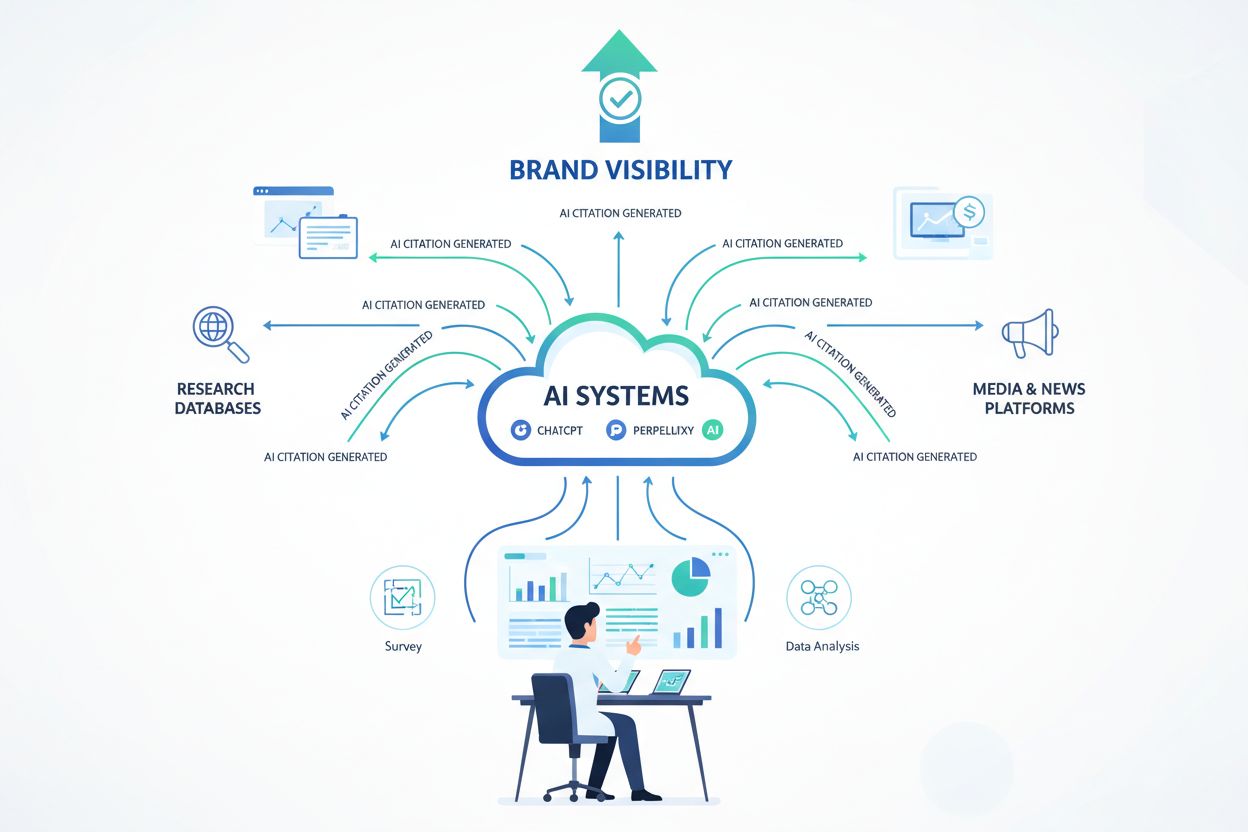
Let me share what research actually gets cited by AI:

High citation content patterns:

  1. Specific statistics - “73% of X do Y” citations are common
  2. Comparison data - “X vs Y” research gets pulled frequently
  3. Trend data - Year-over-year changes
  4. Benchmark data - “Average Z is 123”

What we’ve measured using Am I Cited:

Content with original research statistics: 4.3x citation rate Content with third-party statistics: 1.8x citation rate Content with no statistics: 1x baseline

BUT here’s what matters more than quantity:

Extractability - Can AI easily pull your statistic? Format matters:

  • Good: “According to [Your Company] research, 67% of marketers…”
  • Bad: Statistic buried in paragraph 12 of a PDF

Verification - Can AI cross-reference your claim?

  • Good: Methodology explained, sample size stated, date clear
  • Bad: “Research shows…” with no attribution

Uniqueness - Is this data available elsewhere?

  • Good: Only your company has this insight
  • Bad: You’re reporting what everyone else is

My advice: Before investing in research, audit what unique data you ALREADY have. Most companies sit on goldmines they don’t realize.

EC
Enterprise_Comparison Former Analyst at Major Research Firm · January 5, 2026

I worked at one of the big research firms. Let me demystify how we operated:

The enterprise research machine:

  • 50+ person research team
  • $5M+ annual research budget
  • Multi-channel promotion
  • Existing brand authority

What mid-market can learn:

  1. They’re not as smart as you think - A lot of enterprise research is recycled surveys with big sample sizes. Insights are often shallow.

  2. They can’t go niche - Gartner won’t write about “marketing automation for pet supply e-commerce.” You can.

  3. They’re slow - Enterprise research takes 6-18 months. You can ship in 6-8 weeks.

  4. They’re expensive - Their research requires massive investment to be profitable. Yours just needs to be useful.

The real competition: You’re not competing with McKinsey for “marketing trends.” You’re competing with other mid-market companies for your specific niche queries.

Most of your actual competitors probably aren’t doing original research at all. That’s your opportunity.

Strategic targeting: Find 5-10 specific questions AI gets asked about your space. Create research that answers those exact questions. You don’t need to boil the ocean.

FS
Failure_Story · January 5, 2026

Let me share a cautionary tale about research done wrong.

Our mistake:

Spent $80K on a “State of the Industry” report.

  • 2,000 respondents
  • Beautiful design
  • 60 pages of charts
  • Massive promotional push

Result:

  • Some press coverage
  • Downloaded 500 times
  • AI visibility: Almost zero

What went wrong:

  1. Too broad - “Industry trends” is owned by big players
  2. No unique angle - Same questions everyone asks
  3. PDF format - AI couldn’t parse it easily
  4. No web-first version - HTML content > PDF for AI
  5. One-and-done - No follow-up or updates

What we learned:

The research itself was fine. The strategy was wrong.

If we did it again:

  • Narrow focus (specific segment)
  • Unique angle (questions nobody else asks)
  • Web-first (HTML with structured data)
  • Data points in articles (not just PDF)
  • Annual updates (build citation equity)

It’s not just about doing research. It’s about doing research AI can find, parse, and cite.

PF
Practical_Framework Content Strategist · January 5, 2026
Replying to Failure_Story

Great failure analysis. Here’s a framework to avoid those mistakes:

The AI-Optimized Research Framework:

Step 1: Niche selection

  • What questions do people ask AI about your space?
  • Where is existing research weak or nonexistent?
  • What unique data does your company have?

Step 2: Format optimization

  • Create HTML landing page first (AI can read this)
  • PDF is supplementary, not primary
  • Include key statistics in clear, extractable format
  • Use schema markup for datasets

Step 3: Distribution strategy

  • Break research into multiple blog posts
  • Each post focuses on one extractable insight
  • Internal linking to main research page
  • PR push to get others citing your data

Step 4: Measurement

  • Track citations using Am I Cited
  • Monitor which statistics get picked up
  • Note which formats work better
  • Iterate based on data

Step 5: Update cycle

  • Annual updates build citation equity
  • Each update is a new news moment
  • Historical trends become more valuable

The 80/20: 80% of AI citations come from 20% of your research. Find what’s working and double down.

IA
Incremental_Approach Marketing Director · January 4, 2026

You don’t have to go big immediately. Here’s an incremental approach:

Quarter 1: Micro-research

  • Quick customer survey (100 responses)
  • One focused insight
  • Single blog post with key finding
  • Track if it gets any AI traction

Quarter 2: Expand if it works

  • Larger sample
  • More questions
  • Dedicated landing page
  • Monitor AI citations

Quarter 3: Full research if validated

  • Comprehensive report
  • Multiple content pieces
  • Full promotional push
  • Baseline measurement

This approach:

  • Validates demand before big investment
  • Builds research muscle gradually
  • Shows ROI to leadership incrementally
  • Reduces risk

Our results with this approach:

  • Q1 micro-research: 3 AI citations
  • Q2 expanded research: 12 citations
  • Q3 full report: 40+ citations and growing

Each phase funded the next. Much easier to get buy-in than asking for $50K upfront.

RS
ROI_Skeptic_Marketing OP VP of Content · January 4, 2026

This thread changed my thinking. Here’s my new plan:

What I was wrong about:

  1. Competing with giants - We don’t have to. We can own our niche.

  2. Needing massive budget - Start small, validate, then invest.

  3. Research = PDFs - Web-first, HTML content, extractable statistics.

  4. One-and-done - It’s a multi-year program, not a campaign.

Our new approach:

Phase 1 (Q1): Validate the concept

  • Survey 200 customers on a specific pain point
  • Create one insight-focused blog post
  • See if AI picks it up
  • Budget: $3K

Phase 2 (Q2): Expand if it works

  • Bigger survey, more questions
  • Dedicated landing page
  • Track citations with Am I Cited
  • Budget: $8K

Phase 3 (Q3-Q4): Full program if validated

  • Comprehensive annual report
  • Multiple derivative content pieces
  • PR and distribution push
  • Budget: $25K

The mental shift: We’re not creating “content.” We’re building a citation asset that compounds over time. The ROI calculation isn’t first-year. It’s years 2 and 3.

Specific niche we’re targeting: [Our specific industry segment] - a space where big players don’t focus but where our customers desperately want data.

Thanks everyone. This is actually executable now.

Have a Question About This Topic?

Get personalized help from our team. We'll respond within 24 hours.

Frequently Asked Questions

Warum werden eigene Studien von KI-Systemen zitiert?
KI-Systeme priorisieren eigene Forschung, weil sie einzigartige Daten, Statistiken und Erkenntnisse enthält, die sonst nirgendwo zu finden sind. Forschung demonstriert Fachwissen und liefert überprüfbare Fakten, die KI-Modelle als autoritative Quellen sicher zitieren können.
Welche Arten von eigener Forschung eignen sich am besten für KI-Sichtbarkeit?
Umfragebasierte Studien, Branchen-Benchmark-Reports, proprietäre Datenanalysen und Trendstudien funktionieren gut. Entscheidend ist, einzigartige, überprüfbare Datenpunkte zu erstellen, die Fragen beantworten, die KI-Systeme häufig von Nutzern erhalten.
Wie lange dauert es, bis eigene Forschung die KI-Sichtbarkeit beeinflusst?
Eigene Forschung benötigt in der Regel 6-12 Monate, um Zitationsdynamik aufzubauen. KI-Systeme brauchen Zeit, um Ihre Forschung zu entdecken, zu validieren und zu zitieren. Hochwertige Forschung sorgt jedoch für einen Zinseszinseffekt, da sie über Jahre hinweg Zitate ansammelt.
Können kleine Unternehmen mit Enterprise-Forschung konkurrieren?
Ja, aber mit Fokus. Kleine Unternehmen können gewinnen, indem sie spezifische Nischen besetzen, einzigartige Kundendaten nutzen oder spezialisierte Umfragen durchführen, die größere Wettbewerber übersehen. Tiefe Expertise in engen Themen schlägt oft breite Abdeckung.

Verfolgen Sie die KI-Auswirkungen Ihrer Forschung

Überwachen Sie, wie Ihre eigene Forschung in ChatGPT, Perplexity und anderen KI-Plattformen zitiert wird. Sehen Sie, welche Datenpunkte am häufigsten referenziert werden.

Mehr erfahren
