

Relevanzsignal
Relevanzsignale sind Indikatoren, die KI-Systeme zur Bewertung der Anwendbarkeit von Inhalten nutzen. Erfahren Sie, wie Keyword-Übereinstimmung, semantische Rel...
11 Min. Lesezeit
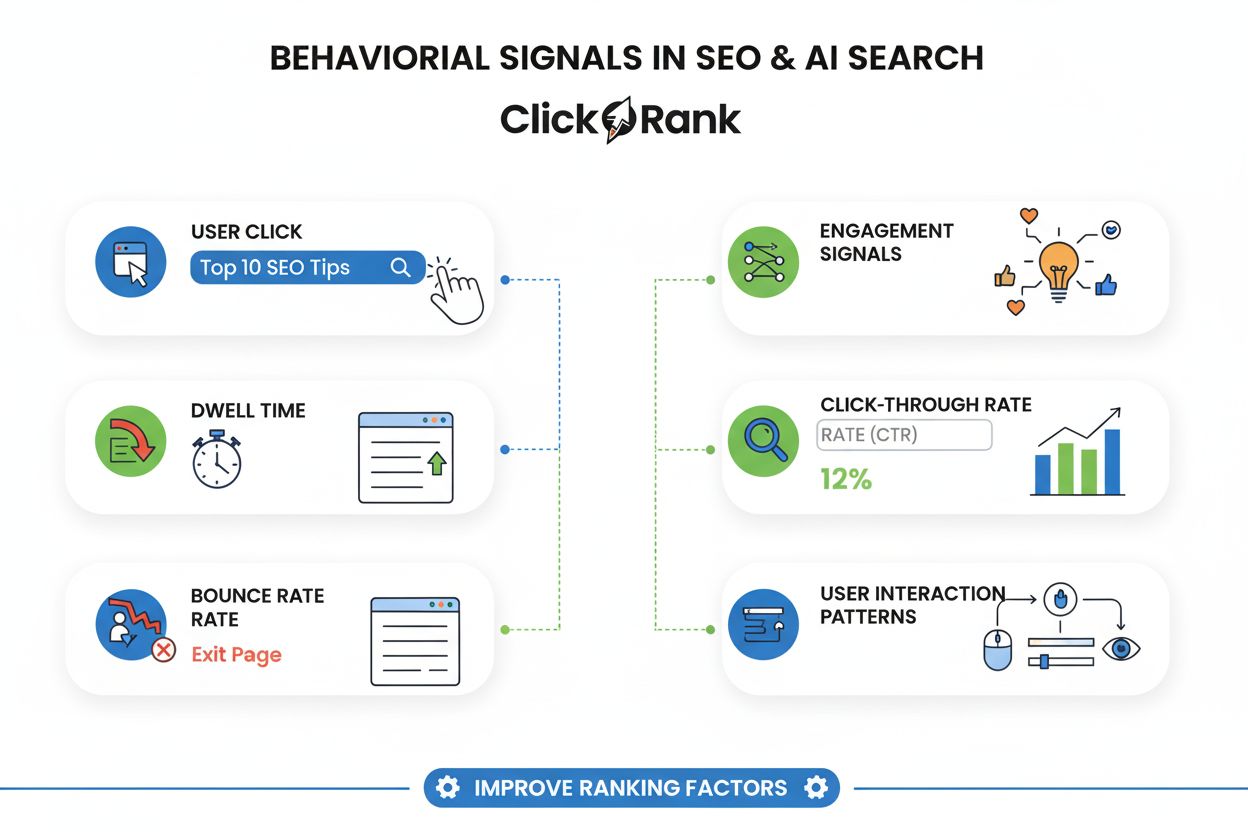
Behaviorale Signale sind messbare Nutzeraktionen und Interaktionsmuster – wie Klickraten (CTR), Verweildauer, Absprungraten und Engagement-Metriken –, die von Suchmaschinen und KI-Systemen analysiert werden, um die Qualität, Relevanz und Zufriedenheit mit Inhalten zu bewerten. Diese Signale zeigen an, ob Nutzer Inhalte als wertvoll empfinden, und beeinflussen direkt Suchrankings sowie KI-Zitationsmuster.
Behaviorale Signale sind messbare Nutzeraktionen und Interaktionsmuster – wie Klickraten (CTR), Verweildauer, Absprungraten und Engagement-Metriken –, die von Suchmaschinen und KI-Systemen analysiert werden, um die Qualität, Relevanz und Zufriedenheit mit Inhalten zu bewerten. Diese Signale zeigen an, ob Nutzer Inhalte als wertvoll empfinden, und beeinflussen direkt Suchrankings sowie KI-Zitationsmuster.
Behavioral signals are quantifiable metrics that measure how users interact with web content and search results. These signals encompass every action a visitor takes—from clicking a link in search results to scrolling through a page, spending time reading content, or navigating to related pages. Behavioral signals serve as direct indicators of content quality, relevance, and user satisfaction to both search engines and AI systems. Unlike static ranking factors such as backlinks or keyword density, behavioral signals are dynamic, real-time data points that continuously evolve based on actual user behavior. Search engines like Google, along with AI platforms such as ChatGPT, Perplexity, and Claude, analyze these signals to determine whether content genuinely serves user needs. The importance of behavioral signals has grown exponentially as search engines shift from purely algorithmic ranking to machine learning systems that prioritize user experience and satisfaction metrics.
The concept of behavioral signals in search ranking emerged gradually as search engines evolved beyond simple keyword matching. In the early 2000s, Google primarily relied on backlinks and keyword relevance, but the introduction of Google’s 2015 patent “Modifying search result ranking based on implicit user feedback and a model of presentation bias” marked a pivotal moment in SEO history. This patent revealed that Google was actively collecting and analyzing user behavior data to adjust rankings. The patent demonstrated that Google could track metrics like clicks, dwell time, and user location to refine search results. Over the past decade, behavioral signals have become increasingly sophisticated, with Google’s RankBrain algorithm—introduced in 2015 and now one of Google’s three most important ranking factors—relying heavily on machine learning to interpret user behavior patterns. According to industry research, approximately 78% of enterprises now use AI-driven content monitoring tools to track how their content performs across search engines and AI platforms, recognizing that behavioral signals directly impact visibility. The rise of conversational AI has further elevated the importance of behavioral signals, as AI systems now analyze user engagement patterns to determine which sources to cite in generated responses.
Click-Through Rate (CTR) represents the percentage of search impressions that result in clicks to your website. When a user sees your page in search results and clicks on it, that action signals relevance to the search engine. A high CTR indicates that your meta title and description effectively communicate your content’s value. Research shows that pages ranking in the top three positions receive approximately 32% of all clicks, while pages on the second page of results receive less than 1% of clicks. This demonstrates how CTR directly correlates with ranking position and visibility.
Dwell time measures the duration a user spends on your page before returning to search results. Longer dwell times suggest that users find your content engaging and valuable. Studies indicate that average dwell time across websites ranges from 2-4 minutes, with high-performing content often exceeding this benchmark. Dwell time is particularly important for AI systems evaluating source credibility, as longer engagement suggests the content provides comprehensive, authoritative information worthy of citation.
Bounce rate tracks the percentage of visitors who leave your site after viewing only one page without taking any action. A high bounce rate—typically above 50-60% depending on industry—signals that content may not meet user expectations or that the page has usability issues. Conversely, a low bounce rate indicates strong content-user alignment and positive user experience.
Pogo-sticking occurs when users click on your search result, quickly return to the search results, and click on a competitor’s result instead. This behavior strongly signals dissatisfaction with your content. When pogo-sticking happens frequently, search engines interpret it as a ranking signal to demote your page in favor of competitors who better satisfy user intent.
| Metric | Behavioral Signals | Traditional Ranking Factors |
|---|---|---|
| Nature | Dynamic, real-time user interactions | Static, external indicators |
| Source | Direct user actions on your site | External websites and links |
| Measurement | Immediate and continuous | Accumulated over time |
| Examples | CTR, dwell time, bounce rate, engagement | Backlinks, domain authority, keywords |
| Responsiveness | Changes within hours or days | Changes over weeks or months |
| AI Relevance | Directly influences AI citation patterns | Indirectly influences through ranking position |
| User Intent | Directly reflects user satisfaction | Reflects external authority perception |
| Optimization Speed | Quick improvements possible | Long-term strategy required |
| Transparency | Partially visible in analytics tools | Visible through SEO tools and audits |
Search engines employ sophisticated machine learning systems to interpret behavioral signals. Google’s RankBrain, which processes approximately 15% of all Google searches that have never been seen before, relies heavily on behavioral signals to understand search intent and deliver relevant results. When RankBrain encounters a novel search query, it analyzes how users interact with the returned results to determine if they satisfy the search intent. If users consistently click on certain results and spend significant time on those pages, RankBrain learns that those results are relevant and may boost their rankings for similar queries in the future.
The Navboost patent, another critical Google innovation, explicitly describes how Google uses user interaction signals to rank pages. According to Google’s own documentation revealed during the DOJ antitrust trial, “not one system, but a great many within ranking are built on logs”—meaning behavioral data from user interactions feeds directly into multiple ranking algorithms. This includes not just traditional systems but also “the most cutting-edge machine learning systems, many of which we’ve announced externally—RankBrain, RankEmbed, and DeepRank.” This revelation confirms that behavioral signals are foundational to modern search ranking, not peripheral factors.
The emergence of conversational AI platforms has created a new dimension for behavioral signals. Unlike traditional search engines that rank pages, AI systems like ChatGPT, Perplexity, Google AI Overviews, and Claude analyze behavioral signals to determine which sources to cite in generated responses. When your content generates strong engagement metrics—high dwell time, low bounce rates, positive user interactions—AI systems recognize it as authoritative and valuable. This makes your content more likely to be cited in AI-generated answers, directly affecting your brand’s visibility in conversational AI search.
AmICited and similar AI monitoring platforms track behavioral signals across multiple AI systems to measure brand visibility. These platforms analyze not just whether your brand is mentioned, but how frequently users engage with your citations in AI responses. Strong behavioral signals increase the likelihood that your content will be selected as a source for AI-generated answers, creating a virtuous cycle where visibility leads to more traffic, which generates stronger behavioral signals, which increases future visibility.
Optimizing behavioral signals requires a multi-faceted approach combining technical excellence with content strategy. Page speed optimization is foundational—pages that load in under 2.5 seconds (Google’s Largest Contentful Paint threshold) experience significantly lower bounce rates. Research shows that a one-second delay in page load time can result in a 7% reduction in conversions, demonstrating the direct impact of technical performance on behavioral signals.
Content structure and readability directly influence dwell time. Using clear heading hierarchies (H1, H2, H3 tags), breaking content into scannable sections, and incorporating relevant visuals increases user engagement. Studies show that content with images receives 94% more views than text-only content, directly improving dwell time metrics.
Internal linking strategy guides users deeper into your site, improving session duration and reducing bounce rates. Strategic internal links to related, high-value content encourage users to explore multiple pages, generating positive behavioral signals across your entire site. Research indicates that sites with strong internal linking structures see 30-40% longer average session durations compared to sites with minimal internal linking.
Mobile optimization is non-negotiable—over 60% of all web traffic comes from mobile devices, and mobile users exhibit different behavioral patterns than desktop users. Mobile pages must load quickly, display content clearly without excessive pop-ups, and provide intuitive navigation to maintain positive behavioral signals.
The relationship between search intent and behavioral signals is fundamental to modern SEO. When content perfectly aligns with user search intent, behavioral signals naturally improve. Users who find exactly what they’re searching for spend more time on the page, click internal links, and are more likely to convert. Conversely, content that misses user intent generates negative behavioral signals—high bounce rates, low dwell time, and pogo-sticking.
Understanding the four types of search intent—informational (seeking knowledge), navigational (finding a specific site), transactional (making a purchase), and commercial investigation (researching before buying)—is essential for optimizing behavioral signals. Content must be structured to satisfy the specific intent behind the search query. For example, a transactional query like “buy running shoes” should lead to product pages with clear purchasing options, while an informational query like “how to choose running shoes” should lead to comprehensive guides with detailed comparisons.
The future of behavioral signals extends beyond traditional search into the rapidly expanding AI search landscape. As AI search platforms mature, behavioral signals will become increasingly important for determining which sources AI systems cite. Currently, approximately 35% of marketers report tracking their brand visibility in AI search results, but this number is expected to grow significantly as AI search becomes mainstream.
Generative Engine Optimization (GEO) is emerging as a new discipline focused specifically on optimizing content for AI search visibility. Unlike traditional SEO, which optimizes for search engine algorithms, GEO optimizes for AI system preferences—and behavioral signals play a central role. Content that generates strong engagement metrics will be prioritized by AI systems when selecting sources for generated responses. This creates a new imperative for content creators: optimize not just for search engine rankings, but for user engagement patterns that signal quality to AI systems.
The integration of behavioral signals with Core Web Vitals—Google’s official page experience metrics—represents another evolution. Core Web Vitals measure technical performance (Largest Contentful Paint, First Input Delay, Cumulative Layout Shift), while behavioral signals measure user response to that performance. Together, they form a comprehensive picture of page quality. As search engines and AI systems become more sophisticated, the distinction between technical metrics and behavioral signals will blur, with both becoming essential components of a unified quality assessment system.
The importance and interpretation of behavioral signals vary significantly across industries. E-commerce sites rely heavily on conversion rate signals—the ultimate behavioral indicator of user satisfaction. A product page with high CTR but low conversion rate signals that the page attracts users but fails to convince them to purchase, indicating potential issues with product descriptions, pricing, trust signals, or checkout process.
Content-heavy sites like blogs and news publications depend on dwell time and engagement metrics. Articles that keep readers scrolling, commenting, and sharing generate strong behavioral signals indicating content quality. These sites often see average session durations of 3-5 minutes for high-performing content, compared to under 1 minute for underperforming content.
SaaS and service websites benefit from behavioral signals indicating feature exploration and demo engagement. When users navigate to pricing pages, watch product demos, or explore feature comparisons, these actions signal genuine interest and intent. High engagement with these elements generates positive behavioral signals that improve rankings for commercial keywords.
Local businesses see behavioral signals influence local search rankings through Google Business Profile interactions. When users click on your business profile, read reviews, view photos, and request directions, these actions signal local relevance and trustworthiness. Research shows that businesses with higher engagement on their Google Business Profile rank significantly higher in local search results.
Effective behavioral signal optimization requires robust measurement and monitoring systems. Google Analytics 4 provides foundational metrics including bounce rate, average session duration, and conversion rates. Google Search Console offers CTR and impression data directly from search results. However, comprehensive behavioral signal analysis requires additional tools. Semrush, Ahrefs, and Moz provide competitive benchmarking, allowing you to compare your behavioral signals against industry competitors. Hotjar and Crazy Egg offer heatmaps and session recordings that reveal exactly how users interact with your pages, identifying friction points and optimization opportunities.
For AI search visibility, AmICited and similar platforms monitor behavioral signals across multiple AI systems. These tools track not just whether your brand is cited, but how frequently users engage with your citations, providing insights into how AI systems perceive your content quality. By monitoring behavioral signals across both traditional search and AI search, you gain a comprehensive understanding of your content’s performance and can identify optimization opportunities across all search channels.
Zu den wichtigsten behavioralen Signalen gehören die Klickrate (CTR), die misst, wie oft Nutzer Ihr Ergebnis in den Suchergebnissen anklicken; die Verweildauer, also wie lange Nutzer auf Ihrer Seite bleiben, bevor sie zu den Suchergebnissen zurückkehren; die Absprungrate, also der Prozentsatz der Nutzer, die ohne weitere Interaktion wieder gehen; und Pogo-Sticking, wenn Nutzer schnell zu den Suchergebnissen zurückkehren, um ein anderes Ergebnis auszuprobieren. Diese Metriken zeigen Suchmaschinen zusammengefasst, wie relevant Inhalte sind und wie zufrieden die Nutzer damit sind.
Während Backlinks statische Indikatoren für Autorität auf Basis externer Verweise sind, sind behaviorale Signale dynamische, Echtzeit-Metriken, die tatsächliche Nutzerinteraktionen mit Ihren Inhalten widerspiegeln. Backlinks messen das Vertrauen anderer Websites, wohingegen behaviorale Signale das Vertrauen und die Zufriedenheit echter Besucher messen. Beide sind wichtig, aber behaviorale Signale geben unmittelbares Feedback darüber, ob Inhalte die Bedürfnisse der Nutzer wirklich erfüllen.
Ja, behaviorale Signale beeinflussen die KI-Sichtbarkeit zunehmend. Wenn Inhalte starke Engagement-Metriken aufweisen – hohe Verweildauer, niedrige Absprungraten und positive Nutzerinteraktionen –, erkennen KI-Systeme sie als autoritativ und wertvoll an. Dadurch werden diese Inhalte mit größerer Wahrscheinlichkeit in KI-generierten Antworten von Plattformen wie ChatGPT, Perplexity und Google AI Overviews zitiert, was die Markenpräsenz in Conversational AI direkt beeinflusst.
Verbessern Sie behaviorale Signale, indem Sie Inhalte erstellen, die direkt auf die Suchintention der Nutzer eingehen. Optimieren Sie die Ladegeschwindigkeit der Seite, um Absprungraten zu senken, nutzen Sie klare Formatierung mit Überschriften und visuellen Elementen für eine bessere Nutzerbindung, setzen Sie strategisches internes Verlinken ein, um Nutzer tiefer durch Ihre Website zu führen, und sorgen Sie für mobile Responsivität. Darüber hinaus sollten Sie ansprechende Meta-Titel und Beschreibungen verfassen, um die CTR aus den Suchergebnissen zu erhöhen.
Googles RankBrain, ein System des maschinellen Lernens, verlässt sich stark auf behaviorale Signale, um Suchintentionen zu verstehen und das Ranking zu verfeinern. RankBrain analysiert Nutzerinteraktionsmuster, um zu ermitteln, ob Suchergebnisse die Nutzeranfragen zufriedenstellen. Wenn Nutzer positiv mit Inhalten interagieren (längere Verweildauer, niedrigere Absprungraten), interpretiert RankBrain dies als Relevanz und kann das Ranking verbessern. Damit sind behaviorale Signale entscheidend für den modernen SEO-Erfolg.
Behaviorale Signale und Core Web Vitals sind miteinander verbundene Ranking-Faktoren. Core Web Vitals messen die technische Performance (Ladegeschwindigkeit, Interaktivität, visuelle Stabilität), während behaviorale Signale die Nutzerreaktion darauf erfassen. Schlechte Core Web Vitals führen zu höheren Absprungraten und kürzerer Verweildauer – also negativen behavioralen Signalen. Gemeinsam bilden sie Googles Page-Experience-Rankingsystem, weshalb beide für SEO essenziell sind.
Die Bedeutung behavioraler Signale variiert je nach Website-Typ. E-Commerce-Seiten profitieren besonders von Konversionsraten-Signalen, während inhaltsreiche Blogs auf Verweildauer und Engagement-Metriken angewiesen sind. Lokale Unternehmen sehen die Auswirkungen behavioraler Signale in den lokalen Rankings durch Interaktionen im Google-Unternehmensprofil. SaaS-Plattformen profitieren von Signalen wie Feature-Erkundung und Demo-Engagement. Das Verständnis des eigenen Website-Typs hilft dabei, die richtigen behavioralen Signale zu priorisieren.
Nutzen Sie Google Analytics 4, um Absprungrate, durchschnittliche Sitzungsdauer und Konversionsraten zu verfolgen. Die Google Search Console liefert Daten zu Klickrate und Impressionen. Tools wie Semrush, Ahrefs und Hotjar bieten tiefere Einblicke in das Nutzerverhalten, darunter Nutzerfluss, Heatmaps und Engagement-Muster. Für KI-Sichtbarkeit überwacht AmICited, wie Ihre Marke in KI-Suchergebnissen erscheint, und verfolgt Zitierungsmuster über ChatGPT, Perplexity und andere KI-Systeme hinweg.
Beginnen Sie zu verfolgen, wie KI-Chatbots Ihre Marke auf ChatGPT, Perplexity und anderen Plattformen erwähnen. Erhalten Sie umsetzbare Erkenntnisse zur Verbesserung Ihrer KI-Präsenz.
Relevanzsignale sind Indikatoren, die KI-Systeme zur Bewertung der Anwendbarkeit von Inhalten nutzen. Erfahren Sie, wie Keyword-Übereinstimmung, semantische Rel...
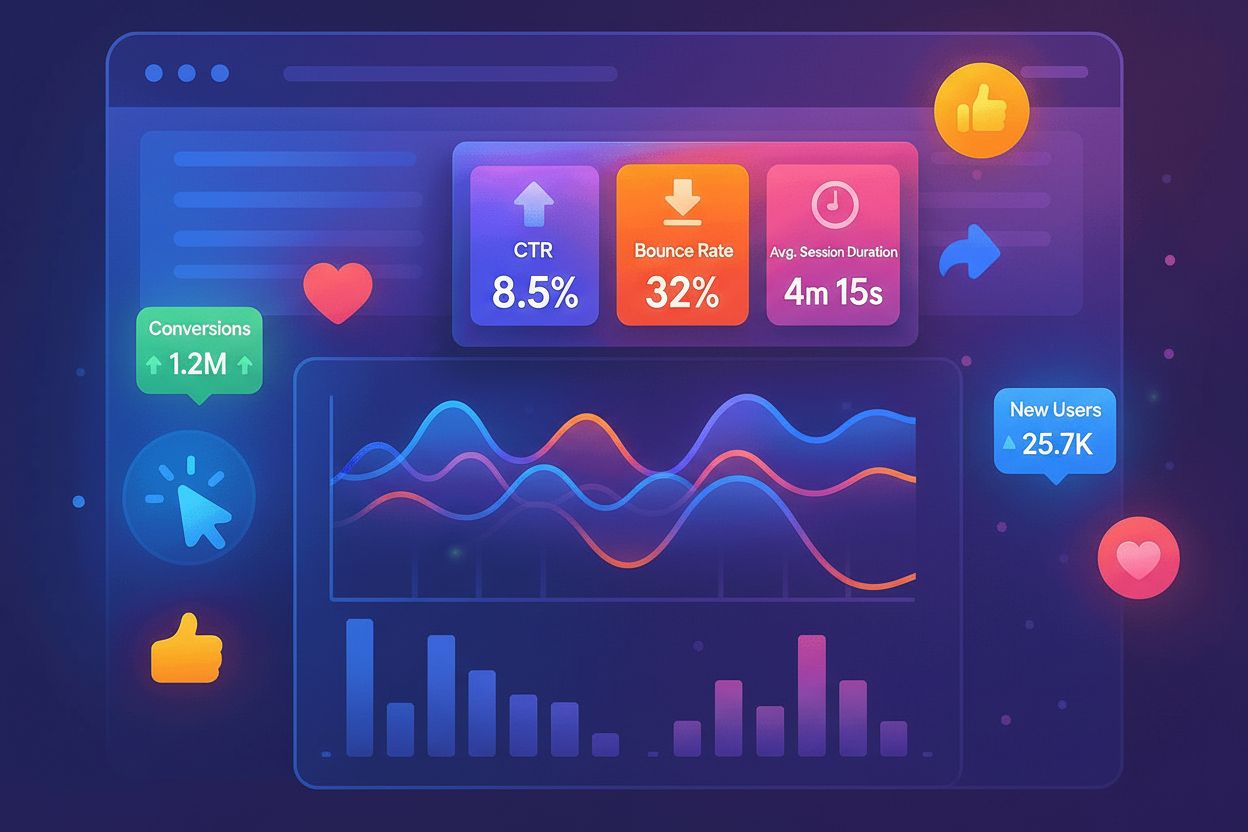
Engagement-Signale sind messbare Indikatoren für die Interaktion von Nutzern mit digitalen Inhalten. Erfahren Sie, wie Klicks, verbrachte Zeit, Shares und Conve...

Brand-Signale sind Ranking-Indikatoren, die Suchmaschinen zur Messung der Markenautorität und Glaubwürdigkeit nutzen. Erfahren Sie, wie Markensuchen, Zitationen...