Discussion Competitive Analysis Analytics

How are you actually benchmarking AI visibility against competitors? Our current approach feels amateur

CO
CompetitiveIntel_Jason · Competitive Intelligence Manager
· · 127 upvotes · 11 comments
CJ
CompetitiveIntel_Jason
Competitive Intelligence Manager · January 5, 2026

I’ve been doing competitive intelligence for 10 years. I know how to benchmark against competitors in traditional search, paid media, social - you name it.

But AI visibility benchmarking? I feel like I’m making it up as I go.

What we’re currently doing (and it feels inadequate):

  • Manual spot checks of 20 prompts weekly
  • Spreadsheet tracking who gets mentioned
  • Rough percentage of “won” vs “lost” prompts

What I want to know:

  • What metrics actually matter for AI competitive benchmarking?
  • How do you define who your “AI competitors” are? (They might differ from traditional competitors)
  • What tools/frameworks are people using?
  • How often should benchmarking happen?

I know I’m not alone in figuring this out. What’s working for everyone else?

11 comments

11 Comments

AS
AIBenchmark_Specialist Expert AI Visibility Consultant · January 5, 2026

Let me share the framework I use with clients:

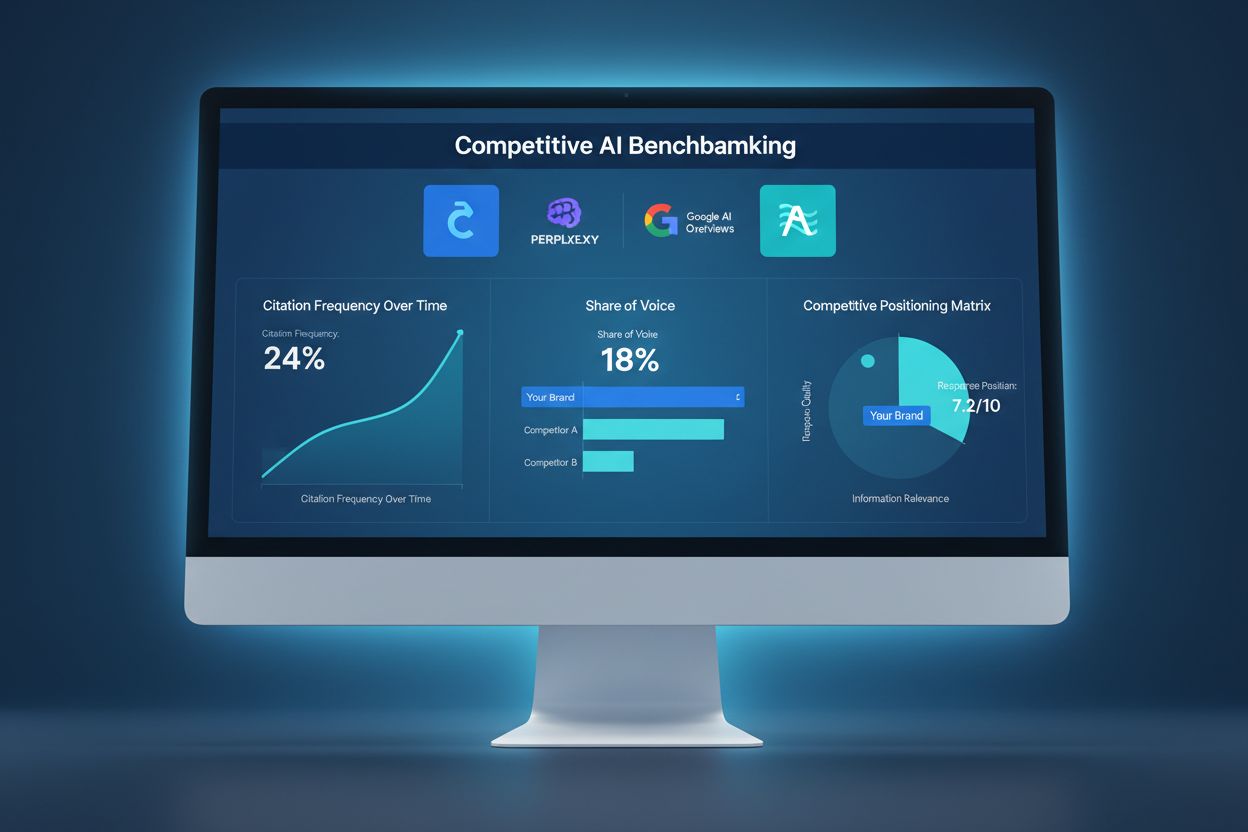
The 5 Core Metrics for AI Competitive Benchmarking:

MetricWhat It MeasuresTarget Benchmark
Citation Frequency Rate (CFR)% of relevant queries where you appear15-30% for established brands
Response Position Index (RPI)Where you appear in response (1st, 2nd, etc.)7.0+ on 10-point scale
Competitive Share of Voice (CSOV)Your mentions vs total competitor mentions25%+ in your category
Sentiment ScoreHow AI describes you (positive/neutral/negative)80%+ positive
Source Diversity IndexHow many AI platforms cite you4+ platforms

How to calculate these:

  • CFR = (Your mentions / Total relevant queries tested) x 100
  • RPI = Weighted score (First mention=10, Second=7, Third=4, etc.)
  • CSOV = Your mentions / (Your + All competitor mentions) x 100

What “winning” looks like:

Market leaders: 35-45% CSOV Strong competitors: 20-30% CSOV Emerging brands: 5-15% CSOV

Manual testing won’t give you statistical significance. You need automated monitoring across hundreds of queries.

CJ
CompetitiveIntel_Jason OP · January 5, 2026
Replying to AIBenchmark_Specialist

This framework is exactly what I needed.

Question: How do you define the “relevant queries” you test against? Do you work from a fixed query set or expand it over time?

AS
AIBenchmark_Specialist Expert · January 5, 2026
Replying to CompetitiveIntel_Jason

Both. Here’s my approach:

Core query set (fixed, for trend tracking):

  • 50-100 queries that represent your primary value proposition
  • Mix of branded, category, and problem-based queries
  • Keep these consistent for apples-to-apples comparison over time

Expansion set (dynamic, for discovery):

  • New queries based on market changes
  • Competitor activity triggers
  • Emerging topics in your space

Query categorization:

  1. Branded queries: “[Your brand] vs [competitor]”
  2. Category queries: “Best [product category]”
  3. Problem queries: “How to solve [problem you address]”
  4. Feature queries: “Tools with [feature]”
  5. Use case queries: “[Specific use case] solution”

Am I Cited lets you set up both fixed and dynamic query tracking. I usually do 60% fixed core + 40% dynamic expansion.

MP
MarketingAnalyst_Priya Marketing Analytics Lead · January 5, 2026

Adding the data science perspective:

Your AI competitors may not be who you think.

We assumed our AI competitors were the same as our traditional competitors. We were wrong.

How we identified actual AI competitors:

  1. Ran 200 queries across AI platforms
  2. Documented every brand mentioned
  3. Created mention frequency matrix
  4. Analyzed co-occurrence patterns

What we found:

  • 3 of our top 5 traditional competitors rarely appeared in AI
  • 2 brands we’d never considered showed up frequently
  • One “dead” competitor still appeared due to historical web presence

The lesson:

AI competitors are whoever AI thinks is relevant to the queries your customers ask. That may not match your traditional competitive set.

Run the analysis. Let data define your AI competitive landscape.

BS
B2BMarketer_Steve · January 4, 2026

Frequency matters for benchmarking.

What we learned the hard way:

We did monthly benchmarks. Thought we were doing fine. Then a competitor published a major content series, and by the time we noticed in our next monthly check, they’d pulled ahead significantly.

Current approach:

  • Weekly: Core query tracking (automated)
  • Daily: Brand mention alerts for significant changes
  • Monthly: Deep competitive analysis report
  • Quarterly: Strategy review based on trends

What triggers an immediate deep dive:

  • Competitor share of voice increases 10%+ suddenly
  • Our citation rate drops unexpectedly
  • New competitor starts appearing we haven’t tracked
  • Major product launch (ours or competitor)

AI visibility changes faster than traditional SEO rankings. Monthly isn’t frequent enough for meaningful competitive intelligence.

ER
EnterpriseCI_Rebecca Enterprise Competitive Intelligence · January 4, 2026

Enterprise perspective on scaling this:

The challenge: We track 50+ competitors across 8 product lines. Manual benchmarking is impossible.

Our stack:

  1. Am I Cited for multi-platform AI visibility tracking
  2. Custom dashboards connecting CI data to business outcomes
  3. Automated alerting for competitive shifts
  4. Quarterly executive briefings on AI competitive landscape

What we report to leadership:

  • AI Share of Voice by product category
  • Competitive position trends (improving/declining)
  • Threat assessment (which competitors are gaining fastest)
  • Gap analysis (where are we losing to competitors)
  • Recommended actions with resource requirements

The key insight:

AI visibility is now part of competitive intelligence, not a separate discipline. It goes in the same reports as market share, win/loss analysis, and brand perception data.

SC
StartupFounder_Chris · January 4, 2026

Startup take:

We can’t afford comprehensive competitive monitoring tools yet. Here’s our scrappy approach:

Weekly manual process (2 hours):

  1. Run 30 core queries across ChatGPT and Perplexity
  2. Document: Did we appear? What position? Who else appeared?
  3. Note any changes from last week
  4. Update simple spreadsheet tracker

Monthly analysis (2 hours):

  1. Calculate share of voice trends
  2. Identify patterns (which query types we win/lose)
  3. Note competitor content that’s getting cited
  4. Prioritize content gaps to address

What we track:

  • Win rate (% of queries where we’re mentioned first)
  • Competitive overlap (who appears alongside us)
  • Gap queries (where we should appear but don’t)
  • Threat queries (where competitors dominate)

It’s not fancy, but it’s better than nothing. As we grow, we’ll invest in proper tooling.

S
SEOAgencyDirector Expert SEO Agency Director · January 3, 2026

For agency folks serving multiple clients:

Benchmark framework we use:

  1. Industry baseline: What’s typical for this vertical?
  2. Leader benchmark: What does #1 player look like?
  3. Client baseline: Where is client starting from?
  4. Target benchmark: Realistic goals based on resources
  5. Progress tracking: Monthly vs targets

Industry-specific observations:

  • SaaS: Very competitive, 20% CFR is good for mid-market
  • Local services: Less competitive, 40%+ achievable
  • E-commerce: Dominated by Amazon/giants, niche positioning needed
  • Professional services: Authority signals matter most

What clients actually want to know:

  1. Are we visible when customers ask AI about solutions?
  2. How do we compare to specific named competitors?
  3. What do we need to do to improve?
  4. How long will it take to see results?

Frame benchmarks around these questions, not vanity metrics.

DM
DataViz_Marcus Data Visualization Specialist · January 3, 2026

On visualization:

What works for communicating AI competitive benchmarks:

  1. Trend lines - Share of voice over time (you vs competitors)
  2. Heatmaps - Query categories x performance (green/yellow/red)
  3. Spider/radar charts - Multi-metric comparison (CFR, position, sentiment, etc.)
  4. Competitive waterfall - Changes period over period by driver

What doesn’t work:

  • Raw data dumps
  • Too many metrics at once
  • No context (what does “23% CFR” even mean?)
  • Missing competitive comparison (standalone numbers are meaningless)

Dashboard design tip:

Start with the answer to “Are we winning or losing in AI?” Everything else supports that top-line answer.

CJ
CompetitiveIntel_Jason OP Competitive Intelligence Manager · January 3, 2026

This thread has been incredibly helpful. Here’s my synthesis:

Framework I’m implementing:

  1. Define AI competitive set through data, not assumption
  2. Core metrics: CFR, RPI, CSOV, Sentiment, Source Diversity
  3. Fixed + dynamic query sets for consistent tracking
  4. Weekly automated + monthly deep analysis rhythm
  5. Executive-friendly visualization tied to business outcomes

Immediate next steps:

  1. Run 200 query analysis to identify true AI competitors
  2. Set up automated monitoring (evaluating Am I Cited)
  3. Establish baselines across all core metrics
  4. Create dashboard template for ongoing tracking
  5. Brief leadership on AI competitive landscape

Key mindset shift:

AI visibility is competitive intelligence, not a separate discipline. It belongs in the same conversations as market share and brand perception.

Thanks everyone for contributing. This community is incredible.

Have a Question About This Topic?

Get personalized help from our team. We'll respond within 24 hours.

Frequently Asked Questions

What metrics should I track for AI visibility benchmarking?
Key metrics include Citation Frequency Rate (how often you appear), Response Position Index (where you appear in responses), Competitive Share of Voice (your mentions vs competitors), and Sentiment Score (how AI describes you).
How do I identify my AI competitors?
AI competitors may differ from traditional competitors. Look at which brands AI mentions alongside yours, which brands AI cites instead of you for relevant queries, and which brands users compare you against in AI queries.
How often should I benchmark AI visibility?
Weekly monitoring during aggressive growth phases, monthly for maintenance. AI responses change frequently, so more frequent tracking catches competitive shifts early.
What's a good target for AI share of voice?
Market leaders typically maintain 35-45% share of voice, strong competitors 20-30%, and emerging brands 5-15%. Your target depends on market position and resources.

Benchmark Your AI Visibility vs Competitors

See how your brand stacks up against competitors in AI-generated answers. Track share of voice, citation frequency, and positioning across ChatGPT, Perplexity, and more.

Learn more

Competitive AI Benchmarking
Competitive AI Benchmarking: Track Your Brand Against Competitors

Competitive AI Benchmarking

Learn how to benchmark your AI visibility against competitors. Track citations, share of voice, and competitive positioning across ChatGPT, Perplexity, and Goog...

9 min read