
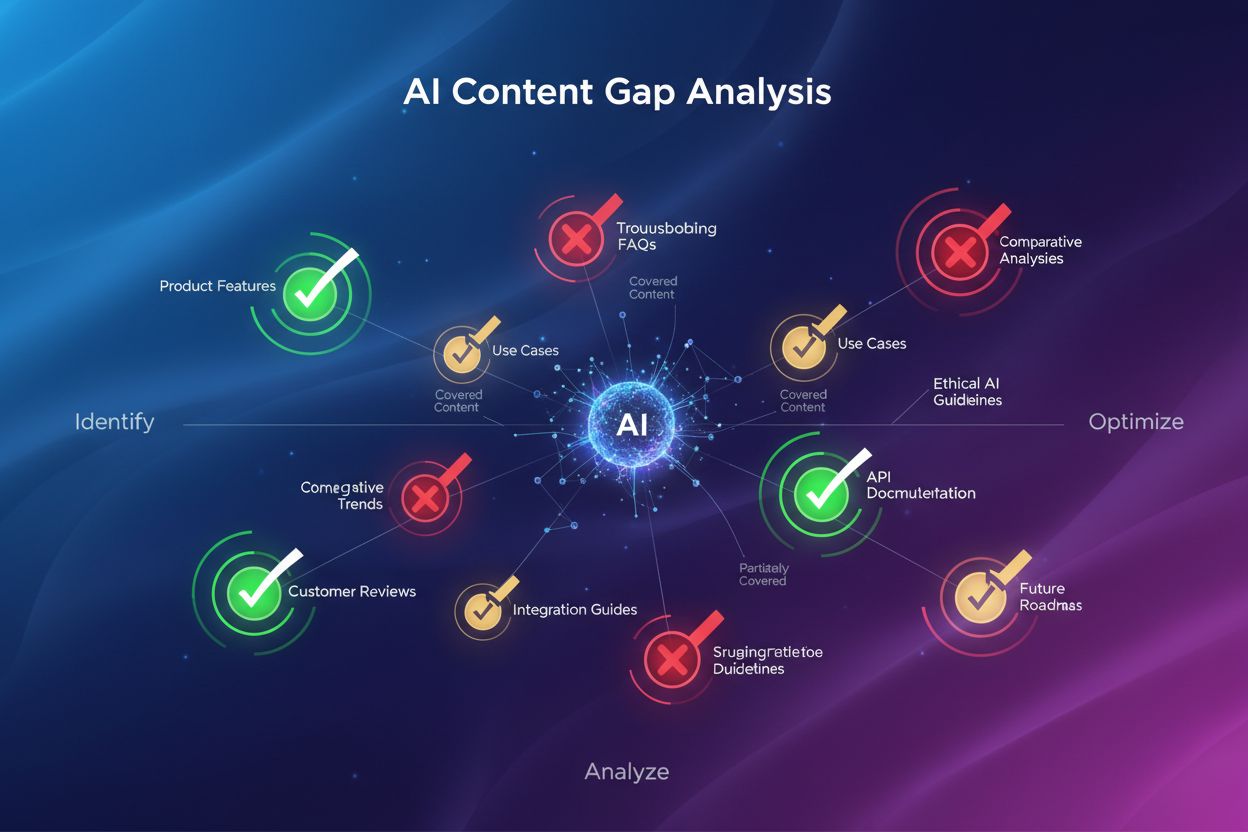
AI Content Gap Analysis
Learn what AI Content Gap Analysis is and how to identify content gaps to improve your visibility in AI Overviews, ChatGPT, and generative search engines. Disco...
9 min read
Traditional content gap analysis: Look at keywords competitors rank for that you don’t.
But for AI search, this doesn’t capture the full picture. AI doesn’t just “rank” content - it cites sources for specific information. The gaps are different.
What I’m finding:
What I need:
Has anyone developed a systematic approach to AI content gap analysis?
I developed a methodology for this. AI gap analysis is fundamentally different from keyword gaps.
The AI Gap Analysis Framework:
Step 1: Build Your Question Map
Start with your topic/category. List every question someone might ask AI:
Aim for 50-100 questions covering your space.
Step 2: Test Each Question
For each question, query ChatGPT, Perplexity, and Gemini. Record:
Step 3: Categorize Your Gaps
Gap Type 1: Competitor Cited, You’re Not They have content, you don’t. Or their content is better structured.
Gap Type 2: No Good Source (AI Synthesizes Poorly) AI pieces together answer from multiple sources. Opportunity to be THE source.
Gap Type 3: You’re Cited, But Not First You appear, but others appear more prominently.
Step 4: Prioritize by Opportunity
Identifying “No Good Source” Opportunities:
Signs that AI lacks a good source:
AI gives vague answer Generic response without specific citations or details.
Multiple sources cited When AI cites 4-5 different sources for one answer, none is authoritative.
Hedging language “Some experts suggest…” “It depends…” without clear guidance.
Outdated information AI cites sources from 2-3+ years ago because nothing current exists.
Conflicting citations AI mentions different approaches from different sources without synthesizing.
How to find these systematically:
Query your topic space with increasingly specific questions. The more specific, the more likely you’ll hit “no good source” territory.
Example progression:
Niche + specific = opportunity for authority.
When you find these, create THE definitive resource. No competition. Pure opportunity.
Competitor-focused gap analysis:
Step 1: Identify Top 3 Competitors Who appears most in AI responses for your category?
Step 2: Reverse Engineer Their Coverage What questions trigger their citations? What content formats get cited?
Step 3: Map Your Overlap
Create comparison matrix:
| Question | Competitor A | Competitor B | Us |
|---|---|---|---|
| “What is X?” | Cited | Not cited | Cited |
| “How to X?” | Cited | Cited | NOT |
| “X vs Y?” | NOT | Cited | NOT |
Step 4: Prioritize Your Gaps
Focus on questions where:
The insight:
Competitors’ AI visibility reveals proven citation opportunities. They’ve done the demand validation for you. Now create better content.
Where to find questions people ask AI:
1. Your Own Support/Sales Teams What questions do customers ask that they might have asked AI first?
2. Reddit and Forums What questions are people asking in your space? Especially look for “I asked ChatGPT about X and…”
3. Answer the Public / AlsoAsked Traditional question tools still help identify question patterns.
4. ChatGPT Itself Ask: “What questions might someone ask about [your topic]?” AI generates its own question ideas.
5. Perplexity Related Questions After a query, Perplexity suggests related questions. Mine these.
6. Your Analytics What internal search queries do people run on your site? Often overlap with AI queries.
7. Competitor Content What questions do their FAQs answer? What do their H2s ask?
Build a master list. Test each in AI. Find your gaps.
Quantifying gap opportunity:
Not all gaps are equal. Prioritize by:
1. Citation Frequency How often does this question type get asked? More common question = bigger opportunity.
2. Commercial Value Does this question lead to buying decisions? “What is X” = informational “Best X for [use case]” = commercial “X vs Y pricing” = high commercial intent
3. Authority Achievability Can you realistically become THE source? Your core expertise = more achievable Tangential topics = harder
4. Content Investment What would it take to create definitive content? Quick win (restructure existing) vs. major project (new research)
Scoring matrix:
| Gap | Frequency | Commercial | Achievability | Investment | Score |
|---|---|---|---|---|---|
| Gap 1 | High | Medium | High | Low | Priority 1 |
| Gap 2 | Medium | High | High | Medium | Priority 2 |
| Gap 3 | High | Low | Medium | High | Priority 3 |
Prioritize: High frequency + High commercial + High achievability + Low investment
The biggest opportunities are often in niches:
Why niche gaps are valuable:
Less competition Fewer players = easier to become THE source.
Higher specificity = higher trust “Expert in [specific thing]” > “We cover everything.”
Better match to queries Specific questions get specific answers. If you have the specific content, you get cited.
How to find niche gaps:
Take any broad topic. Add modifiers:
Each modifier creates a niche question. Test which have gaps.
Example:
Broad: “Email marketing best practices” (Tons of competition, hard to stand out)
Niche: “Email marketing for B2B SaaS free trial conversion” (Specific, fewer sources, achievable authority)
Find your niches. Own them completely.
This thread gave me a complete methodology. Here’s my plan:
Phase 1: Question Mapping (Week 1)
Phase 2: Gap Testing (Week 2)
Phase 3: Prioritization (Week 3)
Phase 4: Content Planning (Week 4)
Key insight:
AI gap analysis isn’t about keywords. It’s about citation opportunities. Find questions where you could be THE source, not just A source.
Thanks everyone for the frameworks and specific techniques!
Get personalized help from our team. We'll respond within 24 hours.
Monitor which topics AI cites competitors for and discover content opportunities for your brand.
Learn what AI Content Gap Analysis is and how to identify content gaps to improve your visibility in AI Overviews, ChatGPT, and generative search engines. Disco...

Community discussion on identifying content opportunities for AI visibility. Marketers share strategies for finding queries where they can compete and win citat...
Community discussion on tools for finding AI search topics. How to identify keywords and questions that drive AI citations.
Cookie Consent
We use cookies to enhance your browsing experience and analyze our traffic. See our privacy policy.