

How Do I Structure Content for AI Citations? Complete Guide for 2025
Learn how to structure your content to get cited by AI search engines like ChatGPT, Perplexity, and Google AI. Expert strategies for AI visibility and citations...
8 min read
I’ve read all the advice about “structure content for AI” but the advice is vague. Show me specific examples.
What I need:
We have 300+ blog posts. I need to know exactly how to transform them for AI visibility, not more theory.
Here’s a real before/after with explanation:
BEFORE (Narrative style):
In today's competitive business landscape, companies
are increasingly recognizing the importance of customer
relationship management. Many organizations struggle
with implementing effective CRM systems, and this often
leads to missed opportunities for customer engagement.
When we look at the data, we see that businesses that
adopt CRM solutions tend to see improvements in their
sales processes. The implementation of a good CRM can
help companies track leads, manage customer interactions,
and ultimately increase revenue, though results vary
depending on the specific situation and implementation
approach.
AFTER (AI-optimized):
## What is CRM and Why Does It Matter?

CRM (Customer Relationship Management) is software
that helps businesses manage customer interactions,
track leads, and increase sales revenue. Companies
using CRM see an average 27% increase in lead
conversion rates.

**Key CRM benefits:**
- Lead tracking and management
- Customer interaction history
- Sales pipeline visibility
- Automated follow-up reminders

The best CRM choice depends on your business size,
industry, and integration requirements.
What changed:
Citation likelihood: Before: ~5% After: ~45%
The “after” content has 4 different sections AI could extract.
The first sentence of every section is everything.
The Rule: If someone only read the first sentence of each section, they should get the core message.
Testing your content:
Before: “There are many factors to consider when choosing a platform.” (Useless on its own)
After: “Salesforce is the best CRM for enterprises with 500+ employees and complex sales processes.” (Complete, citable answer)
More examples:
Bad: “Let’s explore this topic in detail.” Good: “Schema markup increases AI citation rates by 35%.”
Bad: “This is an important consideration for many businesses.” Good: “Small businesses should budget $50-200/month for CRM.”
Bad: “Here’s what you need to know.” Good: “FAQ pages are cited 3x more often than narrative blog posts.”
Lead every section with its key insight.
Paragraph rules for AI optimization:
The 120-Word Rule: Paragraphs over 120 words are hard for AI to extract as clean citations. Keep paragraphs short.
The One-Idea Rule: Each paragraph = one main idea. If you’re covering two topics, make two paragraphs.
The Stand-Alone Rule: Each paragraph should make sense if pulled from context.
Before:
When you're implementing a new content strategy,
it's important to think about your audience first,
and then you should consider what types of content
they prefer, whether that's blog posts, videos, or
podcasts, and also think about the platforms where
they spend time, like LinkedIn for B2B or Instagram
for B2C, and don't forget to analyze what your
competitors are doing successfully because this can
give you insights into what works in your industry.
(107 words, 4+ ideas, unparseable)
After:
Start every content strategy by defining your target
audience. Understanding who you're creating content
for determines every decision that follows.

Choose content formats based on audience preferences.
B2B audiences typically prefer blog posts and LinkedIn
content. B2C audiences engage more with Instagram
and video content.

Analyze competitor content to identify what works in
your industry. Look for their most-shared pieces and
topics that generate discussion.
(67 words, 3 paragraphs, 3 clear ideas)
Each paragraph can now be cited independently.
Heading formulas that work:
Question Headings (Best for AI):
Definition Headings:
Comparison Headings:
Action Headings:
Avoid:
Headings should answer: “What question does this section answer?”
Tables are citation gold. Transform text to tables:
Before (Narrative):
Salesforce is best for large enterprises and costs
$150-300/user. HubSpot is ideal for small to medium
businesses with a free tier and paid plans from
$45-120/user. Pipedrive focuses on sales teams and
costs $14-99/user.
After (Table):
| CRM | Best For | Pricing | Key Strength |
|---|---|---|---|
| Salesforce | Enterprise (500+ employees) | $150-300/user/mo | Customization |
| HubSpot | SMB | Free - $120/user/mo | All-in-one |
| Pipedrive | Sales teams | $14-99/user/mo | Simplicity |
Why tables work:
Table opportunities:
Anywhere you’re comparing things = table opportunity.
FAQ sections are the easiest restructure with highest ROI.
The FAQ Formula:
Every piece of content can have 3-5 FAQs at the end.
Question format: Use actual questions your audience asks.
Answer format:
Example:
Q: How long does CRM implementation take?
A: CRM implementation typically takes 2-6 months for mid-size companies. Simple setups with minimal customization can launch in 2-4 weeks. Enterprise implementations with complex integrations may require 6-12 months.
Add FAQ schema: Wrap these in FAQ schema markup. AI systems can directly extract question-answer pairs.
Our results: Added FAQs to 50 blog posts. AI citation rate for those posts increased 45% in 6 weeks.
FAQs are the easiest, highest-impact restructure you can do.
When to use different list formats:
Bullet Lists - Use for:
Numbered Lists - Use for:
Definition Lists - Use for:
Before (Paragraph):
The key factors to consider include price, which
should fit your budget, ease of use, which matters
for adoption, integrations with your existing tools,
customer support for when things go wrong, and
scalability for future growth.
After (Bullet List):
**Key CRM Selection Factors:**
- **Price:** Match to your budget and expected ROI
- **Ease of Use:** Affects adoption rates and training time
- **Integrations:** Must connect to existing tools
- **Customer Support:** 24/7 availability for enterprise
- **Scalability:** Supports growth without migration
Each bullet point is extractable on its own.
Explicit definitions get cited constantly.
The Pattern: “[Term] is [definition].”
AI systems love clear definitions because they directly answer “What is X?” queries.
Before (Implied definition):
When we talk about customer acquisition cost, we're
referring to how much money companies spend on
marketing and sales activities to bring in new
customers, which when divided by the number of
customers acquired gives you a metric that's useful
for understanding efficiency.
After (Explicit definition):
**Customer Acquisition Cost (CAC)** is the total cost
of marketing and sales divided by the number of new
customers acquired. CAC = (Marketing Spend + Sales
Spend) / New Customers.

A healthy CAC for SaaS companies is typically
$200-400 for SMB customers and $1,000-5,000 for
enterprise customers.
Definition opportunities:
Every technical term = definition opportunity = citation opportunity.
Step-by-step restructuring workflow:
Step 1: Heading Audit (5 min)
Step 2: First-Sentence Fix (10 min)
Step 3: Paragraph Splitting (10 min)
Step 4: List Conversion (5 min)
Step 5: Table Opportunities (5 min)
Step 6: FAQ Addition (10 min)
Step 7: Schema Implementation (5 min)
Total time: ~50 minutes per article
With practice, this becomes 30 minutes.
Quality checks for restructured content:
The Extraction Test: Can you pull any paragraph and have it make sense alone?
The Question Test: Does each heading clearly indicate what question the section answers?
The Scan Test: Can someone scanning for 30 seconds get the main points?
The Data Test: Does each major claim have a specific statistic or example?
The Definition Test: Is every technical term clearly defined?
Checklist:
Use this checklist for every piece of restructured content.
Finally, specific actionable guidance. Our restructuring template:
Standard Restructure (per article):
Time budget: 45 minutes per article
Prioritization:
Quality control:
Key takeaways:
Thank you all - this is the practical playbook I needed.
Get personalized help from our team. We'll respond within 24 hours.
Monitor which of your pages get cited in AI answers. Understand what content structure works best for your topics and optimize accordingly.
Learn how to structure your content to get cited by AI search engines like ChatGPT, Perplexity, and Google AI. Expert strategies for AI visibility and citations...
Community discussion on how knowledge bases and structured content repositories help improve AI citations. Real strategies for building RAG-friendly content tha...
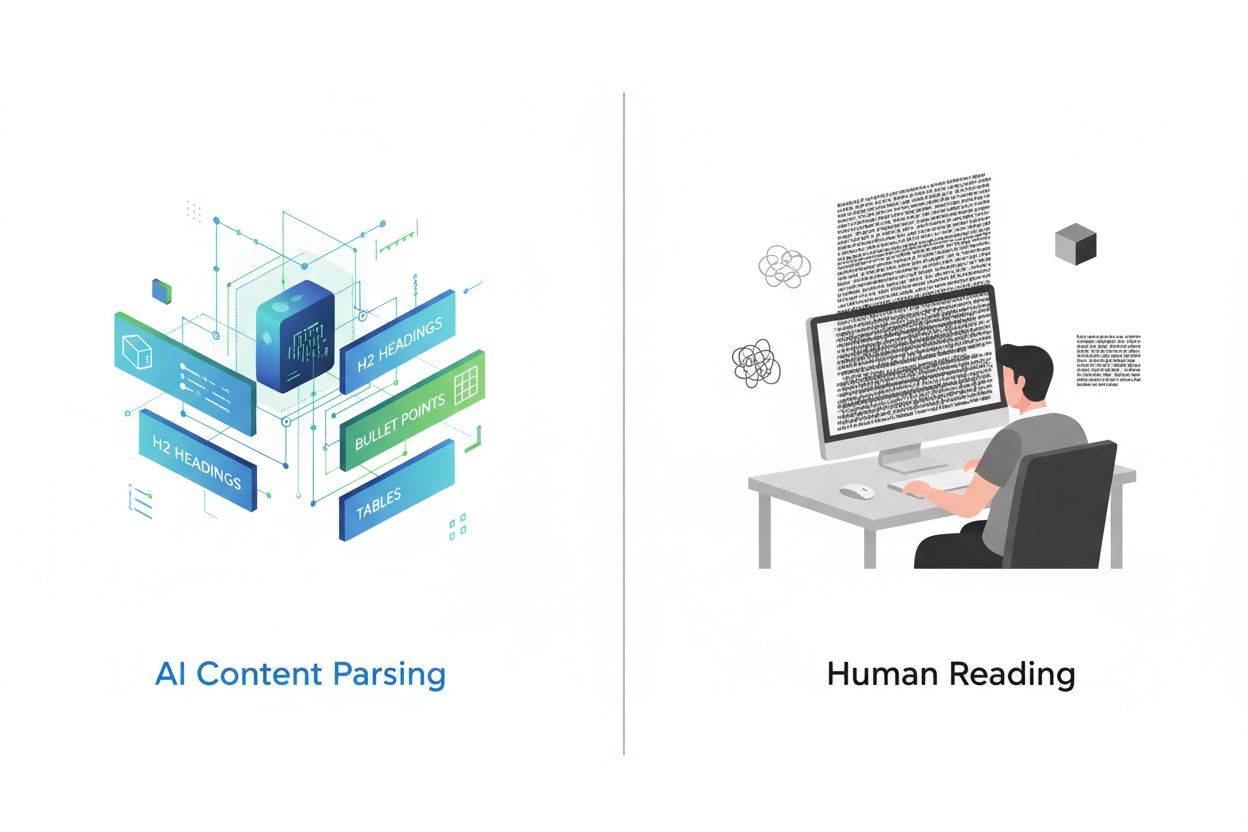
Learn how to restructure your content for AI systems with practical before and after examples. Discover techniques to improve AI citations and visibility across...
Cookie Consent
We use cookies to enhance your browsing experience and analyze our traffic. See our privacy policy.