
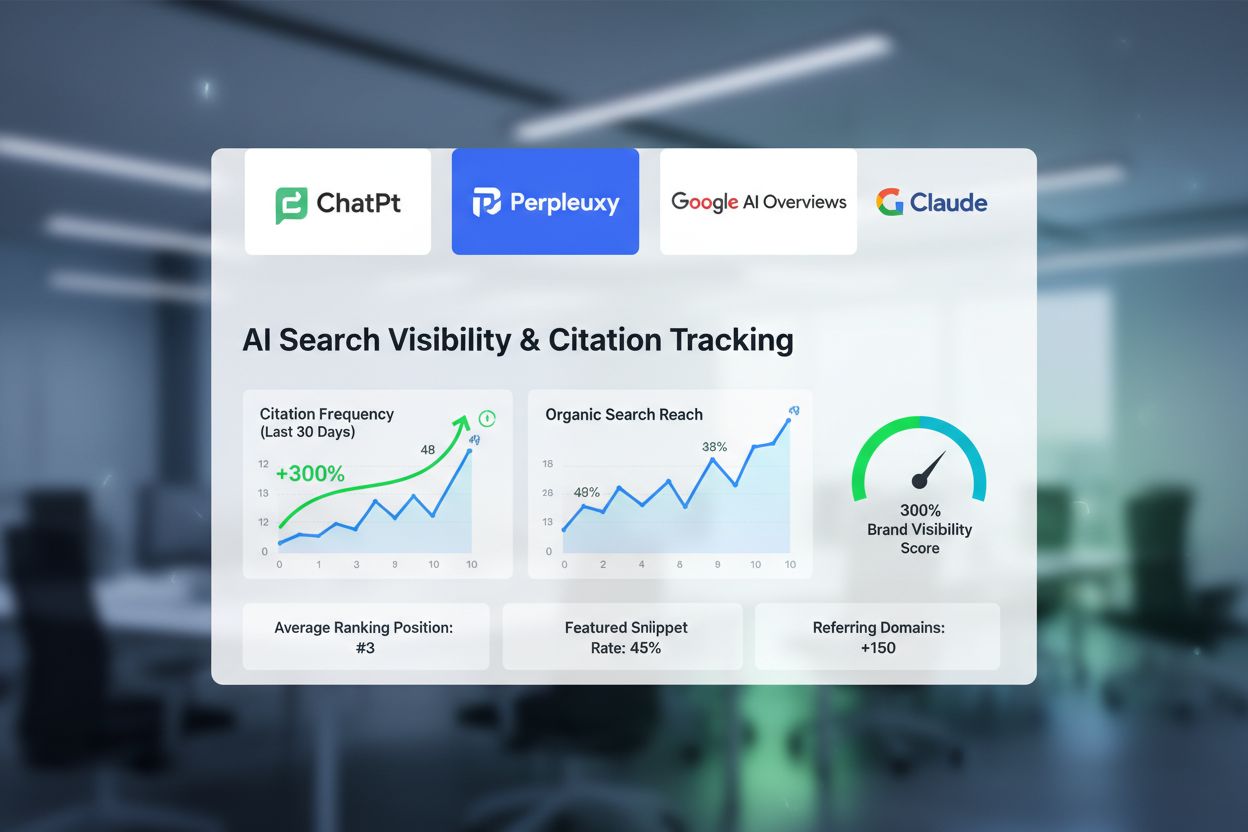
How SaaS Brands Increased AI Visibility by 300%: A Case Study
Discover how TechFlow Solutions achieved 300% AI citation growth and 185% qualified traffic increase through strategic GEO optimization. Real case study with ac...
8 min read
We’ve been working on earning a Google Knowledge Panel for our brand for the past 6 months, and I’m starting to see some interesting correlations with AI visibility.
Background:
Mid-sized B2B SaaS company. Before our knowledge panel efforts, we were basically invisible in AI responses for our industry. Now we’re getting mentioned regularly.
What we did:
The results:
My theory:
Knowledge panels signal to AI systems that an entity is “real” and verified. The structured data feeds directly into how AI understands brands and companies.
Questions for the community:
This is definitely causation, not just correlation. I’ve worked with 40+ brands on entity optimization, and the pattern is consistent.
Why knowledge panels matter for AI:
AI systems don’t just crawl web pages - they build knowledge graphs of entities and relationships. Your knowledge panel is essentially your verified entry in Google’s knowledge graph, which other AI systems also reference or replicate.
The trust signal chain:
What matters most:
In order of importance:
The 4x improvement you’re seeing is typical for brands that go from “no entity presence” to “verified knowledge panel.”
The Wikidata point is huge. We couldn’t get a Wikipedia article (didn’t meet notability guidelines), but we did create a Wikidata entry with complete properties.
That alone seemed to help. Started seeing our company mentioned in Perplexity responses for industry-specific queries within a few weeks.
Wikidata is underrated because it’s not consumer-facing, but AI systems consume it directly.
Adding the local business perspective.
For local businesses, the Google Business Profile IS essentially your knowledge panel for local queries. And it absolutely affects AI citations.
What I’ve seen with clients:
Businesses with complete, verified GBP profiles appear in AI responses for local queries way more than those with sparse profiles.
The completeness factors that matter:
Real example:
A local law firm with a fully optimized GBP appears when users ask ChatGPT “best divorce lawyers in [city].” Their competitor with a minimal GBP doesn’t appear at all, despite similar traditional SEO metrics.
For local businesses, GBP optimization IS entity optimization.
PR perspective here. Media coverage plays a huge role in knowledge panel formation AND AI citations.
The connection:
But there’s also a direct effect:
News mentions in high-authority outlets seem to directly influence AI citations, separate from the knowledge panel path. Our clients who get regular Forbes, TechCrunch, or industry publication coverage see faster AI visibility improvements.
The synergy:
Brands that do both (entity optimization + earned media) see the best results. The media validates your authority, and the structured entity data helps AI systems understand who you are.
Neither alone is as powerful as both together.
We’ve productized this for clients. Here’s our knowledge panel → AI citation framework:
Phase 1: Foundation (Month 1-2)
Phase 2: Authority Building (Month 2-4)
Phase 3: Amplification (Month 4-6)
Average results:
The investment is front-loaded but the payoff compounds over time.
I ran a correlation analysis on this for a client portfolio.
Dataset:
Findings:
The correlation is 0.78 - pretty strong.
Caveat:
This doesn’t prove causation definitively. Companies that earn knowledge panels are also doing other authority-building activities. But the timing correlation (citations spike after panel appearance) suggests a direct relationship.
Question: For those tracking this, does the CONTENT of your knowledge panel seem to affect what you get cited for?
For example, if your knowledge panel emphasizes “software company” vs “AI startup” - does that affect which queries you appear in?
Great question. Yes, it seems to.
We initially had our knowledge panel categorized broadly. After updating our Wikidata to emphasize our specific niche (and seeing it reflected in the knowledge panel), we started appearing in more targeted queries.
The theory:
Knowledge panel categories and descriptions help AI systems understand your “lanes” - what topics you’re authoritative on. If your panel says “software company,” you might appear for general software queries. If it says “AI-powered analytics platform,” you appear for more specific queries in that space.
Practical implication:
Don’t settle for generic knowledge panel descriptions. Work to get your specific positioning reflected in Wikidata and across your entity properties.
One thing I haven’t seen mentioned: knowledge panel ACCURACY matters for AI citations.
If your knowledge panel has wrong information (outdated CEO, wrong founding date, old logo), AI systems seem to cite you less confidently - or propagate the wrong information.
We had a client whose knowledge panel showed a former CEO from 3 years ago. AI responses kept mentioning the wrong person as their leader. It took months of updates and corrections to fix.
Takeaway:
Earning a knowledge panel isn’t enough. You need to actively maintain it and correct any inaccuracies. Wrong data in your panel = wrong data in AI responses = damaged brand perception.
Monitor your knowledge panel regularly and submit corrections immediately when you spot errors.
Enterprise perspective: We have knowledge panels for our main brand and 5 sub-brands.
Interesting finding:
The sub-brands with their OWN knowledge panels (separate from parent) get cited independently in AI responses. Sub-brands that just exist as products under the parent brand don’t get independent citations.
The implication:
If you have multiple brands or products, consider whether each needs its own entity presence for AI visibility. A single corporate knowledge panel may not be enough.
This is especially true for acquired companies that had their own brand equity - maintaining their separate entity presence preserves their AI visibility.
Amazing insights from everyone. Here’s what I’m taking away:
Key learnings:
Action items:
The connection between verified entity presence and AI visibility seems clear. This should be a priority for any brand serious about AI-era discoverability.
Get personalized help from our team. We'll respond within 24 hours.
Monitor how your brand and knowledge panel data appears in AI-generated answers. See your visibility score and citation patterns across all major AI platforms.
Discover how TechFlow Solutions achieved 300% AI citation growth and 185% qualified traffic increase through strategic GEO optimization. Real case study with ac...

Community discussion on Wikidata entries for AI visibility. Real experiences from SEO professionals on creating Wikidata entries to improve AI search presence.
Community discussion on recovering from poor AI visibility. Real experiences from brands that went from invisible to visible in ChatGPT, Perplexity, and Google ...
Cookie Consent
We use cookies to enhance your browsing experience and analyze our traffic. See our privacy policy.