
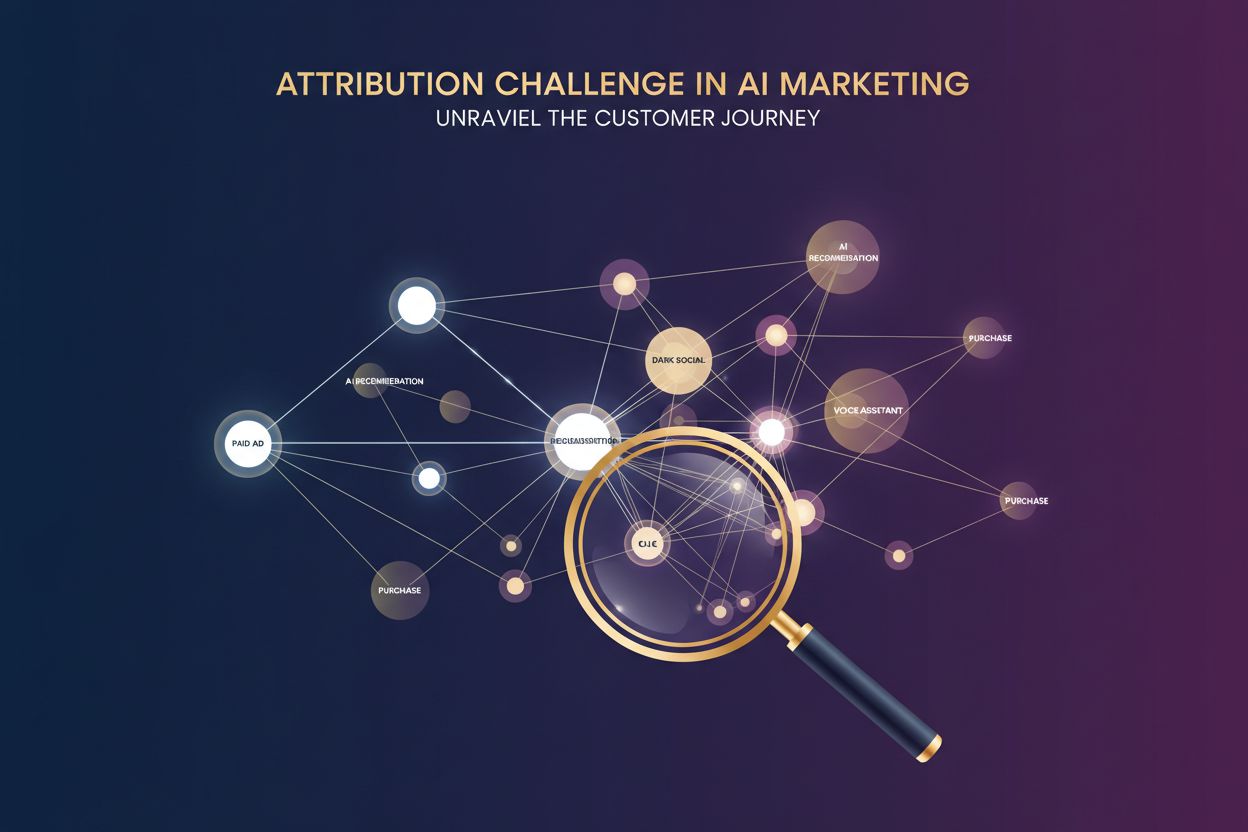
The Attribution Challenge: Linking AI Visibility to Business Outcomes
Discover how AI visibility attribution reshapes business outcomes. Learn why traditional attribution fails with AI intermediaries and how to measure ROI in the ...
10 min read
I’m hearing about the “AI dark funnel” and trying to understand if this is a real challenge for our attribution.
What I’m observing:
What I need to understand:
Looking for practical perspectives on this.
The AI dark funnel is very real. Here’s what’s happening:
The traditional funnel:
Customer searches → Visits website → You track interaction → Attribute to marketing
The AI dark funnel:
Customer asks AI → AI synthesizes answer using your content → Customer makes decision → No tracking possible → Customer shows up as “direct”
Why it matters:
When someone asks ChatGPT “What’s the best CRM for small business?” and AI recommends your competitor, you’ve lost at a touchpoint you can’t even see.
The scale:
| Impact Metric | Data Point |
|---|---|
| CTR decline from AI Overviews | 34% for position #1 |
| Searches ending without clicks | 65% |
| Publisher traffic loss | 26% average |
| Marketers reporting unexplained traffic loss | 64% |
The uncomfortable reality:
A significant portion of customer decision-making is now happening in a black box. Your content may be influencing decisions, but you can’t measure it.
Real example from our business:
What we noticed:
A prospect called requesting a demo. When asked how they found us, they said: “I asked ChatGPT for project management tools for remote teams. It recommended you.”
What our analytics showed:
What actually happened:
The entire research and evaluation journey happened inside ChatGPT. We only saw them when they were ready to buy.
The attribution gap:
In our CRM, this lead has no source attribution. But the REAL source was ChatGPT recommending us. That’s completely invisible.
What this means:
Our content marketing is working - AI is recommending us. But we can’t measure which content or activities drove that recommendation.
Our approach:
1. Added self-reported attribution:
2. Started tracking AI visibility separately:
3. Changed how we explain to leadership:
4. Adjusted investment philosophy:
The mindset shift:
Accept that some marketing influence is now unmeasurable. Optimize for it anyway.
The measurement gap in detail:
What traditional analytics CAN track:
What traditional analytics CANNOT track:
The problem:
Your marketing may be influencing customers effectively through AI, but you have no way to attribute that influence to specific activities.
Example:
Your blog post is in ChatGPT’s training data. When customers ask questions, ChatGPT draws from your content. Customer buys from you. But you can’t connect the blog post to the sale.
The attribution nightmare:
Even with sophisticated attribution models, AI-influenced decisions show up as “direct,” “organic brand search,” or simply unattributed.
Proxy metrics approach:
Since we can’t measure direct attribution, we track proxies:
AI visibility metrics:
| Metric | What It Indicates | Tool |
|---|---|---|
| AI share of voice | Brand presence in AI answers | Am I Cited |
| AI sentiment | How brand is portrayed | AI monitoring |
| Citation frequency | How often cited | AI monitoring |
| Competitor gap | Visibility vs. competitors | AI monitoring |
Correlation metrics:
| Metric | Why It Matters |
|---|---|
| Branded search lift | AI awareness drives brand search |
| Direct traffic patterns | AI-influenced shows as “direct” |
| Self-reported attribution | Actual customer feedback |
| Sales cycle changes | AI-educated leads close faster |
Our finding:
When our AI visibility increases, we see corresponding increases in:
The inference:
We can’t prove causation, but correlation is strong enough to justify investment.
Strategic response to the dark funnel:
Accept the reality:
Some marketing influence is now unmeasurable. This is permanent. Adapt your mindset and processes.
The strategic framework:
1. Optimize for AI presence regardless of attribution:
2. Use proxy metrics for decision-making:
3. Shift resource allocation:
4. Educate stakeholders:
The companies winning:
Those who invest in AI visibility even when they can’t perfectly attribute results. They trust that influence is happening even if they can’t measure it directly.
This is clarifying. Here’s my takeaway:
The AI dark funnel is real:
Practical response:
1. Add self-reported attribution:
2. Track AI visibility separately:
3. Adjust attribution philosophy:
4. Educate leadership:
The mindset:
Marketing influence is larger than what we can measure. Optimize for AI presence because we know it works, even when we can’t prove it directly.
Thanks for the clarity.
Future of measurement in the AI era:
What might change:
What likely won’t change:
The fundamental reality that customer decisions happening inside AI conversations will remain largely invisible to traditional tracking.
Prepare for:
A world where marketing ROI is partially measurable and partially inferred. The companies that accept this and optimize accordingly will outperform those waiting for perfect attribution.
Executive communication perspective:
How to explain the dark funnel to leadership:
Don’t say: “We can’t measure our marketing anymore.”
Do say: “Customer discovery is increasingly happening in AI platforms where traditional tracking doesn’t work. We’re adapting our measurement approach to include AI visibility metrics alongside traditional attribution.”
The narrative:
What leadership needs:
Don’t present this as a problem. Present it as strategic adaptation to market reality.
Competitive angle on the dark funnel:
The opportunity:
While most companies are confused about AI attribution, you can gain advantage by:
The risk:
Competitors who figure this out first will capture AI visibility while you’re waiting for perfect measurement.
The competitive reality:
In the AI dark funnel, visibility = influence. You may not be able to prove it in your attribution model, but customers are being influenced.
Be visible or be invisible. The attribution model shouldn’t stop you from competing.
Get personalized help from our team. We'll respond within 24 hours.
Track where your brand appears in AI-generated answers. Monitor the hidden touchpoints where customers discover and evaluate you.
Discover how AI visibility attribution reshapes business outcomes. Learn why traditional attribution fails with AI intermediaries and how to measure ROI in the ...

Understand the AI dark funnel - the invisible part of customer journeys happening in ChatGPT, Perplexity, and AI search engines. Learn how to monitor and optimi...
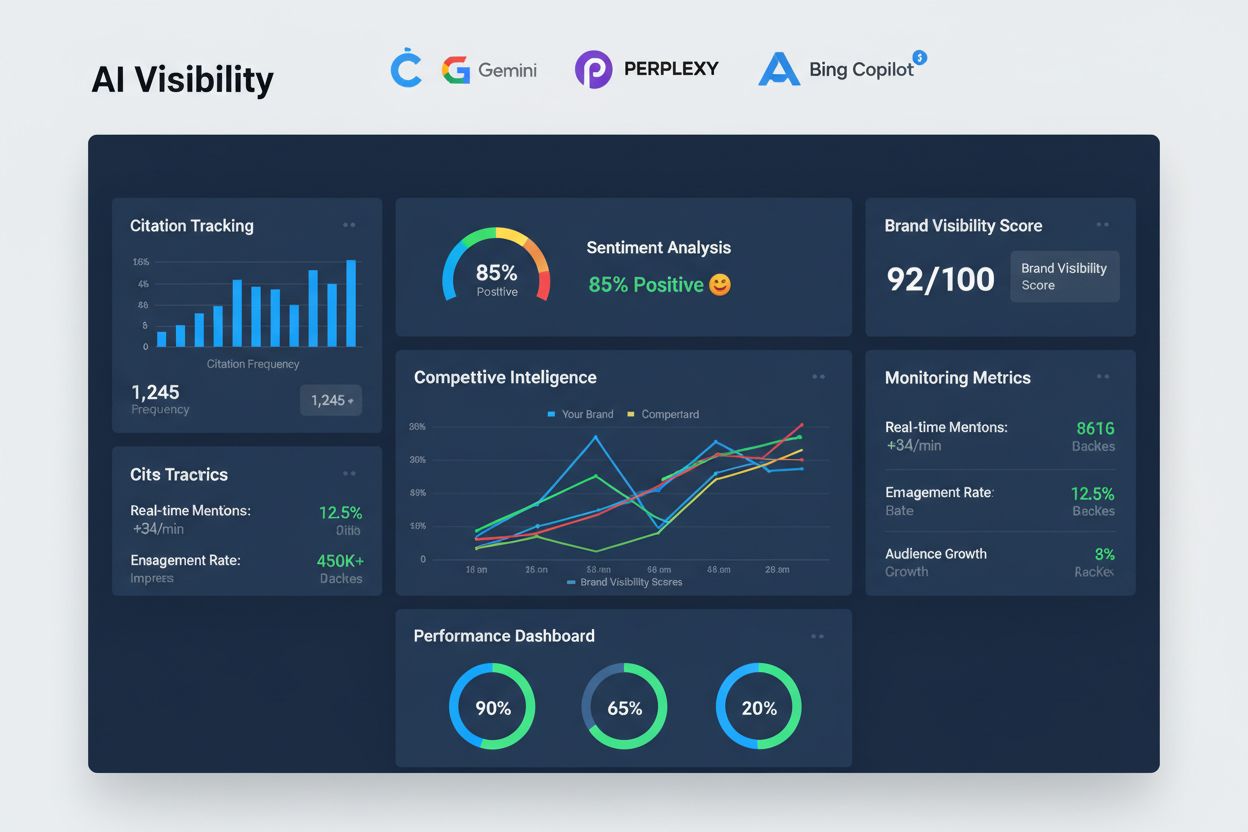
Master AI visibility for your SaaS company. Learn GEO strategies, structured data optimization, and how to get recommended by ChatGPT, Gemini, and Perplexity. C...
Cookie Consent
We use cookies to enhance your browsing experience and analyze our traffic. See our privacy policy.