

Discussion FLIP Framework Content Strategy

Has anyone used the FLIP framework for AI search optimization? Looking for real implementation experiences

CO
ContentManager_Jason · Content Marketing Manager
· · 67 upvotes · 8 comments
CJ
ContentManager_Jason
Content Marketing Manager · January 7, 2026

I keep hearing about the “FLIP framework” for AI search optimization:

  • Findable
  • Linkable
  • Indexable
  • Promotable

It seems logical, but I’m skeptical of frameworks that sound neat but don’t have proven results.

What I’m looking for:

  • Has anyone actually implemented FLIP?
  • What results did you see?
  • Is this just another SEO buzzword or genuinely useful?
  • Are there better frameworks for AI search?

I need a structured approach for our team but don’t want to build processes around something unproven.

8 comments

8 Comments

F
FrameworkPractitioner Expert Content Strategy Consultant · January 7, 2026

I’ve implemented FLIP and several other frameworks across clients. Let me give you a realistic assessment.

What FLIP actually means in practice:

Findable:

  • Can AI crawlers access your content?
  • Is your entity clearly defined?
  • Do you appear in sources AI systems query?

Linkable:

  • Is your content citation-worthy?
  • Are you earning third-party mentions?
  • Do authoritative sources reference you?

Indexable:

  • Is content properly structured for AI extraction?
  • Do you have appropriate schema markup?
  • Can AI systems understand your content?

Promotable:

  • Do you distribute content across channels AI monitors?
  • Are you present on platforms AI cites (Reddit, LinkedIn, etc.)?
  • Do you have social proof and engagement?

My assessment:

FLIP is a useful organizational framework, but it’s not magic. It helps ensure you’re covering the key bases. But the execution within each category matters far more than having the framework itself.

CJ
ContentManager_Jason OP · January 7, 2026
Replying to FrameworkPractitioner
So it’s more of an organizational checklist than a breakthrough methodology?
F
FrameworkPractitioner Expert · January 7, 2026
Replying to ContentManager_Jason

Yes, exactly. And that’s valuable!

What frameworks like FLIP actually do:

  1. Ensure completeness - You don’t forget important elements
  2. Organize teams - Different people can own different pillars
  3. Prioritize investment - Audit gaps against framework
  4. Communicate strategy - Easy to explain to stakeholders

What they don’t do:

  1. Guarantee results - Execution quality determines outcomes
  2. Replace expertise - You still need to know HOW to be findable, linkable, etc.
  3. Provide tactics - Framework = what; tactics = how

My recommendation:

Use FLIP (or any framework) as a structure, then fill it with specific tactics and measurement.

Don’t obsess over which framework is “best.” Pick one that resonates and execute well.

RK
ResultsOriented_Kim Marketing Director · January 7, 2026

We implemented FLIP 6 months ago. Here’s our actual results:

Before FLIP (baseline):

  • AI citation rate: 12% of relevant queries
  • Content audit score: 45/100 (using our FLIP checklist)
  • Third-party mentions: 8 per month
  • AI traffic share: 1.2%

After FLIP (6 months):

  • AI citation rate: 34% of relevant queries
  • Content audit score: 78/100
  • Third-party mentions: 23 per month
  • AI traffic share: 3.8%

What FLIP helped us identify:

  • Findability gap: Our robots.txt was blocking AI crawlers
  • Linkability gap: Almost no original research or citation-worthy content
  • Indexability gap: Missing schema markup across 80% of pages
  • Promotability gap: No presence on Reddit, minimal LinkedIn activity

The framework didn’t cause the improvement. The framework helped us identify where to invest. The execution caused the improvement.

My verdict:

FLIP is useful because it organized our thinking and revealed gaps. But any comprehensive framework would have done similar.

S
SkepticalSEO · January 6, 2026

Skeptic perspective:

Why I’m cautious about frameworks:

AI search is new and evolving rapidly. Any framework claiming to have “the answer” is probably oversimplifying.

What FLIP gets right:

  • Covers important bases
  • Organized and memorable
  • Actionable categories

What FLIP misses:

  • Platform-specific optimization (ChatGPT vs Perplexity vs Google AI)
  • Entity optimization depth
  • Training data vs live search distinction
  • Content quality factors

My alternative approach:

Instead of adopting a framework wholesale, I use a first-principles approach:

  1. How do AI systems actually find and evaluate content?
  2. What specific signals matter for each platform?
  3. What are our specific gaps against those signals?
  4. How do we close those gaps?

Framework can inform this, but shouldn’t constrain it.

AL
AgencyProcess_Lead Agency Operations · January 6, 2026

Agency perspective on operationalizing FLIP:

How we use FLIP with clients:

Phase 1: Audit Run each content piece through FLIP scoring:

  • Findable (1-5)
  • Linkable (1-5)
  • Indexable (1-5)
  • Promotable (1-5)

Total score /20 indicates AI-readiness.

Phase 2: Gap Analysis Which pillar is weakest?

  • Most clients score lowest on “Linkable” (citation-worthiness)
  • Second weakest usually “Promotable” (distribution)

Phase 3: Prioritized Roadmap Focus on weakest pillar first, then balance across all four.

Phase 4: Ongoing Monitoring Track metrics for each pillar:

  • Findable: Crawl accessibility, entity recognition
  • Linkable: Third-party mentions, backlinks
  • Indexable: Schema validation, AI citation rate
  • Promotable: Social engagement, platform presence

The process value:

FLIP gives us a repeatable audit and improvement process. Clients understand it. Teams can specialize by pillar.

CA
ContentStrategist_Alex · January 6, 2026

Here’s how I’ve modified FLIP for our needs:

FLIP 2.0 (our version):

Findable

  • AI crawler access (technical)
  • Entity clarity (brand recognition)
  • Source presence (where AI looks)

Linkable

  • Citation-worthy content (original research, data)
  • Third-party validation (mentions, reviews)
  • Authority signals (E-E-A-T)

Indexable

  • Content structure (AI extractability)
  • Schema markup (machine readability)
  • Semantic clarity (meaning, not just keywords)

Promotable

  • Platform distribution (Reddit, LinkedIn, etc.)
  • Content amplification (PR, partnerships)
  • Engagement signals (social proof)

Added: Measurable

  • AI citation tracking
  • Platform-specific visibility
  • Competitive benchmarking

We call it FLIPM internally.

The point:

Frameworks are starting points. Adapt them to your specific situation and add what’s missing.

CJ
ContentManager_Jason OP Content Marketing Manager · January 5, 2026

This discussion has helped me think about frameworks more practically.

My takeaways:

  1. FLIP is useful but not magic - It’s an organizational tool, not a silver bullet

  2. Execution matters more than framework choice - Any comprehensive framework + good execution beats perfect framework + poor execution

  3. Customize for your situation - The FLIPM adaptation example shows frameworks should evolve

  4. Measure against the framework - Audit scores and pillar-specific metrics make frameworks actionable

  5. Don’t over-index on frameworks - First principles thinking matters too

What I’m going to do:

  1. Adopt FLIP as organizational structure for our AI optimization work
  2. Create audit checklist based on the four pillars
  3. Identify our weakest pillar through systematic assessment
  4. Build roadmap focused on closing gaps
  5. Set up monitoring for each pillar
  6. Adapt framework over time based on what we learn

The meta-lesson:

Frameworks are tools for organizing thinking, not substitutes for thinking.

Use them as starting points, not destinations.

Thanks for the grounded perspectives.

Have a Question About This Topic?

Get personalized help from our team. We'll respond within 24 hours.

Frequently Asked Questions

What is the FLIP framework for AI search?
FLIP stands for Findable, Linkable, Indexable, and Promotable - a framework for optimizing content for AI search visibility. It ensures content can be discovered by AI crawlers, earns citations from authoritative sources, gets properly indexed, and gains distribution across platforms.
How does FLIP differ from traditional SEO frameworks?
Traditional SEO frameworks focus on Google ranking factors. FLIP specifically addresses AI search requirements like entity recognition, citation-worthiness, multi-platform visibility, and structured extractability that matter for ChatGPT, Perplexity, and AI Overviews.
Is FLIP framework proven to improve AI visibility?
The FLIP framework provides structured guidance for AI optimization. Results vary by implementation quality and starting point, but practitioners report improved organization and measurable citation increases when systematically addressing all four framework components.
What other frameworks exist for AI search optimization?
Besides FLIP, practitioners use GEO (Generative Engine Optimization) frameworks, entity optimization methodologies, and AI-native content frameworks. The best approach combines elements from multiple frameworks based on your specific needs and resources.

Monitor Your Framework's Effectiveness

Track how your content performs in AI search after implementing optimization frameworks. Monitor citations across ChatGPT, Perplexity, and Google AI Overviews.

Learn more

What is the FLIP Framework for AI Search?

What is the FLIP Framework for AI Search?

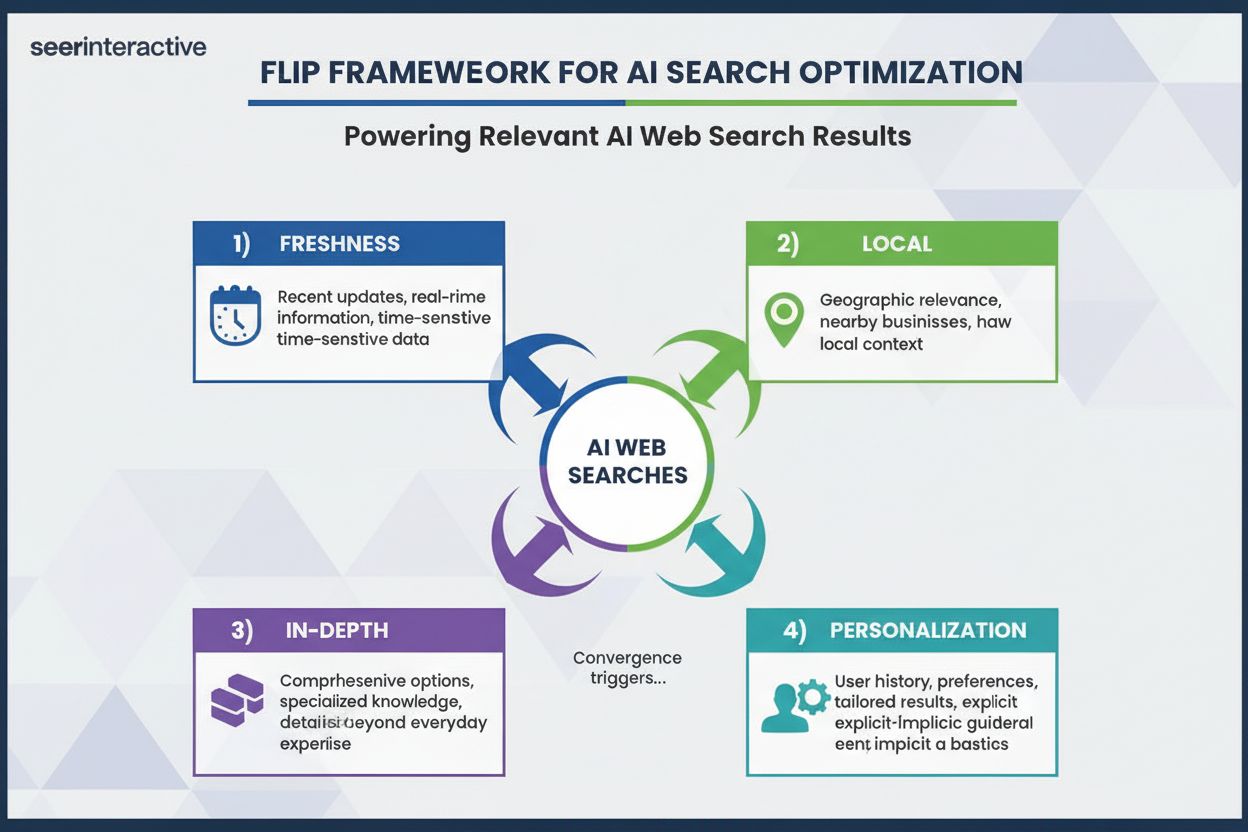
Learn how the FLIP framework helps your content get discovered and cited by AI search engines like ChatGPT, Perplexity, and Claude. Understand Freshness, Local ...
8 min read
FLIP Framework
FLIP Framework: AI Search Query Triggers for Generative Engine Optimization

FLIP Framework

Learn the FLIP Framework (Freshness, Local, In-depth, Personalization) that triggers AI web searches. Essential for GEO and AI visibility strategy.

12 min read