
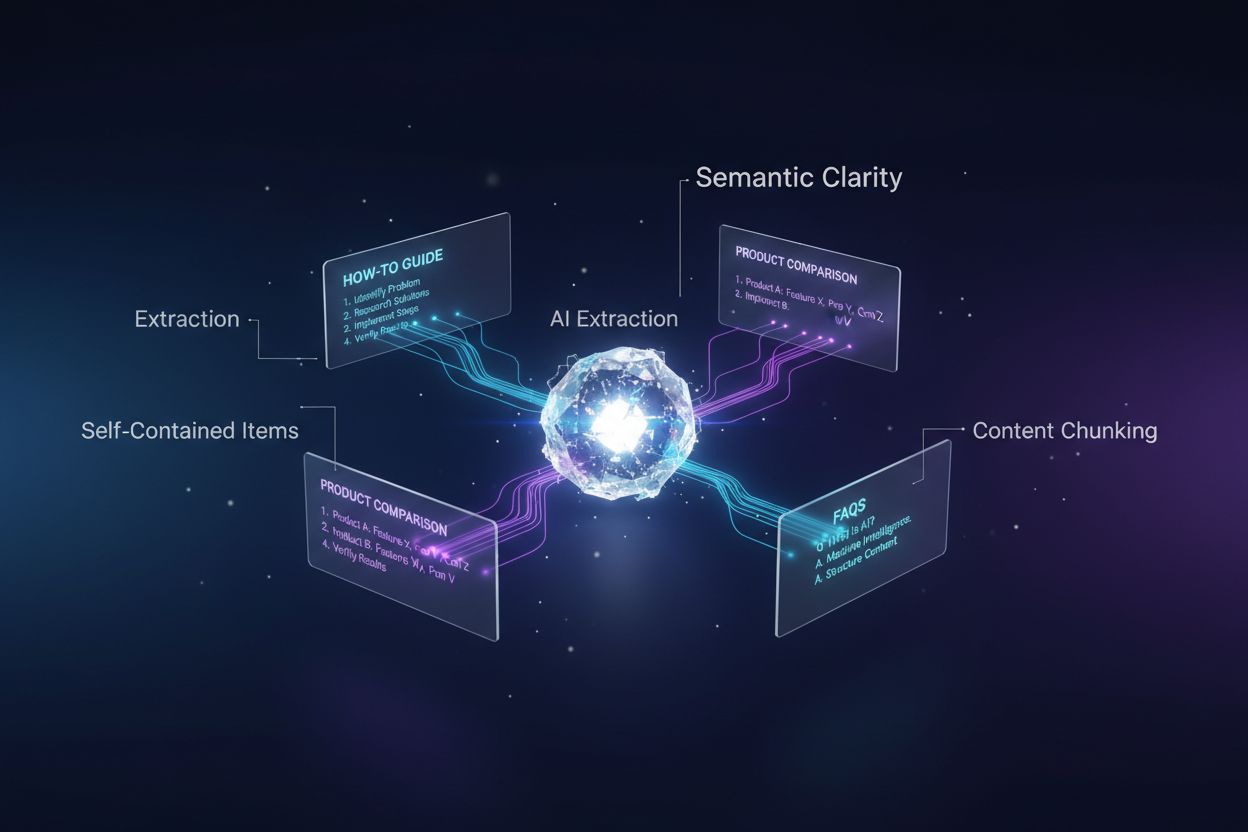
Listicle Optimization
Learn what listicle optimization is and how to structure numbered and bulleted lists for AI extraction. Discover best practices for improving AI search visibili...
7 min read

Discover whether AI search engines like ChatGPT and Perplexity prefer listicles. Learn how to optimize list-based content for AI citations and visibility.
Yes, AI search engines show a strong preference for listicles and structured list-based content. AI models like ChatGPT, Perplexity, and Google's Gemini favor well-organized lists because they are easier to parse, extract information from, and cite. However, the quality and depth of content matter more than the format alone—AI increasingly prioritizes substantive, well-researched listicles over thin, generic lists.
AI search engines demonstrate a clear preference for listicles because of how large language models process and extract information from web content. When AI systems like ChatGPT, Perplexity, and Google’s Gemini scan web pages, they need to quickly identify, parse, and cite relevant information. Listicles provide the structured format that AI models find easiest to understand and reference. The numbered or bulleted structure creates semantic clarity that helps AI systems recognize distinct points, compare options, and generate accurate citations. This structural advantage has made listicles one of the most effective content formats for achieving visibility in AI-generated answers.
The preference for listicles extends beyond simple formatting convenience. AI models are trained to recognize and prioritize content that follows clear hierarchical patterns, which listicles naturally provide. When an AI system encounters a well-organized list with descriptive headings, it can more easily extract individual items and present them as authoritative sources. This is particularly important for AI search engines like Perplexity, which explicitly display citations and source attribution. A listicle’s structure makes it significantly easier for these systems to pull specific information and credit the original source, increasing the likelihood of your content being cited.
Listicles have become dominant in AI search results, with research showing that listicle content appears in AI overviews at substantially higher rates than traditional long-form content. Studies indicate that approximately 20-30% of successful blog posts in competitive niches are listicles, and this percentage has been climbing as AI search optimization becomes more prevalent. The reason is straightforward: when users ask AI systems questions like “What are the best tools for X?” or “Top alternatives to Y?”, the AI naturally gravitates toward listicle-formatted content because it can directly extract and present the list items as answers.
Google’s AI Overviews show a particular affinity for listicles because they can be easily converted into summary snippets. When Google’s Gemini model generates an AI Overview, it often pulls directly from listicle content, presenting the list items in a condensed format. This creates a powerful advantage for listicle publishers: your content doesn’t just rank in traditional search results, it becomes the source material for AI-generated answers. The structured data in listicles—especially when combined with schema markup—makes it trivial for AI systems to extract, verify, and present information. This is why listicles consistently outperform other content formats in AI citation frequency, often appearing in AI answers even when they rank lower in traditional Google search results.
While listicles enjoy a structural advantage with AI systems, quality and depth have become increasingly important factors in AI citation decisions. Early observations suggested that any listicle could rank in AI results, but recent data shows that AI models are becoming more sophisticated in evaluating content substance. AI systems now prioritize listicles that contain original research, detailed comparisons, and substantive analysis over thin, generic lists. A listicle that simply lists five tools with one-sentence descriptions will struggle to get cited, while a listicle that provides in-depth feature comparisons, pricing breakdowns, and use-case recommendations will consistently appear in AI answers.
This shift reflects how AI models are trained to recognize authority and expertise. Large language models evaluate content based on multiple signals including comprehensiveness, factual accuracy, and the presence of original insights. A listicle that includes comparison tables, detailed pros and cons, pricing analysis, and specific use cases signals higher quality to AI systems. The depth of explanation matters because AI models need to extract enough context to provide users with genuinely useful information. When an AI system cites your listicle, it’s implicitly endorsing the quality of your analysis, so AI models have evolved to favor listicles that demonstrate genuine expertise rather than surface-level coverage.
| Listicle Type | AI Performance | Best Use Case | Key Characteristics |
|---|---|---|---|
| Product/Tool Comparisons | Excellent | “Best X tools for Y” queries | Detailed feature matrices, pricing, pros/cons |
| Alternatives Lists | Excellent | Competitor research queries | Direct comparisons, honest assessments, positioning |
| “How-to” Step Lists | Very Good | Process-oriented queries | Sequential steps, clear instructions, outcomes |
| Trend/Prediction Lists | Good | Industry research queries | Data-backed insights, expert opinions, context |
| Simple Ranked Lists | Fair | General informational queries | Basic descriptions, minimal depth |
| Reasons/Benefits Lists | Good | Explanatory queries | Detailed reasoning, supporting evidence |
The most AI-friendly listicle formats are product comparisons and alternatives lists, which consistently achieve the highest citation rates in AI search results. These formats work exceptionally well because they directly answer the types of questions users ask AI systems. When someone queries ChatGPT or Perplexity with “What are the best CRM tools?” or “Salesforce alternatives?”, AI systems immediately look for listicles that provide structured comparisons. Product listicles that include feature matrices, pricing breakdowns, and honest assessments of strengths and limitations perform particularly well because they provide the comprehensive information AI models need to generate useful responses.
How-to and step-by-step listicles also perform strongly in AI search, though slightly less consistently than comparison-based lists. These formats work well because they provide clear, sequential information that AI systems can easily extract and present. The key to success with how-to listicles is ensuring each step is detailed enough to be genuinely useful, with explanations of why each step matters and what outcomes to expect. Listicles that simply list steps without explanation tend to underperform, while those that provide context and reasoning achieve better AI visibility. The common thread across all high-performing listicle formats is that they provide substantive, actionable information rather than surface-level coverage.
The way you structure a listicle dramatically impacts its visibility in AI search results. AI models parse content hierarchically, starting with headings and then analyzing the body text beneath each heading. Clear H2 and H3 heading hierarchies are essential for AI comprehension, as they help models understand the relationship between different sections and identify the main points. Each list item should have a descriptive heading that clearly indicates what the item is about, followed by detailed explanation paragraphs. This structure allows AI systems to quickly identify and extract individual list items without having to parse dense paragraphs.
Comparison tables are one of the most powerful structural elements for AI optimization. When you include a table that summarizes key information about the items in your listicle—such as features, pricing, and overall verdict—you’re providing AI systems with pre-structured data that’s trivial to extract and cite. Tables in HTML format (not images) are particularly valuable because AI models can parse them directly. Including at least one well-designed comparison table in your listicle significantly increases the likelihood of AI citation. The table should appear early in the article, ideally after the introduction, so AI systems encounter it while parsing your content.
Short paragraphs and scannable formatting are critical for AI optimization. While humans appreciate varied paragraph lengths, AI models actually perform better when parsing content with consistent, shorter paragraphs (2-5 sentences each). This allows the model to identify semantic units more easily and extract relevant information without confusion. Bullet points and numbered lists within each listicle item further enhance AI comprehension, as they break complex information into discrete, easily-parsed units. The goal is to make your content as scannable and structurally clear as possible, which benefits both human readers and AI systems.
Publishing listicles across multiple platforms significantly increases your chances of AI citation. AI systems like ChatGPT and Perplexity don’t just scan your website—they pull from across the entire internet, including LinkedIn, Medium, YouTube, and industry publications. A comprehensive listicle strategy involves creating the same core listicle in multiple formats and publishing it across different platforms. For example, you might publish a detailed product comparison listicle on your website, create a LinkedIn Pulse article with a slightly different angle, produce a YouTube video in listicle format, and secure guest posts on industry-relevant websites using the same listicle structure.
LinkedIn Pulse articles are particularly effective for AI visibility because they’re widely indexed and frequently cited by AI systems. When you publish a listicle on LinkedIn, you’re reaching both human readers and AI crawlers that specifically monitor professional content. YouTube videos structured as listicles also perform well in AI search, particularly when you include detailed descriptions and timestamps that break down the list items. AI systems can extract information from video transcripts and descriptions, so a well-structured YouTube listicle can drive AI citations just as effectively as written content. The key is maintaining consistency across platforms—the same core information, presented in the same listicle format, but adapted for each platform’s unique audience and format requirements.
Guest posting on niche-relevant websites amplifies your listicle’s reach in AI systems. When your listicle appears on multiple authoritative websites within your industry, AI models recognize this as a signal of expertise and authority. This multi-platform approach creates what some SEO professionals call a “listicle network”—multiple versions of your core content distributed across trusted sources. AI systems see your brand and content appearing consistently across different platforms, which reinforces your authority in the eyes of large language models. This strategy has proven particularly effective for achieving AI visibility within 3-4 weeks of implementation, according to recent case studies.
One of the most common mistakes is creating listicles that are too long without sufficient depth. The old “skyscraper” SEO tactic of making your listicle longer than competitors’ by adding more items often backfires with AI systems. AI models evaluate content quality holistically, and a listicle with 50 items covered superficially will rank lower than a listicle with 10 items covered comprehensively. The depth of explanation matters far more than the number of items. Each item in your listicle should receive enough explanation to genuinely help readers make decisions or understand the topic. AI systems recognize when content is thin or padded, and they penalize it accordingly in citation decisions.
Another critical mistake is failing to include original research or data. Listicles that simply compile information from other sources without adding original insights, comparisons, or analysis struggle to achieve AI visibility. AI models are trained to recognize and prioritize original content, and they can detect when a listicle is merely aggregating existing information. The most successful listicles include original research, unique comparison frameworks, proprietary data, or expert analysis that can’t be found elsewhere. This original element signals to AI systems that your listicle is a primary source worth citing, rather than a secondary aggregation.
Lack of transparency and honesty in comparisons is another significant problem. If you’re creating a listicle that includes your own product alongside competitors, AI systems can detect bias through various signals. Listicles that treat all items equally, acknowledge limitations honestly, and avoid obvious favoritism toward your own offering perform better with AI systems. This doesn’t mean you can’t position your product favorably—it means doing so through superior quality and depth of explanation rather than through biased presentation. AI models are increasingly sophisticated at detecting manipulation, and listicles that appear manipulative or dishonest will be deprioritized in AI citations.
Tracking whether your listicles appear in AI search results requires specialized monitoring tools, as traditional SEO analytics don’t capture AI citations. Tools like AthenaHQ, Goodie AI, and emerging features in platforms like Semrush now offer AI visibility tracking that shows how often your content appears in ChatGPT, Perplexity, and Google AI Overviews. The key metrics to track are citation frequency, citation quality, and share of voice in AI results. Citation frequency measures how often your content is cited across AI platforms. Citation quality evaluates whether you’re cited as a primary source or mentioned in passing. Share of voice measures what percentage of AI answers in your category mention your brand versus competitors.
Brand impression growth is another important metric for AI visibility. Even if users don’t click through to your website from AI search results, being cited in AI answers builds brand awareness and authority. Track branded search volume to see if increased AI visibility translates into more direct searches for your brand. When your listicles appear consistently in AI answers, you should see corresponding increases in branded search volume as users remember your brand and search for you directly. This indirect traffic is often more valuable than direct clicks from AI results, as it represents genuine brand recall and authority building.
Sentiment analysis of how AI systems mention your brand is also valuable. Some monitoring tools can analyze the tone and context in which AI systems cite your content. Positive sentiment citations—where AI systems present your content as authoritative and trustworthy—are more valuable than neutral mentions. Track whether AI systems cite your listicles as primary sources or secondary references, and whether the context is positive, neutral, or critical. This information helps you understand how AI systems perceive your brand and content quality, allowing you to refine your listicle strategy accordingly.
Track how often your content appears in AI-generated answers across ChatGPT, Perplexity, and other AI search engines. Get real-time insights into your AI visibility and optimize your content strategy accordingly.
Learn what listicle optimization is and how to structure numbered and bulleted lists for AI extraction. Discover best practices for improving AI search visibili...

Community discussion on whether AI search engines prefer listicles. Real experiences from content creators testing different formats for ChatGPT, Perplexity, an...
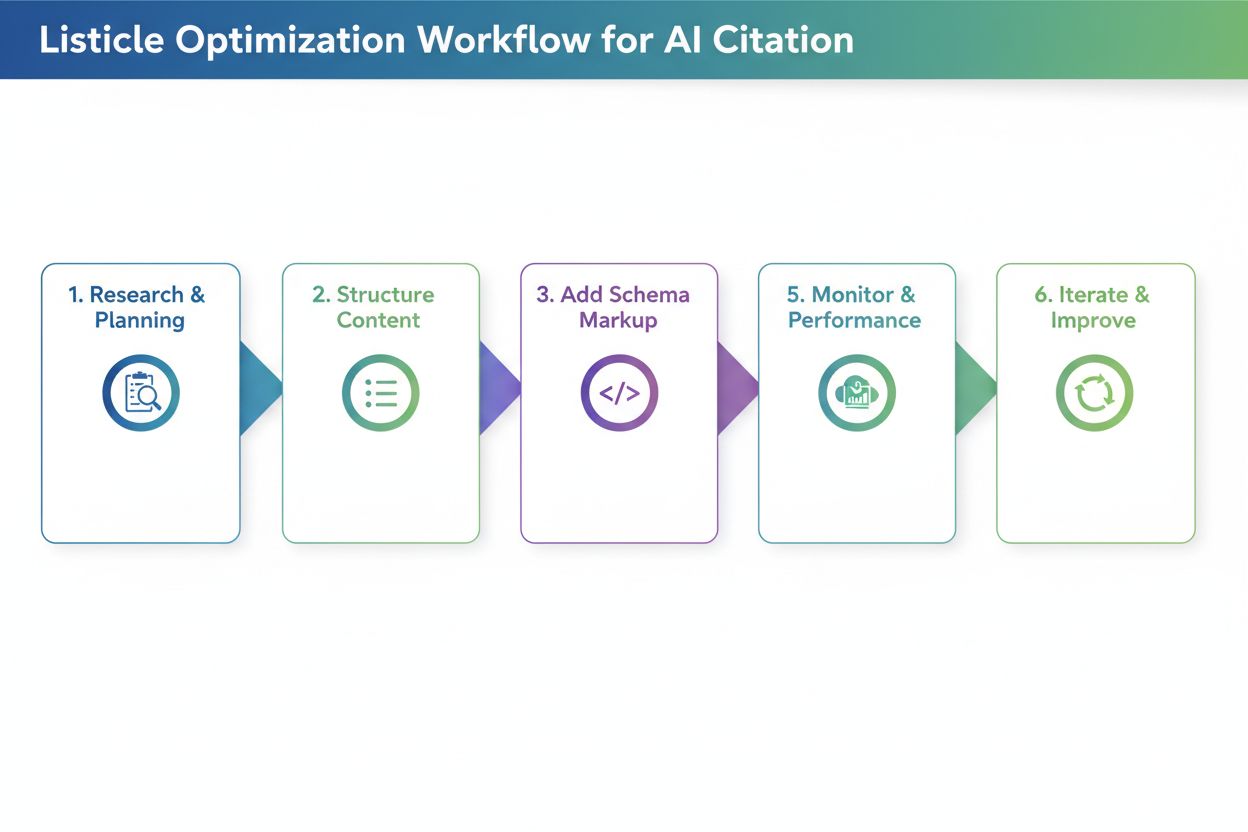
Discover why AI models prefer listicles and numbered lists. Learn how to optimize list-based content for ChatGPT, Gemini, and Perplexity citations with proven s...