
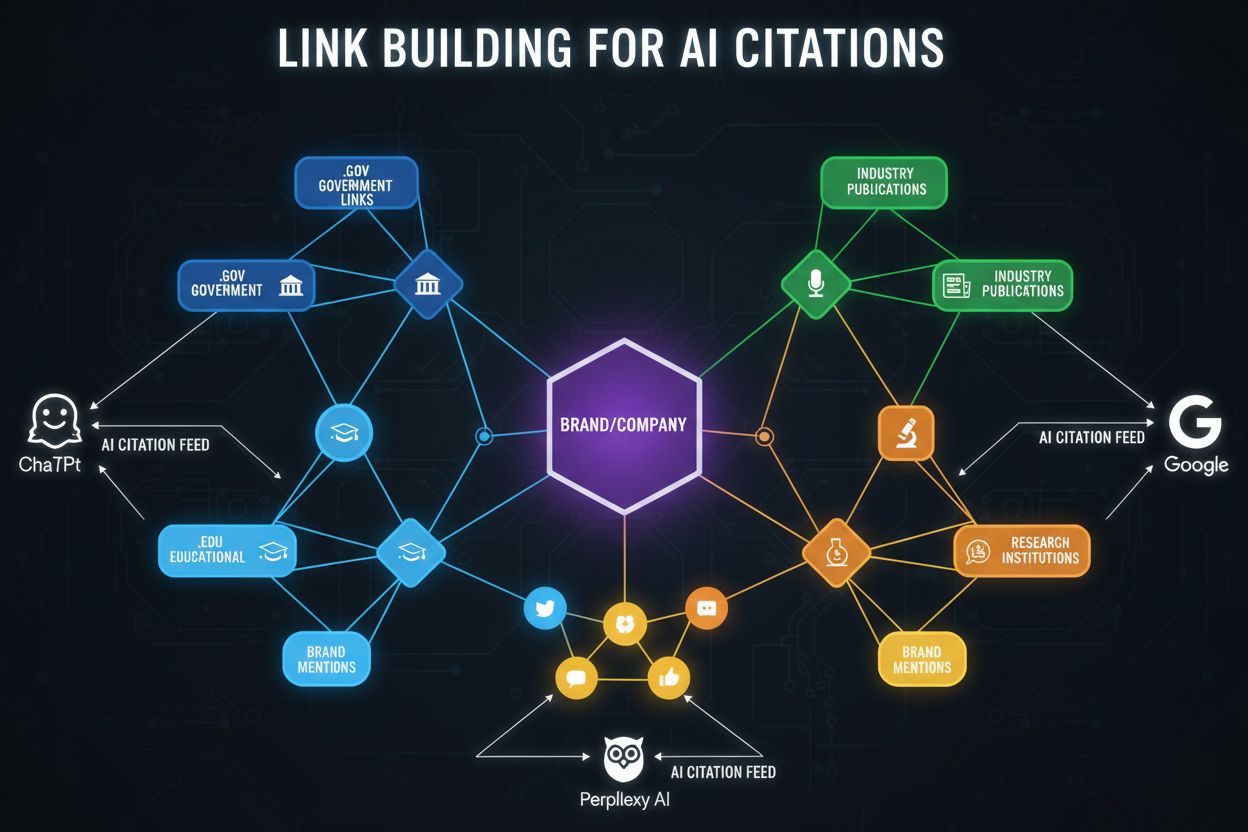
Link Building for AI Citations: New Strategies for the AI Era
Learn how link building has evolved for AI search. Discover strategies to earn AI citations across ChatGPT, Perplexity, and Google AI Overviews. Master the new ...
11 min read

Discover how backlinks impact AI search visibility across ChatGPT, Perplexity, and Google AI Overviews. Learn why quality matters more than quantity in the AI era.
Yes, backlinks remain crucial for AI search visibility, but their role has evolved. Quality and authority now matter far more than quantity. High-quality backlinks from authoritative sources help AI systems identify trustworthy content, while brand mentions and co-citations have become equally important for AI visibility.
Backlinks remain fundamentally important for AI search visibility, but their function has shifted significantly in the era of generative AI. Recent comprehensive research analyzing 1,000 domains across five major AI platforms—ChatGPT, ChatGPT with Search, Gemini, Google’s AI Overviews, and Perplexity—reveals that quality and authority matter exponentially more than sheer volume. The traditional link-building playbook of accumulating as many backlinks as possible has become obsolete. Instead, AI systems now evaluate backlinks within a broader context of domain authority, content quality, and trustworthiness signals that determine whether your brand gets cited in AI-generated answers.
The shift reflects how AI systems fundamentally differ from traditional search engines. While Google’s PageRank algorithm established backlinks as core ranking signals over two decades ago, AI language models approach authority assessment differently. These systems analyze backlinks not just as votes of confidence, but as credibility indicators that help distinguish between authoritative, expert-driven content and manufactured or low-quality material. This distinction has become critical as AI systems prioritize accuracy and reliability in their responses.
One of the most significant findings from recent AI search research is the threshold effect in how backlinks influence AI visibility. This means that incremental improvements in your backlink profile won’t produce proportional gains in AI citations. Instead, real visibility improvements only appear once your domain crosses into higher authority tiers. Domains with stronger backlink authority—measured by metrics like Authority Score, which reflects backlink quality, referring domain diversity, organic traffic to linking pages, and spam signals—are mentioned significantly more often in AI-generated answers.
The data shows a clear pattern: domains with Authority Scores below certain thresholds see minimal correlation with AI mentions, but once they cross into higher authority ranges, citations nearly double or triple. This threshold effect means your link-building strategy should focus on breaking through authority plateaus rather than pursuing incremental gains. A site with 100 high-quality backlinks from authoritative sources will likely see far more AI visibility than a site with 1,000 low-quality links. This represents a fundamental shift from traditional SEO, where link quantity still held some value alongside quality considerations.
Research analyzing 129,000 unique domains across 216,524 pages reveals that the number of referring domains ranked as the single strongest predictor of AI citation likelihood. However, this metric measures diversity and quality, not raw quantity. Sites with up to 2,500 referring domains averaged 1.6 to 1.8 citations, while those with over 350,000 referring domains averaged 8.4 citations. More importantly, a significant threshold appeared at 32,000 referring domains, where citations nearly doubled from 2.9 to 5.6.
This distinction is crucial: referring domains (the number of unique websites linking to you) matters far more than total backlinks. A single high-quality backlink from an authoritative, topically relevant source carries substantially more weight than dozens of links from low-authority or unrelated sites. Domain Trust scores followed similar patterns, with sites scoring 97-100 averaging 8.4 citations compared to 1.6 for sites below 43. The research also revealed that Page Trust scores mattered less than domain-level signals, suggesting AI systems prioritize overall domain authority over individual page metrics when deciding what to cite.
| Authority Level | Referring Domains | Average AI Citations | Citation Growth |
|---|---|---|---|
| Low Authority | Under 100 | 1.2 | Baseline |
| Emerging Authority | 100-1,000 | 1.8 | +50% |
| Established Authority | 1,000-10,000 | 2.9 | +142% |
| High Authority | 10,000-50,000 | 5.6 | +367% |
| Top Authority | 50,000+ | 8.4 | +600% |
One counterintuitive finding from AI search research challenges traditional SEO wisdom: nofollow links carry nearly the same impact as follow links for AI visibility. When researchers compared both link types individually to AI mentions, the correlations were almost identical. Follow links showed Pearson correlation of 0.334 and Spearman correlation of 0.504, while nofollow links showed 0.340 and 0.509 respectively. This suggests that AI models treat both link types similarly when evaluating authority and visibility.
This shift reflects how AI systems approach link evaluation differently than traditional search engines. Since Google began treating nofollow as a hint rather than a directive in 2020, AI systems have followed suit. A nofollow link from a highly authoritative source like Wikipedia, Reddit, or a major news publication can signal credibility just as effectively as a follow link. The weighting does vary slightly by platform—Gemini and ChatGPT tend to favor nofollow links slightly more, while Google AI Overviews and Perplexity lean more toward follow links—but the overall pattern shows that link type matters far less than source authority and relevance.
Research reveals that image-based backlinks often outperform text links for AI visibility, particularly once a domain has established baseline authority. When comparing image links to text links individually against AI mentions, image links showed stronger correlation values. Image links demonstrated Pearson correlation of 0.415 versus 0.334 for text links, and Spearman correlation of 0.538 versus 0.472. This advantage becomes particularly pronounced at higher authority tiers, where image links show even stronger correlations than text links.
The advantage of image links appears once a site has built some baseline authority. From mid-level authority deciles upward, the relationship strengthens and peaks at the top, while low-authority sites show little to no effect from image links. This pattern suggests that AI systems recognize images as reliable reference signals, particularly when they come from established, trustworthy sources. Perplexity and ChatGPT Search show the strongest link between image backlinks and AI visibility, followed by ChatGPT and Gemini, while Google AI Overviews shows the weakest connection, though still noticeable. This finding suggests that creating shareable visual assets—infographics, charts, data visualizations, and product images—represents an underutilized opportunity for earning high-impact backlinks that drive AI visibility.
Understanding how AI systems decide what to cite is essential for optimizing your backlink strategy. AI systems don’t simply rank links like Google does; instead, they construct answers by selecting sources they deem credible and relevant. Google AI Overviews and Gemini pull from Google’s index and prioritize content with strong E-E-A-T signals (Expertise, Experience, Authoritativeness, Trustworthiness), with over 50% of links cited in AI Overviews originating from high-authority domains. ChatGPT merges knowledge from its training dataset with Bing search results when browsing mode is active, showing preference for Wikipedia, expert blogs, and industry publications. Perplexity gravitates toward expert and specialized sources: analytical reports, review platforms like NerdWallet or Investopedia, and industry-specific resources.
A critical insight from research analyzing 75,000 brands is that 75% of pages cited in Google’s AI Overviews rank in the top 12 organic results. This creates a powerful feedback loop: strong backlink profiles improve organic rankings, which in turn increases the likelihood of AI Overview citations. This relationship suggests that traditional SEO fundamentals remain essential for AI visibility. However, the selection process goes beyond simple ranking position. AI systems also consider repetition and context—a single mention rarely suffices. LLMs more frequently cite brands and sources that appear consistently across trusted contexts, from comparison articles to industry reports and Reddit discussions. Co-citations amplify this effect, with regular appearances alongside competitors or in connection with industry keywords helping AI categorize your brand as relevant within that sector.
While backlinks remain important, brand mentions and co-citations have become equally valuable for AI visibility. Research from Ahrefs analyzing 75,000 brands found that brand mentions correlate more strongly with AI visibility than backlinks alone (0.664 vs. 0.218). This doesn’t mean backlinks are less important; rather, it means AI systems evaluate authority through multiple signals working together. A brand mentioned consistently across trusted sources—from comparison articles to industry reports, forums, and review platforms—signals to AI systems that the brand is relevant and trustworthy within that sector.
Co-citations work in two primary ways. First, mentions of your brand alongside competitors signal to AI systems that you’re a relevant category player. If your brand appears frequently in articles comparing you to competitors, AI systems understand you’re part of that competitive set. Second, mentions in the context of specific topics or industry keywords help establish topical authority. When your brand appears consistently in discussions about particular concepts, problems, or solutions, AI systems recognize you as relevant to those topics. This semantic understanding helps AI systems decide when to cite your content. The research also shows that consistent appearances across different, often unrelated websites signal authority and trustworthiness. A brand mentioned on Forbes, Zapier, and industry-specific publications gains credibility signals that influence AI citation likelihood.
AI systems show strong preference for deep, well-structured content that clearly answers user questions. Research analyzing ChatGPT citations found that content length showed consistent correlation with citations—articles under 800 words averaged 3.2 citations, while those over 2,900 words averaged 5.1. However, raw word count matters less than structure and clarity. Pages with section lengths of 120 to 180 words between headings performed best, averaging 4.6 citations, while extremely short sections under 50 words averaged only 2.7 citations.
Structure extends beyond word count. Pages with expert quotes averaged 4.1 citations versus 2.4 for those without, while content with 19 or more statistical data points averaged 5.4 citations compared to 2.8 for pages with minimal data. Content freshness produced one of the clearer findings: pages updated within three months averaged 6 citations, while outdated content averaged 3.6. This suggests that AI systems prioritize current, well-maintained content when selecting sources to cite. The implication is clear: creating comprehensive, regularly updated content with clear structure, expert insights, and data-driven evidence significantly increases your likelihood of being cited by AI systems, which in turn improves your backlink profile as other sites reference your authoritative content.
Page speed metrics correlate significantly with AI citation likelihood, suggesting that technical excellence influences AI visibility. Pages with First Contentful Paint under 0.4 seconds averaged 6.7 citations, while slower pages over 1.13 seconds averaged only 2.1. Speed Index showed similar patterns, with sites below 1.14 seconds performing reliably well and those above 2.2 seconds experiencing steep decline. This correlation likely reflects how AI systems prioritize user experience signals—fast, responsive pages signal quality and reliability.
However, one counterintuitive finding emerged: pages with the fastest Interaction to Next Paint scores (under 0.4 seconds) actually received fewer citations (1.6 average) than those with moderate INP scores (0.8 to 1.0 seconds, averaging 4.5 citations). Researchers suggested that extremely simple or static pages may not signal the depth and complexity that AI systems look for in authoritative sources. This implies that technical excellence should support content quality, not replace it. A fast, simple page with minimal content won’t outperform a slightly slower page with comprehensive, authoritative information. The goal is to combine technical excellence with substantive content that demonstrates expertise and authority.
Google’s E-E-A-T framework (Experience, Expertise, Authoritativeness, Trustworthiness) has become central to how AI systems evaluate content credibility. Backlinks serve multiple E-E-A-T functions that influence AI visibility. Links from sites where the author has demonstrated real-world experience in the topic validate experience signals. Citations from academic institutions, professional organizations, and industry authorities demonstrate expertise. Links from established, recognized sources in your field build authority. Backlinks from verified, secure, and transparent websites strengthen trust signals.
Beyond traditional link metrics, modern authority assessment extends to entity relationships—how your brand connects to known entities, organizations, and topics across the web. AI systems recognize patterns in how your brand is discussed and associated with other entities. Links to comprehensive, well-researched content that demonstrates subject matter expertise carry more weight than links to thin or superficial pages. Links associated with verified authors and industry experts signal higher credibility than anonymous or unverified sources. Backlinks from sites with clear editorial standards and fact-checking processes indicate trustworthiness. This holistic approach to authority assessment means that building a strong backlink profile requires more than just accumulating links—it requires demonstrating genuine expertise, experience, and trustworthiness across multiple signals that AI systems can recognize and evaluate.
Given how AI systems evaluate backlinks and authority, several strategic approaches emerge for building backlinks that drive AI visibility. Focus on breaking authority plateaus rather than pursuing incremental link gains. Small link wins won’t make a visible difference in AI citations until you reach stronger overall authority levels. Target earning backlinks from higher-authority, topically relevant sites such as well-known publications, leading blogs, or industry directories. Expand your pool of referring domains by prioritizing outreach to new domains in your space rather than collecting more links from the same sources. Getting links from a variety of different websites matters more than the sheer volume of links.
Balance authority with credibility by keeping content accurate, current, and well-sourced. Aim for mentions from reputable sites—even without links—to reinforce your authority. Invest in attracting image-based links by distributing your visuals where publishers and creators look for reference material. Share them on platforms such as Reddit, LinkedIn, and industry newsletters where journalists and content teams source visuals. Create useful image assets based on original research, such as charts, infographics, product visuals, and data diagrams that others will naturally embed and link to. Don’t overlook nofollow links from high-authority sites, as they contribute meaningfully to AI visibility. Remember that getting mentioned by an authoritative and relevant source is more important than chasing quick gains.
Tracking how your backlinks translate to AI visibility requires a multi-faceted approach. Manual testing provides a starting point—ask the same questions across different AI platforms like ChatGPT, Claude, Perplexity, and Google AI Mode, taking screenshots of responses and noting which sources get cited. Do this regularly to spot patterns in which types of content get mentioned and how your visibility changes over time. However, manual testing has limitations due to how AI systems personalize responses based on conversation history and settings.
Dedicated tracking tools provide more comprehensive data. Platforms like Semrush Enterprise AIO help you track your brand’s visibility across AI platforms like ChatGPT, Claude, and Google’s AI Overviews, showing exactly where you stand against competitors and providing actionable steps to improve. Tools like Ziptie.dev surface unlinked mentions across AI outputs, helping you understand how your brand appears even without direct citations. If you already have Semrush, the Organic Research report within the SEO Toolkit provides tracking for Google AI Overviews specifically, allowing you to track which keywords you rank for that have an AI Overview on the SERP. Tracking the keywords you rank for in these AIOs over time helps you gauge the performance of your backlink and content strategy.
The evidence is clear: backlinks not only remain relevant in the era of AI search—they’ve become more sophisticated and, in many ways, more important than ever. While the tactics and strategies have evolved, the fundamental principle remains unchanged: quality backlinks from authoritative, relevant sources continue to be one of the strongest signals of trustworthiness and expertise that both traditional search algorithms and AI systems rely upon. The future belongs to those who understand that backlinks are not just about PageRank transfer or direct traffic—they’re about building the kind of comprehensive authority that allows your content to be discovered, trusted, and cited by the AI systems that increasingly mediate our access to information.
As AI search continues to evolve and reshape how people discover information, success will come to those who master both the art and science of earning high-quality backlinks in an AI-driven world. This means creating genuinely valuable content that deserves to be cited, building relationships with authoritative sources in your industry, and maintaining the technical and content excellence that signals credibility to both human evaluators and AI systems. The backlink remains a fundamental building block of digital authority—it has simply become more selective, more quality-focused, and more integrated with broader signals of expertise, experience, authoritativeness, and trustworthiness.
Track how your domain appears in AI-generated answers from ChatGPT, Perplexity, and Google AI Overviews. Get real-time insights into your AI visibility and stay ahead of competitors.
Learn how link building has evolved for AI search. Discover strategies to earn AI citations across ChatGPT, Perplexity, and Google AI Overviews. Master the new ...

Learn how to build trust signals for AI search engines like ChatGPT, Perplexity, and Google AI Overviews. Discover E-E-A-T principles, authority signals, and ci...
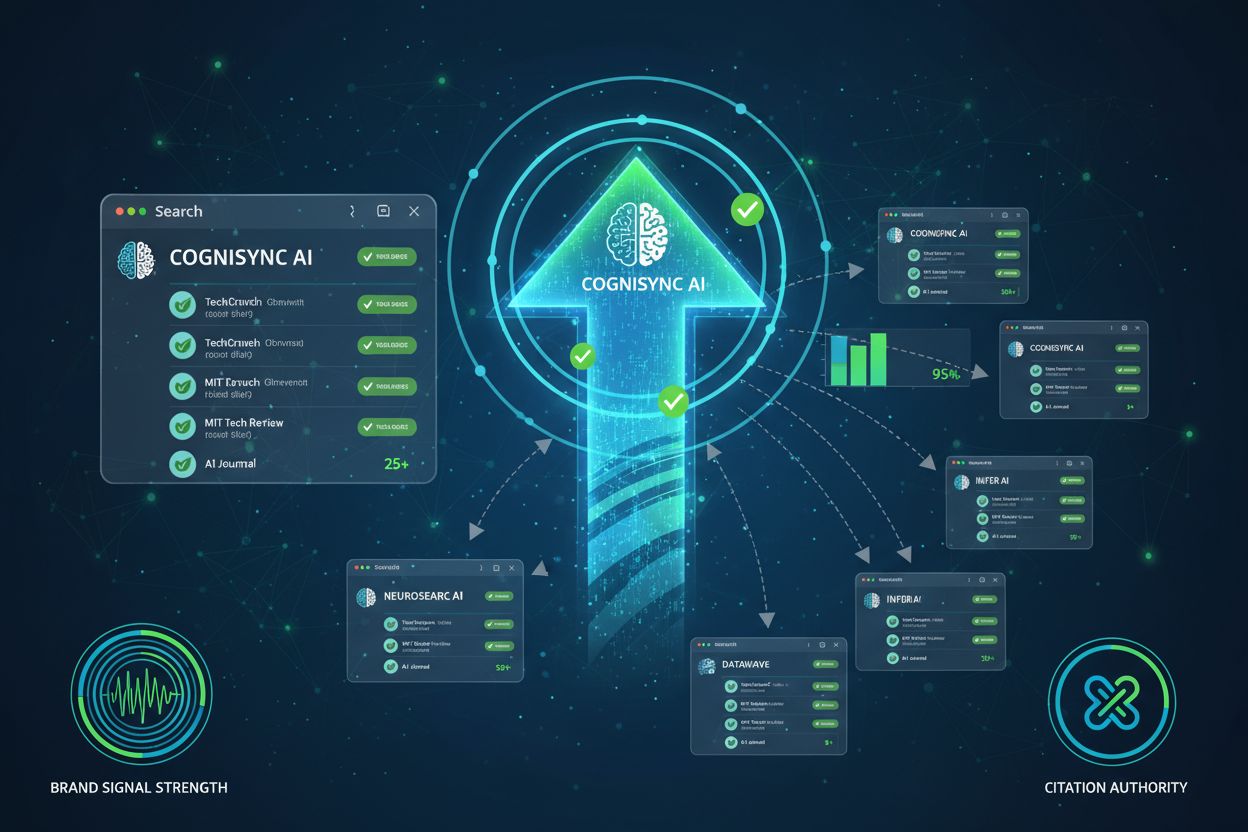
Master AI search optimization with proven tactics to outrank competitors in ChatGPT, Perplexity, and Google AI Overviews. Learn brand visibility strategies that...