

Domain Authority for AI Search: Why DA Doesn't Matter for AI Citations
Learn how domain authority affects AI search visibility. Discover why ChatGPT, Perplexity, and Claude prioritize expertise over DA scores and what metrics actua...
11 min read

Learn how traditional domain authority impacts AI search engines like ChatGPT, Perplexity, and Google AI Overviews. Discover what actually matters for AI visibility and citations.
Domain Authority does not directly affect AI search engines, but it indirectly influences AI visibility through citation patterns and data confidence. AI engines prioritize content recency, expertise demonstration, and citation quality over traditional domain metrics, making topic authority more valuable than overall domain reputation.
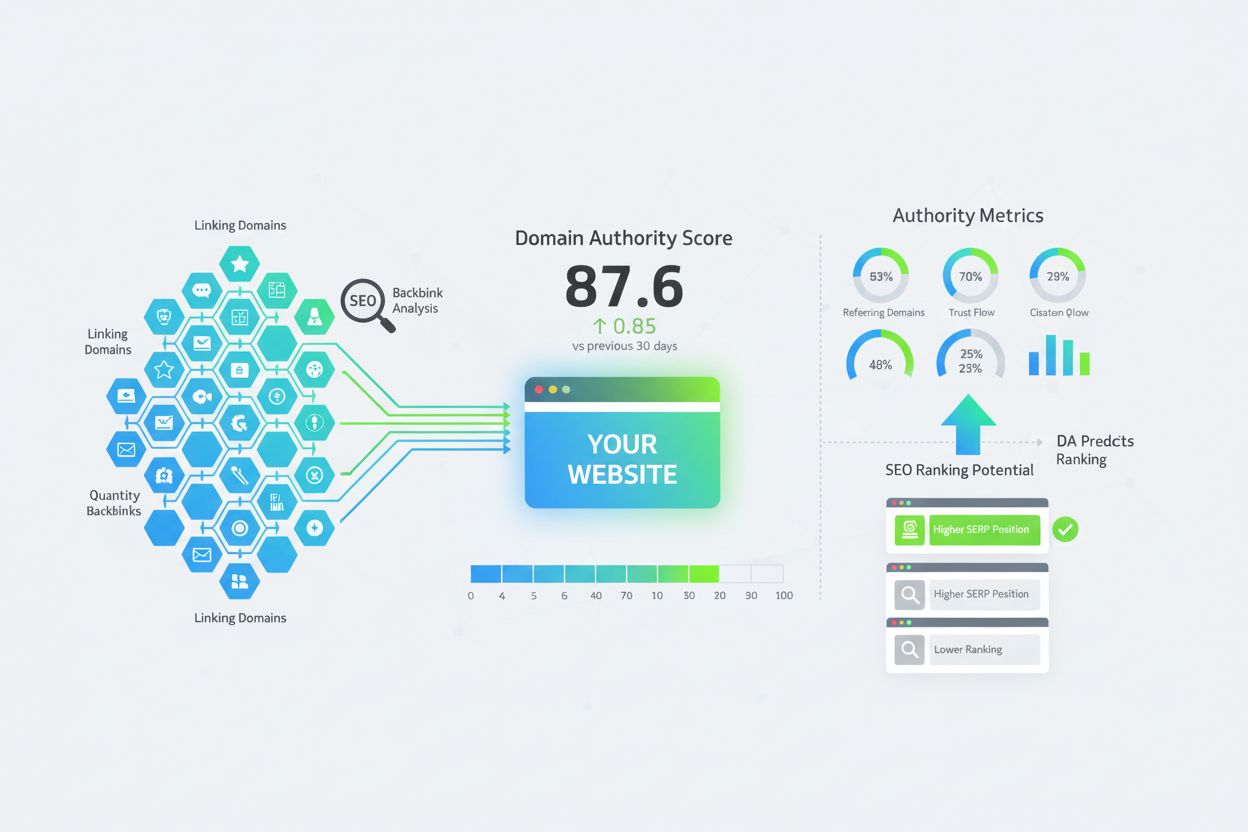
Domain Authority (DA) is a proprietary metric developed by Moz that predicts how well a website might rank in traditional search engines based on backlink quantity and quality. However, AI search engines like ChatGPT, Perplexity, Google AI Overviews, and Claude do not use Domain Authority scores in their algorithms. This represents a fundamental shift in how content gets discovered and cited in the modern search landscape. AI engines operate through entirely different mechanisms that evaluate sources through sophisticated natural language processing, knowledge graph integration, and semantic understanding rather than third-party domain metrics.
The critical distinction is that AI engines don’t rank websites—they generate answers. When you ask ChatGPT or Perplexity a question, these systems synthesize information from multiple sources to create a direct response, often citing specific sources within that answer. This process relies on different evaluation criteria than traditional search engine ranking algorithms. AI systems analyze content depth, technical accuracy, recency, and contextual relevance at the page and author level rather than assessing overall domain reputation. A blog post from a domain with a DA of 15 can easily outrank content from a high-DA corporate website if it demonstrates superior expertise, provides more current information, or answers the question more directly.
While AI engines don’t directly measure Domain Authority, the ecosystem they rely on does recognize and value the signals that create high DA scores. This creates an indirect but significant relationship between traditional authority and AI visibility. When your brand earns backlinks from reputable publications, gets mentioned across authoritative websites, and builds a strong online reputation, you’re essentially creating a pattern of credibility that AI systems can detect through their training data and real-time retrieval mechanisms.
High Domain Authority correlates with increased mention frequency across the web, which means AI models encounter your brand more often during their information gathering processes. If your content appears consistently alongside other credible sources when discussing specific topics, AI systems develop higher confidence in your information. This confidence translates into a greater likelihood of your brand being cited in AI-generated answers. Think of it as indirect influence—your DA doesn’t directly affect AI algorithms, but the visibility and credibility that high DA represents does shape how often AI systems encounter and trust your content.
| Authority Signal | Traditional SEO Impact | AI Engine Impact | Relevance |
|---|---|---|---|
| Backlinks from high-authority sites | Direct ranking factor | Increases mention frequency in training data | High |
| Domain Authority score | Direct ranking factor | Not used in algorithms | Low |
| Content recency | Ranking signal | Primary evaluation criterion | Very High |
| Topic-specific expertise | Authority signal | Primary evaluation criterion | Very High |
| Citation quality and accuracy | Trust signal | Primary evaluation criterion | Very High |
| Structured data implementation | Technical signal | Critical for content extraction | Very High |
Content recency and information freshness represent one of the most powerful factors determining whether AI engines cite your content. A blog post published last week on a relatively new domain can easily outrank months-old content from a high-DA site when answering current questions. AI systems are programmed to provide the most up-to-date and relevant information available, not necessarily information from the most “authoritative” domains according to third-party metrics. This is particularly evident in rapidly evolving fields like technology, finance, and health where information becomes outdated quickly.
Expertise demonstration through content quality significantly influences AI citation decisions. AI engines can identify when an author displays genuine knowledge through specific examples, detailed explanations, nuanced understanding of complex topics, and practical implementation details. This evaluation happens at the content level, not the domain level. A technical tutorial on a personal blog that demonstrates deep understanding through code examples and troubleshooting scenarios will rank higher in AI citations than surface-level content on a high-DA corporate website. The AI can parse the actual value and expertise demonstrated in the content, regardless of the domain’s overall authority score.
Citation quality and cross-reference validation matter tremendously in AI evaluation processes. AI systems excel at cross-referencing information across multiple sources to validate accuracy. They look for content that properly cites sources, provides verifiable claims, and aligns with authoritative information in their training data. When AI engines find consistent information across multiple sources, they’re more likely to cite those sources regardless of their DA scores. A well-researched article on a medium-authority site that properly cites primary sources will outperform poorly sourced content on a high-DA domain.
Technical documentation and tutorials frequently appear in AI responses despite coming from low-authority domains. GitHub Pages sites with a DA of 15 consistently outrank major tech publications with DA scores above 80 when users ask for specific coding solutions. AI engines recognize the practical value and accuracy of the technical content over the perceived authority of the domain. A developer’s personal documentation site becomes more valuable to AI systems than a general tech news site because it directly answers the user’s specific technical question with proven solutions.
Niche expertise blogs run by individual experts often get cited over mainstream publications in AI-generated answers. A cybersecurity researcher’s personal blog with detailed malware analysis consistently appears in AI responses, while general tech news sites with much higher DA scores are ignored. The depth of expertise and original research trumps domain metrics. AI systems understand that specialized knowledge from a focused expert is more valuable than generalist coverage from a larger publication.
Recent research and data hosted on relatively unknown domains frequently get cited over older content from established news sites. AI engines prioritize information currency and source credibility—not domain credibility—when selecting sources. Academic papers, government reports, or industry studies published on lesser-known domains will outrank outdated content from prestigious publications because the information is more current and relevant to the user’s query.
Community-driven content from platforms like Reddit, Stack Overflow, and specialized forums often gets cited despite being hosted on subdomains or user-generated sections that wouldn’t traditionally be considered “high authority” by DA standards. AI engines recognize the collaborative validation and real-world experience demonstrated in these discussions. The collective expertise and peer verification in community platforms makes them valuable sources for AI systems, even when individual contributors have no domain authority.
Entity SEO and knowledge graph presence have become critical for AI visibility. AI engines rely heavily on entity recognition and knowledge graph data to understand context and authority. Optimizing for entity SEO means clearly establishing your organization, authors, and topics as recognized entities within the AI’s understanding framework. This requires creating comprehensive About pages with detailed author bios and credentials, implementing organization schema markup to establish entity relationships, consistently using author bylines with expertise indicators, and building topical clusters around core entity relationships.
Semantic search optimization focuses on how AI engines understand content through semantic relationships rather than keyword density or backlink profiles. They analyze how concepts relate to each other and how thoroughly content covers topic areas. This requires developing comprehensive topic coverage rather than targeting individual keywords, creating content that demonstrates understanding of related concepts and subtopics, using natural language patterns that AI systems can easily parse, and building content clusters that demonstrate topical expertise.
Structured data and schema markup implementation has become increasingly important for AI engine optimization. While schema markup has existed for years, its importance for AI engine optimization cannot be overstated. AI systems rely on structured data to understand content context, authorship, publication dates, and topical relationships. Critical schema implementations include Article schema with author, publication date, and organization information; Person schema for author credentials and expertise areas; Organization schema to establish entity authority; FAQ and How-to schema for direct AI response optimization; and Review and rating schema for credibility signals.
Topic authority versus domain authority represents a fundamental shift in how AI engines assess source credibility. While Domain Authority attempts to measure overall site authority, AI engines evaluate authority within specific topic areas. A specialized site focused on a specific topic area can achieve higher visibility in AI results than a generalist site with broader authority but less specialized expertise. A financial blog that consistently produces in-depth analysis on cryptocurrency will outrank a general business publication when AI engines respond to crypto-specific queries, regardless of overall DA scores.
Implement comprehensive author authority by creating detailed author profiles that demonstrate expertise through professional credentials and certifications relevant to content topics, links to published research and speaking engagements, consistent author schema markup across all content, and author bylines on every piece with expertise indicators. This signals to AI systems that your content comes from a credible expert, not just any website.
Develop topic cluster architecture that demonstrates comprehensive coverage by creating pillar pages covering broad topic areas thoroughly, developing supporting content exploring subtopics in detail, using internal linking to show topical relationships, and implementing topic-based schema markup to clarify content relationships. This approach shows AI systems that you have deep, authoritative knowledge of specific subject areas.
Optimize for semantic search patterns by structuring content to align with how AI engines understand and process information. Use clear, descriptive headings that outline content structure, include comprehensive definitions and explanations of technical concepts, provide specific examples and case studies demonstrating practical application, and create content answering related questions comprehensively. This makes your content inherently more extractable and citable for AI systems.
Prioritize content recency and accuracy by implementing content review schedules to update information regularly, adding publication and last-updated dates to all content, creating systems for monitoring industry changes affecting your content, and developing processes for quickly updating content when new information becomes available. AI systems heavily weight fresh, accurate information over older content from high-authority domains.
Domain Authority doesn’t directly affect AI search engines, but it represents patterns of credibility that AI systems do recognize and value. The shift from domain-level to topic-level authority evaluation represents a fundamental change in how AI engines assess source credibility. Rather than chasing Domain Authority scores through link-building campaigns, smart organizations are focusing on signals that AI engines actually use: entity clarity, comprehensive topic coverage, structured data implementation, content recency, and demonstrated expertise.
The organizations that recognize this shift early and adapt their strategies accordingly will dominate AI search results. Those that continue to optimize for outdated metrics will find themselves increasingly invisible in the AI-powered search landscape. The future of visibility belongs to those who understand that AI evaluates content through the lens of demonstrated expertise, current relevance, and contribution to the overall knowledge ecosystem—not through third-party domain metrics that were designed for a different era of search.
Track how often your brand appears in AI-generated answers across ChatGPT, Perplexity, Google AI Overviews, and other AI search engines. Get real-time insights into your AI citations and share of voice.
Learn how domain authority affects AI search visibility. Discover why ChatGPT, Perplexity, and Claude prioritize expertise over DA scores and what metrics actua...
Domain Authority is a Moz-developed SEO metric (1-100 scale) predicting website ranking potential. Learn how DA is calculated, its importance for SEO strategy, ...
Learn how page authority works in AI search engines like ChatGPT and Perplexity. Discover what signals AI systems use to evaluate page credibility and how to op...