
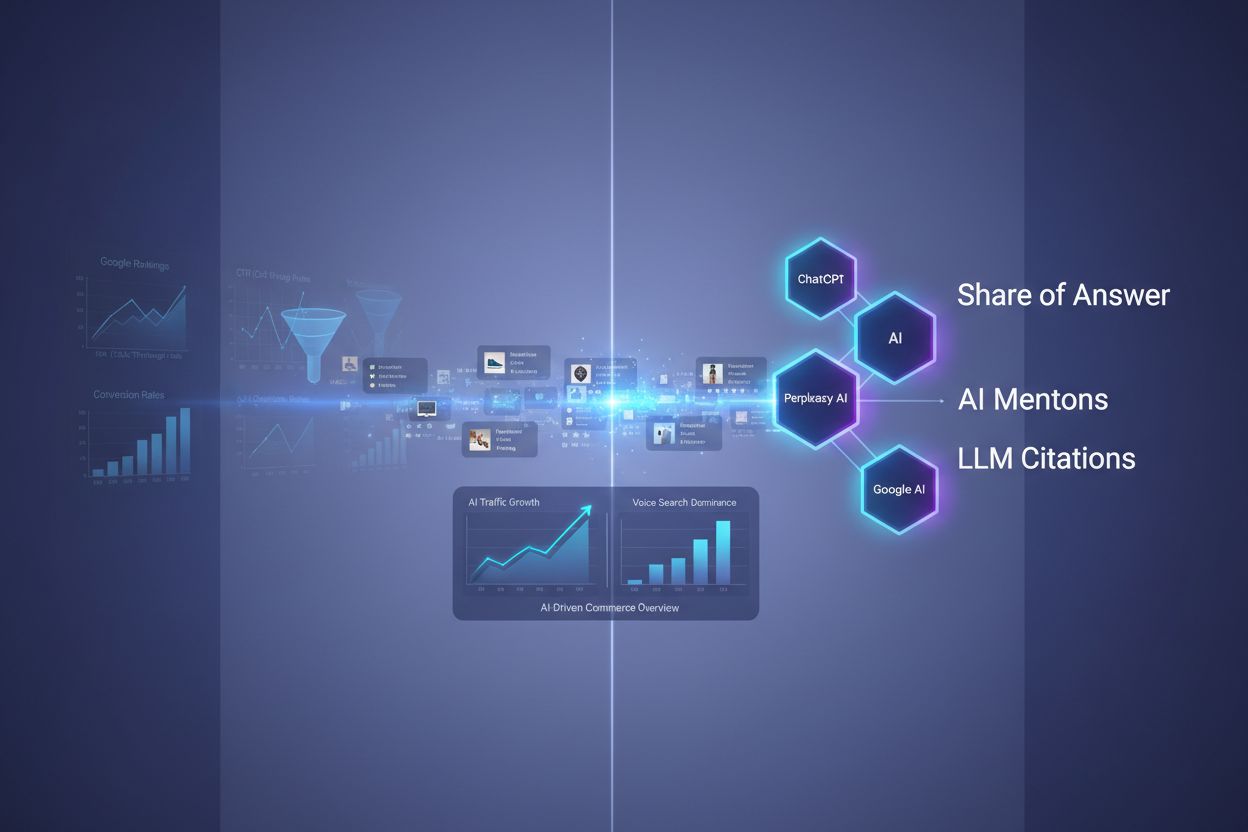
E-commerce AI Visibility: Product Discovery in AI Shopping
Learn how AI is transforming product discovery. Discover strategies for optimizing your brand's visibility in ChatGPT, Perplexity, and Google AI Overviews with ...
8 min read

Discover how AI assistants are transforming consumer shopping habits, from personalized recommendations to streamlined purchasing decisions and the future of retail commerce.
AI assistants are fundamentally transforming shopping behavior by merging product discovery and purchase into a single experience, enabling personalized recommendations, streamlining decision-making, and reducing friction in the buying process. Nearly 60% of consumers now use AI to shop, with AI agents driving billions in sales and changing how brands reach customers.
AI assistants are fundamentally reshaping how consumers discover, research, and purchase products. Unlike traditional shopping methods where customers browse multiple websites and compare options across dozens of pages, AI-powered shopping tools consolidate this entire process into a single, streamlined experience. The shift represents what industry experts call the “Agentic Era” — a transition from general-purpose AI models to specialized assistants designed for specific tasks like shopping. This transformation is not theoretical; it’s already happening at scale, with AI and AI agents driving $14.1 billion in online sales globally on Black Friday alone, demonstrating the significant impact these tools have on consumer purchasing decisions.
The fundamental change lies in how AI assistants merge product discovery and purchase into one intuitive experience. Previously, the shopping journey involved multiple steps: searching on Google, visiting retailer websites, reading reviews across platforms, comparing prices, and finally making a purchase decision. AI shopping assistants eliminate this friction by summarizing reviews, analyzing historical prices, providing personalized recommendations, and even completing purchases without requiring customers to leave the platform. This consolidation of the entire shopping funnel into a single interface represents a seismic shift in retail commerce that will have lasting implications for both consumers and brands.
Personalization is one of the most powerful ways AI assistants affect shopping behavior. These systems build unique private knowledge bases within consumer devices that adapt to individual needs, preferences, and purchase history. When a customer interacts with an AI shopping assistant, the system learns from their past purchases, browsing behavior, calendar events, family preferences, and even dietary restrictions. This level of personalization enables AI assistants to make highly relevant product recommendations without requiring customers to conduct extensive research. For example, an AI assistant integrated with a grocery service could automatically replenish household staples based on consumption patterns, family size, and upcoming meal plans — all triggered by a simple voice command.
The personalization extends beyond simple product suggestions to encompassing the entire decision-making process. AI assistants can analyze product features, compare specifications across multiple brands, and present information in a format tailored to individual shopping preferences. Some consumers prefer detailed technical specifications, while others want emotional appeals and lifestyle benefits. AI systems can adapt their presentation style to match each customer’s decision-making preferences, making the shopping experience feel more natural and intuitive. This personalization capability directly influences purchasing behavior by reducing decision fatigue and increasing confidence in purchase decisions, ultimately leading to higher conversion rates and customer satisfaction.
The proliferation of AI shopping agents across major technology platforms has created new pathways for consumer purchases. Major retailers including Amazon, Walmart, Target, Victoria’s Secret, IKEA, and Instacart have launched their own AI shopping assistants, while non-retailers like Perplexity, Google, Apple, and FedEx have integrated shopping capabilities into their platforms. This expansion means consumers can now shop through multiple entry points — not just traditional retail websites, but through AI search engines, email platforms, voice assistants, and mapping applications. The strategic importance of this shift cannot be overstated: companies that successfully position themselves at the center of commerce through AI assistants become essential parts of consumers’ everyday lives.
Perplexity’s “Shop Like a Pro” tool exemplifies how non-traditional retailers are capturing shopping intent. This AI-powered shopping assistant pulls information from multiple sources in real-time, amalgamating product features, reviews, and pricing into shopping modules that users can explore without leaving the platform. Users can compare products, read summaries, and complete purchases directly within Perplexity — a capability that fundamentally changes where shopping transactions occur. Similarly, Google has integrated AI Overview results into its search experience, providing AI-generated shopping recommendations alongside traditional search results. Yahoo Mail now helps users track orders and stay informed about promotions, while FedEx’s ShopRunner app includes wishlist features that aggregate products across multiple websites. This platform diversification means retailers must now ensure their products appear not just on their own websites, but across the AI assistant ecosystem.
AI assistants dramatically accelerate the consumer decision-making process by eliminating research friction. Historically, purchasing decisions involved multiple stages: awareness, consideration, comparison, and finally purchase. AI shopping assistants compress these stages by providing comprehensive product information, competitive analysis, and personalized recommendations simultaneously. A consumer asking an AI assistant for headphone recommendations receives not just a single suggestion, but a curated comparison of options with feature breakdowns, price analysis, and user reviews — all synthesized from multiple sources and presented in an easy-to-understand format.
The speed advantage translates directly into behavioral changes. Consumers are more likely to make impulse purchases when the friction of research is removed. Instead of spending hours comparing products across websites, customers can ask an AI assistant a natural language question and receive a comprehensive answer within seconds. This reduction in decision time particularly affects routine purchases like groceries, household items, and commodity products where consumers previously relied on habit or brand loyalty. AI assistants can now suggest alternatives based on price, quality, or personal preferences, potentially shifting purchasing patterns away from established brands toward products that better match individual needs. The ability to complete purchases directly within the AI platform — without navigating to external websites — further reduces friction and increases conversion likelihood.
The emergence of AI shopping assistants as gatekeepers of consumer intent fundamentally changes how brands should approach marketing. In the traditional search-based model, brands competed for visibility through search engine optimization and paid search advertising, capturing consumer intent at the moment of purchase. With AI assistants handling product discovery and recommendations, the traditional point-of-purchase advertising model becomes less effective. When a consumer asks an AI assistant to “reorder peanut butter,” the AI makes the selection based on its training data and user preferences — not based on which brand paid for the top search result.
This shift necessitates a fundamental reorientation of marketing strategy toward top-of-funnel brand-building that emphasizes emotional connections, trust, and brand awareness. Rather than relying on lower-funnel tactics like keyword targeting and retargeting ads, brands must focus on creating strong first impressions through social media, influencer partnerships, traditional advertising, and content marketing. The fight for consumer loyalty in an AI-driven ecosystem is won long before the moment of purchase, during the awareness and consideration stages. Brands that build strong emotional connections and establish themselves as trustworthy will be more likely to be recommended by AI assistants, which typically prioritize well-known, highly-rated brands in their recommendations. Additionally, brands must ensure their products are properly indexed and integrated into AI shopping platforms, as visibility in these systems is becoming as important as visibility in traditional search engines.
Nearly 60% of consumers now use AI to shop, representing a dramatic shift in consumer behavior adoption. This high adoption rate indicates that AI shopping assistants have moved beyond novelty status to become mainstream tools in the consumer shopping toolkit. The financial impact is substantial: McKinsey estimates that $3 trillion to $5 trillion of shopping worldwide will occur through AI agents by 2030. To put this in perspective, this represents a significant portion of global retail commerce, suggesting that AI-assisted shopping will become the dominant shopping method within the next five years.
The adoption varies by product category and consumer demographics. Routine purchases like groceries, household items, and commodity products show the highest adoption rates for AI-assisted shopping, as these purchases benefit most from the efficiency gains AI provides. Younger consumers and tech-savvy shoppers adopt AI shopping tools more quickly, while older demographics are gradually increasing their usage as the technology becomes more intuitive and widely available. The holiday shopping season has proven particularly important for AI adoption, with traffic to retail sites from chatbots increasing by 1,800% compared to the previous year, and AI-enabled online chat services growing 31% year-over-year. This seasonal spike suggests that as consumers become more comfortable with AI shopping during peak shopping periods, they’re likely to continue using these tools year-round.
| Behavioral Change | Impact | Example |
|---|---|---|
| Reduced Research Time | Consumers make faster purchasing decisions | Asking AI for product recommendations instead of browsing 20+ websites |
| Increased Personalization | Higher relevance and satisfaction with recommendations | AI suggesting products based on past purchases and preferences |
| Platform Consolidation | Shopping occurs across multiple AI platforms, not just retailer websites | Purchasing through Perplexity, Google, or voice assistants |
| Impulse Purchase Increase | Lower friction leads to more spontaneous buying | Completing purchases without leaving the AI platform |
| Brand Loyalty Shift | Consumers more open to alternatives recommended by AI | Switching from preferred brand if AI suggests better option |
| Routine Purchase Automation | Recurring purchases handled automatically by AI | Grocery replenishment without manual reordering |
| Review and Comparison Reliance | Consumers trust AI synthesis of reviews over individual research | Accepting AI-generated product comparisons as authoritative |
The trajectory of AI shopping assistants suggests even more dramatic behavioral changes ahead. As these systems become more sophisticated and integrated into daily life, consumers will increasingly delegate shopping decisions to AI agents. Voice-activated shopping through devices like Siri, Alexa, and Google Assistant will become the primary shopping interface for many consumers, particularly for routine purchases. Imagine telling your AI assistant, “Keep my pantry stocked,” and having it automatically manage grocery shopping based on your family’s consumption patterns, dietary preferences, and budget constraints — this level of automation is already technically feasible and will likely become commonplace within the next few years.
The integration of AI shopping into non-traditional platforms will continue to expand. Email clients, mapping applications, social media platforms, and even messaging apps will increasingly incorporate shopping capabilities. This omnichannel AI shopping ecosystem means consumers will shop wherever they naturally spend time, rather than visiting dedicated retail websites. For brands, this fragmentation of shopping touchpoints creates both challenges and opportunities. Brands that successfully integrate with multiple AI shopping platforms and maintain strong brand presence across the AI ecosystem will thrive, while those that rely solely on traditional e-commerce channels risk becoming invisible to consumers who increasingly shop through AI intermediaries. The competitive landscape will shift from competing for search visibility to competing for prominence in AI recommendation algorithms and ensuring seamless integration across the AI shopping ecosystem.
Ensure your products and brand appear in AI-generated shopping recommendations and answers. Track how AI assistants like ChatGPT, Perplexity, and Google AI Overview mention your domain and products.
Learn how AI is transforming product discovery. Discover strategies for optimizing your brand's visibility in ChatGPT, Perplexity, and Google AI Overviews with ...

Learn how to optimize your e-commerce store for AI shopping assistants like ChatGPT, Google AI Mode, and Perplexity. Discover strategies for product visibility,...

Compare ChatGPT Shopping and Perplexity Shopping for e-commerce. Explore features, user experience, pricing, and which AI platform works best for your business.