
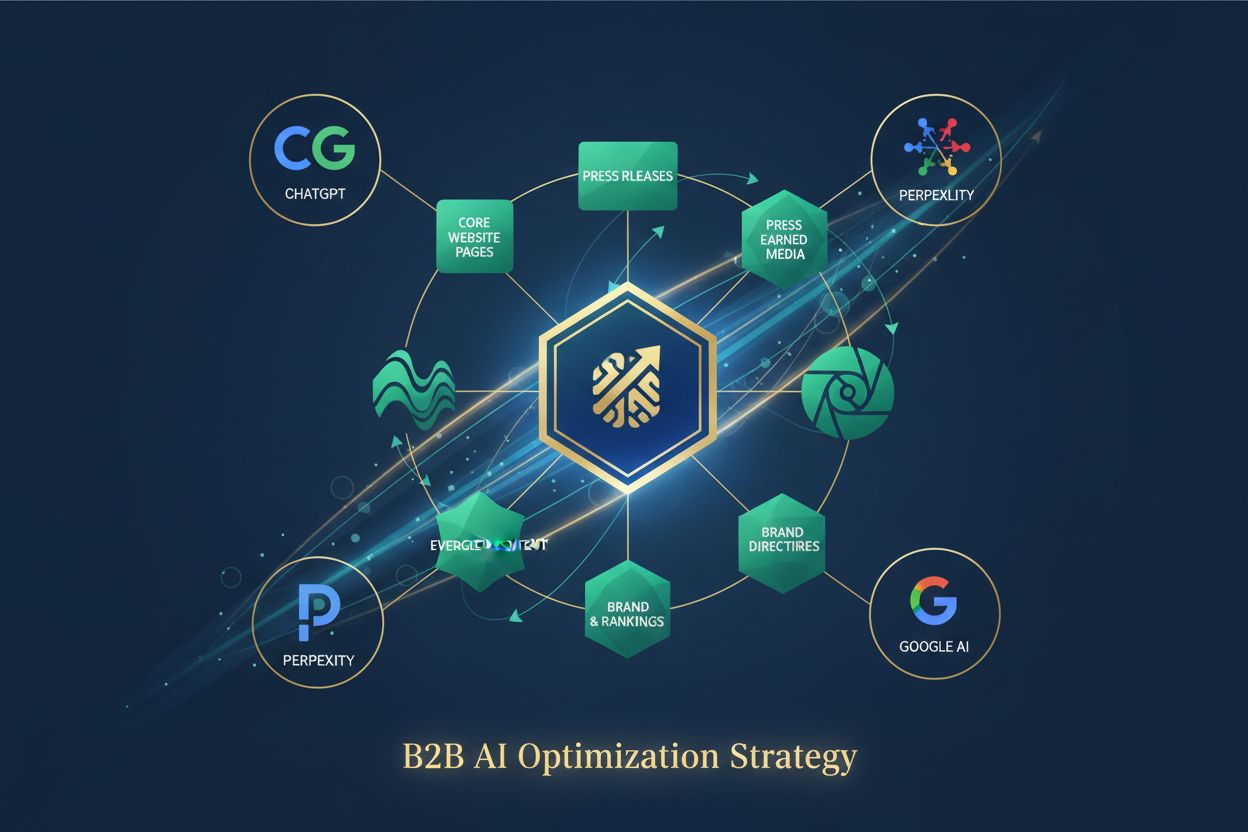
B2B AI Optimization
Learn B2B AI Optimization strategies to enhance your brand visibility in ChatGPT, Perplexity, and Google AI Overviews. Discover how to optimize for AI citations...
8 min read

Learn how B2B companies optimize content for AI search engines like ChatGPT, Perplexity, and Google AI Overviews. Discover strategies for Answer Engine Optimization (AEO) and Generative Engine Optimization (GEO) to increase visibility in AI-generated answers.
B2B companies optimize for AI search by creating authoritative, well-structured content with clear answers, implementing schema markup, building topic clusters, and ensuring semantic clarity. Success requires focusing on E-E-A-T signals, conversational language, and making content easily parsable by AI systems across multiple platforms including ChatGPT, Perplexity, and Google's AI Overviews.
The landscape of B2B search has fundamentally shifted. Traditional search engine optimization focused on ranking positions in a list of blue links, but AI-powered search engines like ChatGPT, Perplexity, Google’s AI Overviews, and Microsoft Copilot now synthesize information from multiple sources to deliver direct answers to users. This transformation requires B2B companies to adopt new optimization strategies collectively known as Answer Engine Optimization (AEO) and Generative Engine Optimization (GEO). Rather than competing for the top ranking position, companies must now ensure their content is selected and cited by AI systems when generating responses to user queries.
AI systems don’t evaluate content the same way traditional search engines do. When an AI assistant processes a query, it breaks down web content into smaller, structured pieces through a process called parsing. These modular pieces are then ranked and assembled into coherent answers that often draw from multiple sources. For B2B companies, this means content must be designed with AI comprehension in mind from the ground up.
The primary factors that determine whether AI systems select your content include Experience, Expertise, Authoritativeness, and Trustworthiness (E-E-A-T), semantic clarity, topic authority, and structured data implementation. Content that demonstrates real-world expertise through author credentials, original research, and credible citations is significantly more likely to be surfaced in AI-generated responses. Additionally, AI systems favor content that is logically formatted, easy to extract, and directly answers the specific questions users are asking.
| Optimization Factor | Traditional SEO Focus | AI Search Focus |
|---|---|---|
| Content Structure | Keyword density and placement | Clear headings, modular sections, semantic clarity |
| Authority Signals | Backlinks and domain authority | E-E-A-T, author expertise, original research |
| Content Format | Long-form articles | Snippable answers, Q&A blocks, structured data |
| Visibility Metric | Ranking position | Citation frequency in AI responses |
| User Intent | Keyword matching | Conversational queries and contextual relevance |
The foundation of AI search optimization is creating content that AI systems can understand, trust, and confidently cite. This begins with leading each section with a clear, direct answer of 40-60 words that summarizes the key point. This approach helps AI models quickly grasp the main idea and significantly increases the chances of being included in the AI’s final synthesized response. B2B companies should build detailed guides, Q&A pages, and explainer articles that anticipate follow-up questions and address them comprehensively.
Demonstrating E-E-A-T is critical for AI selection. This means highlighting subject matter experts with bylines and professional credentials, citing reputable data sources, and publishing original research that becomes a go-to reference for AI systems. For example, a B2B SaaS company could publish benchmark studies or industry reports that AI systems reference when answering related queries. Additionally, companies should interlink supporting pages to form topic clusters, which signals to both AI and human readers that the site is a hub of expertise on the subject. This interconnected approach helps AI systems understand the depth and breadth of your knowledge across related topics.
AI systems parse content differently than humans read it. They don’t process pages top-to-bottom but instead break content into smaller, usable pieces that can be evaluated for authority and relevance. To optimize for this parsing behavior, B2B companies must pay careful attention to page titles, descriptions, H1 tags, and heading hierarchy.
Your page title should clearly summarize what the content delivers using natural language that aligns with search intent. The H1 tag acts as your content’s headline and should match or closely reflect the page title while setting clear expectations for what follows. Consistent alignment between title, H1, and description improves both discoverability and confidence signals for AI systems. H2 and H3 headings act like chapter titles that define clear content slices, helping AI understand where one idea ends and another begins. Instead of vague headings like “Learn More,” use specific, question-based headings such as “What Makes This Solution More Cost-Effective Than Competitors?”
Lists and tables are particularly effective for AI parsing. Bulleted lists, numbered steps, and comparison tables break complex details into clean, reusable segments that AI can lift directly into answers. Q&A formats are especially powerful because they mirror the way people search and allow AI to often use these pairs word-for-word in generated responses. Avoid long walls of text that blur ideas together and make it harder for AI to separate content into usable chunks. Similarly, don’t hide important answers in tabs or expandable menus, as AI systems may not render hidden content.
Schema markup is a type of structured data code that helps search engines and AI systems understand your content with greater precision. It transforms plain text into machine-readable information that AI can interpret with confidence. Schema is typically added in JSON-LD format as a script in the backend of your site, often through your CMS or by a developer inserting it into the page code.
Common schema types that benefit B2B companies include FAQPage schema for Q&A content, HowTo schema for step-by-step instructions, Article schema for blog posts and thought leadership, Organization schema to define company information, Product or SoftwareApplication schema to describe offerings, and Author schema to show credentials. Implementing schema across multiple content types significantly improves how AI systems classify and surface your content. For instance, VideoObject markup signals video title, description, and length, making videos easier to add to AI overviews or search carousels. The more structured data you provide, the more confidently AI systems can extract and cite your content.
AI search expands what counts as a “keyword.” Prospects now type or speak long-tail, conversational queries that traditional keyword research might miss. Capturing these requires a question-first approach to content creation. B2B companies should use tools like Google’s People Also Ask, AnswerThePublic, AlsoAsked, and Semrush’s Question Hub to find the specific questions their buyers are asking at different stages of the purchasing journey.
Building FAQ sections on major topic pages is particularly effective. Each question should have a succinct 40-60 word answer, which helps content appear in AI overviews and featured snippets. Implementing FAQ schema markup makes these answers machine-readable and eligible for enhanced display in search results. Use conversational headings that replace generic terms with specific, intent-driven language. For example, instead of “Features,” use “How Our Software Solves [Problem]” or “Why This Matters for [Industry].” This approach aligns with how AI systems evaluate user intent and makes content more likely to surface practical, detailed answers that map to a prospect’s decision-making process.
Even the best content won’t appear in AI overviews if crawlers can’t access or render it quickly. Technical SEO remains the backbone of discoverability in the AI search era. B2B companies must optimize Core Web Vitals, which measure user experience and site performance. Aim for LCP (Largest Contentful Paint) under 2.5 seconds so your main content appears quickly, INP (Interaction to Next Paint) under 200 milliseconds for instant responsiveness, and CLS (Cumulative Layout Shift) under 0.1 to prevent page jumping during load.
Mobile-first readiness is essential since most voice and AI searches happen on mobile devices. Test pages on multiple devices to ensure usability and load speed. Maintain clean HTML and semantic structure with clear heading hierarchy, descriptive alt text for images, and avoid hiding text behind scripts. Audit your site quarterly for crawl errors, outdated redirects, and broken internal links. A strong technical foundation is your ticket to being considered for AI citations. Additionally, ensure your site is easily crawlable by AI agents by creating well-organized resource centers that combine whitepapers, case studies, videos, and tools into single, well-structured hub pages.
Voice assistants often read aloud from structured, easy-to-read content, whether that’s a knowledge panel, text cited in an AI overview, or a featured snippet. Write for the ear by using natural, conversational language with short sentences and contractions that feel more human when read aloud. Begin paragraphs with the key takeaway, then elaborate with supporting details. Format steps as lists for how-to content using numbered lists or bullet points, which are voice-friendly, snippet-friendly, and align well with AI overview formatting.
While Google’s AI Overviews may cite multiple sources, the traditional featured snippet still exists and optimizing for clear, snippet-friendly answers increases your chances of appearing in both. B2B companies should also update their Google Business Profile with location and contact information if local B2B queries are important to their business. Research shows that B2B brands adding FAQ blocks and voice-optimized summaries to high-traffic pages have seen higher inclusion rates in AI overviews and an uptick in branded voice queries, demonstrating that structuring for voice search improves discoverability even without traditional featured snippets.
AI answer engines don’t only pull content from your website—they tap into a broad range of public sources including Reddit, Quora, LinkedIn, and YouTube. Each platform offers a unique path to visibility and authority. Reddit and Quora are strong for technical and long-tail queries, LinkedIn prioritizes professional thought leadership and B2B authority, and YouTube is favored for structured, explainer-style video content. Instead of chasing reach, B2B companies should focus on relevance by identifying high-intent topics in these forums and aligning their strategy accordingly.
Cross-functional collaboration is now essential for AI search success. PR, content, and SEO teams should work in tandem to build authority by getting cited in industry publications, being mentioned in credible forums, and contributing to trusted third-party platforms. These activities increase the likelihood of appearing in AI-generated responses. B2B companies should consider ungating more high-quality content without giving away the farm, as AI engines can’t access information hidden behind forms. Striking the right balance between lead generation and open-access authority is now part of modern SEO strategy. Thought leaders should be featured in videos, webinars, podcasts, and LinkedIn posts, with these assets embedded or linked on the company website to reinforce expertise signals.
Traditional SEO metrics don’t tell the complete story in the AI search era. While Google Search Console offers limited transparency into AI Overview placements, B2B companies can use proxy indicators to measure impact. Track branded search volume, long-tail keyword performance, impression share, and lead quality metrics to fill gaps where direct click data falls short. Alternative tools like Profound, Brandlight, and Evertune have emerged to track how answer engines surface and rank your brand against competitors.
Refresh content regularly with current data and examples to keep it eligible for citations, as AI favors current information. Monitor how your industry is represented in generative search results and adjust your strategy accordingly. Offer unique assets like proprietary calculators, surveys, or benchmarking tools that provide value AI can’t fully replicate and drive click-throughs from “learn more” links. The key is to continue refining SEO strategies and adapting formats for structured content as search evolves. Success in AI search isn’t about luck—it’s about structure, clarity, and snippability working together to make your content easier for AI to process and surface.
Track how your brand appears in AI-generated answers across ChatGPT, Perplexity, Google AI Overviews, and other AI search engines. Get real-time insights into your AI search visibility and competitive positioning.
Learn B2B AI Optimization strategies to enhance your brand visibility in ChatGPT, Perplexity, and Google AI Overviews. Discover how to optimize for AI citations...

Learn how ecommerce businesses optimize for AI search engines like ChatGPT, Perplexity, and Google AI Mode. Discover strategies for product visibility, schema m...
Learn how technology companies optimize content for AI search engines like ChatGPT, Perplexity, and Gemini. Discover strategies for AI visibility, structured da...