
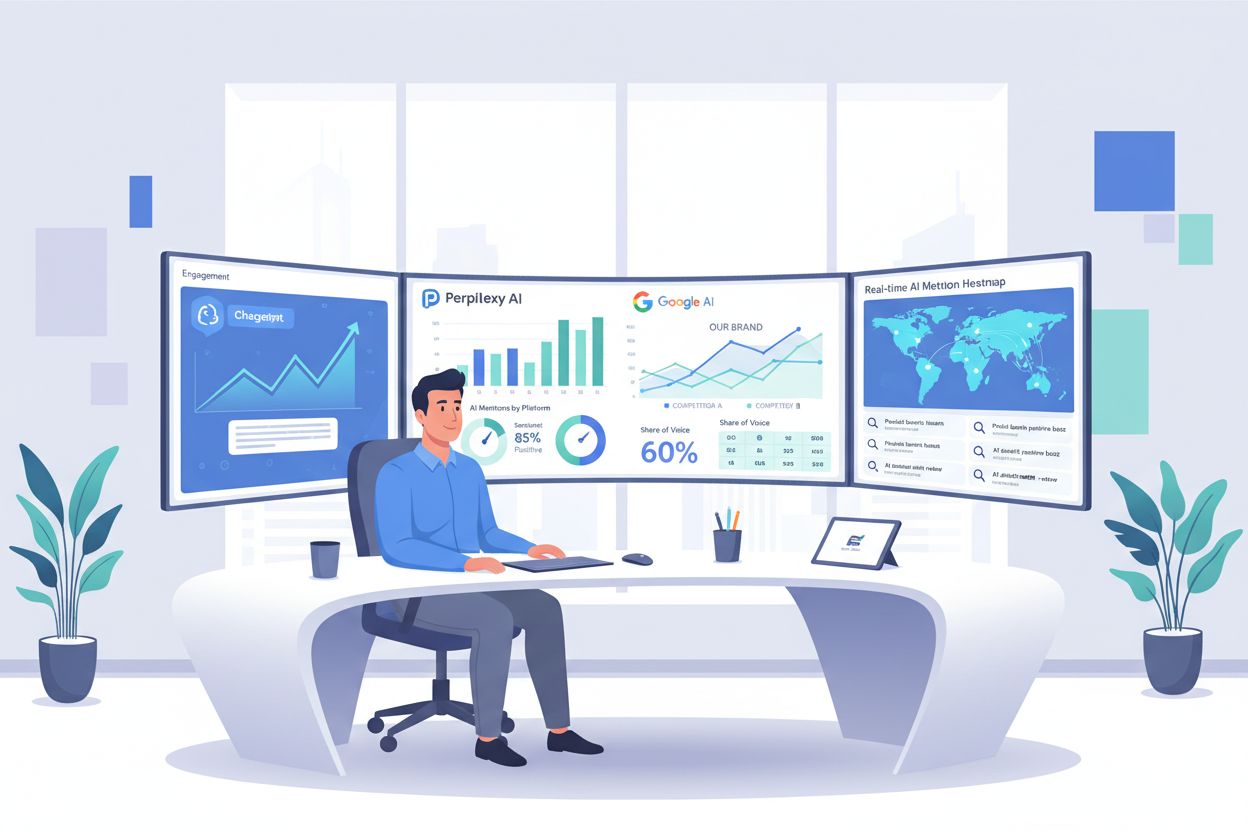
How to Set Up AI Brand Monitoring: A Complete Guide
Learn how to set up AI brand monitoring to track your brand across ChatGPT, Perplexity, and Google AI Overviews. Complete guide with tools, strategies, and best...
9 min read

Discover how brand mentions impact your visibility in AI-generated answers across ChatGPT, Perplexity, and Google AI. Learn strategies to increase AI visibility and monitor brand presence.
Brand mentions significantly impact AI visibility by signaling credibility and authority to AI systems. When your brand appears in AI-generated answers, it influences user perception and trust, directly affecting whether customers discover and choose your business over competitors in AI search results.
Brand mentions in AI-generated answers have become a critical factor in modern digital visibility. Unlike traditional search engines where your website competes for ranking positions on a results page, AI search engines like ChatGPT, Perplexity, Claude, and Google AI Overviews deliver synthesized answers that cite only a few sources. When your brand is mentioned in these AI responses, it signals credibility and authority to users who increasingly rely on AI for product discovery and decision-making. The impact is profound: if your brand isn’t mentioned in AI answers, you may be completely invisible to millions of users who have replaced traditional search with AI assistants. This shift represents a fundamental change in how customers discover, evaluate, and ultimately choose brands.
The significance of AI brand mentions extends beyond simple visibility. Research shows that 58% of consumers have already replaced traditional search engines with generative AI tools for product recommendations, and this trend continues to accelerate. When people see your brand consistently mentioned in AI-generated answers, it creates a perception of expertise and trustworthiness that directly influences purchasing decisions. These mentions act as a form of digital endorsement, where the AI system itself becomes a validator of your brand’s relevance and quality. The more visible you are in AI responses, the more likely users are to trust and ultimately choose your brand over competitors who may not appear in those same answers.
AI systems use retrieval-augmented generation (RAG) to synthesize answers from multiple sources. This process fundamentally differs from traditional search ranking algorithms. Rather than ranking individual pages, AI systems pull information from various sources and create a single synthesized answer that cites only the most relevant and authoritative sources. This means your brand’s visibility depends not on keyword rankings or backlink counts alone, but on whether AI systems recognize your content as relevant, authoritative, and citation-worthy for specific user queries. The selection process is influenced by multiple factors including content quality, domain authority, training data presence, and how well your information aligns with what the AI system has learned about your industry.
The training data that AI systems were built on plays a crucial role in brand mentions. ChatGPT, for example, tends to cite trusted brands from its training data, even when live search grounding is absent. This means established brands with historical online presence have an inherent advantage in ChatGPT responses. However, other platforms like Google AI Overviews generate significantly more brand mentions per query, averaging 6.02 brand mentions compared to ChatGPT’s 2.37. This platform-specific behavior creates different opportunities for brands of varying sizes and market positions. Smaller or newer brands may find better visibility opportunities in Google AI Overviews, while established brands leverage their historical presence in ChatGPT. Understanding these platform-specific behaviors is essential for developing an effective AI visibility strategy.
| Factor | Impact Level | Description |
|---|---|---|
| Google Search Rankings | High (~0.65 correlation) | Brands ranking on page 1 of Google show strong correlation with LLM mentions |
| Content Quality & Structure | High | Clear formatting, statistics, and expert insights increase citation likelihood |
| Domain Authority | Medium | Established domains receive more mentions, but not as critical as content quality |
| Backlinks | Low-Medium | Surprisingly weak impact on LLM mentions compared to traditional SEO |
| Commercial Intent Keywords | High | Keywords with “buy,” “where,” “deals” trigger mentions in 65% of cases |
| Content Freshness | Medium | Regular updates and new publishing improve visibility in AI responses |
| Fact Density | High | Content packed with statistics and verifiable details boosts AI visibility |
| Platform-Specific Presence | Medium | Being cited on platforms AI systems reference increases mention likelihood |
Google search rankings remain one of the strongest correlations with AI brand mentions. A comprehensive study analyzing over 300,000 keywords and 10,000 AI-generated responses found that brands ranking on page 1 of Google showed approximately 0.65 correlation with LLM mentions. This suggests that traditional SEO efforts still matter significantly in the AI era, but they’re not the complete picture. The study also revealed that when researchers filtered out noise from forums, social media, and aggregator sites to focus on solution-oriented websites, the correlation became even stronger. This indicates that AI systems prioritize content from authoritative, solution-focused sources rather than discussion platforms or general aggregators.
Surprisingly, the research found that backlinks had weak or even neutral impact on LLM mentions, contrary to traditional SEO wisdom. This suggests that AI systems evaluate content quality and relevance differently than traditional search engines. Instead of relying heavily on link signals, AI systems appear to prioritize content that directly answers user questions with clear, factual information. Multi-modal content including images and videos also showed less impact than expected, indicating that text-based, fact-dense content remains the primary driver of AI visibility. This finding is important because it suggests brands don’t need to invest heavily in complex multimedia strategies to improve AI visibility; instead, they should focus on creating comprehensive, well-structured, fact-rich written content.
Each major AI platform exhibits distinct behavior patterns when mentioning brands. ChatGPT tends to cite established brands from its training data, creating a “brand authority play” where historical presence matters significantly. Google AI Overviews, by contrast, generates the highest number of brand mentions per query and offers broader coverage, creating what researchers call a “volume opportunity” for brands to gain visibility. Google AI Mode takes a more selective approach, restricting mentions to brands with strong validation signals, reinforcing authority but limiting the number of brands mentioned. This platform fragmentation means that the same query can return completely different brand recommendations depending on which AI system a user consults.
Research analyzing tens of thousands of queries across these platforms found that brand mentions disagreed 61.9% of the time, with only 33.5% of queries producing the same brand names across all three major platforms. This dramatic divergence has important implications for brand strategy. A brand might be prominently mentioned in Google AI Overviews but completely absent from ChatGPT responses for the same query. This means brands cannot rely on a single optimization strategy; instead, they must understand and adapt to the unique characteristics of each platform. The study also found that commercial intent keywords such as “best,” “buy,” and “where” triggered mentions in 65% of cases, showing that e-commerce and finance verticals achieved 40% or more brand coverage, significantly higher than other industries.
When users see your brand consistently mentioned in AI-generated answers, it creates a powerful trust signal. Unlike traditional advertising where users know they’re seeing paid promotions, AI-generated mentions feel like objective recommendations from a neutral source. This perception gap makes AI mentions particularly valuable for building brand credibility. Users who see your brand mentioned alongside competitors in an AI answer perceive your business as equally relevant and trustworthy, even if you haven’t paid for that placement. The psychological impact is significant: over 40% of users rarely or never click through to source materials, meaning the initial AI response is often the final word in their decision-making process. If your brand isn’t mentioned in that initial response, you’ve lost the opportunity to influence that user’s perception.
The competitive dynamics created by AI mentions are stark. If a brand isn’t mentioned clearly and positively, customers will see and choose competitors who are featured in AI responses. This creates a winner-take-most dynamic where the brands mentioned in AI answers capture disproportionate attention and trust. Research shows that users trust AI-generated answers more than traditional search results, making the stakes even higher for brand visibility. The absence of your brand from AI answers doesn’t just mean lost visibility; it actively reinforces competitor positioning in users’ minds. When users repeatedly see the same competitors mentioned in AI responses across multiple queries, those competitors become the default choice in users’ mental models, making it increasingly difficult for your brand to compete even if you eventually gain visibility.
Targeting highly-cited websites and platforms is one of the most effective strategies for improving AI visibility. AI systems frequently reference platforms like Reddit, Quora, industry news sites, and authoritative publications when synthesizing answers. By actively seeking mentions and engaging in discussions on these platforms, brands can increase their presence in the sources that AI systems draw from. This doesn’t mean spamming or self-promotion; rather, it involves providing genuine value, answering questions authentically, and building authority within these communities. When your brand appears in discussions on these high-authority platforms, AI systems are more likely to recognize and cite your brand when answering related questions.
Creating structured, fact-dense content is essential for AI visibility. AI systems can easily parse and reference content that uses clear formatting like headers, bullet points, FAQ sections, and step-by-step guides. Content packed with statistics, data points, and expert insights is more likely to be cited because AI systems can extract specific, verifiable information. Brands should prioritize creating comprehensive guides, comparison articles, and detailed how-to content that directly answers the questions users ask AI systems. The content should be optimized for both human readers and AI systems, with clear section headers, concrete data, and natural language that makes it easy for AI to understand and extract relevant information.
Encouraging authentic reviews and positive sentiment is another critical strategy. Positive sentiment is heavily weighted by AI systems when deciding which sources to cite. Brands should actively encourage customers to leave detailed, honest reviews on platforms that AI systems reference. These reviews serve as social proof that influences how AI systems perceive and present your brand. Additionally, leveraging digital PR to secure positive coverage in publications that AI models frequently cite can significantly improve visibility. Building relationships with media outlets, industry influencers, and thought leaders in your space increases the likelihood that your brand will be mentioned in authoritative sources that AI systems rely on.
Tracking brand mentions in AI responses requires systematic monitoring across multiple platforms. Manual checking is possible but time-consuming and inconsistent. Users can manually query ChatGPT, Perplexity, Google AI Overviews, and Google AI Mode with relevant prompts, then note whether their brand appears. However, this approach doesn’t scale well and provides only a snapshot rather than ongoing insights. For meaningful data, brands need to monitor hundreds of prompts across multiple platforms, countries, and languages to understand their true AI visibility. This is where automated AI visibility tracking tools become essential, providing consistent, real-time monitoring that reveals patterns and trends over time.
Key metrics to track include citation frequency, brand visibility score, and AI share of voice. Citation frequency measures how often your website appears as a source in AI-generated answers, which is the AI equivalent of earning a backlink. Your brand visibility score is a composite metric showing how prominently your brand appears across AI platforms for your target keywords and topics. AI share of voice compares your brand’s mention rate to competitors in AI-generated answers, revealing whether you’re gaining or losing ground. If a competitor appears in 60% of relevant AI responses while you appear in only 15%, that gap represents a significant lost opportunity. Tracking these metrics over time reveals whether your optimization efforts are working and where you need to adjust your strategy.
Sentiment and positioning analysis provides deeper insights into how AI describes your brand. AI systems don’t just mention brands neutrally; they characterize them in specific ways that influence user perception. Understanding whether AI describes your business positively, neutrally, or negatively helps identify perception gaps and optimization opportunities. Geographic performance analysis is also important, as AI responses can vary significantly by location. A brand might have strong visibility in one market but be completely absent in another, requiring localized optimization strategies. By monitoring these detailed metrics, brands can move from random manual checks to a consistent, data-driven approach that reveals exactly where they stand in the AI visibility landscape.
The shift toward AI-driven discovery is accelerating rapidly and will continue to reshape how customers find brands. Traditional organic search traffic is expected to decline by 50% by 2028 according to Gartner research, while AI search adoption continues to grow exponentially. ChatGPT now has 700 million weekly active users, a 4x increase year-over-year, and other AI platforms are growing at similar rates. This trend means that brands that ignore their AI visibility today are essentially ceding market share to competitors who are actively optimizing for AI search. The window to establish strong AI visibility is now, before the competitive landscape becomes saturated and harder to break into.
Emerging trends in AI search include multimodal capabilities, real-time integration, and platform fragmentation. AI systems are beginning to process images, voice, and video alongside text, creating new opportunities for brand visibility beyond traditional written content. Real-time integration means AI systems are connecting to live data sources for fresher, more accurate answers, which could increase the importance of current, up-to-date content. Platform fragmentation continues as new AI search options emerge and compete for user attention, meaning brands must maintain visibility across an expanding ecosystem of AI platforms. The brands that adapt to these evolving dynamics and maintain a proactive approach to AI visibility will gain compounding advantages over time, while those that rely solely on traditional search risk becoming increasingly invisible to users who have migrated to AI-powered discovery.
Start tracking how your brand appears across ChatGPT, Perplexity, Google AI Overviews, and other AI platforms. Get real-time insights into your AI visibility and competitive positioning.
Learn how to set up AI brand monitoring to track your brand across ChatGPT, Perplexity, and Google AI Overviews. Complete guide with tools, strategies, and best...
Learn how to monitor and manage positive and negative AI mentions across ChatGPT, Perplexity, and Google AI Overviews. Protect your brand reputation with AI-pow...
Learn how to set up AI mention alerts to monitor your brand across ChatGPT, Perplexity, and Google AI Overviews. Protect your reputation and gain competitive in...