

Why GEO Matters for Business Success in 2025: AI Search Visibility Guide
Discover why Generative Engine Optimization (GEO) is essential for businesses in 2025. Learn how AI-powered search is reshaping brand visibility, consumer behav...
8 min read

Learn how ecommerce businesses optimize for AI search engines like ChatGPT, Perplexity, and Google AI Mode. Discover strategies for product visibility, schema markup, feeds, and brand mentions.
Ecommerce sites optimize for AI search by making product pages crawlable to AI bots, implementing structured data schema markup, creating high-quality product feeds, aligning content with conversational prompts and user intent, building brand presence across the web, and monitoring visibility in AI-powered platforms like ChatGPT, Perplexity, and Google AI Mode.
Generative Engine Optimization (GEO) is fundamentally different from traditional SEO. While traditional search engine optimization focuses on ranking websites in link-based search results, GEO is about ensuring your ecommerce products and brand content are selected, summarized, and cited by AI-powered systems like ChatGPT, Perplexity, Google AI Mode, and Amazon Rufus. The shift is significant: instead of competing for the top position in search results, ecommerce businesses now need to ensure they’re included as a source within AI-generated answers and product recommendations. This represents a major change in how customers discover products online, with research showing that 60% of search queries now end without users visiting another website, relying instead on AI overviews for their answers.
The foundation of AI search optimization begins with ensuring AI crawlers can actually access and understand your product content. Many ecommerce sites inadvertently block AI bots through their robots.txt files or serve critical product information using JavaScript, making it invisible to AI systems. To optimize crawlability, you must first verify that your robots.txt file does not contain blocking rules for AI crawlers such as GPTBot, OAI-SearchBot, PerplexityBot, or Bingbot. These bots need unrestricted access to your product pages to include them in their responses. Additionally, all critical product information—including titles, descriptions, pricing, and images—must be present in the raw HTML rather than loaded dynamically through JavaScript. When you disable JavaScript in your browser and view your product pages, AI systems see exactly what you see. If key product details disappear without JavaScript, AI crawlers won’t be able to access that information either. This technical foundation is non-negotiable for any ecommerce site serious about AI visibility.
Structured data using JSON-LD schema markup is essential for helping AI systems understand your products with precision. Schema markup provides explicit information about product attributes, pricing, availability, reviews, and other critical details that AI models rely on to make recommendations. The most important schema types for ecommerce include Product schema (containing product names, descriptions, images, prices, and identifiers like GTIN or SKU), Offer schema (for dynamic pricing and availability), AggregateRating and Review schema (for customer feedback and ratings), and FAQPage schema (for common questions and answers). When implementing schema, focus first on your product detail pages, as these are where AI systems extract the most valuable information for recommendations. Each product page should include complete and accurate schema that reflects current availability, pricing, and specifications. Beyond basic product information, you should also enrich your schema with contextual attributes that help AI understand use cases—such as “best for hot sleepers,” “eco-friendly,” “hypoallergenic,” or “TSA-approved.” This additional context helps AI systems match your products to specific user needs and prompts. Validation is critical: use Google’s Rich Results Test or Schema.org Validator to ensure your markup is correct and that all fields are properly populated.
High-quality product feeds have become essential infrastructure for AI-powered discovery, not just for traditional shopping platforms. Your product feed serves as the dataset that AI systems pull from when generating product recommendations and shopping answers. Perplexity has launched a Merchant Program that accepts product feed uploads, while OpenAI is testing ways for store owners to submit feeds to improve ChatGPT’s product recommendations. A well-optimized product feed should include essential fields such as product title, description, price, availability, product URL, GTIN or MPN, brand name, and image URLs. Beyond these basics, layer in high-value fields like product category, color and material variants, shipping costs and delivery times, review counts and star ratings, and custom labels for campaign segmentation. The critical principle is to use the same language your customers use when describing products. Instead of technical specifications like “moisture-wicking synthetic upper,” write “running shoes that keep your feet dry.” This customer-centric language helps AI systems match your products to real-world shopping prompts. Consistency across all channels is equally important—ensure that product information remains synchronized across your website, Google Merchant Center, marketplace listings, and any feeds submitted to AI platforms. Tools like Feedonomics can help automate this synchronization at scale, ensuring data accuracy across multiple channels.
The way customers interact with AI search is fundamentally different from traditional keyword-based search. Instead of typing “best bed sheets,” customers now ask AI systems conversational questions like “I sleep hot and have sensitive skin—can you recommend breathable bed sheets that won’t irritate me?” This shift requires ecommerce sites to rethink their content strategy around prompts, personas, and use cases rather than keywords alone. Your product pages should address specific scenarios and buyer needs explicitly. For example, instead of just listing product features, connect those features to real-world outcomes: “100% cotton” becomes “breathable and ideal for summer,” and “100ml” becomes “TSA-friendly and safe for carry-on.” Create content that speaks to different personas and situations—hot sleepers, allergy sufferers, budget-conscious buyers, luxury seekers—and the specific problems your products solve for each group. Use phrases like “best for,” “ideal when,” and “great choice if” throughout your product descriptions, category pages, and blog content. This language gives AI systems clear signals to match your products to intent-rich queries. Additionally, implement product tags consistently across your catalog for attributes like “pet-friendly,” “made for dry climates,” or “compatible with iOS.” These tags help AI systems associate your products with specific needs and surface them in the right context.
AI systems heavily weight third-party validation and brand mentions when deciding which products to recommend. Authentic customer reviews, forum discussions, and mentions across trusted platforms significantly influence how AI systems perceive and recommend your brand. Encourage customers to leave detailed, experience-based reviews that speak to specific outcomes—such as “held up in heavy rain” or “perfect for studio apartments.” These specific, verified reviews carry more weight with AI systems than generic praise. Beyond your own site, your brand needs to exist in the wider conversation across platforms that AI systems actively monitor. This includes review sites like Trustpilot, Amazon, and Google Reviews; community platforms like Reddit and Quora; YouTube videos and transcripts; and affiliate content and product roundups. When your products are mentioned consistently in the right context—such as appearing in eco-conscious product lists or being praised for durability in relevant communities—AI systems start associating those qualities with your brand. This semantic association makes it more likely your products will be recommended in similar queries. The key is not just earning mentions, but earning them in the right context alongside relevant competitors and use cases. This requires active participation in your category through content marketing, partnerships with creators, and engagement in relevant communities.
Measuring AI search visibility requires a different approach than traditional SEO metrics. While you should continue tracking traditional metrics like rankings, impressions, and organic traffic, you also need to monitor new indicators of GEO performance. Start by building a library of conversational prompts that your customers might use when searching for products like yours. Organize these prompts by topic (cooling sheets, organic materials, luxury bedding), persona (hot sleepers, allergy sufferers, budget-conscious buyers), and intent. Then use tools like Semrush AI Visibility Toolkit, Peec.AI, or Profound to test how often your brand appears in AI-generated responses for these prompts. For each prompt, track whether your brand shows up, which competitors appear instead, what sources the AI tools are citing, and what language they use to describe your products. Over time, this reveals patterns in your AI visibility across different use cases and helps you identify optimization opportunities. Additionally, monitor your appearance in specific AI platforms: Google AI Overviews, ChatGPT Shopping responses, Perplexity Shop recommendations, and Amazon Rufus suggestions. Track metrics like share of voice (percentage of times your domain is referenced versus competitors), brand mentions across the web, and sentiment analysis of how your brand is discussed. Since many AI tools don’t provide detailed click data, indirect metrics such as user behavior, time on site, and assisted conversions can signal GEO impact.
| Optimization Strategy | Traditional SEO Focus | AI Search Focus | Implementation Priority |
|---|---|---|---|
| Schema Markup | Rich snippets in search results | AI system understanding and extraction | High - Essential for all PDPs |
| Product Feeds | Google Shopping ads | AI platform product recommendations | High - Required for major platforms |
| Content Language | Keyword targeting | Conversational intent and prompts | High - Affects all content |
| Brand Mentions | Backlinks and citations | Third-party validation and context | Medium - Ongoing effort |
| Technical Foundation | Page speed and mobile | Crawlability and JavaScript rendering | High - Foundational requirement |
| Reviews and Ratings | Social proof signals | AI extraction and summarization | Medium - Supports recommendations |
| Product Attributes | Category organization | AI matching to specific use cases | High - Enables precise matching |
The shift toward AI-powered search is accelerating rapidly. Research indicates that AI-driven search is projected to reach 14% of US search ad revenue by 2029, and Gartner predicts a 25% drop in overall search engine volume by 2026 as users increasingly turn to AI chatbots. For ecommerce businesses, this represents both a challenge and an opportunity. The brands that invest in AI search optimization now—by ensuring their products are crawlable, well-structured, and visible across the web—will have a significant advantage as AI becomes the primary discovery channel. The optimization isn’t about gaming the system or using tricks; it’s about giving AI systems the right signals so your products show up when it matters most. By combining strong technical foundations with customer-centric content and authentic brand presence, ecommerce sites can ensure they remain visible and competitive in an increasingly AI-driven search landscape.
Track how your products and brand appear in AI-generated answers across ChatGPT, Perplexity, Google AI Mode, and other AI search platforms. Get insights into your AI visibility and optimize your presence.
Discover why Generative Engine Optimization (GEO) is essential for businesses in 2025. Learn how AI-powered search is reshaping brand visibility, consumer behav...
Learn how to get started with Generative Engine Optimization (GEO) today. Discover essential strategies to optimize your content for AI search engines like Chat...
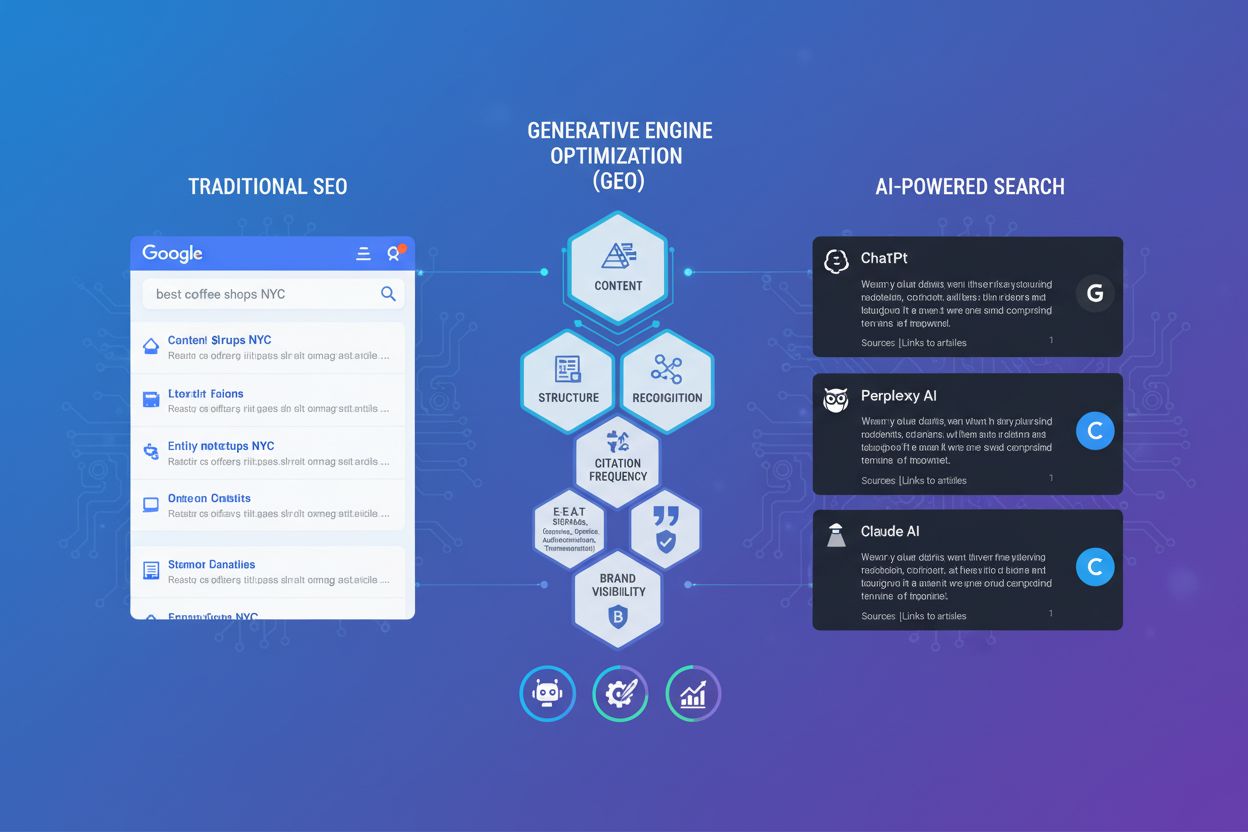
Learn what Generative Engine Optimization (GEO) is, how it differs from SEO, and why it's critical for brand visibility in AI-powered search engines like ChatGP...