
AI Search Engine
Learn what AI search engines are, how they differ from traditional search, and their impact on brand visibility. Explore platforms like Perplexity, ChatGPT, Goo...
12 min read

Enterprise AI search strategy: integration, governance, ROI metrics. Learn how large organizations implement AI search platforms for ChatGPT, Perplexity, and internal systems.
Enterprise companies approach AI search through strategic implementation of enterprise AI search platforms that integrate internal data sources, prioritize security and compliance, and focus on measurable ROI. They combine natural language processing, machine learning, and federated search capabilities while addressing governance, workforce readiness, and legacy system integration challenges.
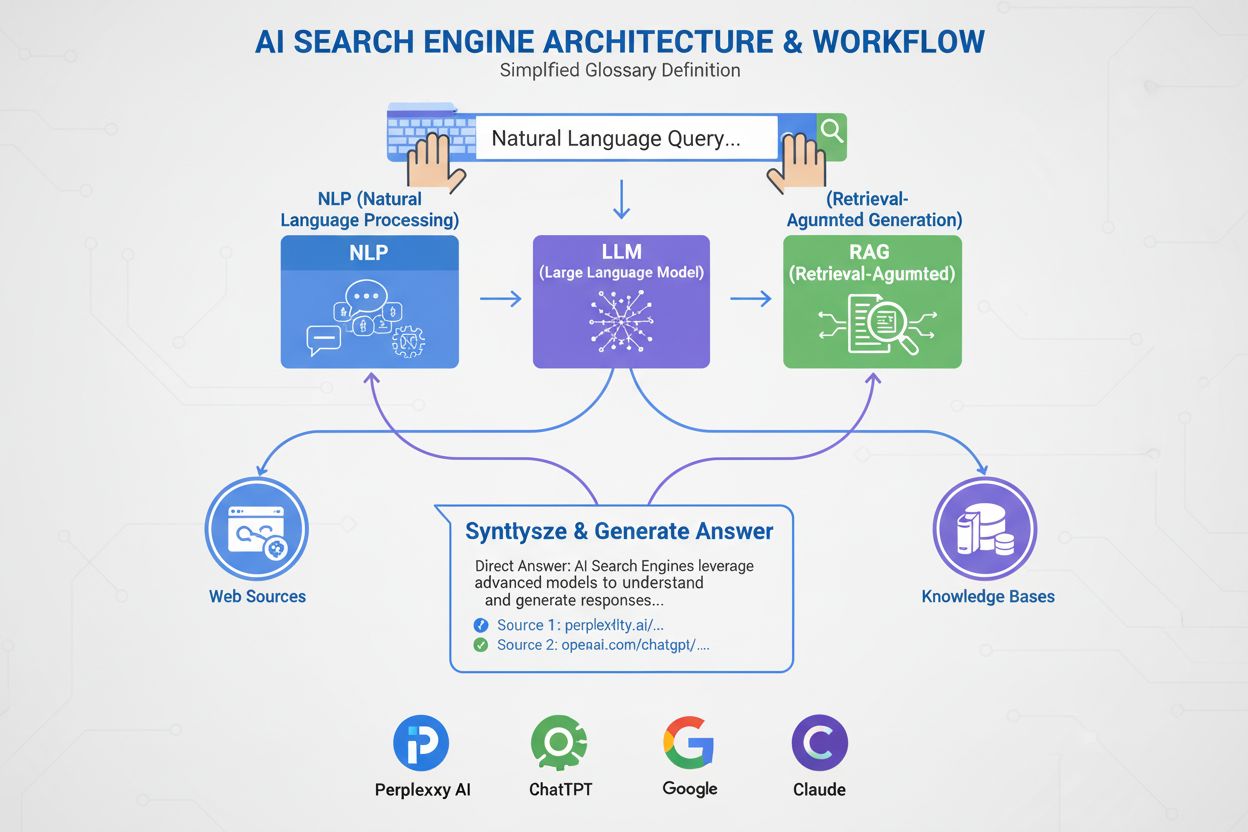
Enterprise AI search represents a fundamental shift in how large organizations access, retrieve, and leverage internal information at scale. Unlike consumer-facing AI search tools like ChatGPT or Perplexity, enterprise AI search solutions are purpose-built to connect disparate internal data sources, maintain strict security protocols, and deliver verified, context-aware answers based on company-owned information. Enterprise companies recognize that generative AI alone cannot solve their information discovery challenges because public models lack access to proprietary data, internal workflows, and organizational context. The strategic approach to enterprise AI search involves integrating multiple technologies—natural language processing (NLP), machine learning, federated search, and retrieval-augmented generation (RAG)—into a cohesive system that accelerates decision-making while maintaining governance and compliance standards. This comprehensive approach has become mission-critical as organizations face the reality that employees spend approximately 2.5 hours daily searching for information, representing nearly 30% of their workday and costing enterprises an estimated 650 hours per employee annually in lost productivity.
Enterprise companies approach AI search with a clear focus on return on investment (ROI) and measurable business outcomes. According to recent research, organizations implementing enterprise AI search solutions report significant productivity gains, with 60.5% faster decision-making and 31% improvement in overall decision velocity among companies with strong knowledge management programs. However, the path to ROI is not without challenges—a 2023 IBM Institute for Business Value report found that enterprise-wide AI initiatives achieved an average ROI of just 5.9%, highlighting the importance of strategic implementation and clear use case definition. Enterprise companies address this challenge by establishing specific metrics before deployment, including brand visibility in AI search results, sentiment analysis of AI citations, conversion rates from AI-driven traffic, and employee productivity improvements. The business case extends beyond productivity metrics to include revenue acceleration through faster deal cycles, cost reduction in customer support operations, and improved employee engagement through better access to organizational knowledge. Large enterprises recognize that successful AI search implementation requires alignment between technology investment, organizational readiness, and clear business objectives—a principle that distinguishes mature enterprise approaches from experimental pilot programs.
| Implementation Factor | Internal Enterprise Search | Hybrid Cloud Approach | Vendor-Managed SaaS |
|---|---|---|---|
| Data Control | Full on-premise control, highest security | Shared responsibility, regional compliance | Vendor-managed, potential data residency concerns |
| Integration Complexity | Requires custom API development, legacy system retrofitting | Moderate integration, pre-built connectors | Simplified integration, pre-configured workflows |
| Deployment Timeline | 6-12 months, significant IT resources | 3-6 months, balanced resource allocation | 4-8 weeks, minimal internal infrastructure |
| Customization Level | Unlimited customization, high technical debt | Moderate customization, managed complexity | Limited customization, standardized features |
| Compliance & Governance | Complete control, sovereign AI capability | Shared governance framework, audit trails | Vendor compliance certifications, SLAs |
| Total Cost of Ownership | High upfront, ongoing maintenance burden | Moderate, predictable scaling costs | Lower upfront, subscription-based pricing |
| Scalability | Limited by infrastructure, requires expansion | Elastic scaling, cloud-native architecture | Unlimited scaling, vendor-managed infrastructure |
| AI Model Ownership | Organization owns models, vendor-independent | Hybrid ownership, potential lock-in | Vendor-owned models, limited customization |
Federated search architecture represents the cornerstone of enterprise AI search implementation, enabling organizations to unify information discovery across fragmented data ecosystems. Enterprise companies typically face a complex landscape of data sources including enterprise resource planning (ERP) systems, customer relationship management (CRM) platforms, cloud storage solutions like Google Drive and Dropbox, collaboration tools such as Slack and Microsoft Teams, content management systems, and legacy databases. Rather than forcing employees to navigate between multiple applications, enterprise AI search solutions create a single unified interface that simultaneously queries all connected systems, returning relevant results ranked by intelligent algorithms that consider document freshness, author authority, historical engagement patterns, and contextual importance. This integration approach directly addresses a critical enterprise challenge: knowledge workers spend an average of 12 hours per week searching for information across fragmented systems, according to Forrester Research. Enterprise companies implement content connectors that maintain real-time synchronization with source systems, ensuring that search results reflect current information rather than stale data. The technical implementation requires careful attention to access control and permissions, ensuring that search results respect organizational security boundaries—a user should only discover documents they have authorization to access. This federated approach eliminates information silos that plague large organizations and enables cross-departmental collaboration by making organizational knowledge discoverable and accessible to authorized users.
Enterprise companies recognize that governance frameworks represent a critical gating factor for AI search adoption at scale. Unlike consumer AI tools that operate in relatively permissive environments, enterprise AI search must navigate complex regulatory requirements including GDPR, HIPAA, SOX, and industry-specific compliance standards. Organizations implement data residency requirements that ensure sensitive information remains within specified geographic boundaries, addressing both regulatory mandates and organizational risk tolerance. The governance approach extends to model transparency and explainability—enterprise decision-makers require understanding of why AI systems return specific results, particularly when those results inform high-stakes business decisions. Enterprise companies address this through retrieval-augmented generation (RAG) architectures that ground AI responses in verifiable source documents, reducing hallucination rates from 58-82% in standard AI models to 17-33% according to Stanford research on legal AI tools. This dramatic reduction in false information represents a critical differentiator between consumer AI and enterprise-grade solutions. Organizations also establish human-in-the-loop workflows where AI recommendations are reviewed by qualified personnel before implementation, particularly for sensitive domains like legal, financial, or healthcare applications. The governance framework includes audit trails and logging that document which users accessed which information and when, supporting both compliance verification and security investigations. Enterprise companies recognize that robust governance is not a barrier to AI adoption but rather an enabler—organizations with strong governance frameworks can scale AI search with confidence, knowing that risks are actively managed and compliance is maintained.
Enterprise companies must evaluate how their AI search strategy aligns with the broader AI search landscape that includes consumer platforms like ChatGPT, Perplexity, Google AI Overviews, and Claude. While these platforms serve different purposes than internal enterprise search, they represent important touchpoints where enterprise brands and content may be cited. Organizations implementing enterprise AI search solutions must simultaneously consider their generative engine optimization (GEO) strategy—ensuring that their authoritative content is recognized and cited by external AI systems. This dual approach requires enterprises to establish topical authority through high-quality, well-structured content that AI systems recognize as trustworthy and authoritative. Enterprise companies use schema markup and entity optimization to make their content machine-readable, helping both internal AI search systems and external AI platforms understand organizational entities, relationships, and expertise areas. The integration of natural language processing (NLP) capabilities enables enterprise AI search to understand conversational queries rather than requiring precise keyword matching, making the search experience more intuitive for employees. Machine learning algorithms continuously improve search relevance by analyzing user interactions—which results users click on, how long they spend with documents, and explicit feedback—to refine ranking algorithms over time. This continuous improvement cycle means that enterprise AI search systems become more effective as they accumulate usage data, creating a virtuous cycle where improved results drive higher adoption, which generates more training data, which further improves results.
Enterprise companies recognize that workforce readiness represents a critical success factor often overlooked in technology implementations. Successful AI search adoption requires employees to shift their mental models from keyword-based search to conversational query formulation, a change that requires training and cultural reinforcement. Organizations implement change management programs that help employees understand how AI search differs from traditional search engines, what types of queries work best, and how to interpret results. Enterprise companies establish centers of excellence or AI competency teams that serve as internal experts, helping departments understand how to leverage AI search for their specific workflows and use cases. The workforce readiness challenge extends to technical teams who must maintain and optimize AI search systems—organizations report that lack of technical expertise represents a significant barrier to agentic AI adoption, and similar challenges apply to enterprise AI search implementation. Companies address this through upskilling programs, vendor partnerships, and hiring specialized talent in areas like machine learning operations (MLOps), data engineering, and AI governance. Enterprise companies also recognize that AI search adoption varies by department—technical teams may embrace conversational AI search quickly, while other departments may require more structured training and support. Successful implementations include executive sponsorship that signals organizational commitment to AI search, early adopter programs that identify champions within departments, and feedback mechanisms that allow employees to report issues and suggest improvements. This human-centered approach to AI search implementation recognizes that technology adoption is fundamentally a change management challenge, not merely a technical deployment.
Enterprise companies establish comprehensive KPI frameworks to measure AI search success across multiple dimensions. Adoption metrics track the percentage of employees using the system, frequency of usage, and growth trends over time—organizations typically target 60-80% adoption among knowledge workers within 12 months of deployment. Engagement metrics measure the depth of interaction, including average queries per user, result click-through rates, and time spent with discovered documents. Productivity metrics quantify time savings through employee surveys and time-tracking analysis, with organizations reporting 2-5 hours per week in reclaimed time for strategic work. Quality metrics assess search result relevance through user satisfaction surveys, explicit feedback mechanisms, and analysis of result abandonment rates. Business impact metrics connect AI search usage to organizational outcomes including faster decision-making cycles, improved customer satisfaction, reduced support ticket resolution time, and revenue acceleration. Enterprise companies also track cost metrics including total cost of ownership, cost per user, and cost per query to ensure that AI search investments deliver acceptable ROI. Compliance metrics monitor adherence to governance policies, including audit trail completeness, access control violations, and data residency compliance. The most sophisticated enterprises establish predictive analytics that forecast future adoption and impact, enabling proactive resource allocation and optimization. These comprehensive measurement frameworks ensure that enterprise AI search remains aligned with business objectives and that investments continue to deliver value over time.
Enterprise companies are preparing for the next evolution of AI search through agentic AI systems that can autonomously execute tasks based on search results and organizational context. Rather than simply returning information, agentic AI search systems will retrieve relevant data, synthesize insights, and recommend or execute actions within defined parameters. This evolution requires enterprises to establish governance frameworks for autonomous decision-making, defining which types of decisions can be delegated to AI agents and which require human oversight. Organizations are investing in infrastructure modernization to support agentic systems, moving away from rigid, legacy architectures toward cloud-native, API-driven platforms that enable seamless agent orchestration. Enterprise companies recognize that data quality and governance become even more critical in agentic environments—autonomous systems making decisions based on poor-quality data can cause significant organizational harm. The future of enterprise AI search also involves sovereign AI considerations, where organizations maintain control over AI models and infrastructure rather than depending on vendor-provided systems. This shift reflects growing concerns about data privacy, vendor lock-in, and regulatory compliance in an increasingly fragmented global regulatory environment. Enterprise companies are exploring hybrid approaches that combine vendor-managed platforms with internal customization, enabling organizations to maintain strategic control while leveraging vendor expertise and infrastructure. The evolution toward agentic AI search represents a fundamental shift from information retrieval to intelligent automation, requiring enterprises to rethink not just their technology infrastructure but their organizational processes, governance models, and workforce capabilities.
Enterprise companies that successfully implement AI search recognize several strategic imperatives that distinguish leaders from laggards. Data centralization and quality represents the foundation—organizations must establish a single source of truth for critical information, ensuring consistency across systems and enabling AI search to return authoritative answers. Organizational alignment ensures that AI search implementation supports strategic business objectives rather than becoming a technology solution in search of a problem. Vendor evaluation and selection requires careful assessment of platform capabilities, integration options, security features, and total cost of ownership—organizations must balance best-of-breed solutions against integrated platforms based on their specific requirements. Phased implementation allows enterprises to learn from early deployments, refine processes, and build organizational confidence before scaling to enterprise-wide adoption. Continuous optimization recognizes that AI search implementation is not a one-time project but an ongoing journey of improvement, requiring dedicated resources and attention. Enterprise companies that excel at AI search implementation treat it as a strategic capability rather than a tactical tool, investing in the organizational infrastructure, governance frameworks, and workforce development necessary to realize long-term value. The most successful enterprises recognize that AI search is fundamentally about enabling better decision-making—by providing employees with faster access to verified, relevant information, organizations can accelerate innovation, improve customer experiences, and drive competitive advantage in an increasingly complex business environment.
Track how your brand appears in AI search results across ChatGPT, Perplexity, Google AI Overviews, and Claude. Ensure your enterprise content is cited as an authoritative source.
Learn what AI search engines are, how they differ from traditional search, and their impact on brand visibility. Explore platforms like Perplexity, ChatGPT, Goo...

Learn what SearchGPT is, how it works, and its impact on search, SEO, and digital marketing. Explore features, limitations, and the future of AI-powered search.

Learn how to adapt your brand for AI search engines. Discover strategies for semantic authority, entity optimization, and visibility in ChatGPT, Perplexity, and...