

HowTo Schema: Optimizing Step-by-Step Content for AI Extraction
Learn how HowTo schema optimizes step-by-step content for AI extraction. Implement structured data to improve visibility in LLM responses and AI Overviews.
12 min read

Learn how to implement HowTo schema markup for better visibility in AI search engines. Step-by-step guide to adding structured data for ChatGPT, Perplexity, and Google AI Overviews.
Add HowTo schema markup using JSON-LD format to your instructional content pages. Include required properties like name and step elements, then validate with Google's Rich Results Test. This structured data helps AI systems like ChatGPT and Perplexity understand and cite your how-to content in their generated answers.
HowTo schema markup is a structured data format from Schema.org that explicitly tells search engines and AI systems that your content contains step-by-step instructions for completing a task. In the era of generative AI search, where platforms like ChatGPT, Perplexity, and Google AI Overviews synthesize information to provide direct answers, proper schema implementation has become critically important for brand visibility. When you add HowTo schema to your instructional content, you’re essentially creating machine-readable labels that help AI systems quickly identify, extract, and cite your content as an authoritative source. This is particularly valuable because AI systems must make decisions about which sources to include in milliseconds, and structured data dramatically speeds up information extraction compared to parsing plain text.
The significance of this cannot be overstated. Research shows that LLMs using structured data achieve answer accuracy levels 300% higher than models working only with unstructured text. Additionally, studies indicate that proper schema implementation can increase content visibility in AI-generated answers by up to 40%. Without HowTo schema, your instructional content remains invisible to these AI systems, even if it ranks well in traditional search results.
To ensure your HowTo schema is recognized by AI systems and search engines, you must include specific required properties. The name property is essential—this should be a clear, descriptive title of your how-to, such as “How to Change a Flat Tire” or “How to Set Up Email Forwarding.” The step property is equally critical and must contain at least one HowToStep element that includes the actual instructions. Each step requires a text property with the full instruction text, and optionally an itemListElement property that can contain HowToDirection or HowToTip elements.
Beyond these required fields, several recommended properties significantly enhance AI visibility. The description property provides context about the entire how-to process. The totalTime property should be specified in ISO 8601 duration format (for example, “PT30M” for 30 minutes), helping AI systems understand the time commitment required. The estimatedCost property indicates the financial investment needed, which is particularly valuable for DIY and instructional content. The tool property lists equipment needed but not consumed, while the supply property identifies materials that are consumed during the process. Including an image property with a photo of the completed result or key step provides visual context that AI systems can reference.
| Property | Type | Priority | Purpose |
|---|---|---|---|
| name | Text | Required | Title of the how-to instruction |
| step | HowToStep | Required | Individual steps in the process |
| description | Text | Recommended | Overview of the how-to |
| totalTime | Duration | Recommended | Total time in ISO 8601 format |
| estimatedCost | MonetaryAmount | Recommended | Cost of supplies needed |
| image | URL | Recommended | Visual representation of result |
| tool | HowToTool | Recommended | Equipment required |
| supply | HowToSupply | Recommended | Materials consumed |
| video | VideoObject | Recommended | Instructional video content |
Step One: Assess Your Content for Suitability - Begin by identifying pages on your website that contain instructional content with clear, sequential steps. This includes tutorials, guides, DIY instructions, software setup procedures, and any content that explains how to achieve a specific result. Not all content qualifies for HowTo schema; it must genuinely provide step-by-step instructions that a user can follow to complete a task. Review your content to ensure it meets this criteria and that the instructions are clear and actionable.
Step Two: Structure Your Content Logically - Before adding schema markup, ensure your content is well-organized with clear headings for each step. Use descriptive H2 or H3 headings that summarize what each step accomplishes. Break down complex procedures into smaller, manageable steps. Each step should be numbered or clearly delineated, making it easy for both humans and AI systems to follow the progression. This logical structure is essential because AI systems parse your content to extract step information, and clear organization dramatically improves extraction accuracy.
Step Three: Create JSON-LD Markup - Google recommends using JSON-LD format for schema implementation, and this is the format that AI systems process most efficiently. Place your JSON-LD code in the <head> section of your HTML or immediately after the opening <body> tag. Here’s a practical example structure:
{
  "@context": "https://schema.org",
  "@type": "HowTo",
  "name": "How to Optimize Your Website for AI Search",
  "description": "A comprehensive guide to implementing schema markup and structured data for better visibility in AI-powered search engines.",
  "totalTime": "PT45M",
  "estimatedCost": {
    "@type": "MonetaryAmount",
    "currency": "USD",
    "value": "0"
  },
  "tool": [
    {
      "@type": "HowToTool",
      "name": "Schema.org Validator"
    },
    {
      "@type": "HowToTool",
      "name": "Google Rich Results Test"
    }
  ],
  "step": [
    {
      "@type": "HowToStep",
      "position": "1",
      "name": "Audit Your Current Schema",
      "text": "Review your website's existing schema markup using the Google Rich Results Test tool to identify gaps and errors."
    },
    {
      "@type": "HowToStep",
      "position": "2",
      "name": "Implement Required Properties",
      "text": "Add the required HowTo schema properties including name, description, and step elements to your instructional pages."
    }
  ]
}
Step Four: Validate Your Markup - After implementing your schema, validation is absolutely critical. Use Google’s Rich Results Test (search.google.com/test/rich-results) to verify that your markup is correctly formatted and eligible for rich results display. Additionally, use the Schema.org Markup Validator (validator.schema.org) to check for syntax errors. These tools will identify any issues with your implementation and provide specific guidance for corrections. Testing ensures that AI systems can properly parse your structured data without errors.
Step Five: Deploy and Monitor - Once validated, deploy your schema markup to your live website. Monitor your pages’ appearance in AI Overviews and track mentions in ChatGPT, Perplexity, and Claude. Use tools like seoClarity or similar platforms to check if your pages appear in AI-generated answers for your target queries. Track metrics over time to measure the impact of your schema implementation on AI visibility.
Beyond basic HowTo schema implementation, research from Princeton University and Georgia Tech identified seven critical factors that significantly impact visibility in AI-generated answers. Comprehensive structured data is foundational—ensure all relevant schema properties are properly filled out. Systematic citation of authoritative sources within your how-to content can increase visibility by over 115%. When you reference studies, official documentation, or recognized experts, you signal to AI systems that your content is well-researched and trustworthy.
Structuring content in question-and-answer format dramatically improves AI visibility. Start your how-to sections with specific questions your audience is asking, then provide concise answers. Saturating content with specific statistics rather than vague claims helps AI systems extract measurable data. Instead of writing “many companies use this,” write “according to a 2024 Gartner study, 47% of B2B companies have implemented this.” Including direct quotes from recognized experts with their names and titles signals expertise and authority. Explicitly demonstrating timeliness through publication and modification dates is crucial—always include datePublished and dateModified fields in your Article Schema. Finally, flawless technical performance matters; slow pages or poor mobile optimization may be skipped by AI systems due to timeouts.
One critical mistake is overtagging pages with conflicting schemas. A simple how-to guide should only receive HowTo schema, not Product schema or other types, even if products are mentioned. This confusion can actually harm your visibility rather than improve it. Another common error is using invalid code or incorrect formatting. Always validate your markup before deployment; invalid JSON-LD will be ignored by AI systems entirely.
Marking up content that doesn’t match visible page content is a serious violation that can result in manual penalties from Google. Your schema must accurately reflect what’s actually displayed on the page. Don’t mark up fake ratings, incorrect prices, or steps that don’t exist in your visible content. Additionally, ignoring mobile optimization is a mistake because AI systems increasingly crawl and evaluate mobile versions of pages. Ensure your schema is present and valid on both desktop and mobile versions.
Failing to update schema when content changes is another oversight. If you modify your how-to steps or update the time required, update your schema accordingly. Stale schema that doesn’t match current content can damage your credibility with AI systems. Finally, not testing across multiple validation tools can leave errors undetected. Use both Google’s Rich Results Test and the Schema.org Validator to catch issues that one tool might miss.
After implementing HowTo schema, establish baseline metrics before making changes. Track whether your pages appear in AI Overviews for your target keywords using manual checks or automated tools. Monitor the frequency of mentions in ChatGPT, Perplexity, and Claude by searching for your brand name and relevant keywords in these platforms. Set up Google Search Console alerts to track when your pages appear in search results alongside AI Overviews.
Measure the impact on traffic and engagement. While AI citations may not always generate direct clicks (research shows only about 1% of users click through from AI Overviews), brand mentions in AI-generated answers significantly increase brand awareness and authority. Track branded search volume and brand sentiment to measure these indirect benefits. Compare your visibility metrics before and after schema implementation to quantify the impact. If you see positive trends after one month, scale your GEO efforts across your entire site using programmatic generation for large projects.
HowTo schema is just one component of a comprehensive Generative Engine Optimization (GEO) strategy. Combine it with other schema types like Organization schema to establish entity recognition, Article schema for your content pages, and FAQ schema for question-and-answer sections. Ensure your E-E-A-T signals are strong by including detailed author biographies with credentials, company information, and trust indicators. Build comprehensive structured data across your entire website, not just individual pages.
Remember that consistency is critical for AI systems. Use the same company name, branding, and information across all your schema markup and throughout your website. Link your Organization schema to verified profiles on trusted platforms like Wikipedia and LinkedIn using the sameAs property. This consistency helps AI systems recognize your brand as a distinct, authoritative entity worthy of citation in their generated answers.
Track where your content appears in AI-generated responses across ChatGPT, Perplexity, and Google AI Overviews. Get real-time alerts when your brand is mentioned and optimize your visibility strategy.
Learn how HowTo schema optimizes step-by-step content for AI extraction. Implement structured data to improve visibility in LLM responses and AI Overviews.
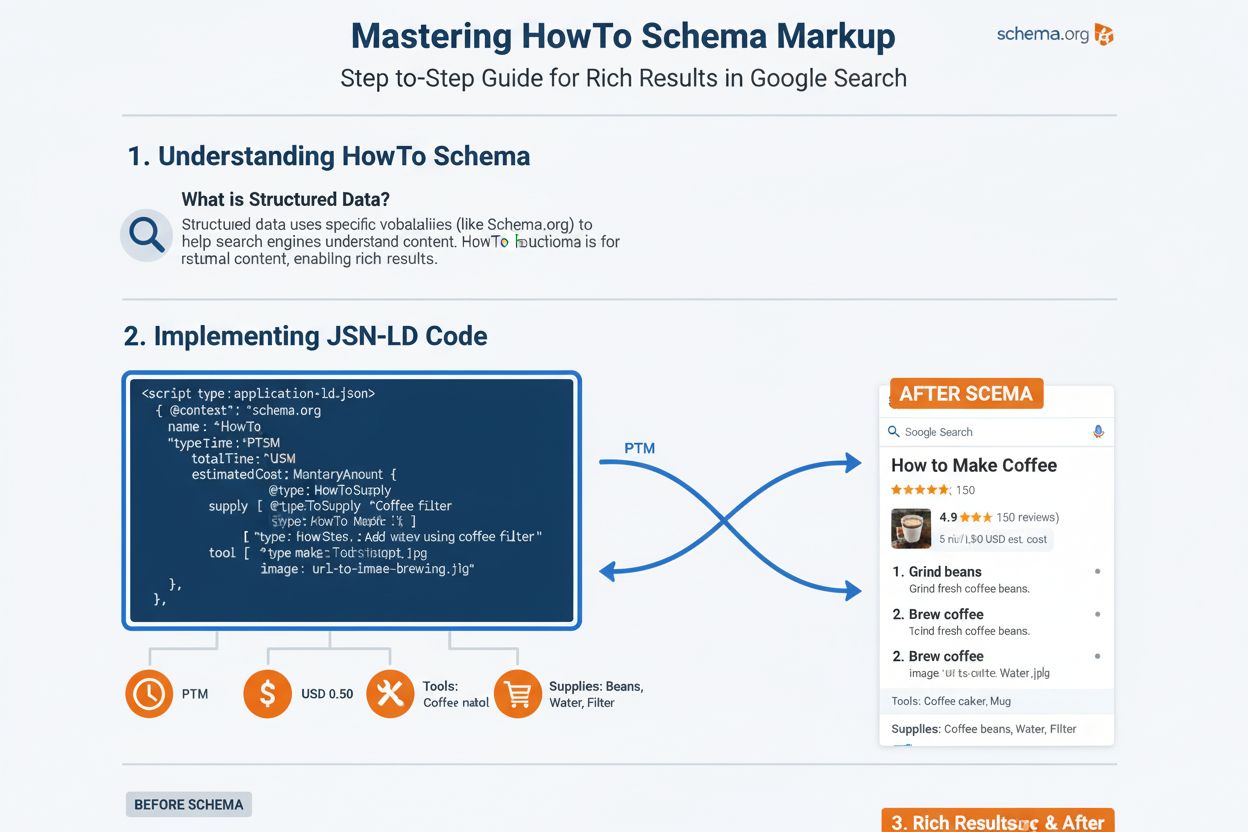
HowTo Schema is structured data markup that helps search engines understand instructional content. Learn how it improves SEO, enables rich results, and increase...

Discover which schema markup types boost your visibility in AI search engines like ChatGPT, Perplexity, and Gemini. Learn JSON-LD implementation strategies for ...