
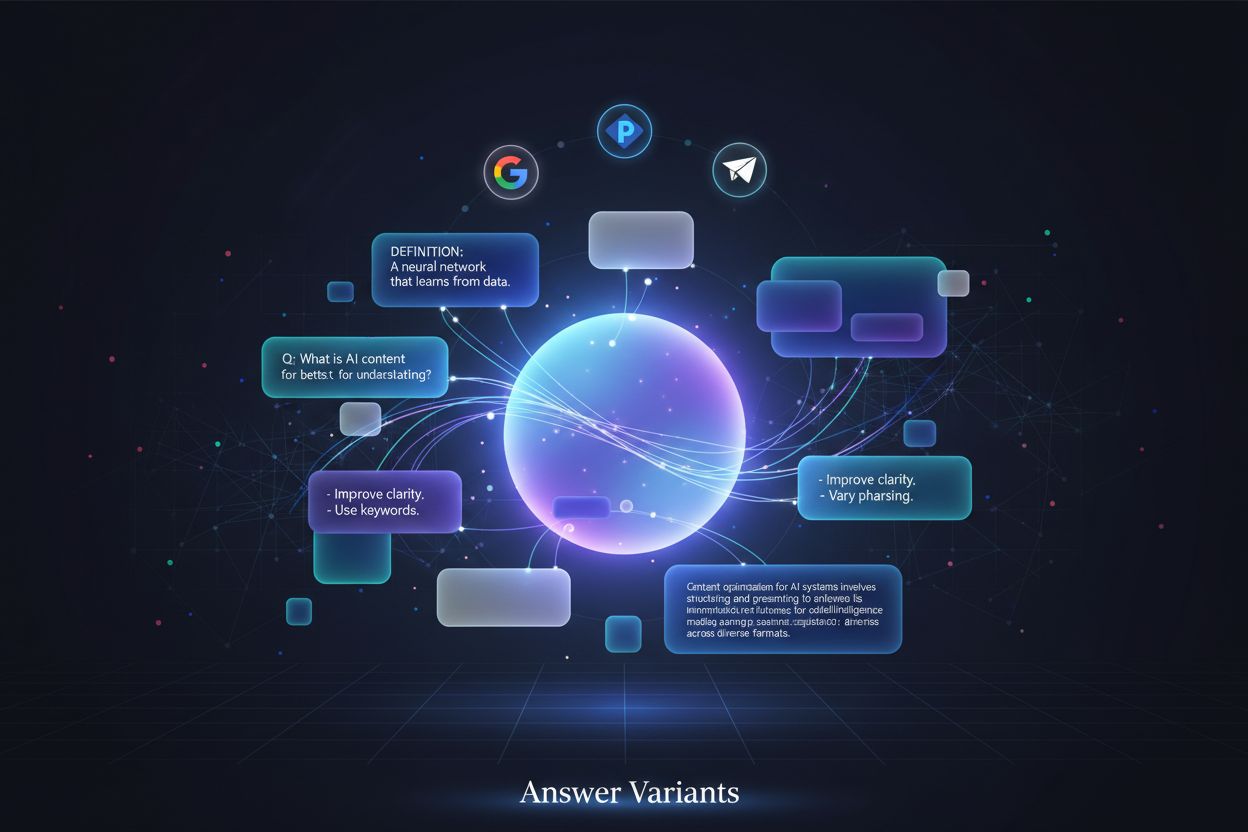
Answer Variants
Learn what answer variants are and how to optimize your content with multiple phrasings to improve citations in AI systems like ChatGPT, Perplexity, and Google ...
5 min read

Learn how to add variety to content for AI systems. Discover strategies for diverse data sources, semantic richness, content structure, and optimization techniques to improve AI citations and visibility.
Add variety to content for AI by diversifying data sources, incorporating multiple perspectives and formats, using semantic richness with natural language, implementing structured data markup, and ensuring content covers topics from different angles. This improves AI model accuracy, reduces bias, and increases the likelihood of your content being cited in AI-generated answers.
Content variety is fundamental to how artificial intelligence systems learn, understand, and generate responses. When you add variety to your content, you’re not just creating more material—you’re providing AI models with diverse perspectives, formats, and data sources that improve their accuracy and reduce bias. This is particularly important for AI search engines like ChatGPT, Perplexity, and Google’s AI Overviews, which rely on varied, high-quality content to generate trustworthy answers. The mathematical principle behind this is straightforward: the wider the variance in data, the more accurate the mean prediction becomes. This means that diverse content directly improves AI model performance and increases the likelihood that your brand will be cited in AI-generated answers.
The relationship between content diversity and AI accuracy is not merely theoretical—it’s backed by empirical research and mathematical principles. When AI models train on homogeneous data, they inherit the biases and limitations of that narrow dataset, leading to inaccurate or skewed outputs. Conversely, when AI systems learn from diverse, representative data, they develop more comprehensive understanding and generate more balanced, accurate responses. Companies that prioritize diversity in their content strategy consistently outperform competitors in both AI visibility and user trust. This is because AI systems are explicitly designed to satisfy user queries with helpful, reliable information, and diverse content better serves that purpose.
| Content Diversity Factor | Impact on AI Systems | Business Outcome |
|---|---|---|
| Multiple data sources | Reduces bias, improves accuracy | Higher citation rates in AI answers |
| Varied perspectives | Broader context understanding | Better representation in AI responses |
| Different content formats | Enhanced comprehension | Increased visibility across AI platforms |
| Semantic richness | Improved context extraction | More relevant AI-generated citations |
| Global representation | Reduced cultural bias | Wider AI audience reach |
| Multiple languages | Expanded model training | International AI visibility |
The foundation of content variety begins with diversifying your data sources. Rather than relying on a single perspective or dataset, actively seek information from multiple, credible sources that represent different viewpoints, geographies, and demographics. This approach ensures that your content reflects a broader understanding of your topic and reduces the risk of perpetuating narrow or biased narratives. When creating content, incorporate insights from academic research, industry reports, expert interviews, case studies, and real-world examples from different regions and cultures. This multi-source approach not only enriches your content but also signals to AI systems that your material is well-researched and comprehensive.
Start by identifying the key topics within your niche and researching them across multiple authoritative sources. Look beyond English-language sources if possible, as this expands the cultural and linguistic diversity of your content. When you integrate findings from diverse sources, always ensure proper attribution and context. This demonstrates intellectual honesty and helps AI systems understand the credibility of your information. Additionally, consider including data from underrepresented communities and voices, as this actively combats bias in AI training data and makes your content more inclusive and valuable to a global audience.
Perspective diversity is crucial for creating content that AI systems can trust and cite. When your content presents multiple viewpoints on a topic, it demonstrates balanced thinking and comprehensive coverage. This is particularly important for topics where legitimate disagreement exists or where different stakeholders have different interests. Rather than presenting a single “correct” answer, acknowledge different perspectives and explain the reasoning behind each viewpoint. This approach not only makes your content more valuable to human readers but also helps AI systems understand the nuance and complexity of your topic.
To implement perspective diversity, consider including expert opinions from different fields, case studies showing different outcomes, and acknowledgment of both benefits and limitations of approaches you discuss. When presenting contrasting views, do so fairly and with equal depth. This balanced approach is especially valued by AI systems that are trained to recognize and reward nuanced, thoughtful content. Additionally, involve diverse team members in your content creation process. Teams with varied backgrounds, experiences, and expertise naturally produce more diverse content because they bring different viewpoints to the table. This diversity of thought translates directly into richer, more comprehensive content that AI systems can better understand and cite.
Semantic richness refers to the depth and variety of language used to express ideas. Rather than repeating the same keywords and phrases, use synonyms, related terms, and varied sentence structures to convey your message. This approach serves multiple purposes: it makes your content more engaging for human readers, and it helps AI systems understand that you’re discussing a topic comprehensively rather than just targeting specific keywords. AI models are sophisticated enough to recognize when content is naturally written versus artificially optimized, and they favor naturally written, semantically rich content.
To enhance semantic richness, incorporate related concepts and terminology naturally throughout your content. For example, when discussing “artificial intelligence,” also mention “machine learning,” “neural networks,” “algorithms,” and “data science” where contextually appropriate. Use varied sentence structures—mix short, punchy sentences with longer, more complex ones. Include examples, analogies, and explanations that approach the topic from different angles. This variety in language and structure helps AI systems grasp the full scope of your topic and increases the likelihood that different passages of your content will be relevant to different user queries. Additionally, write in a conversational, natural tone that mirrors how people actually speak and ask questions, as AI systems are increasingly trained on conversational data and favor content that reads naturally.
Structured data and schema markup are technical tools that help AI systems understand your content more precisely. By adding schema markup to your pages, you explicitly label different types of information—questions and answers, product details, author credentials, publication dates, and more. This makes it easier for AI systems to extract and cite your content accurately. Schema markup is particularly valuable for content variety because it allows you to present the same information in multiple formats and contexts, all properly labeled for AI comprehension.
Implement FAQ schema for question-and-answer content, HowTo schema for instructional content, Article schema for editorial pieces, and Product schema for product-related content. Each schema type helps AI systems understand different aspects of your content. Additionally, use ImageObject schema for images with descriptive alt text, and VideoObject schema for video content. This multi-format approach with proper schema markup ensures that your content can be discovered and cited by AI systems regardless of the format in which users are seeking information. Regularly audit your schema implementation to ensure accuracy and completeness, as incorrect or incomplete schema can actually harm your AI visibility.
Content variety extends beyond text to include multiple formats: articles, videos, infographics, podcasts, interactive tools, and more. Different AI systems and users prefer different formats, and by creating content in multiple formats, you increase the chances that your material will be discovered, understood, and cited. Video content, for example, can be transcribed and indexed by AI systems, while infographics can be analyzed for visual information. Podcasts can be transcribed to create text-based content that AI can process.
When creating multi-format content, ensure that each format is optimized for AI comprehension. Videos should include transcripts and descriptive titles. Infographics should have detailed alt text and accompanying explanatory text. Podcasts should be transcribed and include timestamps for different topics. This approach serves dual purposes: it makes your content more accessible to human users with different preferences, and it provides AI systems with multiple entry points to understand and cite your material. Additionally, cross-link your different formats so that AI systems can understand that they’re all addressing the same topic from different angles, which reinforces your topical authority.
Audience diversity is another critical aspect of content variety. Different users have different needs, expertise levels, and contexts. By creating content that addresses different audience segments, you increase both the breadth and depth of your content portfolio. For example, you might create beginner-friendly content for newcomers to your topic, intermediate content for practitioners, and advanced content for experts. This tiered approach ensures that your content is relevant to a wider range of users and AI queries.
When addressing different audience segments, use appropriate language and depth for each level. Beginner content should explain foundational concepts clearly, intermediate content should assume some baseline knowledge and dive deeper, and advanced content should explore nuances and cutting-edge developments. This variety in depth and complexity helps AI systems understand that your site is a comprehensive resource that can serve different types of queries. Additionally, consider creating content that addresses different use cases or applications of your topic. If you’re writing about project management tools, for example, create content for different industries (marketing, software development, construction) or different company sizes (startups, enterprises). This use-case diversity makes your content more relevant to a wider range of AI queries.
Global representation in your content is increasingly important as AI systems serve users worldwide. Content that reflects diverse cultural perspectives, examples from different regions, and acknowledgment of different cultural contexts is more valuable to global AI systems. This doesn’t necessarily mean translating all your content into multiple languages (though that’s valuable), but rather ensuring that your content examples, case studies, and perspectives include global representation.
When creating content, deliberately include examples from different countries and cultures. If you’re discussing business practices, include examples from different regions. If you’re discussing social issues, acknowledge different cultural perspectives. Use inclusive language that doesn’t assume a single cultural context. This approach makes your content more valuable to AI systems that serve global audiences and reduces the risk of cultural bias in AI-generated responses. Additionally, if you have the resources, consider creating content in multiple languages. This significantly expands the diversity of your content and makes it accessible to AI systems trained on different language datasets.
Bias reduction is a critical outcome of content diversity. Biased input leads to biased AI output—this is a fundamental principle in machine learning. By consciously diversifying your content sources, perspectives, and representation, you actively work to reduce bias in AI systems that train on or cite your content. This involves regularly auditing your content for unintended biases, seeking out underrepresented voices and perspectives, and actively working to present balanced viewpoints.
Implement bias detection practices in your content creation process. Ask yourself: Are all perspectives represented fairly? Are examples diverse in terms of gender, ethnicity, age, and other characteristics? Are there any stereotypes or assumptions embedded in the language? Do case studies represent different types of organizations and individuals? By asking these questions and actively working to address them, you create content that AI systems can trust and cite with confidence. Additionally, involve diverse team members in content review and feedback processes. People from different backgrounds will catch biases that others might miss, leading to more balanced, representative content.
The structure of your content also contributes to variety. Rather than presenting information in a single linear format, use varied structures: lists, tables, narratives, Q&A formats, step-by-step guides, and conceptual frameworks. This structural variety helps AI systems understand your content from multiple angles and makes different portions of your content relevant to different types of queries. A well-structured page might include an introductory narrative, a quick-reference table, a detailed explanation, a step-by-step guide, and a Q&A section—all addressing the same topic but in different ways.
Use clear headings and subheadings to organize your content logically. Implement bullet points and numbered lists for key information. Create tables for comparisons and data. Use bold text to highlight important concepts. This structural variety not only makes your content more scannable for human readers but also helps AI systems identify and extract relevant information more easily. Additionally, use “content chunking”—breaking your content into self-contained sections that can stand alone. This approach increases the likelihood that individual chunks of your content will be cited by AI systems in response to specific queries.
Content freshness is an often-overlooked aspect of variety. Regularly updating your content with new information, recent examples, and current data adds variety over time and signals to AI systems that your content remains relevant and authoritative. Establish a content review cycle where you periodically revisit important pages to check for outdated information, add new examples, and incorporate recent research or developments.
When updating content, don’t just make minor tweaks—consider adding new sections, incorporating new perspectives, or presenting information in new ways. This approach keeps your content fresh while also adding variety to your overall content portfolio. Additionally, consider creating “update” or “refresh” posts that revisit previous topics with new information, new examples, or new perspectives. This practice not only keeps your content current but also demonstrates to AI systems that you’re actively engaged with your topic and committed to providing the most up-to-date information.
User feedback is a valuable source of insights for adding variety to your content. Pay attention to questions users ask, comments they leave, and feedback they provide. These insights reveal gaps in your content and areas where additional variety would be valuable. If users consistently ask the same question, that’s a signal that your content should address that question more explicitly. If users provide different perspectives or examples, consider incorporating those into your content.
Implement feedback mechanisms on your website—comment sections, surveys, or feedback forms—that allow users to share their thoughts and questions. Monitor social media and forums where your audience discusses your topic. Use this feedback to identify areas where your content could be more diverse or comprehensive. Additionally, consider creating content that directly addresses user questions and feedback. This approach not only adds variety to your content but also demonstrates to AI systems that your content is responsive to actual user needs and questions.
To understand the impact of your content variety efforts, you need to measure AI visibility and track how your content appears in AI-generated answers. While direct measurement of AI citations is still evolving, you can track several indicators: monitor mentions of your brand in AI search results, track traffic from AI-powered platforms, and use tools that analyze your presence in AI-generated responses. Additionally, track traditional SEO metrics like search rankings and organic traffic, as these often correlate with AI visibility.
Create a baseline of your current AI visibility before implementing content variety improvements, then track changes over time. Look for increases in branded search volume, improvements in search rankings for key topics, and growth in traffic from AI-powered platforms. Additionally, monitor engagement metrics on your content—time on page, scroll depth, and conversion rates—as these indicate whether your diverse content is meeting user needs. Use these insights to refine your content variety strategy and focus on the types of diversity that have the greatest impact on your AI visibility and business goals.
Track how your content appears in AI-generated answers across ChatGPT, Perplexity, Google AI Overviews, and other AI search engines. Get real-time insights into your brand visibility.
Learn what answer variants are and how to optimize your content with multiple phrasings to improve citations in AI systems like ChatGPT, Perplexity, and Google ...

Learn how to structure your content to get cited by AI search engines like ChatGPT, Perplexity, and Google AI. Expert strategies for AI visibility and citations...
Learn proven strategies to accelerate AI content discovery including content structuring, schema markup implementation, semantic optimization, and technical SEO...