

How to Balance SEO and GEO Efforts: Complete Strategy Guide
Learn how to effectively balance SEO and GEO efforts to maximize visibility in both traditional search results and AI-generated answers. Discover unified strate...
11 min read

Learn how to allocate marketing budget between SEO and GEO. Discover the optimal split, ROI benchmarks, and strategic framework for balancing traditional search optimization with generative engine optimization across ChatGPT, Perplexity, and Google AI.
Allocate 80-90% of your budget to proven SEO fundamentals that drive current traffic and conversions, while dedicating 10-20% to GEO initiatives that prepare you for AI-powered search growth. Since Google organic search still drives 40-60% of traffic for most businesses compared to less than 1% from standalone AI platforms, prioritize SEO while building GEO foundations through content optimization, structured data, and brand authority that naturally work across both traditional and generative search environments.
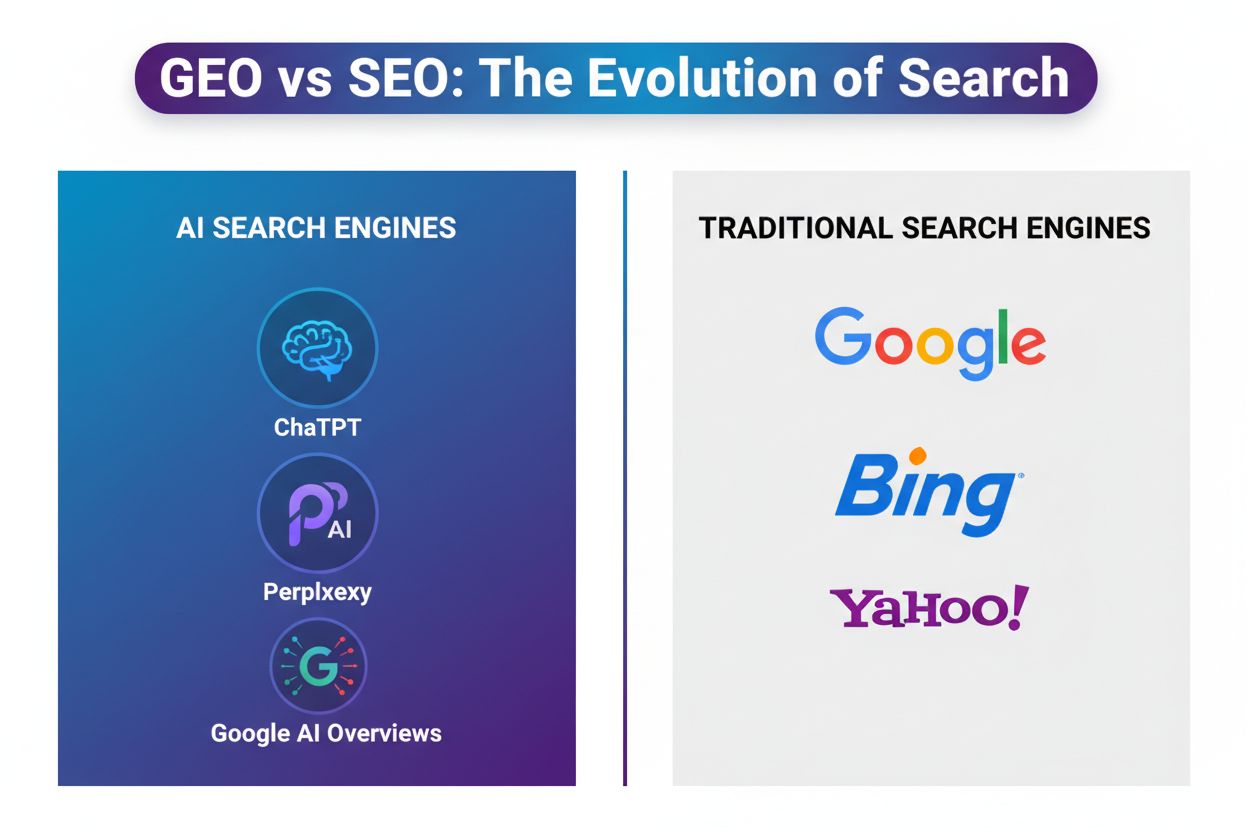
Search Engine Optimization (SEO) and Generative Engine Optimization (GEO) represent two distinct but complementary approaches to digital visibility. SEO focuses on optimizing your website to rank in traditional search engine results on Google, Bing, and other platforms, while GEO targets visibility in AI-powered answer engines like ChatGPT, Perplexity, Google AI Overviews, and Claude. The critical distinction lies in where discovery happens: SEO drives traffic through blue links in search results, while GEO secures citations within AI-generated responses. Understanding this difference is essential because it directly impacts how you should allocate your marketing budget. Currently, Google organic search still drives 40-60% of traffic for most businesses, compared to less than 1% from standalone AI platforms like ChatGPT and Perplexity. However, this landscape is shifting rapidly, with over 1 billion prompts sent to ChatGPT daily and 71% of Americans already using AI search to research purchases. Your budget allocation strategy must reflect current traffic realities while preparing for this inevitable evolution in how customers discover information.
The relationship between SEO and GEO is fundamentally symbiotic rather than competitive. Many of the foundational practices that build SEO authority—creating comprehensive, authoritative content, implementing structured data, earning high-quality backlinks, and establishing E-E-A-T signals—naturally position your brand for AI citations as well. This overlap means you’re not choosing between two entirely separate strategies but rather optimizing a unified approach that serves both current and emerging search behaviors. The businesses winning in 2025 are those that recognize this connection and allocate budget strategically across both channels rather than treating them as mutually exclusive investments.
Before determining budget allocation, you need to understand where your traffic actually comes from today. B2B marketers now allocate 25% of their total marketing budget to SEO, reflecting its proven ROI. Companies are seeing 16% return on investment on SEO and social media shopping tools, which outperforms paid social and email marketing in many cases. However, these statistics mask important nuances about platform distribution. Google remains the dominant traffic driver, but the emergence of AI search engines has created a new discovery channel that’s growing exponentially. Research from Ahrefs analyzing over 17 million citations across 7 AI search engines found that AI platforms prefer content that’s 25.7% fresher than average, with ChatGPT showing the strongest preference for recent content, typically citing pages less than 3 years old. This preference for fresh, authoritative content creates an interesting dynamic: the content investments you make for SEO naturally serve GEO when properly maintained and updated.
The traffic distribution varies significantly by industry and business model. E-commerce businesses typically see higher percentages of traffic from Google Shopping and product-specific searches, while B2B SaaS companies often rely more heavily on informational content and comparison queries. Local service businesses derive substantial traffic from Google Maps and local pack results. Understanding your specific traffic sources is crucial because it determines whether you should weight your budget more heavily toward SEO fundamentals or begin allocating more aggressively to GEO. For most businesses in 2025, the answer is still heavily weighted toward SEO, but the gap is narrowing as AI search adoption accelerates.
| Factor | SEO Focus (80-90% Budget) | GEO Focus (10-20% Budget) | Overlap/Synergy |
|---|---|---|---|
| Primary Goal | Rank in Google search results and drive organic traffic | Secure citations in AI-generated responses | Both require authoritative, comprehensive content |
| Current Traffic Impact | 40-60% of website traffic for most businesses | Less than 1% for standalone AI platforms | Growing convergence as AI adoption increases |
| Content Strategy | Keyword-optimized, SERP-focused content | Conversational, question-answering, structured content | High-quality content serves both equally |
| Authority Building | Backlinks, domain authority, topical clusters | Citation authority, E-E-A-T signals, brand mentions | Both require original research and expertise |
| Technical Requirements | Core Web Vitals, mobile optimization, crawlability | Schema markup, structured data, LLMs.txt | Overlapping technical foundations |
| Measurement | Rankings, organic traffic, conversions | Visibility score, citation count, sentiment | Unified analytics track both channels |
| Time to Results | 3-6 months for initial improvements | 1-3 months for initial AI visibility | Simultaneous optimization possible |
| Platform Diversity | Single primary platform (Google) | Multiple platforms (ChatGPT, Perplexity, Claude, Google AI) | Diversified visibility reduces platform risk |
| ROI Benchmark | 5:1 to 10:1 return on investment | 3:1 to 7:1 (emerging, less mature) | Combined approach maximizes total ROI |
| Budget Flexibility | Stable, proven allocation | Growing allocation as AI adoption increases | Quarterly reallocation based on performance |
The optimal budget allocation for most businesses in 2025 follows an 80/20 framework: allocate 80-90% of your search and content budget to proven SEO fundamentals that drive current business results, while dedicating 10-20% to GEO initiatives that prepare you for AI-powered search growth. This allocation reflects current traffic realities while acknowledging the strategic importance of emerging channels. Within your SEO allocation, break down spending as follows: 40-50% on content creation and optimization, 20-25% on technical SEO and site infrastructure, 15-20% on link building and authority development, and 10-15% on SEO tools and analytics. Your GEO allocation should focus on: 30-40% on content structuring and schema implementation, 25-35% on AI visibility monitoring and prompt testing, 20-25% on brand authority and E-E-A-T signals, and 10-15% on emerging AI-specific tools and platforms.
This framework works because it acknowledges that SEO investments naturally serve GEO objectives. When you create comprehensive, authoritative content optimized for search intent, implement proper schema markup, and build topical authority through interconnected content clusters, you’re simultaneously positioning yourself for AI citations. The overlap means you’re not duplicating effort but rather layering optimization approaches. A well-structured pillar page that ranks for competitive keywords in Google will also be more likely to be cited by ChatGPT when users ask related questions. The key is ensuring your content strategy explicitly addresses both audiences: write for human readers and search engines (SEO), but structure content in ways that AI systems can easily parse and cite (GEO).
Understanding where SEO and GEO investments overlap is crucial for efficient budget allocation. Authority building represents the strongest overlap point. Traditional SEO rewards topical authority through high-quality, relevant content and backlinks from authoritative domains. GEO follows similar principles but with an important distinction: AI platforms pull from a broader range of sources including YouTube, social media, documentation, forums, books, and podcasts through Retrieval Augmented Generation (RAG). This means the SEO fundamentals you’re already executing—creating quality content that demonstrates expertise—work for AI platforms too. However, AI tools also consider your brand mentions and presence across multiple channels when determining what to cite. A brand mentioned frequently across Reddit, LinkedIn, YouTube, and industry publications is more likely to be cited by AI systems than one with only a strong website presence.
Content structure represents another critical overlap. Both SEO and GEO benefit from clear, well-organized content with proper heading hierarchies, bullet points, tables, and FAQ sections. AI systems can more easily extract and cite information from structured content, while search engines reward this structure through featured snippets and improved rankings. When you optimize content for featured snippets—a core SEO tactic—you’re simultaneously optimizing for AI citation. Research from SurferSEO analyzing 100 blog posts found that content covering more facts gets better visibility and ranks for more keywords, exactly what both traditional search engines and AI platforms reward. This means your content investment serves dual purposes: it improves your SEO rankings while simultaneously increasing your likelihood of being cited in AI responses.
Technical optimization also overlaps significantly. Core Web Vitals, mobile optimization, HTTPS security, and proper site architecture benefit both SEO and GEO. AI systems need to crawl and understand your content effectively, just as Google does. Implementing schema markup like FAQPage, HowTo, and Article schemas helps both search engines and AI systems understand your content’s structure and relevance. Adding LLMs.txt to your site signals to AI crawlers which content you want them to prioritize. These technical investments are not GEO-specific; they’re foundational improvements that enhance your overall digital presence across all discovery channels.
Your business stage significantly influences optimal budget allocation between SEO and GEO. Early-stage startups and growth-focused companies should allocate 70% to SEO and 30% to GEO because they need rapid visibility and traffic growth. At this stage, SEO provides more immediate, measurable results, but early investment in GEO positions you advantageously as AI search adoption accelerates. Focus your GEO budget on building strong E-E-A-T signals, creating founder/expert content, and establishing brand authority across multiple platforms. Established mid-market companies should follow the 80/20 framework (80% SEO, 20% GEO) because they have existing SEO infrastructure and proven traffic channels. Their GEO investment should focus on monitoring AI visibility, optimizing existing content for AI citation, and testing new AI platforms. Enterprise organizations can afford 85/15 allocation (85% SEO, 15% GEO) because their SEO programs are mature and generating substantial revenue. Their GEO investment should be more sophisticated, including dedicated teams monitoring AI visibility across multiple platforms, testing conversational workflows, and developing AI-specific content strategies.
The rationale behind these allocations is straightforward: businesses with limited budgets need to focus on proven channels that drive immediate results, while larger organizations can afford to invest more aggressively in emerging opportunities. However, all businesses should maintain some GEO investment regardless of size because the cost of inaction is high. If your competitors dominate AI search results while you’re absent, you’re ceding an entire discovery channel. The good news is that GEO investments don’t require massive budgets; they require strategic thinking and proper execution of SEO fundamentals with AI-specific optimization layered on top.
Rather than creating separate content for SEO and GEO, successful marketers develop unified content strategies that serve both audiences simultaneously. This approach reduces costs while maximizing impact. Start by identifying your highest-value topics—those that drive significant search volume, have commercial intent, and align with your business goals. For each topic, create comprehensive pillar content (4,000-6,000 words) that thoroughly addresses the topic from multiple angles. This content should include: clear definitions and explanations that answer fundamental questions, original data or research that establishes authority, expert perspectives with credentialed authors, structured formats like tables and FAQs that AI can easily parse, and internal linking to related content that builds topical clusters.
This pillar content serves SEO by establishing topical authority and ranking for competitive keywords. It simultaneously serves GEO because AI systems searching for information on this topic will find comprehensive, authoritative content worth citing. The key is ensuring your content explicitly addresses the questions users ask in both traditional search and conversational AI queries. For example, instead of just optimizing for the keyword “project management software,” create content that answers: “What is project management software?”, “How does project management software work?”, “What are the best project management tools for remote teams?”, “How much does project management software cost?”, and “How to choose the right project management tool for your business?” This comprehensive approach captures both traditional keyword searches and the more conversational queries users pose to AI systems.
Allocate your content budget strategically: 50% on pillar content and cornerstone pieces that establish authority, 25% on supporting content and topic clusters that deepen expertise, 15% on content updates and refreshes (critical for AI citation since AI systems prefer fresh content), and 10% on content distribution and promotion. This allocation ensures you’re building permanent assets while maintaining their relevance over time. The content refresh component is particularly important for GEO because Ahrefs found that AI systems prefer content that’s 25.7% fresher than average. Allocating budget to quarterly content updates ensures your existing content remains competitive for both SEO rankings and AI citations.
Effective budget allocation requires robust measurement systems that track performance across both SEO and GEO channels. For SEO measurement, track: organic traffic by source and landing page, keyword rankings for target terms, conversion rates from organic traffic, customer acquisition cost from organic, and return on investment by content piece. Use Google Analytics 4, Google Search Console, and SEO tools like SEMrush or Ahrefs to gather this data. For GEO measurement, track: visibility score across AI platforms, citation count and frequency, sentiment of AI mentions, share of voice compared to competitors, and traffic attribution from AI sources (when available). Tools like AmICited specifically monitor where your brand appears across ChatGPT, Perplexity, Google AI Overviews, and Claude, providing the visibility data necessary to justify GEO budget allocation.
Establish a unified dashboard that tracks both SEO and GEO metrics alongside business outcomes like leads, revenue, and customer acquisition cost. This unified view helps you understand the combined impact of your search optimization efforts. For example, you might discover that while your organic traffic increased 20%, your AI visibility also improved 35%, and your total qualified leads increased 40%—demonstrating that the combined investment is delivering results greater than either channel alone. Review this dashboard monthly to identify trends, and conduct quarterly strategic reviews to reallocate budget based on performance. If SEO is delivering strong ROI but GEO is underperforming, you might maintain your current allocation. If GEO is showing rapid growth and strong ROI, you might increase that allocation from 15% to 20% in the next quarter.
Rather than setting annual budgets in stone, implement a quarterly reallocation process that adjusts spending based on performance data and market changes. This approach maintains strategic consistency while allowing tactical flexibility. At the end of each quarter, analyze: which channels delivered the highest ROI, which initiatives showed the most promise, how competitive landscape changed, what new opportunities emerged, and what underperformed expectations. Based on this analysis, reallocate 10-15% of your budget between channels. For example, if your GEO initiatives are showing strong early results with 4:1 ROI, you might increase GEO allocation from 15% to 18% in the next quarter, reducing SEO allocation from 85% to 82%. Conversely, if a particular SEO tactic isn’t delivering expected results, you might reduce that specific allocation and redirect funds to higher-performing initiatives.
Establish clear reallocation triggers that automatically prompt budget adjustments: increase investment when ROI exceeds target by 25%+, decrease investment when ROI falls below breakeven for two consecutive months, increase investment when cost per acquisition drops 20%+, decrease investment when cost per acquisition increases 30%+ without corresponding LTV increase, increase investment when new platform gains rapid mainstream adoption in your audience, and decrease investment when major algorithm changes negatively impact performance. This data-driven approach removes emotion from budget decisions and ensures you’re always investing in what’s working. Reserve 10-15% of total budget as uncommitted funds to deploy opportunistically based on quarterly reviews. This flexibility allows you to capitalize on unexpected opportunities—like a new AI platform gaining traction or a competitor weakness you can exploit—without completely restructuring your budget.
One of the biggest challenges in justifying GEO budget allocation is connecting it to measurable business outcomes. Unlike SEO, which has decades of proven ROI data, GEO is still emerging, making it harder to justify investment to leadership. However, several approaches help bridge this gap. First, track brand mentions and sentiment in AI responses. When your brand appears in ChatGPT responses to relevant queries, that’s a form of earned media equivalent to a press mention. Calculate the value of that mention based on what you’d pay for equivalent advertising or PR. Second, measure traffic attribution from AI sources when possible. Some analytics platforms now track traffic from ChatGPT, Perplexity, and other AI platforms. Even if the traffic volume is currently small, track the trend and project future growth. Third, conduct competitive analysis to understand where competitors appear in AI responses. If competitors are getting cited and you’re not, that represents lost opportunity.
Fourth, connect GEO to lead quality and conversion rates. Leads coming from AI platforms may have different characteristics than those from traditional search. They might be more qualified (because they’ve had a conversation with an AI before finding you) or less qualified (because they’re earlier in the research process). Understanding these differences helps you allocate budget appropriately. Fifth, measure brand awareness and consideration metrics. When your brand appears in AI responses, it increases brand awareness among users researching your category. This awareness eventually converts to traffic and customers, even if the attribution isn’t immediate. Use brand lift studies or surveys to measure this impact. Finally, use forward-looking projections to justify GEO investment. If AI search is growing 40% year-over-year and is projected to surpass Google traffic by 2030, then investing 10-20% of budget in GEO today is essentially investing in your future visibility. Frame it as insurance against platform dependency and preparation for inevitable market evolution.
Many businesses make critical mistakes when allocating budget between SEO and GEO. The first mistake is treating them as completely separate channels requiring entirely different content and strategies. This approach doubles costs and reduces efficiency. Instead, recognize the overlap and develop unified strategies that serve both audiences. The second mistake is over-investing in GEO too early. While GEO is important, allocating 50% of budget to AI optimization when AI platforms drive less than 1% of traffic is premature. Maintain focus on proven channels while building GEO foundations. The third mistake is neglecting GEO entirely. Some businesses dismiss GEO as hype and refuse to invest. This approach leaves them vulnerable to competitive disadvantage as AI adoption accelerates. The fourth mistake is not measuring GEO performance. Without proper tracking, you can’t justify continued investment or optimize your approach. Implement measurement systems from day one. The fifth mistake is allocating GEO budget to tactics that don’t align with SEO fundamentals. GEO isn’t about special tricks or AI-specific hacks; it’s about doing SEO better. Avoid vendors promising “AI optimization secrets” and instead focus on content quality, authority building, and technical excellence.
The sixth mistake is failing to update content regularly. AI systems prefer fresh content, so allocating budget to content creation without allocating to content maintenance means your content becomes stale and loses both SEO and GEO value. The seventh mistake is ignoring brand authority and E-E-A-T signals. Both SEO and GEO reward expertise, experience, authoritativeness, and trustworthiness. Allocating budget to content creation without allocating to author credibility, transparent sourcing, and trust signals is inefficient. The eighth mistake is not considering your specific business context. Budget allocation should reflect your industry, competitive landscape, business model, and growth stage. Copying another company’s allocation without customizing for your situation often leads to suboptimal results.
As the search landscape continues evolving, your budget allocation strategy must remain flexible and forward-looking. Monitor emerging AI platforms and their adoption rates. When a new platform like Perplexity or Claude gains significant user adoption, consider allocating budget to optimize for that platform. Track AI search adoption metrics in your industry. If AI search adoption is accelerating faster than expected, increase your GEO allocation accordingly. Stay informed about algorithm changes in both traditional search and AI systems. When Google updates its ranking algorithm or ChatGPT changes how it retrieves and cites sources, adjust your strategy and budget allocation accordingly. Invest in emerging tools and technologies that help you measure and optimize for both SEO and GEO. Tools like AmICited that track AI visibility across multiple platforms are becoming essential for data-driven budget allocation.
Build organizational alignment around your budget allocation strategy. Ensure your content team, technical team, and leadership all understand why you’re allocating budget the way you are. This alignment prevents conflicts and ensures consistent execution. Develop internal expertise in both SEO and GEO. As these disciplines evolve, your team needs to stay current with best practices. Allocate budget for training, conferences, and professional development. Create feedback loops between your measurement systems and budget allocation decisions. The data you collect should directly inform how you allocate budget in future quarters. Plan for platform consolidation. As AI search matures, some platforms will consolidate or disappear. Your budget allocation should be flexible enough to adapt to these changes without requiring complete restructuring.
The businesses that will thrive in the next 3-5 years are those that recognize SEO and GEO as complementary rather than competitive, allocate budget strategically across both channels, measure performance rigorously, and adjust allocation based on data. The 80/20 framework provides a solid starting point, but your specific allocation should reflect your business context, competitive landscape, and growth objectives. Start with this framework, measure results carefully, and adjust quarterly based on what’s working. By treating budget allocation as an ongoing optimization process rather than an annual decision, you’ll maximize your return on investment across both traditional and emerging search channels.
Track where your brand appears across ChatGPT, Perplexity, Google AI Overviews, and Claude. Use AmICited to measure GEO performance and justify budget allocation decisions with real visibility data across all AI platforms.
Learn how to effectively balance SEO and GEO efforts to maximize visibility in both traditional search results and AI-generated answers. Discover unified strate...
Understand the critical differences between Generative Engine Optimization (GEO) and traditional SEO. Learn how to optimize for AI search engines like ChatGPT, ...
Understand the critical differences between GEO (Generative Engine Optimization) and SEO (Search Engine Optimization). Learn how AI search differs from traditio...