

Best AI Search Visibility Monitoring Tools 2025 | Track Brand Mentions
Discover the top AI search visibility monitoring tools to track your brand across ChatGPT, Perplexity, and Google AI Overviews. Compare features, pricing, and c...
9 min read

Learn how to automate monitoring of your brand mentions and website citations across ChatGPT, Perplexity, Google AI Overviews, and other AI search engines with continuous tracking.
Automate AI search monitoring by using dedicated monitoring platforms that continuously track your brand mentions and website citations across ChatGPT, Perplexity, Google AI Overviews, Gemini, Claude, and Copilot. These tools run predefined search prompts automatically, measure your share of voice against competitors, and deliver weekly reports without manual intervention.
Automated AI search monitoring is the process of continuously tracking your brand’s appearance, mentions, and website citations across AI-powered search platforms without manual intervention. Unlike traditional search engine optimization that focuses on ranking positions in Google’s results pages, AI search monitoring captures how often your brand gets mentioned when AI systems like ChatGPT, Perplexity, and Google AI Overviews generate answers to user queries. The automation aspect means these monitoring systems run predefined search prompts repeatedly on a scheduled basis—typically daily or weekly—and compile the results into actionable reports that show your brand visibility trends over time.
The fundamental difference between manual and automated monitoring lies in consistency and scale. When you manually search for your brand on ChatGPT or Perplexity, you’re seeing a single snapshot influenced by your search history, location, and the AI system’s memory. Automated monitoring platforms eliminate these variables by running neutral, standardized queries across multiple AI engines simultaneously, providing objective data about your actual visibility. This continuous tracking reveals patterns that would be impossible to detect through occasional manual checks, such as seasonal fluctuations in brand mentions, the impact of new content on citation rates, or how competitor visibility shifts week to week.
The necessity of automation becomes clear when you consider the scale and frequency of AI search activity. With 58% of consumers already using generative AI tools for product recommendations and traditional organic search traffic expected to decline by 50% by 2028, the volume of AI-generated answers mentioning brands is growing exponentially. Manually checking your brand visibility across six major AI platforms—ChatGPT, Google AI Overviews, Perplexity, Gemini, Claude, and Microsoft Copilot—would require hundreds of hours monthly. Automated systems compress this work into minutes by simultaneously querying all platforms with your predefined search prompts and analyzing the responses in real-time.
Beyond time savings, automation provides consistency that manual monitoring cannot match. Each AI platform uses different data sources, retrieval methods, and response generation algorithms. Automated monitoring tools account for these differences by running identical queries across all platforms and normalizing the results for comparison. This standardization is essential for accurate share of voice calculations—the percentage of AI mentions your brand receives compared to competitors. Without automation, you’d struggle to establish reliable baselines or detect meaningful changes in your competitive position. Additionally, automated systems can monitor hundreds of search prompts simultaneously, capturing your visibility across the full spectrum of customer questions rather than just a handful of high-priority keywords.
Automated AI search monitoring platforms operate through a systematic process that combines query automation, response analysis, and data aggregation. The workflow begins with prompt library creation, where you define the search queries your target audience actually asks on AI platforms. These prompts differ from traditional keywords because they’re conversational and question-based—for example, “What’s the best project management tool for remote teams?” rather than “project management software.” Once your prompt library is established, the platform’s automation engine runs these queries against all configured AI platforms on a predetermined schedule.
| Component | Function | Frequency |
|---|---|---|
| Query Engine | Sends standardized prompts to AI platforms | Daily or Weekly |
| Response Parser | Analyzes AI-generated answers for brand mentions | Real-time |
| Citation Tracker | Identifies which websites are cited as sources | Real-time |
| Sentiment Analyzer | Evaluates how your brand is characterized | Real-time |
| Data Aggregator | Compiles results into unified dashboards | Daily |
| Report Generator | Creates automated weekly/monthly reports | Scheduled |
When the platform sends a query to ChatGPT, Perplexity, or another AI engine, it captures the complete response including all brand mentions, citations, and source links. Advanced parsing algorithms then extract structured data from these responses: which brands were mentioned, in what order, with what sentiment, and which websites were cited as sources. This data flows into a centralized database where it’s compared against historical records to identify trends. If your brand appeared in 40% of responses last week and 45% this week, the system flags this as a positive trend. If a competitor’s citation rate jumped from 20% to 35%, the platform alerts you to this competitive threat.
Effective automated AI search monitoring requires tracking metrics specifically designed for the AI search era, not traditional SEO metrics. Brand mention frequency is the foundational metric—it measures how often your brand appears in AI-generated answers across all monitored prompts. This differs from traditional rankings because multiple brands can appear in a single AI response, and the order of mention doesn’t necessarily correlate with importance. A brand mentioned in 60% of relevant AI responses has significantly higher visibility than one mentioned in 15%, regardless of whether it appears first or third in the answer.
Citation rate represents the percentage of AI responses that include your website as a source. This metric is particularly valuable because it directly influences traffic and authority. When an AI system cites your website, it’s essentially endorsing your content as authoritative enough to include in its synthesized answer. Share of voice compares your brand’s mention rate to competitors’ mention rates within the same set of queries. If you appear in 30% of responses and your top competitor appears in 50%, your share of voice is 37.5% (30 divided by 80 total mentions). This competitive positioning metric helps you understand whether you’re gaining or losing ground in AI search visibility.
Additional metrics tracked by automated systems include sentiment analysis (whether AI describes your brand positively, negatively, or neutrally), geographic performance (how visibility varies by location), and platform-specific visibility (your performance on ChatGPT versus Perplexity versus Google AI Overviews). These metrics collectively paint a picture of your brand’s position in the AI search landscape and reveal specific opportunities for improvement.
Leading automated AI search monitoring platforms share several essential features that distinguish them from basic tracking tools. Multi-platform coverage is non-negotiable—the platform must monitor all major AI search engines including ChatGPT, Google AI Overviews, Perplexity, Gemini, Claude, and Microsoft Copilot. Each platform has different user bases, data sources, and response characteristics, so comprehensive monitoring requires simultaneous tracking across all of them. A platform that only monitors ChatGPT misses 40% of the AI search landscape and provides an incomplete picture of your visibility.
Automated prompt management allows you to create, organize, and update your search prompt library without manual intervention. The best platforms include AI-powered prompt suggestions based on your industry and target keywords, helping you discover questions you might not have considered. Real-time alerting notifies you immediately when significant changes occur—such as a sudden drop in brand mentions, a competitor entering your visibility space, or your website being cited in a high-impact response. Competitive benchmarking automatically compares your metrics against defined competitors, showing you exactly where you’re winning and losing visibility.
Customizable reporting is essential for different stakeholder needs. Executive summaries might focus on overall share of voice trends, while content teams need detailed breakdowns of which pages get cited and for which prompts. Integration capabilities with existing marketing tools—such as Semrush, Google Analytics, or marketing automation platforms—allow you to incorporate AI search data into your broader marketing analytics. Finally, historical data retention enables trend analysis over months and years, revealing seasonal patterns and the long-term impact of your optimization efforts.
Implementing effective automated monitoring requires strategic planning beyond simply turning on a tool. Begin with prompt research and categorization, mapping the questions your target audience asks at each stage of their customer journey. Organize these prompts into categories such as awareness-stage questions (“What is X?”), consideration-stage questions (“How do I choose between X and Y?”), and decision-stage questions (“Where can I buy X?”). This structure ensures your monitoring captures visibility across the entire funnel, not just branded searches.
Next, establish baseline metrics by running your initial monitoring for 2-4 weeks before making any optimization changes. This baseline reveals your current state across all platforms and competitors, providing the reference point against which you’ll measure future improvements. Document your brand mention frequency, citation rate, share of voice, and sentiment for each prompt and platform. Then, define success metrics specific to your business goals. If your primary objective is increasing website traffic from AI search, focus on citation rate improvements. If brand awareness is the goal, prioritize mention frequency growth.
Implement weekly review cycles where you examine automated reports, identify trends, and prioritize optimization opportunities. The platform should highlight queries where you’re close to visibility (appearing in 20-30% of responses) as quick-win opportunities. It should also flag competitive threats where a competitor’s visibility is growing faster than yours. Finally, establish feedback loops between your monitoring data and content strategy. When you publish new content optimized for AI search, monitor how it impacts your metrics within 1-2 weeks. This direct feedback accelerates your learning and helps you refine your approach continuously.
Automated monitoring reveals which content gets cited by AI systems, but you must act on these insights to improve visibility. Fact density optimization involves packing your content with statistics, research findings, and verifiable data points. AI systems prefer content that’s information-rich because it provides more material to synthesize into answers. Research suggests that adding citations and quotes to your content can boost AI visibility by more than 40%. When you include specific statistics, expert quotes, and data sources, you’re giving AI systems more reasons to cite your content.
Structural optimization makes your content easier for AI systems to parse and extract information from. Use clear heading hierarchies (H1, H2, H3), include TL;DR summaries at the beginning or end of articles, and create FAQ sections that directly answer common questions. AI systems often pull structured content directly into their responses, so content with clear structure gets cited more frequently. Entity authority building involves ensuring your brand information is consistent and authoritative across trusted sources that AI systems rely on. When multiple authoritative sources mention your brand in the same context, AI systems recognize your brand as an entity worth citing.
Semantic footprint expansion means covering your core topics thoroughly, including adjacent concepts and related questions. If you’re a project management software company, don’t just create content about “project management tools”—also create content about “remote team collaboration,” “agile methodology,” “resource allocation,” and “project tracking.” This broader coverage increases the number of prompts for which your content is relevant, expanding your potential visibility. Finally, regular content updates signal to AI systems that your information is current and reliable. Stale content gets deprioritized in AI responses, so refreshing your top-performing pages quarterly maintains and improves your citation rates.
Get real-time visibility into how your brand appears in AI-generated answers. Track mentions, citations, and competitive positioning automatically across all major AI platforms.
Discover the top AI search visibility monitoring tools to track your brand across ChatGPT, Perplexity, and Google AI Overviews. Compare features, pricing, and c...
Learn what reputation management for AI search means, why it matters for your brand, and how to monitor your presence across ChatGPT, Perplexity, Claude, and ot...
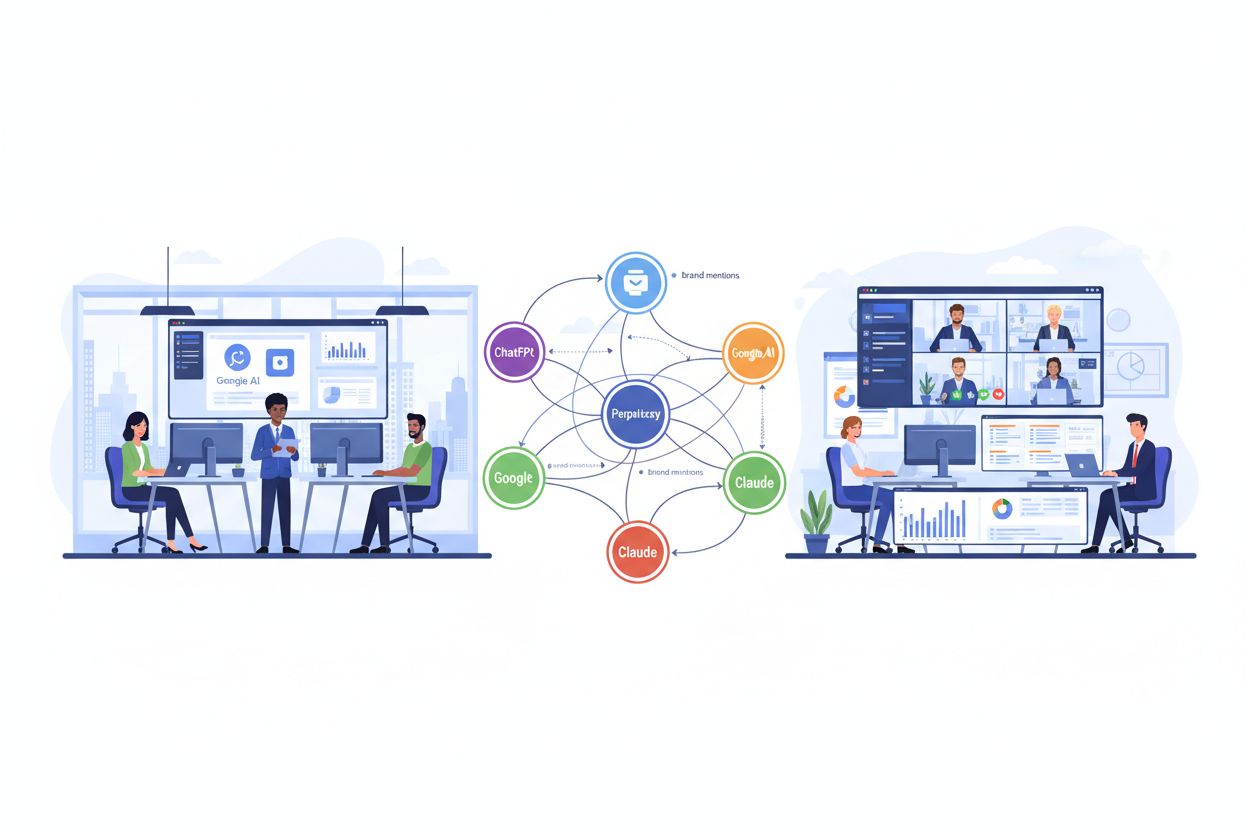
Compare agency vs in-house AI visibility monitoring. Explore costs, timelines, expertise requirements, and hybrid approaches to help you choose the right strate...