
GEO vs SEO: Key Differences Every Marketer Must Know
Understand the critical differences between Generative Engine Optimization (GEO) and traditional SEO. Learn how to optimize for AI search engines like ChatGPT, ...
9 min read

Learn how to effectively balance SEO and GEO efforts to maximize visibility in both traditional search results and AI-generated answers. Discover unified strategies for keyword research, content optimization, and technical implementation.
Balance SEO and GEO by building a unified keyword strategy that serves both traditional search engines and AI platforms, strengthening technical foundations, creating clear content with proper structure, and monitoring your brand visibility across both channels. GEO is not a replacement for SEO but an evolution that requires integrating AI-friendly optimization into your existing SEO workflow.
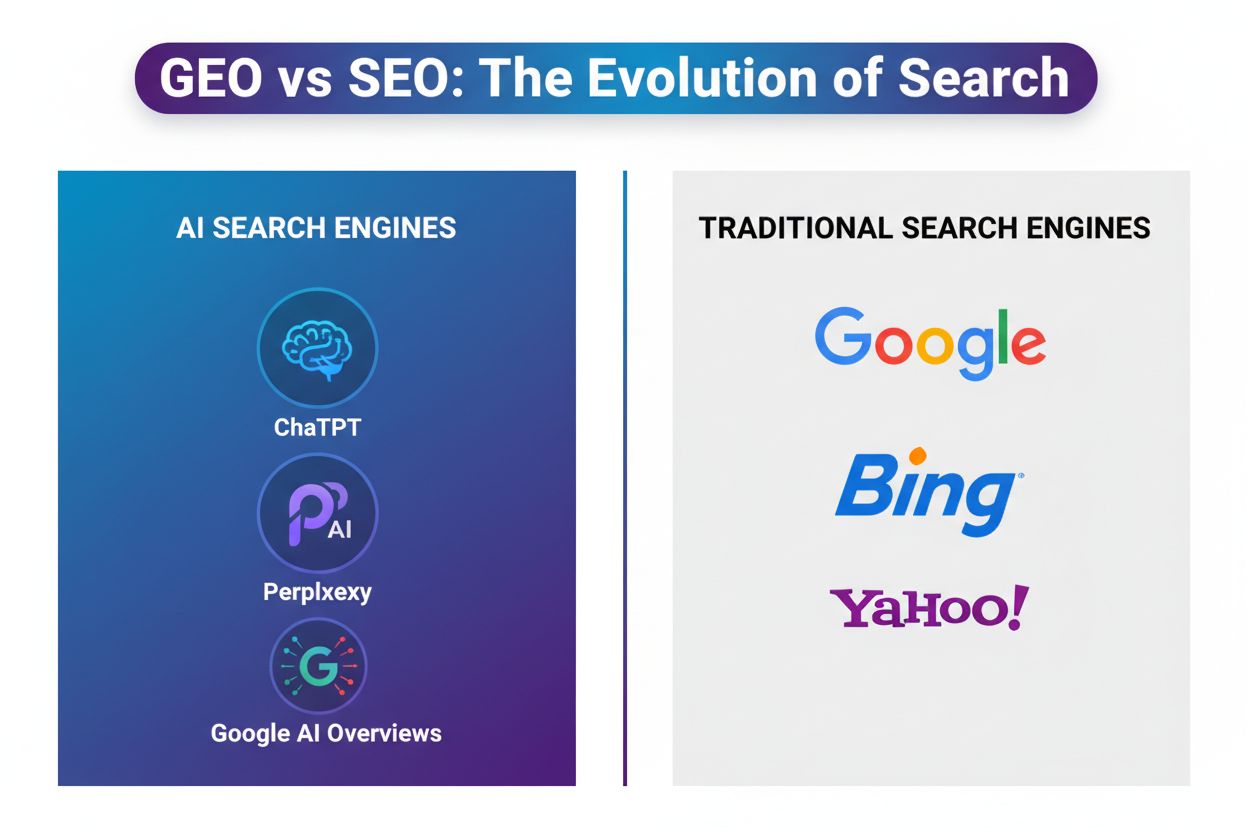
SEO (Search Engine Optimization) and GEO (Generative Engine Optimization) are two distinct but complementary disciplines that work together to maximize your online visibility. SEO focuses on ranking higher in traditional search engine results like Google, while GEO focuses on getting your brand cited or referenced inside AI-generated answers from platforms like ChatGPT, Gemini, and Perplexity. The critical insight is that GEO is not a replacement for SEO—it’s an evolution of it. Both channels rely on similar foundational principles, but they interpret and reward signals differently. Understanding this relationship is essential for developing a balanced strategy that captures visibility across both discovery channels.
The search landscape has fundamentally shifted. While traditional search remains dominant, AI search is growing as a complementary discovery channel. Users now start their research with AI platforms, build initial awareness, and then return to traditional search engines when ready to take action. This dual-path journey means your brand must be visible in both places to capture the full customer lifecycle. Ignoring either channel leaves significant visibility and conversion opportunities on the table.
The relationship between SEO and GEO is symbiotic rather than competitive. Research shows that 40.58% of AI citations come from Google’s top 10 search results, which means strong SEO performance gives you a head start in AI visibility. However, this statistic also reveals a critical truth: ranking well in Google does not guarantee citations in AI answers. A page can rank #3 on Google because it has strong backlinks and high engagement, but if the writing is vague or buries key information deep in the text, AI engines may skip it entirely.
| Aspect | SEO Focus | GEO Focus | Balanced Approach |
|---|---|---|---|
| Primary Goal | Rank higher in traditional search results | Get cited in AI-generated answers | Maximize visibility in both channels |
| Key Signals | Backlinks, click-through rates, engagement metrics | Entity recognition, explicit mentions, content clarity | Authority + clarity + structure |
| Content Interpretation | Keyword relevance and user engagement | Entity mapping and contextual understanding | Natural language + explicit naming |
| Measurement | Traffic, rankings, conversions | Brand mentions, citations, AI visibility | Integrated metrics across channels |
| Time Horizon | Short to medium-term traffic gains | Long-term brand building and awareness | Sustained visibility and authority |
The distinction matters because AI engines interpret signals through entity recognition rather than backlinks or click metrics. Google ranks pages based on how many authoritative sites link to them and how users engage with the content. AI engines, however, need to extract specific facts and attribute them correctly to your brand. They analyze whether your content clearly states who, what, when, and where in a way they can confidently cite. This fundamental difference means you need to optimize for both systems simultaneously, not sequentially.
Effective keyword research is the foundation of both SEO and GEO success, but the approach must evolve to serve both channels. Traditional SEO focuses on identifying keywords with measurable search volume and targeting them with optimized content. GEO requires understanding conversational prompts and intent clusters rather than isolated keywords. People ask AI engines full questions: “What’s the best project management tool for remote teams?” or “How do I improve my website’s AI visibility?” They don’t just type two words and scroll.
Use conversational phrases that match natural user language. Search engines and AI platforms increasingly prioritize conversational phrases that align with how users naturally speak. Incorporate keywords that mirror everyday language to more accurately reflect search intent. This bridges the gap between traditional keyword usage and evolving semantic search standards. For example, instead of targeting just “project management software,” also target “best project management tool for small teams” and “how to choose a project management platform.”
Leverage contextually relevant terms to strengthen keyword depth. Integrating contextually linked terms into your content strengthens both SEO and GEO performance. Expand your content with variations of primary keywords that provide meaningful context. This helps capture long-tail keyword queries while maintaining relevance for a broader audience. If your primary keyword is “AI monitoring platform,” contextually relevant terms might include “brand monitoring in AI answers,” “track brand mentions in ChatGPT,” and “AI visibility tracking tools.”
Prioritize search intent and AI optimization simultaneously. Understand the intent behind user searches to create content that serves their needs. AI-driven platforms value this alignment and reward it by recommending content to users. Combine intent analysis with natural language phrasing to ensure maximum visibility and usability. This means analyzing not just what people search for, but why they’re searching for it and what problem they’re trying to solve.
Technical SEO remains critical for both traditional search and AI visibility. A website that loads slowly, isn’t mobile-friendly, or lacks proper structure will struggle in both channels. Ensure your website loads quickly and performs well across all devices to enhance user experience and meet SEO standards. Optimize for mobile usability through responsive design, ensuring seamless navigation and readability on smartphones and tablets. Use secure HTTPS connections to safeguard user data and build trust with your audience, improving rankings and engagement.
Add structured data to help search engines and AI platforms understand your content better. Schema markup is often overlooked but essential for both SEO and GEO success. Clear and concise metadata makes your site eligible for GEO prioritization and boosts its generative engine optimization potential. Implement structured data types like Article, FAQ, HowTo, and LocalBusiness to provide explicit context about your content. This helps AI engines extract information more accurately and increases the likelihood they’ll cite your content.
Monitor and update your website regularly to maintain speed and usability. Use tools to identify performance issues and address them promptly to avoid disruptions in user experience. These proactive measures strengthen your technical foundations, maintaining consistent visibility and results over time. Regular audits should check for broken links, outdated content, slow-loading images, and missing schema markup.
Content is where SEO and GEO strategies truly converge. You don’t need separate content for each channel—you need content that’s optimized for both simultaneously. Craft clear, concise, and relatable content to engage readers effectively. Use a conversational tone to make your message approachable while addressing the needs of your target audience. This approach keeps readers interested and ensures your content aligns with evolving digital demands.
Structure your content in ways that allow AI platforms to interpret and repurpose it easily. Incorporate direct answers to user queries and layer information thoughtfully to provide context without overwhelming the reader. Balancing readability with GEO objectives ensures your content excels in generative engine optimization and improves overall reach. Start each section with the most important takeaway, then provide supporting details and examples.
Use headers to bridge contexts and guide both users and AI systems. Headers provide structure and clarity to your content, making it easier for users and search engines to follow. Use concise, descriptive headers that clearly outline the topic of each section. Align these headers with keywords and conversational phrases to enhance their relevance and improve GEO and SEO performance. Well-crafted headers help maintain structure while boosting search visibility and promoting better user engagement.
Enable entity recognition with explicit writing. GEO content demands explicitness and clarity. Instead of saying “It’s a popular shoe brand,” you should say “Nike is a popular shoe brand.” The more explicitly entities are named and connected, the easier it becomes for AI to cite your brand as a trustworthy source. When you cite research or data, mention the author and source directly: “According to a 2025 Amicited study” rather than just hyperlinking. This ensures AI can verify the credibility of your content, even if it struggles to read linked sources.
Different content formats serve different purposes in your balanced SEO and GEO strategy. Creating a mix of content types helps capture the attention of different user groups and aligns with varying platform preferences. Use formats like blog posts, videos, infographics, and interactive tools to engage audiences with distinct learning styles. This approach enhances user experience while improving visibility on traditional search engines and GEO platforms.
How-to guides tailored for traditional search provide detailed, step-by-step instructions that rank well in search results. Complement these with conversational Q&A formats designed for GEO platforms, making your content easy to understand and AI-friendly. Balancing long-form and casual formats ensures your strategy meets diverse user expectations effectively. Include engaging visuals and interactive elements like quizzes or polls paired with clear, concise text that addresses user queries directly.
Combine multimedia with context for AI and SEO success. Integrating multimedia effectively enhances user engagement while boosting optimization for both channels. Visuals, videos, and other interactive content improve comprehension and make your material more accessible to diverse audiences. Use descriptive alt text for all images to improve accessibility and relevance in search rankings. Include transcripts, captions, and metadata in your videos to enhance both user understanding and search visibility. Ensure images, infographics, and charts are directly connected to the surrounding text to foster seamless content integration.
Balancing SEO and GEO requires ongoing monitoring and optimization. Analyze AI-generated responses for insights into how platforms cite and present source materials. Study AI platforms like Bing AI and Perplexity to see how they cite and present source materials. Review their responses to understand the structure, tone, and content they prioritize. This analysis helps you identify patterns and techniques to refine your content for better alignment with these platforms. Use the data from AI queries to adjust your content’s format, ensuring it matches what these systems highlight and recommend.
Monitor how AI represents your brand across the web. If AI tools misinterpret your content, that misinformation can spread quickly across the generative ecosystem. AI engines form their understanding of your brand based on what’s publicly available across the web: articles, reviews, discussions, and mentions. If incorrect, negative, or outdated information exists online, AI may surface or even amplify it in its responses. GEO therefore requires a defensive layer that traditional SEO never demanded. Conduct ongoing content audits to catch outdated or incorrect information before AI engines pick it up. Check for factual consistency across all your pages, as contradictions confuse AI systems. Update schema markup to ensure structured data accurately represents your brand and offerings. Monitor your brand mentions across third-party platforms, where AI might source information about you.
Track metrics that matter for both channels. Traditional SEO metrics like rankings and traffic remain important, but you must also track AI visibility metrics. Monitor where your brand appears in AI-generated answers, which pages get cited most frequently, and what prompts trigger your content. Compare your performance against competitors in both traditional search and AI answers. This integrated approach to measurement ensures you’re optimizing for genuine business impact rather than vanity metrics.
Many organizations make critical errors when attempting to balance these two strategies. Don’t assume strong SEO automatically translates to GEO success. The overlap creates a false sense of security. Yes, strong SEO gives you a foundation. But without deliberate GEO optimization, you’re leaving visibility on the table and your competitors who do optimize will capture it instead. The brands that dismiss this shift as “just SEO” are the ones who’ll find themselves absent from the conversations where their customers are actually making decisions.
Avoid creating duplicate or thin content across locations. Copying and pasting the same content with only minor variations can trigger SEO penalties and confuse AI systems. Each page should be uniquely written and tailored to the specific needs of the reader. Don’t keyword stuff with location names or other terms. Mentioning keywords naturally in headings, paragraphs, and alt text is great. Repeating them excessively makes your content look spammy and unnatural to both users and AI systems.
Don’t ignore third-party content and brand mentions. GEO expands far beyond your owned assets. AI engines pull information from across the entire web, including places you don’t own or directly control. User-generated content platforms like Reddit and Quora get cited frequently in AI answers. Third-party mentions in news articles, reviews, and industry blogs shape how AI describes your brand. Even archived content on sites you’ve never heard of can influence AI’s understanding of your company. This means GEO requires a broader content and reputation strategy that includes monitoring and outreach towards third-party content.
Start by conducting a comprehensive audit of your current SEO performance and AI visibility. Identify which pages rank well in Google and which ones get cited in AI answers. You’ll likely find that some pages perform well in one channel but not the other. These gaps represent optimization opportunities. Prioritize pages that have high search volume and clear commercial intent, as these typically offer the best ROI for balanced optimization.
Next, implement the technical foundations: ensure your site is fast, mobile-friendly, and secure. Add comprehensive schema markup to all important pages. Update your headers and metadata to be more descriptive and conversational. Then, systematically review and update your content to be more explicit about entities, clearer in structure, and more conversational in tone. Don’t try to optimize everything at once—focus on your highest-value pages first, measure the results, and then scale the approach.
Finally, establish ongoing monitoring processes. Set up tracking for both traditional search metrics and AI visibility metrics. Create a regular cadence for reviewing how AI platforms cite your content and what third-party mentions exist about your brand. Use these insights to continuously refine your strategy. The organizations that win in this new landscape will be those that treat SEO and GEO not as separate initiatives but as integrated components of a unified visibility strategy.
Ensure your brand appears in both traditional search results and AI-generated answers. Track your visibility across ChatGPT, Perplexity, and Google's AI Overviews while maintaining strong SEO performance.
Understand the critical differences between Generative Engine Optimization (GEO) and traditional SEO. Learn how to optimize for AI search engines like ChatGPT, ...

Understand the critical differences between GEO (Generative Engine Optimization) and SEO (Search Engine Optimization). Learn how AI search differs from traditio...
Discover why Generative Engine Optimization (GEO) is essential for businesses in 2025. Learn how AI-powered search is reshaping brand visibility, consumer behav...