Understanding How AI Systems Evaluate Authority
AI search engines evaluate authority through fundamentally different mechanisms than traditional search engines. Unlike Google’s PageRank algorithm that relies heavily on backlinks and domain metrics, AI systems like ChatGPT, Claude, Perplexity, and Google’s AI Overviews assess credibility through sophisticated natural language processing and knowledge graph integration. These systems analyze content depth, technical accuracy, author credentials, and the consistency of information across multiple sources. The critical distinction is that AI engines prioritize demonstrated expertise and content quality over third-party metrics like Domain Authority scores. Research shows that AI systems evaluate sources through five key signal categories: entity recognition, high-quality citations, topical depth, brand consistency, and engagement indicators. Each of these signals reinforces the others, creating a comprehensive authority framework that differs significantly from traditional SEO metrics.
The Five Core Authority Signals AI Systems Recognize
Entity recognition serves as the foundation for how AI systems understand and categorize your brand. AI agents rely heavily on entity understanding to connect your brand with relevant topics, requiring consistent and accurate representation in structured data across the web. When your brand isn’t clearly represented in knowledge graphs and structured data, AI search engines struggle to surface it when users ask related questions. High-quality citations function as external validation of your expertise and credibility. When authoritative websites reference or link to your content, AI systems interpret these mentions as endorsements of your reliability and expertise. The stronger and more relevant these external citations are, the more confident AI search engines become in surfacing your brand as a trusted source in their responses.
| Authority Signal | How AI Systems Use It | Implementation Strategy |
|---|
| Entity Recognition | Connects brand to topics in knowledge graphs | Implement schema markup, claim profiles, align naming conventions |
| High-Quality Citations | Validates expertise through third-party mentions | Publish original research, contribute guest content, secure media mentions |
| Topical Depth | Evaluates comprehensive expertise coverage | Create content hubs, address multiple angles, update regularly |
| Brand Consistency | Prevents confusion across platforms | Audit profiles quarterly, ensure factual accuracy, maintain unified messaging |
| Engagement Indicators | Signals trust and relevance | Generate positive interactions, encourage social shares, build community presence |
Topical authority represents how comprehensively your content covers subject areas. AI systems prefer sources that demonstrate breadth and depth in their coverage of specific topics, making comprehensive expertise essential for consistent citations. Content that remains at surface-level won’t sustain visibility in AI search results. Brand consistency across all platforms is critical because inconsistent or outdated brand identity erodes authority signals and makes it harder for AI agents to recognize and trust your brand when evaluating sources to cite. Engagement indicators including positive user interactions, high engagement rates, and social shares signal trust and relevance to AI systems, demonstrating that your content resonates with real audiences.
Ready to Monitor Your AI Visibility?
Track how AI chatbots mention your brand across ChatGPT, Perplexity, and other platforms.
Implementing Structured Data and Entity Optimization
Structured data implementation is one of the strongest factors influencing how often your brand gets cited in AI-generated answers. According to research from Search Engine Land, a well-implemented schema was the only factor that got a page into AI Overviews over competitors in their experiment. In the same test, a page with poor schema implementation ranked for ten keywords but never appeared in a single AI overview. AI agents rely on machine-readable information to understand your content, and schema markup provides this clarity directly. Implement organization schema to establish your brand as a legitimate entity, person schema for author credentials and expertise areas, product schema for offerings, and article schema with author, publication date, and organization information. Additionally, implement FAQ and How-to schema for direct AI response optimization, and review schema for credibility signals.
Claiming and optimizing profiles on authoritative platforms is equally important for entity recognition. Update official pages on Google Business Profile, LinkedIn, Crunchbase, and industry-specific directories to establish your brand as a recognized entity. Align naming conventions consistently across all channels to prevent fragmented entity recognition that confuses AI systems. Use consistent brand names, taglines, and descriptions everywhere your brand appears online. Reference authoritative sources in your content to reinforce topic alignment and help AI systems understand your expertise positioning within your industry landscape.
Building High-Value Citations and Brand Mentions
Citations from authoritative sources serve as credibility signals that directly influence how AI agents evaluate and select content for their responses. AI models prioritize sources that other experts trust enough to reference, making citation building a cornerstone of authority development. Publishing original research demonstrates deep expertise in your topic areas and positions your brand as the authoritative source others reference. Create original studies, quantitative reports, or benchmark data that becomes an industry reference point. Contribute guest content to industry publications to expand your brand’s reach and establish backlinks with high-authority domains that AI systems recognize as credible validators.
Offering expert commentary through quotes and insights for news stories, podcasts, and interviews creates valuable brand mentions that AI systems recognize as authority signals. Perform targeted outreach to websites that mention your competitors or cover your topics to secure backlinks and mentions through relationship building. Expand your community presence authentically in relevant channels like Reddit, Quora, and industry forums where AI systems frequently source information. Research shows that Reddit is the most-cited source for both Google AI and Perplexity, making community participation essential for modern authority building. Unlinked brand mentions alongside traditional link-building strategies are increasingly important for GEO (Generative Engine Optimization), as AI systems learn about your expertise through co-citation patterns that teach them where you fit in your industry.
Stay Updated on AI Visibility Trends
Get the latest insights on AI mentions, brand monitoring, and optimization strategies.
Developing Comprehensive Topical Authority
Topical authority requires both strategic content creation and ongoing maintenance to establish your brand as a go-to resource in your industry. Create content hubs that organize articles into interconnected topic clusters to help AI systems understand the full scope of your expertise. This interconnected structure demonstrates that you’ve thoroughly explored a subject area from multiple angles. Update content regularly with fresh data, examples, and statistics to signal that your knowledge stays current and reliable. Research from AirOps found that more than 53% of content cited in ChatGPT had been updated within the last six months, giving brands that commit to regular content updates a significant advantage in AI search rankings.
Address multiple angles of your core topics by covering definitions, how-to guides, comparisons, case studies, and best practices. This comprehensive coverage shows AI systems that you provide thorough knowledge rather than surface-level information. Include expert credentials and author information to provide trust signals that AI systems use to evaluate content quality. Feature named authors with relevant experience, link to their professional profiles, and highlight their specific expertise areas. The goal is to become a recognized resource that earns credibility and recognition in your industry through demonstrated knowledge and consistent expertise demonstration.
Maintaining E-E-A-T Signals for AI Visibility
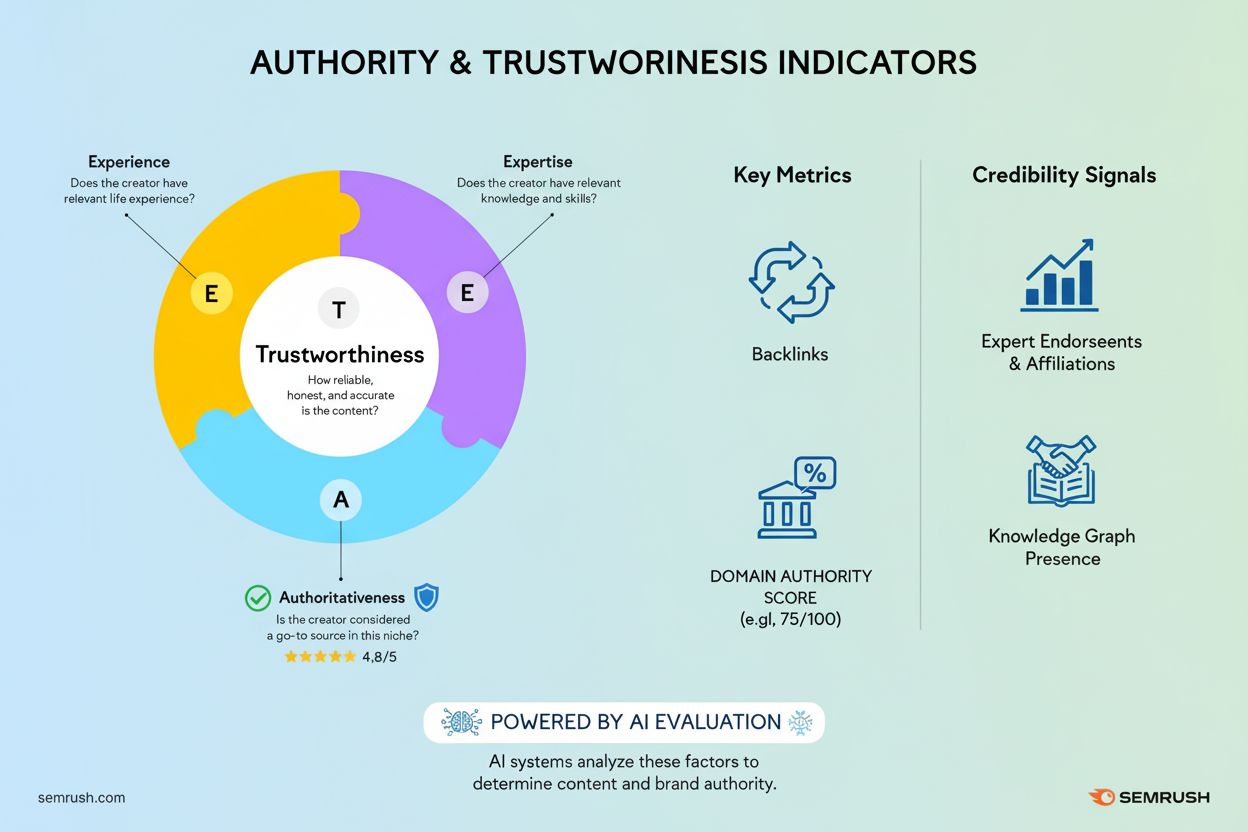
E-E-A-T stands for Experience, Expertise, Authoritativeness, and Trustworthiness—the framework that both Google and AI systems use to evaluate source credibility. Experience means your content demonstrates first-hand technical or industry knowledge, such as a blog authored by a CISSP-certified engineer carrying more weight than generic brand-authored content. Expertise requires highlighting formal credentials including degrees, certifications, and professional roles, with contributor bios and LinkedIn profile links reinforcing credibility. Authoritativeness comes from external validation through citations from analysts, mentions in trade publications, and links from respected organizations that elevate perceived authority. Trustworthiness requires proof of reliability through compliance certifications, transparent sourcing, and consistent publishing schedules.
Show detailed author credentials on every piece of content with relevant experience and professional background. Publish original research to demonstrate deep expertise and become the authoritative source others reference. Update content regularly—AI models heavily favor fresh content, with ChatGPT citing journalism published within the past year 56% of the time according to research from Muck Rack. Position yourself as an industry thought leader by sharing your experience and expertise through guest posting, speaking engagements, and thought leadership contributions. Don’t be afraid to participate in industry discussions and share your insights on key topics and emerging trends. Showcase awards, certifications, and public speaking engagements to provide third-party validation that AI systems recognize as credibility indicators.
Measuring and Monitoring Authority Signal Success
Authority building requires ongoing measurement to ensure your brand stays competitive in AI search and maintains visibility across answer engines. Monitor citation share, which represents the percentage of AI citations that reference your brand compared to competitors when answering relevant queries. Track share of voice, your visibility in AI responses versus competitors within your industry or topic area. Measure brand mention frequency to understand how often your brand appears in AI-generated responses, even without direct citations. Monitor brand sentiment to understand the context and tone in which AI systems reference your brand across different queries. Track entity coverage to see how well AI systems recognize and categorize your brand across knowledge graphs and structured data sources.
Monitor these metrics monthly to identify trends and opportunities for improvement. Strong performance across citation share and share of voice metrics indicates healthy brand authority signals. Use Search Console to monitor citations in AI summaries and track AI overview impressions. Audit media and analyst mentions regularly and incorporate coverage tracking into your authority reporting. Implement quarterly audits to review author bios, schema implementation, backlinks, and branded mentions. Track branded search volume as a key performance indicator for authority growth, as direct brand searches signal to AI that your company is a trusted, authoritative source. This systematic approach to measurement ensures you can identify what’s working and adjust your strategy accordingly to maintain competitive advantage in AI search.