

Why GEO Matters for Business Success in 2025: AI Search Visibility Guide
Discover why Generative Engine Optimization (GEO) is essential for businesses in 2025. Learn how AI-powered search is reshaping brand visibility, consumer behav...
8 min read

Learn how to select the right Generative Engine Optimization agency with proven expertise in AI search visibility, content optimization, and authority building across multiple platforms.
Choose a GEO agency with proven SEO foundations, multi-platform generative search expertise, AI-friendly content structuring skills, authority-building capabilities, and demonstrated innovation in generative engine optimization. Evaluate their team structure, case studies, measurement frameworks, and ability to align GEO with your business goals.
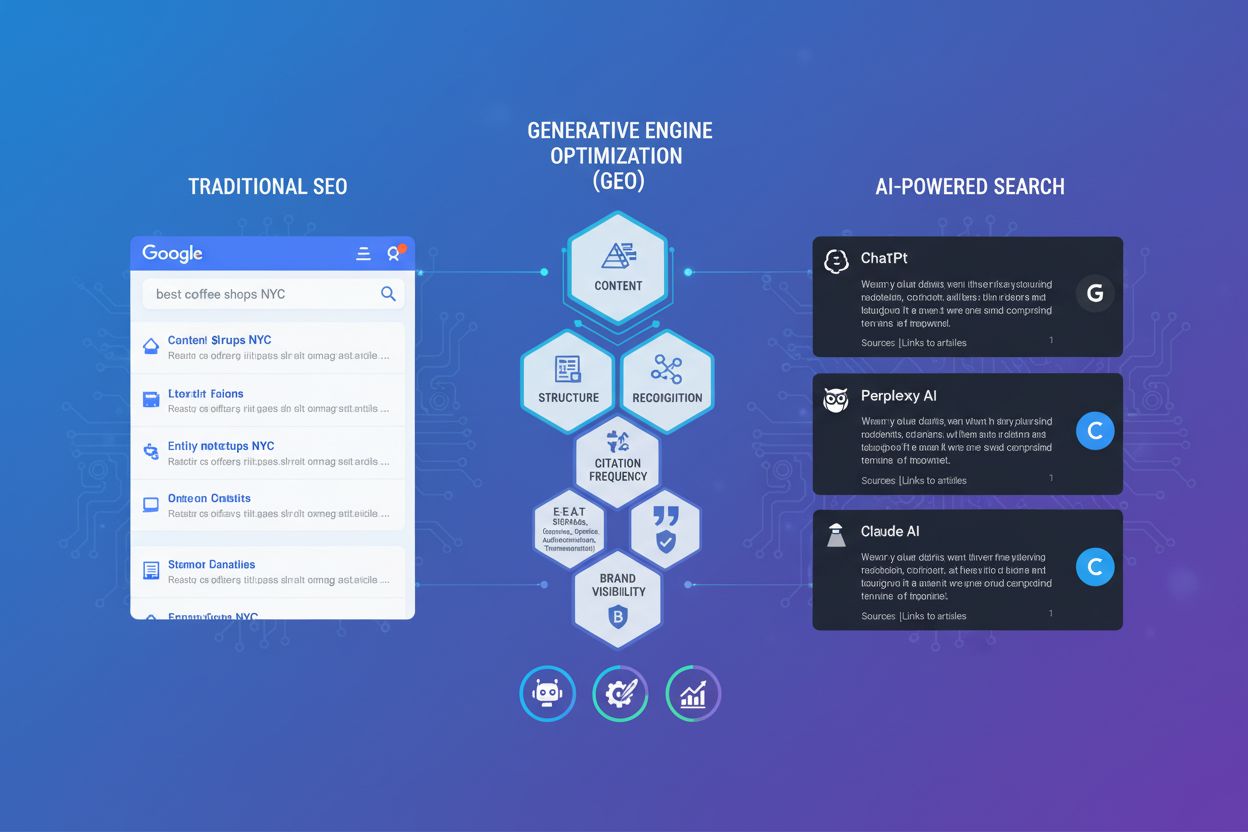
Selecting the right Generative Engine Optimization (GEO) agency is one of the most critical decisions for brands navigating the AI-powered search landscape. Unlike traditional SEO agencies that focus primarily on ranking positions in Google’s search results, GEO agencies specialize in ensuring your brand gets cited and referenced within AI-generated answers from platforms like ChatGPT, Perplexity, Google AI Overview, and Bing Copilot. The shift from link-based search results to conversational AI answers fundamentally changes how visibility works, making agency selection more nuanced and strategic than ever before.
The challenge lies in the fact that not all SEO agencies understand GEO, and not all agencies claiming GEO expertise have the technical depth required to deliver results. Many agencies continue selling traditional SEO packages focused on keywords and rankings without addressing the emerging reality that pages ranking number one on Google only appear in the top three cited links in AI overviews approximately 50% of the time. This gap between traditional rankings and AI citations represents both a risk and an opportunity for brands willing to invest in the right partner.
The first critical criterion when evaluating a GEO agency is their demonstrated expertise in traditional SEO. This might seem counterintuitive, but GEO builds directly on SEO foundations rather than replacing them. An agency without strong SEO credentials lacks the technical and content expertise required to optimize for generative search effectively. The technical fundamentals—site speed, mobile responsiveness, crawlability, schema markup, and information architecture—remain essential for both traditional search and AI systems.
Look for agencies that can demonstrate concrete results in SEO performance, including keyword rankings, organic traffic growth, and technical optimization implementations. Agencies with proven track records should be able to show evidence of earning significant keyword rankings across diverse client portfolios, implementing sophisticated schema markup strategies, and building topical authority through content clusters. When evaluating their SEO work, examine whether they understand entity optimization, semantic relationships between content, and how to structure information for both human readers and machine parsing.
| Evaluation Criteria | What to Look For | Red Flags |
|---|---|---|
| SEO Track Record | 10+ years experience, multiple case studies, keyword ranking improvements | Vague metrics, no specific examples, focus only on traffic |
| Technical Expertise | Schema markup implementation, site architecture optimization, Core Web Vitals | No mention of technical SEO, outdated practices |
| Content Strategy | Topical authority building, entity mapping, semantic optimization | Keyword stuffing, thin content, no strategic approach |
| Authority Building | Backlink acquisition, brand mentions, E-E-A-T signals | No link building strategy, low-quality placements |
The generative search landscape is fragmented, with each platform operating according to different algorithms, retrieval mechanisms, and citation preferences. A competent GEO agency must demonstrate expertise across multiple AI search platforms rather than specializing in just one. Google AI Overview reaches over 200 countries and more than 40 languages, making it a primary focus, but it’s far from the only platform that matters for brand visibility.
Perplexity AI has rapidly grown its user base and is particularly effective for research-style queries where users seek comprehensive, cited answers. Bing Copilot, powered by OpenAI and integrated directly into Windows, reaches millions of users daily. ChatGPT’s web browser functionality allows users to ask questions and receive answers synthesized from internet sources. Beyond these major platforms, niche AI search engines are emerging in specific sectors, offering opportunities for targeted visibility. An agency that can only optimize for one platform is leaving significant visibility opportunities on the table.
When evaluating multi-platform expertise, ask potential agencies to explain their strategies for each major platform. How do they approach optimization differently for Perplexity versus Google AI Overview? What unique considerations apply to ChatGPT versus Bing Copilot? The best agencies will acknowledge that while core principles remain consistent, each platform has distinct preferences for content structure, citation patterns, and authority signals. They should be actively experimenting with emerging platforms and staying ahead of algorithm changes rather than simply applying yesterday’s tactics to today’s tools.
Generative engines have distinct preferences for how information is presented and structured. Unlike traditional SEO, which rewards comprehensive, long-form content with keyword optimization, AI systems prioritize clarity, extractability, and conversational tone. The best GEO agencies employ teams skilled in reformatting content specifically for AI readability and summarization. This requires a fundamentally different approach to content creation than traditional SEO content writing.
Effective AI-optimized content typically begins with a quick answer section of 40-80 words that directly addresses the core query before expanding into deeper context. Headers should be structured as actual questions that mirror how users and AI systems phrase queries. Content should be broken into scannable sections with bullet points, numbered lists, and comparison tables that AI systems can easily extract and attribute. Paragraphs should be concise, typically under 120 words, with each section capable of standing alone without requiring additional context.
The best GEO agencies will demonstrate expertise in creating FAQ-style content that directly answers reader questions, building summarizable content blocks that AI can easily extract, and writing in natural, conversational styles that match how people actually phrase questions to AI assistants. They should understand entity optimization—how to clearly identify primary topics and connect them to supporting concepts through strategic linking. They should also be familiar with emerging standards like llms.txt files that provide AI systems with structured information about your site’s content and crawler access policies.
Generative engines prioritize content from trusted, authoritative sources when generating answers. This means your brand needs to work with an agency that has proven experience in developing clients’ online presence, building legitimacy, and establishing the E-E-A-T signals (Experience, Expertise, Authoritativeness, Trustworthiness) that AI systems recognize and prefer. The goal isn’t just visibility—it’s credibility sufficient that AI prefers citing your work over competitors.
Agencies demonstrating strong authority-building capabilities should show evidence of earning substantial backlinks from high-quality domains, securing mentions in authoritative publications, and building consistent brand presence across multiple platforms. Look for agencies that understand entity stacking—the practice of establishing your brand presence on recognized platforms like Better Business Bureau, Crunchbase, G2, and industry-specific directories that lend credibility to your primary domain. They should have strategies for securing third-party mentions in industry publications, vendor directories, and association listings that AI systems recognize as authority signals.
Additionally, evaluate whether the agency understands how to implement visible author credentials and expertise signals. Every piece of content should have named authors with clearly displayed roles, credentials, and professional profiles. For compliance-sensitive topics, content should include reviewer credentials prominently displayed near the answer section. This transparency about expertise directly influences how AI systems evaluate source credibility and citation worthiness.
AI search is evolving faster than any other digital channel, making adaptability and continuous innovation essential qualities in a GEO partner. The agency you select must demonstrate a commitment to testing, learning, and adapting practices as AI systems change. This isn’t a “set it and forget it” discipline—it requires ongoing experimentation and willingness to challenge assumptions about what works.
Look for agencies that publish research about AI search behavior, conduct controlled experiments to test optimization hypotheses, and share learnings publicly. Agencies that are actively experimenting with new content formats, testing how different content structures perform in AI answers, and monitoring algorithm changes demonstrate the forward-thinking mindset necessary for long-term success. They should be able to articulate where they see GEO evolving in the next 1-3 years and explain how they’ll help future-proof your brand’s visibility.
Ask potential agencies about their experimentation process. How do they test new tactics without risking your current search visibility? What tools do they use to monitor AI citations and track performance? How frequently do they update their strategies as AI search evolves? The best agencies will have documented processes for continuous learning and improvement rather than static methodologies.
The team composition of a GEO agency reveals a lot about their capabilities and depth. A truly competent GEO agency should employ relevance engineers who understand how AI systems retrieve and rank information, prompt strategists who know how to structure content for AI query patterns, data scientists who can analyze citation patterns and optimize based on data, and content specialists who can write and structure content for both human and machine consumption.
A one-person “SEO expert” claiming GEO expertise is unlikely to deliver comprehensive results. GEO requires collaboration across multiple disciplines—technical SEO, content strategy, PR and authority building, analytics and measurement, and AI-specific optimization. When evaluating agencies, ask detailed questions about their team structure. Who will be working on your account? What are their specific roles and expertise areas? How do they collaborate internally and with clients? Do they have dedicated resources for your account or will you be sharing resources with many other clients?
The best agencies will be transparent about their team structure and willing to introduce you to the people who will actually be working on your account. They should be able to explain how different team members contribute to GEO success and how they coordinate their efforts to deliver integrated results.
An often-overlooked criterion is the agency’s measurement and analytics capabilities. A competent GEO agency should track multiple layers of metrics including input metrics (what content is being optimized), channel metrics (performance across different AI platforms), and business outcome metrics (how AI visibility translates to leads, sales, or other business goals). They should be able to monitor your citation share across ChatGPT, Perplexity, Gemini, and Google AI Overviews for your priority query set.
Ask potential agencies about their tools and methodologies for monitoring AI citations. What platforms do they track? How frequently do they monitor? What metrics do they report? The best agencies will have invested in or developed tools that allow them to track which of your pages appear in AI answers, how frequently your brand gets cited, and how that visibility correlates with business outcomes. They should understand the difference between vanity metrics (like “number of keywords ranked”) and meaningful metrics that connect AI visibility to actual business impact.
Look for agencies that can explain their GEO analytics stack—the specific tools and processes they use to measure success. This might include tools like Ahrefs or SEMrush for tracking AI Overview citations, Profound or Scrunch for monitoring prompt results, and custom dashboards that connect AI visibility to pipeline and revenue data. The ability to measure and prove ROI is essential for justifying ongoing investment in GEO.
When evaluating potential GEO agencies, come prepared with specific questions that reveal their depth of expertise and alignment with your business goals. Ask what generative engines they currently optimize for and how their approach differs for each platform. Inquire about their methodology for entity optimization and structured data implementation. Ask how they adapt content for AI readability and summarization, and what their approach is to building authority and trust signals.
Request evidence of clients being cited in AI-generated results—not just rankings in traditional search. Ask how they measure GEO success and what metrics they track. Inquire about their update cadence for strategies as AI search evolves. Ask where they see GEO going in the next 1-3 years and how they’ll future-proof your brand. Request case studies showing detailed explanations of strategies used and metrics achieved, avoiding agencies that rely on vanity metrics without addressing generative search inclusion.
The best GEO agencies won’t hesitate over these questions. They’ll reply with confidence, specific examples, and thoughtful consideration of your unique situation. While they may acknowledge uncertainty about some aspects of rapidly evolving AI search, they should demonstrate clear appetite for the new search landscape and commitment to staying ahead of changes.
Before committing to a long-term contract with a GEO agency, consider starting with a pilot project focused on a specific topic or content set. This allows you to evaluate the agency’s communication style, technical expertise, and ability to deliver results in a lower-risk engagement. Use the pilot to assess whether the collaboration feels productive, whether the agency respects your brand voice, and whether they’re willing to share knowledge and build your internal capabilities.
A well-structured pilot project typically runs 30-90 days and focuses on optimizing a specific content cluster or topic area for AI visibility. The agency should be able to show you how they’re implementing the optimization checklist, what changes they’re making to content structure and technical setup, and how they’re monitoring results. By the end of the pilot, you should have clear evidence of whether the agency’s approach is working and whether you want to expand the engagement.
This pilot approach also gives you time to evaluate cultural fit and collaboration style. A good GEO partner will respect your brand voice, work collaboratively with your internal teams, and be willing to share knowledge rather than keeping their methods opaque. They should be transparent about their processes and willing to explain their reasoning for specific recommendations.
The best GEO agencies understand that generative engine optimization doesn’t exist in isolation—it must align with your broader search strategy including traditional SEO and paid search. They should be able to explain how GEO complements rather than competes with your existing search efforts. When AI assistants extract information from your content to answer user questions, they effectively pre-qualify prospects by educating them before they visit your site. This transforms zero-click scenarios from lost opportunities into pre-sales education touchpoints.
Rather than viewing GEO as a separate initiative, the best agencies will help you coordinate keyword intent clusters across organic search, paid search campaigns, and generative engine optimization. They’ll ensure your pillar content performs well in both traditional blue-link results and AI-generated answers. They’ll help you understand how GEO feeds into your overall demand generation strategy and contributes to pipeline and revenue goals.
This integrated approach requires agencies that understand your business model, sales cycle, and key performance indicators. They should be able to articulate how GEO investments support your broader business objectives rather than just driving abstract metrics like “AI citations.”
Choosing a GEO agency is ultimately about finding a strategic partner to guide you through one of the biggest shifts in digital history. Look for an agency with proven SEO foundations, demonstrated real results in generative engine visibility, transparent methodologies, and innovative thinking. The right partner will help ensure your brand doesn’t just appear in search results—it becomes associated with the answers people trust in the AI-powered search era.
Take time to evaluate multiple agencies, ask detailed questions, and request pilot projects before making a final commitment. The investment in selecting the right partner will pay dividends as AI search continues to reshape how people discover information and make decisions. Your GEO agency should be someone you trust to navigate this transformation and help your brand thrive in the new search landscape.
Track how your brand appears in AI-generated responses across ChatGPT, Perplexity, Google AI Overview, and other AI search engines with AmICited's monitoring platform.
Discover why Generative Engine Optimization (GEO) is essential for businesses in 2025. Learn how AI-powered search is reshaping brand visibility, consumer behav...
Learn how to get started with Generative Engine Optimization (GEO) today. Discover essential strategies to optimize your content for AI search engines like Chat...
Learn what Generative Engine Optimization (GEO) is, how it differs from SEO, and why it's critical for brand visibility in AI-powered search engines like ChatGP...