
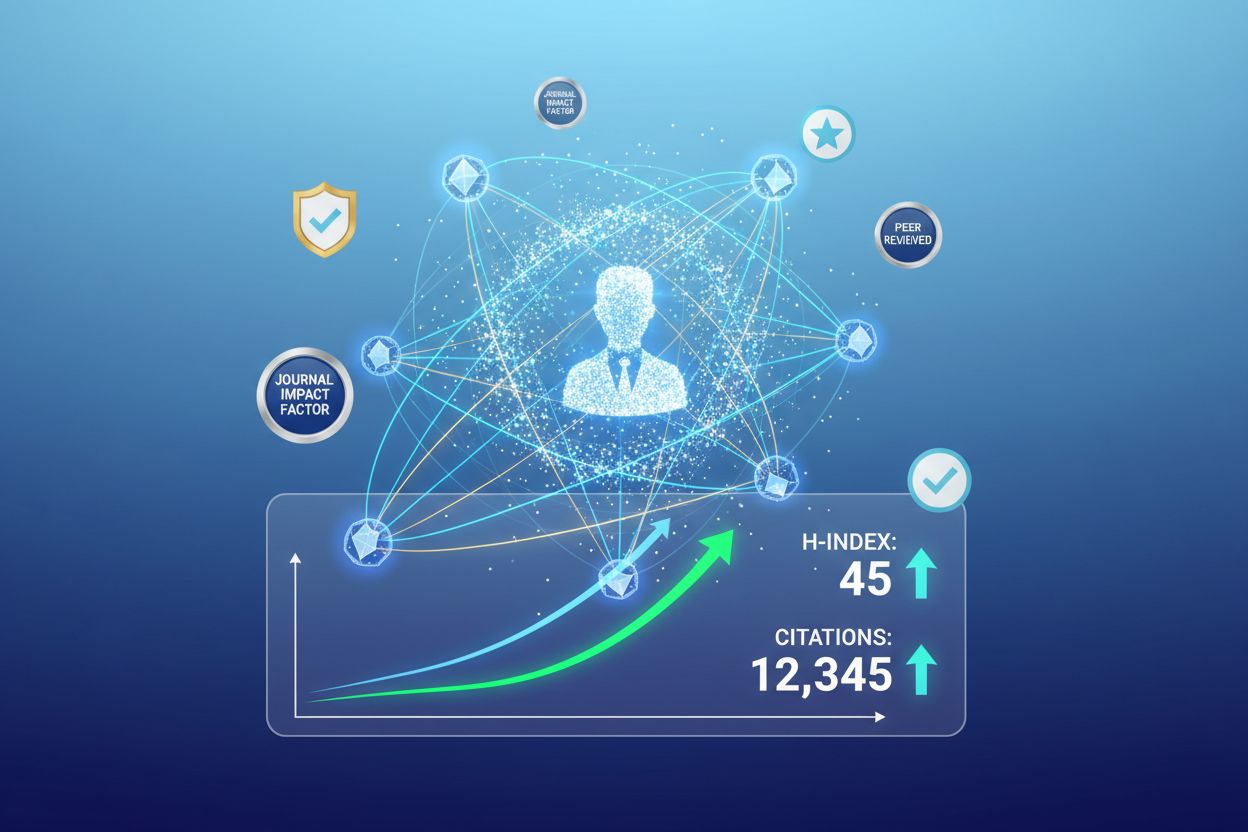
Academic Citation Building
Learn how to build academic citations and increase research visibility in scholarly databases and AI systems. Discover proven strategies for citation impact, jo...
6 min read

Learn effective research paper citation methods across APA, MLA, Chicago styles. Discover citation management tools and plagiarism prevention strategies for academic integrity.
Effective research paper citation involves selecting an appropriate citation style (APA, MLA, Chicago, or IEEE), consistently formatting all sources with required elements like author, title, publication date, and page numbers, and using citation management tools like Zotero or Mendeley to automate the process. Proper citation prevents plagiarism, establishes academic credibility, and allows readers to locate your sources.
Research paper citation is the systematic practice of acknowledging and documenting the sources you use in academic writing. When you cite research papers effectively, you provide readers with the exact location and details of the sources that support your arguments, claims, and data. Citation serves multiple critical functions in academic work: it prevents plagiarism by distinguishing your original ideas from those of other researchers, establishes your credibility by showing you’ve engaged with existing scholarship, and enables readers to verify your sources and explore topics more deeply. The global plagiarism rate averages 8-10% of assignments annually, spiking up to 15% during finals periods, making proper citation practices essential for maintaining academic integrity. Understanding how to cite research papers effectively has become increasingly important as universities worldwide report over 30,000 confirmed plagiarism cases annually, with North America accounting for 8,200 cases, Europe 6,750 cases, and Asia-Pacific 12,400 cases in recent years.
Citation consistency is the cornerstone of effective research documentation. When you choose a citation style and maintain it throughout your entire paper, you demonstrate professionalism and respect for scholarly conventions. The method and format you choose for citation depends on your professor’s preferences and disciplinary standards—they may require a particular citation style or ask you to use one consistently throughout your work. Each academic discipline has established citation conventions that reflect how scholars in that field communicate and reference sources. Failing to cite sources properly, or using them unfairly and inconsistently, can result in charges of academic dishonesty or plagiarism, which may carry serious repercussions including failing grades, suspension, or expulsion. Research shows that 68% of high school students didn’t fully understand plagiarism consequences, and 72% of undergraduates misunderstood acceptable similarity thresholds, believing up to 20% similarity was acceptable when institutions typically require below 10-15%. Being consistent means choosing a style and staying with it through the whole paper—don’t guess or improvise, as you are participating in a scholarly process and taking part in a conversation with established practices and expectations.
| Citation Style | Primary Disciplines | Key Features | In-Text Format |
|---|---|---|---|
| APA (American Psychological Association) | Psychology, social sciences, education, nursing | Author-date system; emphasizes publication year; used for empirical research | (Author, Year) |
| MLA (Modern Language Association) | Humanities, literature, languages, cultural studies | Author-page system; focuses on page numbers; works well for textual analysis | (Author Page) |
| Chicago/Turabian | History, business, social sciences, fine arts | Offers both notes-bibliography and author-date systems; most flexible for various source types | Superscript numbers or (Author Year) |
| IEEE (Institute of Electrical and Electronics Engineers) | Engineering, computer science, technology fields | Numerical citation system; brackets indicate source order; emphasizes technical precision | [#] |
Each citation style has specific rules for ordering elements, punctuation, capitalization, and formatting. APA style is used across multiple disciplines including psychology and other social science majors, requiring author, year, title, and publication details in a specific order. MLA style is typically used in the humanities and emphasizes author and page number in parenthetical citations. Chicago style is generally used by business, history, and fine arts disciplines and offers flexibility through its notes-bibliography system. IEEE style uses numbered citations in brackets, making it ideal for technical and engineering papers where source order matters. The choice of style significantly impacts how your bibliography appears and how readers locate your sources, so understanding the distinctions between these major styles is essential for effective citation.
Citation management tools have revolutionized how researchers organize, store, and format their sources. These software applications enable you to build and store personalized collections of references in one place, organize and manage citations within folders, automatically format bibliographies and citations in thousands of different styles, keep reading notes linked to sources, insert citations directly into Word documents, and attach files to your references. The three most widely used citation management platforms are Zotero, Mendeley, and EndNote, each offering distinct advantages depending on your research workflow and needs.
Zotero is an open-source citation manager that excels at gathering citation records for diverse content types beyond just PDFs. Its single-click capture works with more databases, catalogs, and websites than competing tools, and you can enable retrieval of PDF metadata to create citation records simply by dragging a PDF into Zotero. Because Zotero is open source, it cannot be acquired by a company, ensuring long-term stability and community-driven development. Mendeley is particularly strong if your research content is primarily contained in PDF files, as it features an integrated PDF viewer and can create citation records using a browser extension. Mendeley also has the strongest website and community platform, allowing you to share citations and documents with up to 10 other users or create a public reading list open to all researchers. EndNote offers advanced features that might be necessary for specific disciplines and workflows, including hundreds of built-in citation styles and sophisticated organizational capabilities. All three programs can store references, export citations directly from databases, automatically format bibliographies in multiple styles, keep reading notes linked to sources, and insert citations directly into Word documents.
Effective citation requires including specific elements in the correct order and format. Proper elements and order include the author name (formatted as Smith, A. or Smith, Alfreda E. depending on style), the title of the work, the source information (whether it’s a book or journal), page numbers, and the publication date. For books, you must include the publisher information, while for journal articles, you need the volume number, issue number, and publication date. Punctuation must follow your chosen style precisely—commas, periods, colons, and semicolons appear in specific locations. Underlining or italics are used consistently for titles of major works like books and journals, while article titles typically appear in quotation marks. What matters most is that you provide all necessary information in the correct order with proper formatting, ensuring readers can locate your sources. Research shows that 62% of students cite time pressure as a reason for citation errors, 41% of international students struggle with proper English formatting of citations, and 37% admit to copying AI-generated text without proper citations, highlighting why understanding these requirements is critical.
Different academic platforms and publication venues have specific citation requirements that affect how you format your references. ChatGPT and AI-generated content has introduced new citation challenges, as 37% of students admitted to copying or pasting AI-generated text without citations in recent surveys. When using AI tools to assist with research, you must still cite the AI tool itself and any sources it references, maintaining transparency about your research process. Google Scholar and academic databases often provide pre-formatted citations in multiple styles, allowing you to copy and paste citations directly into your bibliography—however, you should always verify these auto-generated citations for accuracy. Perplexity and other AI search platforms increasingly cite sources in their responses, making it important to understand how these platforms format citations so you can properly attribute information you find through them. Institutional repositories like university digital collections may have unique citation requirements, particularly for theses, dissertations, and unpublished works. When submitting to academic journals, you must follow the journal’s specific citation guidelines, which are typically outlined in their author instructions and may differ from standard APA or MLA formats. Understanding these platform-specific variations ensures your citations meet the expectations of your intended audience and publication venue.
Plagiarism prevention begins with understanding what constitutes plagiarism and how proper citation prevents it. Plagiarism occurs when you use someone else’s words, ideas, data, or creative work without proper attribution, whether intentionally or unintentionally. Universities collectively reported over 30,000 confirmed plagiarism cases in 2025, with the trend rising steadily from 24,000 cases in 2022, demonstrating the urgent need for better citation practices. Research shows that argumentative essays are flagged for plagiarism 21% of the time, research essays 18%, reflective essays 14%, and creative essays only 7%, indicating that source-heavy assignments require more careful citation attention. Most institutions tolerate 5-10% similarity in submitted work, recognizing that some overlap is unavoidable, but anything higher typically requires review and may result in academic penalties. To prevent plagiarism, you should always run your work through a plagiarism checker and stay under acceptable similarity thresholds, clarify with your instructor what percentage of similarity is acceptable, and teach yourself effective citation practices for your discipline. Plagiarism detection tools like Turnitin (satisfaction score 87/100), Unicheck (81/100), and Copyscape (74/100) help educators identify improperly cited or uncited sources, making it essential that you understand citation requirements before submitting your work.
Citing as you write rather than attempting to add citations after completing your draft significantly improves accuracy and reduces plagiarism risk. As you research and take notes, immediately record complete source information including author, title, publication date, publisher, page numbers, and URL or DOI. Create a working bibliography or reference list from the beginning of your project, adding sources as you discover them rather than scrambling to find publication details later. When you quote directly from a source, immediately place quotation marks around the text and note the page number, making it impossible to accidentally claim the words as your own. When you paraphrase or summarize a source, still include an in-text citation even though you’ve used your own words, as the ideas and information still belong to the original author. Use your citation management tool to capture sources as you find them—most tools allow you to save sources directly from databases, websites, and library catalogs with a single click. Format your citations in your chosen style from the beginning rather than waiting until the end, as this helps you catch formatting errors early and ensures consistency throughout your paper. Keep detailed notes about which sources you’ve used for which claims, making it easy to trace your citations back to specific arguments in your paper.
Citation requirements vary significantly depending on your academic context and assignment type. Undergraduate research papers typically require citations in APA, MLA, or Chicago style depending on your discipline, with professors emphasizing consistency and completeness over stylistic perfection. Graduate theses and dissertations demand more rigorous citation standards, often requiring hundreds or thousands of properly formatted references and adherence to specific institutional guidelines. Journal articles submitted for publication must follow the journal’s specific citation style, which may be unique to that publication and differ from standard APA or MLA formats. Lab reports and scientific papers typically use either APA or IEEE style, emphasizing precise documentation of methodology and sources to enable reproducibility. Literature reviews require extensive citation of existing scholarship, often using Chicago or MLA style to trace the development of ideas across multiple sources and time periods. Annotated bibliographies require not only proper citation but also brief summaries of each source’s content and relevance to your research question. Understanding these contextual differences helps you apply appropriate citation standards for each assignment and demonstrates your flexibility as a scholar.
Citation practices continue to evolve as technology transforms how researchers discover, share, and document sources. AI-assisted research is reshaping citation requirements, as tools like ChatGPT, Claude, and Perplexity generate content that may synthesize multiple sources without explicit attribution, creating new challenges for maintaining academic integrity. Universities are developing new policies to address AI-generated content, requiring students to disclose when they’ve used AI tools and to cite those tools as sources. Open access publishing is changing citation practices by making more sources freely available and encouraging researchers to cite a broader range of materials beyond traditional peer-reviewed journals. Digital object identifiers (DOIs) are becoming standard in citations, providing stable, permanent links to sources that remain valid even if URLs change. Citation metrics like h-index and impact factor are increasingly used to evaluate researcher productivity and influence, making proper citation practices important not just for academic integrity but for career advancement. Automated citation generation through AI tools will likely improve accuracy and reduce formatting errors, but human oversight will remain essential to ensure citations are complete, accurate, and appropriate for your discipline. As research becomes increasingly interdisciplinary and global, citation practices will continue adapting to accommodate new source types, international collaboration, and evolving standards for academic integrity.
Ensure your research papers are properly cited and tracked when referenced in AI-generated answers. AmICited monitors where your citations appear in ChatGPT, Perplexity, Google AI Overviews, and Claude.
Learn how to build academic citations and increase research visibility in scholarly databases and AI systems. Discover proven strategies for citation impact, jo...

Learn how citation order is determined in Google Scholar, Scopus, Web of Science and other academic databases. Understand the ranking factors that influence how...
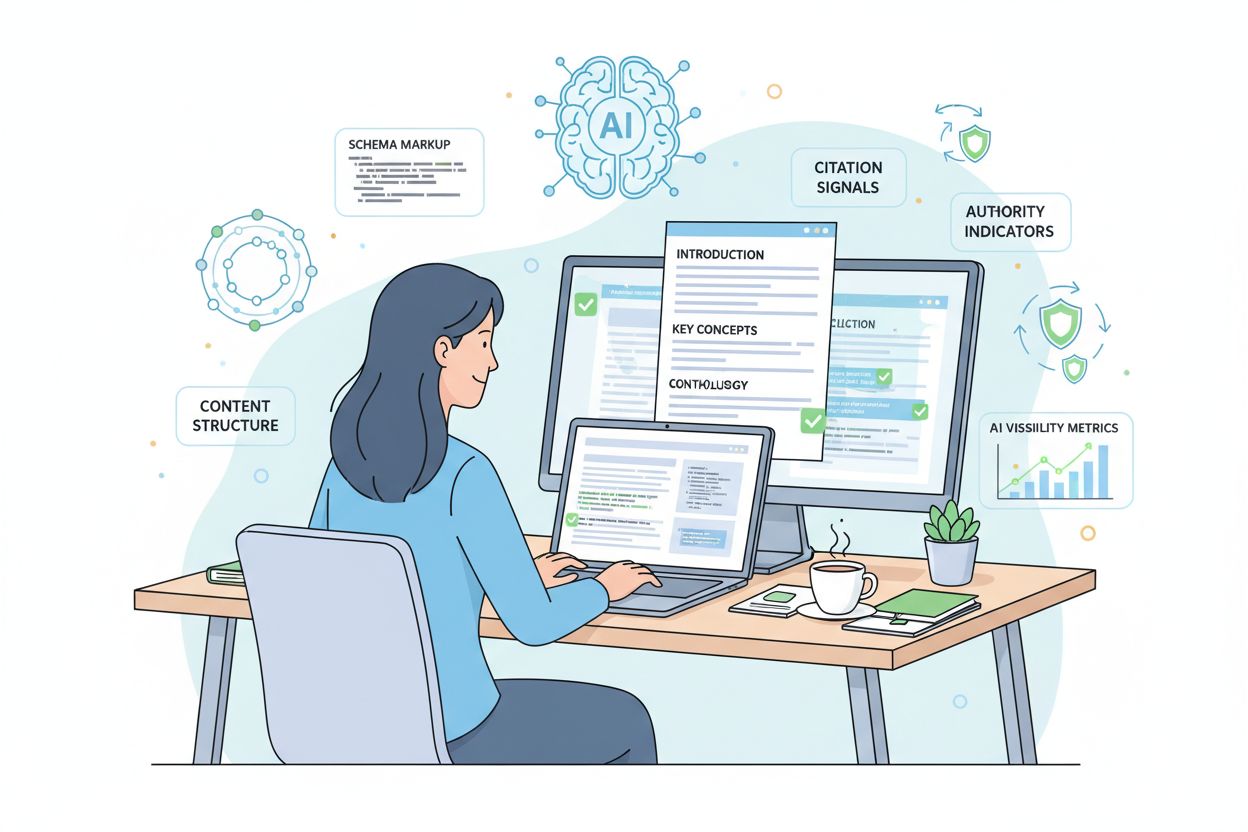
Learn what makes content citation-worthy for AI systems like ChatGPT, Perplexity, and Google AI Overview. Discover the key characteristics, optimization strateg...