

How Do I Research AI Search Queries?
Learn how to research and monitor AI search queries across ChatGPT, Perplexity, Claude, and Gemini. Discover methods to track brand mentions and optimize for AI...
9 min read

Learn how to create comprehensive AI search reports to monitor your brand visibility across ChatGPT, Perplexity, Gemini, and other AI answer engines. Step-by-step guide to tracking mentions, citations, and share of voice.
Create AI search reports by using specialized monitoring platforms that track your brand mentions and website citations across AI engines like ChatGPT, Perplexity, and Gemini. Set up tracked prompts, monitor visibility metrics, and generate automated reports to measure your share of voice and citation performance.
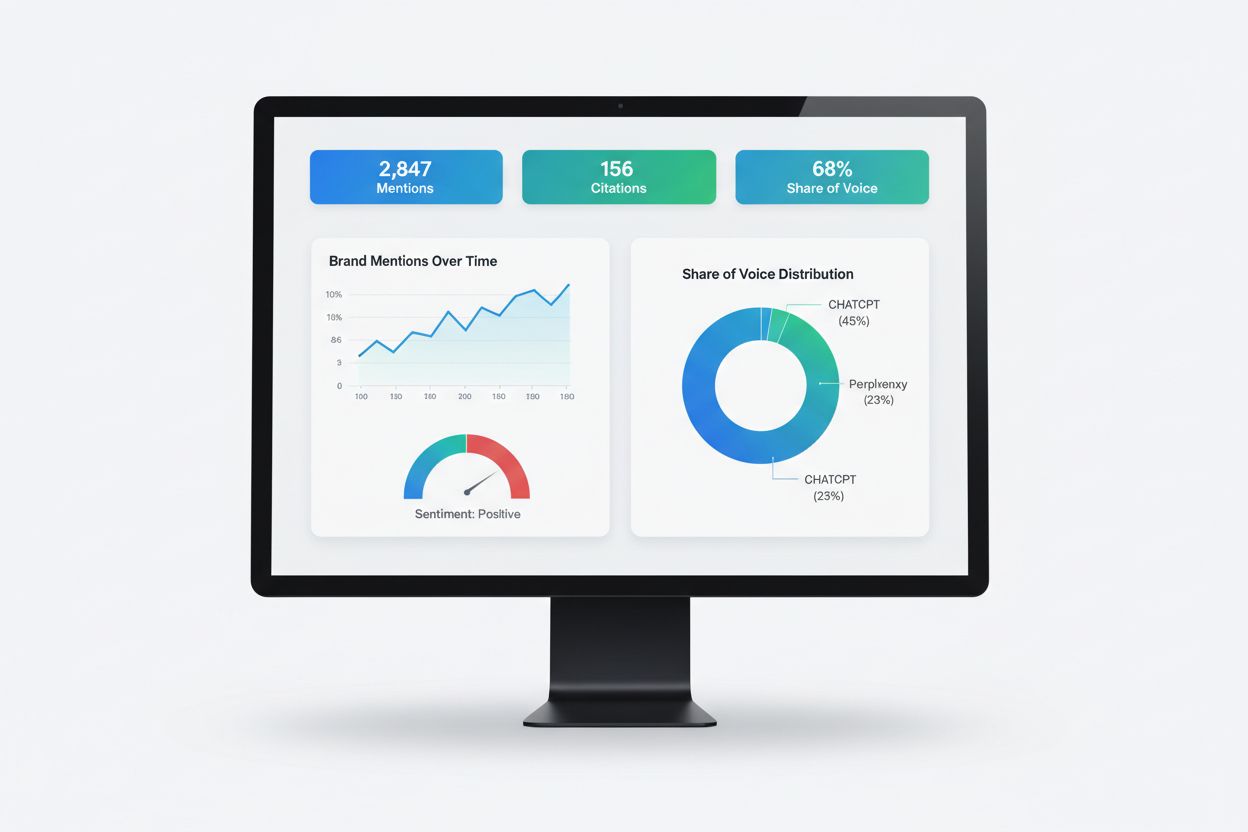
AI search reports are comprehensive analytics documents that track how your brand, products, and content appear in responses generated by artificial intelligence answer engines like ChatGPT, Perplexity, Google Gemini, Claude, and Microsoft Copilot. Unlike traditional SEO reports that focus on search engine rankings and click-through rates, AI search reports measure whether your brand gets mentioned at all when users ask relevant questions to AI systems. These reports have become essential because 58% of consumers have replaced traditional search engines with generative AI tools for product recommendations and information discovery. Creating effective AI search reports requires understanding the unique metrics that matter in the AI era, including brand mention frequency, citation rates, share of voice, and cross-platform performance across multiple AI engines.
Before you can create meaningful AI search reports, you need to establish a solid monitoring foundation. The first critical step is identifying your core prompts—these are the natural language questions that your target audience actually asks AI systems. Unlike traditional keyword research that focuses on search terms, prompt research centers on conversational questions people type into ChatGPT or Perplexity. For example, instead of tracking “best CRM software,” you would track “What’s the best CRM for small businesses?” or “Which CRM integrates with Slack?” These prompts should be organized into semantic clusters based on topics and user intent. You should aim to create 20 to 50 core prompts that represent your primary business areas, product categories, and competitive positioning. Document these prompts in a structured format, grouping related questions together so you can analyze performance by topic cluster rather than individual queries.
Next, you need to select which AI platforms to monitor. The major platforms worth tracking include ChatGPT (with 800+ million weekly users), Google AI Overviews (appearing on billions of searches), Perplexity (growing rapidly for research queries), Claude (increasingly integrated into applications), and Microsoft Copilot (embedded in Windows and Microsoft products). Each platform pulls from different data sources and uses distinct retrieval methods, meaning your brand might be visible in ChatGPT but completely absent from Perplexity. A comprehensive AI search report should cover all major platforms to give you a complete picture of your visibility landscape. Some platforms also offer geographic variations, so if you serve multiple markets, you should track visibility by country and language to understand regional performance differences.
| Metric | Definition | Why It Matters | How to Measure |
|---|---|---|---|
| Brand Mention Frequency | How often your brand appears in AI-generated answers | Shows overall visibility and recognition | Count mentions across tracked prompts monthly |
| Citation Rate | Percentage of answers that cite your website as a source | Indicates content authority and trustworthiness | Track which URLs appear in AI responses |
| Share of Voice (SOV) | Your brand mentions compared to competitors | Reveals competitive positioning | Compare your mentions to top 3-5 competitors |
| Citation Sources | Which external sites AI references alongside your brand | Shows authority signals AI recognizes | Analyze domains cited in answers mentioning you |
| Sentiment Analysis | How AI describes your brand (positive, neutral, negative) | Reveals brand perception in AI answers | Analyze language and context of mentions |
| Platform Performance | Visibility differences across ChatGPT, Perplexity, Gemini, etc. | Identifies platform-specific opportunities | Track metrics separately by platform |
| Geographic Variation | How visibility differs by country or region | Shows market-specific performance | Monitor by location if serving multiple markets |
| Trend Analysis | Month-over-month changes in visibility metrics | Indicates whether optimization efforts work | Compare metrics across reporting periods |
The most critical metric is citation frequency—how often your website actually appears as a source in AI-generated answers. This is the AI-era equivalent of earning a backlink, except it directly shapes what millions of users see. A brand that gets mentioned 100 times but cited only 5 times has a visibility problem that needs addressing. Your share of voice metric reveals whether you’re gaining or losing ground against competitors. If competitors appear in 60% of relevant AI responses while you appear in only 15%, that gap represents significant lost opportunity. Sentiment analysis is equally important because AI doesn’t just mention brands—it characterizes them. Understanding how AI describes your business helps identify perception gaps and optimization opportunities.
To create your first AI search report, start by running an initial visibility audit across your tracked prompts on all major AI platforms. This baseline measurement shows where you stand before any optimization efforts. Document for each prompt: whether your brand appears, whether your website is cited, what position you occupy in the answer (first mention, middle, or end), and what sentiment surrounds the mention. This audit typically takes 2-4 weeks to complete manually, which is why most brands use specialized monitoring platforms that automate this process. Once you have baseline data, organize your findings into sections covering each AI platform separately, then create a summary section showing aggregate metrics across all platforms.
Your report should include competitive benchmarking that shows how your visibility compares to your top 3-5 competitors. For each tracked prompt, note which competitors appear, whether they’re cited, and how their positioning differs from yours. This competitive analysis reveals where you’re winning and where you’re losing ground. Create a section highlighting quick wins—prompts where you’re close to visibility or where small content improvements could earn citations. These quick wins should be your first optimization targets because they require less effort than building visibility from scratch. Include a gap analysis section identifying prompts where competitors appear but you don’t, as these represent your biggest opportunities for growth.
Manual AI search reporting becomes impractical once you’re tracking more than a handful of prompts. Automated monitoring platforms handle the heavy lifting by continuously checking your tracked prompts across all major AI engines, capturing responses, analyzing mentions and citations, and compiling data into dashboards and reports. These platforms use sophisticated techniques to ensure accuracy, including statistical sampling (since AI responses can vary slightly between queries) and consistent monitoring across different times of day and geographic locations. Most platforms offer weekly or monthly automated reports that you can customize to focus on the metrics most important to your business.
When selecting an automation platform, look for features that matter for your reporting needs. Prompt library management allows you to organize and test prompt sets before full deployment, grouping related questions into clusters for easier analysis. Citation source tracking shows not just whether you’re mentioned, but which external sites AI references alongside your brand—this reveals which authority signals AI recognizes. Competitor benchmarking automatically compares your metrics against rivals, saving hours of manual analysis. GA4 integration ties AI visibility data to actual website traffic, showing which AI referrals convert and which don’t. Sentiment tracking analyzes the language AI uses when mentioning your brand, helping you understand perception. Geographic and model audits show how your performance varies by location and AI platform version.
Understanding what your AI search report data actually means is crucial for taking effective action. High visibility with low citations suggests your brand gets mentioned but your content isn’t structured in ways AI engines prefer. This typically means you need to strengthen your content with statistics, expert quotes, clear source attribution, and structured data markup. Strong performance on one platform but weak on others indicates that different AI engines draw from different data sources. If you’re visible in ChatGPT but absent from Perplexity, investigate which sources each platform favors and adjust your distribution strategy accordingly. Declining visibility over time signals that competitors are creating more citation-worthy content or your existing content is becoming stale. AI systems continually retrain on new data, so regular content updates and fresh publishing are essential.
Competitor visibility gaps represent your biggest opportunities. When you spot queries where competitors appear but you don’t, you’ve identified prompts worth targeting. Analyze what makes their content citation-worthy—do they have more statistics, better structure, stronger authority signals? Then create competing assets that match or exceed their quality. Sentiment shifts deserve investigation too. If AI’s description of your brand becomes more negative or neutral, something has changed in how your brand is being discussed online. This might indicate a PR issue, negative reviews gaining prominence, or simply that your brand narrative isn’t being effectively communicated.
Your AI search reports should directly inform your optimization strategy. Start with semantic footprint expansion—cover your core topics thoroughly, including adjacent concepts and related questions users are likely to ask. If you’re a project management tool, don’t just optimize for “best project management software” but also “project management for remote teams,” “project management for agencies,” and “project management integrations.” This broader coverage increases the chances AI systems recognize your brand as relevant across multiple contexts. Increase fact density in your content because AI platforms prefer content packed with statistics, research findings, and verifiable details. Research shows that adding citations and quotes to content boosts AI visibility by more than 40%.
Optimize for structure by using clear headers, TL;DR summaries, FAQ sections, and bullet points. AI engines often pull structured content directly into their answers, so formatting matters significantly. Build entity authority by keeping your brand’s information consistent across trusted sources that AI platforms rely on—Wikipedia, industry directories, review sites, and authoritative databases. Create content that AI systems can easily understand and cite, focusing on answer-first formats that directly address the questions in your tracked prompts. Your AI search reports should show which content pieces are getting cited most frequently; double down on those formats and topics while reworking underperforming content.
Determine how frequently you need to generate AI search reports based on your business needs and optimization pace. Weekly reports work best if you’re actively testing new content and optimization strategies, allowing you to quickly see whether changes are working. Monthly reports provide a good balance for most brands, giving enough time for visibility changes to stabilize while keeping you informed of trends. Quarterly reports work for brands with slower content cycles or those just starting their AI optimization journey. Your reporting cadence should align with your content publishing schedule—if you publish new content weekly, weekly reports make sense; if you publish monthly, monthly reports are sufficient.
Include trend analysis in every report, comparing current metrics to previous periods. Month-over-month changes reveal whether your optimization efforts are working or whether you need to adjust your strategy. Track not just absolute numbers but also velocity—is your share of voice growing faster than competitors? Are your citations increasing while mentions stay flat? These trends matter more than individual data points. Create alert thresholds that trigger investigation when metrics change significantly. If your share of voice drops 10% in a month, that’s worth investigating. If a competitor suddenly appears in prompts where they weren’t before, understand why.
Effective AI search reports need to reach the right stakeholders in your organization. Content teams need to understand which prompts they should target and what content formats work best. Marketing teams need visibility metrics to understand whether AI search is driving meaningful traffic and conversions. Executive leadership needs high-level summaries showing competitive positioning and business impact. Product teams benefit from understanding how AI describes your product and what features get highlighted. Create different report versions for different audiences rather than sending the same detailed report to everyone. Executive summaries should focus on key metrics and competitive positioning; detailed reports should go to teams doing the actual optimization work.
Use your AI search reports to build internal alignment around AI search optimization as a strategic priority. Show how visibility in AI answers directly impacts brand discovery and customer acquisition. Demonstrate that brands ignoring AI search visibility risk losing discovery opportunities as more users rely on AI for recommendations. Use competitive benchmarking data to create urgency—if competitors are gaining ground in AI visibility, your organization needs to act. Make AI search reporting a regular part of your marketing rhythm, discussing findings in team meetings and using insights to inform content strategy and resource allocation.
Volatility is the biggest challenge in AI search reporting. LLM outputs and prompt rankings change frequently, sometimes dramatically, making it difficult to establish stable baselines. A prompt that shows your brand in 80% of answers one week might show you in only 40% the next week. This volatility is normal and doesn’t necessarily indicate a problem with your optimization efforts. Focus on trends over multiple weeks rather than reacting to single-week fluctuations. Blind spots are another challenge—not every prompt you track will show your brand, and that gap is actually where your opportunity lives. Don’t get discouraged by low visibility on some prompts; instead, use those gaps to identify content you need to create.
Attribution challenges arise because GA4 referral tracking isn’t always perfect with AI systems. Some AI traffic might not be properly attributed, making it difficult to prove ROI. Work with your analytics team to set up proper tracking for AI referrals, using UTM parameters and custom segments. False metrics can mislead you if you focus on vanity numbers rather than meaningful impact. A high mention count means nothing if those mentions don’t drive citations or traffic. Focus on metrics that directly impact your business—citations, traffic, and conversions matter more than raw mention counts. Hallucinations where AI makes up information about your brand or competitors also occur, requiring human review of significant changes before taking action.
Get real-time visibility into how your brand appears in ChatGPT, Perplexity, Gemini, and other AI answer engines. Track mentions, citations, and share of voice with AmICited's comprehensive monitoring platform.
Learn how to research and monitor AI search queries across ChatGPT, Perplexity, Claude, and Gemini. Discover methods to track brand mentions and optimize for AI...
Learn what AI visibility reporting is, how it works, and why it's essential for monitoring your brand's presence in ChatGPT, Perplexity, Google AI Overviews, an...
Discover the best tools to find AI search topics, keywords, and questions people ask in AI search engines like ChatGPT, Perplexity, and Claude. Learn which tool...