
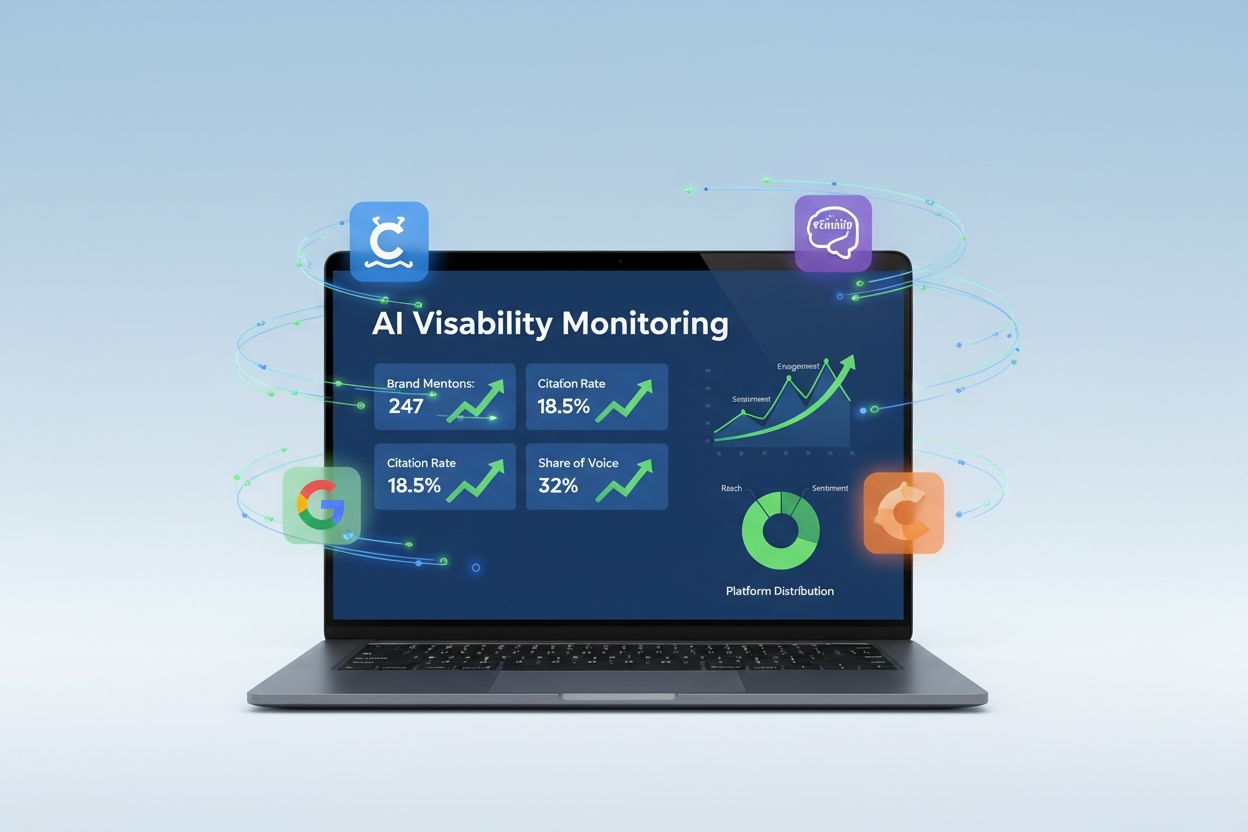
The AI Visibility Starter Kit: Essential Resources and Tools
Learn essential AI visibility resources and tools for beginners. Discover how to monitor your brand in ChatGPT, Perplexity, and Google AI Overviews with our com...
8 min read

Learn how to create effective how-to guides for AI visibility monitoring. Discover strategies for Answer Engine Optimization, content structuring, and tracking your brand across AI search platforms.
Create how-to guides for AI visibility by establishing clear baselines, optimizing content with structured data and semantic clarity, and implementing iterative monitoring across AI platforms like ChatGPT, Perplexity, and Google AI Overviews.
AI visibility refers to how frequently your brand, content, and products appear in responses generated by AI search engines and answer generators like ChatGPT, Perplexity, Google AI Overviews, Claude, and Microsoft Copilot. Unlike traditional search engine optimization that focuses on ranking positions in blue link results, AI visibility is about becoming the trusted source cited directly within AI-generated answers. Creating effective how-to guides for AI visibility requires understanding that these AI systems don’t simply rank pages—they parse content into smaller, structured pieces and assemble them into comprehensive answers. Your how-to guides must be designed not just for human readers, but for AI systems to easily extract, understand, and recommend your content.
The shift from traditional SEO to Answer Engine Optimization (AEO) and Generative Engine Optimization (GEO) means your how-to guides need to be structured differently. AI systems evaluate content based on clarity, structure, and semantic meaning rather than keyword density. When creating how-to guides for AI visibility, you’re essentially creating content that AI systems can confidently parse, verify, and surface to users asking specific questions. This requires a fundamental shift in how you approach content creation, from keyword-focused writing to intent-focused, semantically clear content that directly answers user questions.
Before creating how-to guides, you need to understand your current position in AI search results. Establishing a baseline means documenting where your brand currently appears (or doesn’t appear) across major AI platforms. Start by manually querying your most important keywords in AI-enabled search environments like Google with AI Overviews enabled, ChatGPT, Perplexity, and Claude. Document every instance where your brand is cited, where competitors appear, and which sources the AI pulls from. This manual audit provides invaluable qualitative context about how AI systems currently perceive your brand and content.
Once you have this initial snapshot, you need a scalable way to monitor it. Your options range from manual spot-checking (cost-effective but not scalable) to automated AEO platforms (professional-grade solutions that track thousands of queries across different models and locations). Automated platforms parse AI-generated answers to track your citation frequency, share of voice within answers, and even the sentiment of mentions. The goal is to select a monitoring method that gives you consistent data on key metrics: citation volume, competitor citation frequency, and which specific content assets are performing best. This baseline becomes your benchmark against which all future optimization efforts will be measured.
AI systems don’t read content the way humans do. They break pages into smaller, modular pieces through a process called parsing. These individual pieces are then ranked and assembled into answers. To create how-to guides that AI systems can effectively use, you must structure your content with clear, hierarchical organization. Start with a compelling page title that clearly summarizes what the guide delivers, using natural language that aligns with search intent. Your H1 tag (the top-level HTML heading) should match or closely reflect the page title while setting clear expectations for what follows.
Use H2 and H3 tags to break your guide into logical sections, with each heading acting like a chapter title that defines clear content slices. Instead of vague headings like “Learn More,” use specific, question-based headings such as “What Are the Key Steps to Monitor Your Brand in ChatGPT?” This approach helps AI systems understand where one idea ends and another begins. Incorporate Q&A formats that directly mirror how people search—AI assistants can often lift these question-and-answer pairs word for word into their generated responses. Use bulleted lists and numbered steps to break complex procedures into clean, reusable segments, and include comparison tables to present information in structured formats that AI can easily parse and repurpose.
| Element | Purpose | Example |
|---|---|---|
| Page Title | Signals content purpose | “How to Monitor Your Brand in AI Search Engines” |
| H1 Tag | Main headline | “Complete Guide to AI Brand Visibility Monitoring” |
| H2 Headings | Major sections | “Setting Up Your Baseline Metrics” |
| H3 Headings | Subsections | “Choosing Between Manual and Automated Tracking” |
| Q&A Blocks | Direct answers | Q: “How often should I check AI visibility?” A: “Weekly for priority keywords, monthly for broader analysis” |
| Lists | Step-by-step procedures | 1. Identify keywords 2. Query AI platforms 3. Document results |
| Tables | Comparisons | Comparison of AI platforms and their citation patterns |
Semantic clarity is about more than just word choice—it’s how you phrase, format, and punctuate content so AI systems can interpret your how-to guides with confidence. AI systems don’t just scan for keywords; they look for clear meaning, consistent context, and clean formatting. Write for user intent rather than just keywords, using phrasing that directly answers the questions users ask. Avoid vague language like “innovative” or “cutting-edge” without specifics. Instead, anchor claims in measurable facts. For example, instead of saying “monitor your brand visibility,” say “track how often your brand appears in AI-generated answers across ChatGPT, Perplexity, and Google AI Overviews.”
Add context to every claim. A how-to guide should explain not just what to do, but why it matters and what results to expect. Use synonyms and related terms throughout your guide to reinforce meaning and help AI connect concepts. For instance, when discussing monitoring, use related terms like “track,” “measure,” “benchmark,” and “monitor” to help AI systems understand these concepts are interconnected. Keep punctuation simple and consistent; avoid decorative arrows, symbols, or long strings of punctuation that break parsing. Be cautious with em dashes—overuse can confuse sentence structure for machines. Use periods or semicolons instead. Avoid overloaded sentences that pack multiple claims into one line, as this makes it harder for both AI and readers to parse meaning.
In traditional search, snippets are short previews pulled from your page that appear in results. In AI search, the same principle applies—AI systems extract concise, “snippable” pieces of content and weave them into answers. Your how-to guides should be designed with snippet optimization in mind. Create concise answers that directly address questions in one to two sentences. Use structured formatting like lists, tables, and Q&A blocks that can be lifted cleanly from your content. Ensure your headings are strong and signal where complete ideas start and end. Write with self-contained phrasing where sentences make sense even when pulled out of context.
For example, instead of writing “The process involves several steps that we’ll explore in detail,” write “There are five key steps to monitoring AI visibility: establishing baselines, selecting platforms, creating tracking workflows, analyzing results, and iterating your strategy.” This self-contained approach makes your content immediately useful to AI systems that need to extract and repurpose individual sentences. Each section of your how-to guide should be able to stand alone while also contributing to the larger narrative. This dual approach ensures that whether an AI system uses your entire guide or just extracts specific sections, the content remains valuable and coherent.
Schema markup is a type of code that helps search engines and AI systems understand your content. It’s usually added in JSON-LD format as a script in the backend of your site, often through your CMS or by a developer inserting it into the page code. For how-to guides, use the HowTo schema to explicitly label your content structure. This schema allows you to mark up steps, images, and estimated time to complete. Use FAQPage schema if your guide includes frequently asked questions. Use Article schema to provide metadata about your guide including author, publication date, and description.
Schema transforms plain text into structured data that machines can interpret with confidence. When you mark up your how-to guide with proper schema, you’re essentially telling AI systems: “This is a how-to guide with these specific steps, this is the estimated time to complete it, and here’s who wrote it.” This structured information helps AI systems understand your content’s purpose and makes it more likely to be selected for relevant queries. Validate your schema markup using tools like Google’s Rich Results Test to ensure it’s properly implemented and recognized by search systems.
AI users ask longer, more specific questions and follow up with deeper queries than traditional search users. Your how-to guides should anticipate these multi-layered questions. Instead of just explaining “how to monitor AI visibility,” create guides that address specific scenarios: “How to monitor AI visibility for a SaaS product,” “How to track brand mentions in ChatGPT vs. Perplexity,” or “How to respond when your brand is misrepresented in AI answers.” This specificity helps your guides match the exploratory nature of AI queries, where users are trying to understand concepts deeply rather than just finding quick answers.
Consider the full user journey in AI search. Someone might start by asking “What is AI visibility?” then follow up with “How do I measure it?” and finally “What tools should I use?” Your how-to guides should be comprehensive enough to address this progression while remaining focused enough to be useful at each stage. Create guides that explain not just the “how” but the “why” and “when”—when should you monitor AI visibility, why does it matter for your business, and how does it differ from traditional SEO? This comprehensive approach positions your guides as authoritative resources that AI systems will confidently cite.
Creating how-to guides for AI visibility is not a one-time effort—it’s an iterative process where data informs continuous improvement. After publishing your guides, monitor how they perform in AI search results. Track which guides are being cited, in what context, and by which AI platforms. Use this data to identify gaps in your content strategy. If you notice that competitors’ guides are being cited more frequently for certain topics, analyze their content structure, depth, and approach. Then create guides that are demonstrably better, more comprehensive, and more trustworthy.
Schedule regular reviews—weekly or bi-weekly—of your AI visibility metrics. Ask critical questions: Where are we losing share of answer to competitors? Which of our recently published guides have been cited? Are there recurring questions where no brand is cited, representing a blue-ocean opportunity? Use the answers to guide your content calendar and optimization priorities. If a competitor consistently owns the answer for a high-value query, analyze their content structure, schema implementation, and source credibility. Then create a resource that is demonstrably better. This cycle of tracking, analyzing, optimizing, and tracking again is how you build and defend your position as an authoritative voice in AI search.
Creating effective how-to guides for AI visibility requires understanding that AI systems parse content differently than humans read it. Focus on creating unique, valuable content that directly answers user questions with semantic clarity and precise language. Structure your guides with clear hierarchies using H1, H2, and H3 tags, Q&A formats, lists, and tables that AI systems can easily parse. Implement schema markup to signal content structure and purpose. Optimize for snippet selection by creating concise, self-contained answers that can be lifted directly into AI-generated responses. Monitor your guides’ performance across multiple AI platforms and iterate based on data. Remember that traditional SEO fundamentals still matter—crawlability, metadata, and internal linking remain essential foundations. The difference is that AI visibility requires additional attention to content structure, semantic clarity, and the ability for AI systems to confidently extract and repurpose your content. By following these principles, your how-to guides will be better positioned to appear in AI-generated answers, driving visibility and authority for your brand across the evolving landscape of AI search.
Start tracking how your brand appears in AI-generated answers across ChatGPT, Perplexity, Google AI Overviews, and other AI search engines. Get real-time insights into your AI visibility performance.
Learn essential AI visibility resources and tools for beginners. Discover how to monitor your brand in ChatGPT, Perplexity, and Google AI Overviews with our com...

Learn the essential skills AI visibility professionals need: technical expertise, content strategy, data analysis, and continuous learning. Master GEO and AI mo...
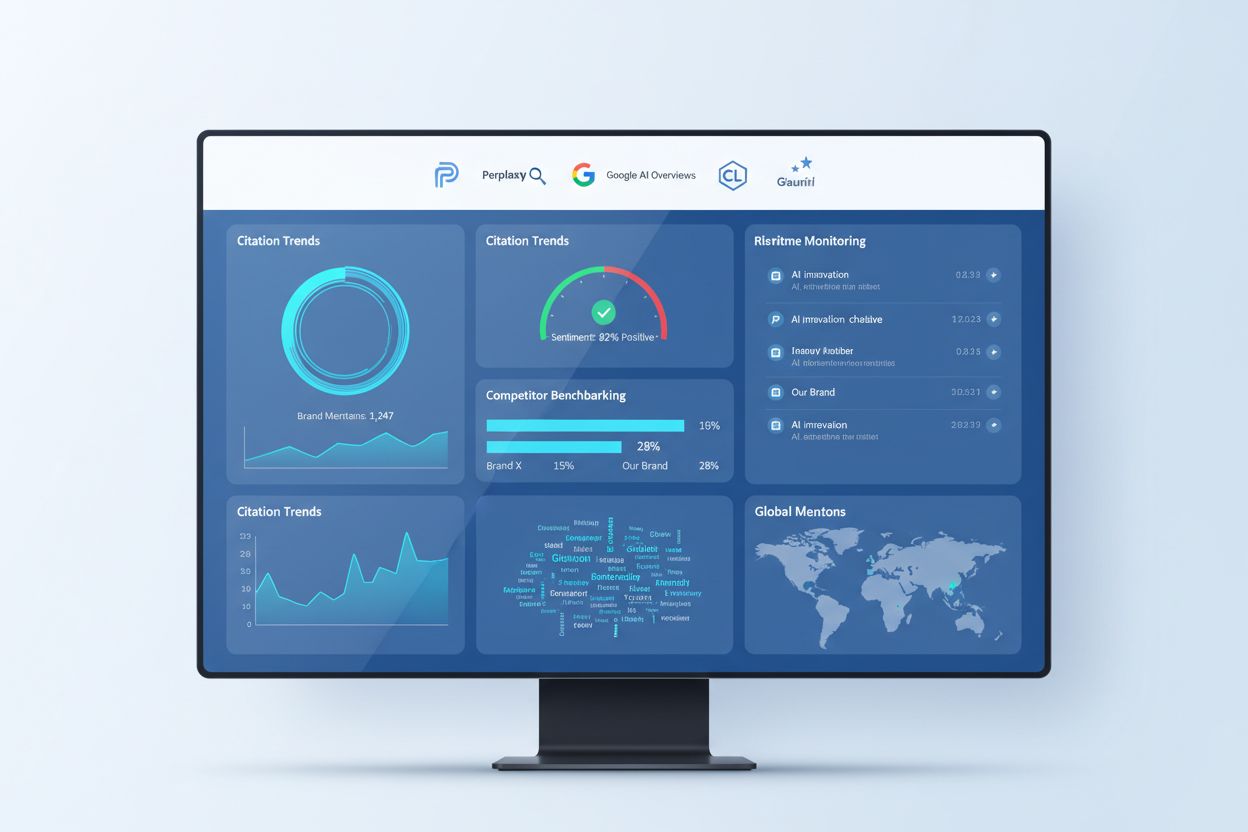
Discover critical features to look for in AI visibility software. Compare GEO tools, learn about citation tracking, sentiment analysis, and competitor benchmark...