
Pillar Page
Learn what a pillar page is, how it differs from cluster pages, and why it's essential for SEO strategy. Discover how pillar pages build topical authority and i...
11 min read

Learn how to create pillar pages optimized for AI search engines like ChatGPT, Perplexity, and Google AI Overviews. Comprehensive guide to building topical authority and earning AI citations.
Create pillar pages by selecting a broad topic, conducting keyword research, building comprehensive content (3,000-5,000+ words) with clear structure, implementing schema markup, and interlinking to cluster pages. Optimize for AI comprehension with answer-first architecture, structured formatting, and multi-platform visibility to ensure your content gets cited by ChatGPT, Perplexity, and Google AI Overviews.
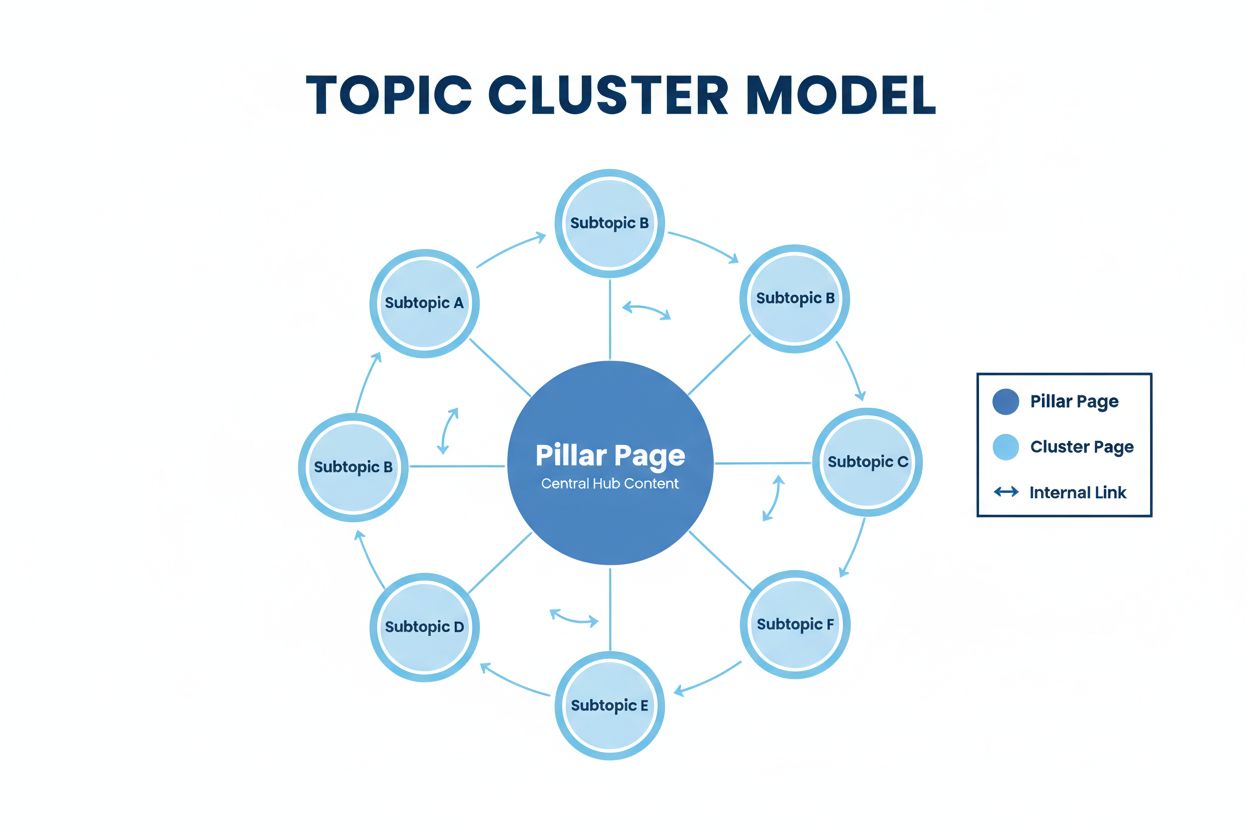
Pillar pages are comprehensive, in-depth content pieces that serve as the foundation for a specific topic or subject area on your website. In the context of AI search optimization, pillar pages have become even more critical because they signal topical authority to AI language models like ChatGPT, Perplexity, and Claude. A pillar page acts as a central hub that links to more detailed content on related subtopics, known as cluster pages, creating a structured content ecosystem that both users and AI systems can easily navigate and understand.
The fundamental difference between traditional pillar pages and those optimized for AI search lies in how they’re structured and presented. While traditional SEO pillar pages focus on ranking for broad keywords in Google’s search results, AI-optimized pillar pages must be designed for comprehension by large language models. This means they need clear answer-first architecture, structured data markup, and content that directly addresses questions users ask AI systems. The stakes are higher now because 65% of searches end without a click, and that number is projected to reach 70% by 2025, meaning visibility in AI-generated answers is becoming more valuable than traditional click-through traffic.
Creating pillar pages specifically for AI search is essential because AI models don’t rank content the way Google does. Instead, they cite and reference authoritative sources when generating answers. When someone asks ChatGPT “What are the best practices for remote team collaboration?” or searches Perplexity for industry insights, the AI system pulls from multiple sources to synthesize an answer. If your pillar page is comprehensive, well-structured, and recognized as authoritative, your brand gets mentioned in that AI-generated response—even if the user never clicks through to your website.
| Aspect | Traditional SEO | AI Search Optimization |
|---|---|---|
| Primary Goal | Rank web pages in search results | Get cited in AI-generated answers |
| Success Metric | Click-through traffic | Brand mentions and citations |
| Content Structure | Keyword-focused with internal links | Answer-first with structured data |
| Authority Signals | Backlinks and domain authority | E-E-A-T (Expertise, Experience, Authoritativeness, Trustworthiness) |
| Optimization Target | Google’s algorithm | LLM comprehension and parsing |
| Time to Impact | Weeks to months | Immediate to weeks |
The business impact of this shift is profound. Pillar pages that earn AI citations become brand-building assets at scale. When your company is consistently mentioned as the authoritative source across ChatGPT, Perplexity, and Google AI Overviews, you’re building recognition and trust with potential customers before they even visit your website. This is particularly valuable for B2B companies, SaaS platforms, and thought leaders who want to establish themselves as industry experts.
The foundation of any successful pillar page starts with selecting the right topic. Your pillar topic should be broad enough to support multiple cluster pages but specific enough to have clear intent. Rather than choosing a topic based on intuition, validate it using data from multiple sources. Start by analyzing your existing content performance using Google Analytics and Google Search Console. Look for pages that attract significant organic traffic but have high bounce rates—these indicate topics where users are searching for more comprehensive information than what you currently provide.
Next, conduct SERP reverse engineering by entering your potential topic into Google and analyzing the top-ranking results. Pay attention to what formats dominate (guides, tools, templates, comparisons), what questions appear in the “People Also Ask” section, and what subtopics competitors are covering. This research reveals what Google—and by extension, what AI models trained on web data—associates with your topic. Use keyword research tools like Semrush or Ahrefs to identify search volume and keyword difficulty for your potential pillar topic. A strong pillar topic typically has 5,000+ monthly searches and supports at least 8-12 distinct cluster page topics.
For AI search specifically, validate that your topic has multi-platform relevance. Check if people are asking about this topic on Reddit, Quora, LinkedIn, and in industry forums. AI models are trained on diverse web content, so topics with broad discussion across multiple platforms are more likely to be referenced in AI-generated answers. Additionally, ensure your topic aligns with your business goals and customer needs. The best pillar topics solve real problems your audience faces and naturally lead to conversions or customer engagement.
Once you’ve selected your pillar topic, conduct layered keyword research to identify both your primary pillar keyword and secondary keywords for cluster pages. Your primary pillar keyword should be the broadest term that captures the essence of your topic. For example, if your pillar topic is “content marketing strategy,” your primary keyword might be “content marketing” or “how to create a content marketing strategy.” This keyword should have substantial search volume (ideally 5,000+ monthly searches) and represent the core concept you want to own.
For cluster page keywords, use Google’s “People Also Ask” section and “Related Searches” to identify long-tail keywords that support your pillar topic. These cluster keywords should be more specific than your pillar keyword and address distinct subtopics. For instance, if your pillar is about content marketing, cluster keywords might include “content marketing tools,” “how to write a content brief,” “content calendar templates,” or “measuring content ROI.” Each cluster keyword should have clear search intent and ideally support a standalone article that provides unique value.
When researching keywords for AI search optimization, pay special attention to question-based keywords. AI models are trained on question-answer pairs, so keywords phrased as questions (like “What is content marketing?” or “How do I measure content marketing ROI?”) are particularly valuable. These question-based keywords align naturally with how people interact with AI systems. Additionally, identify semantic variations of your keywords—related terms and phrases that convey similar meaning. AI models understand semantic relationships, so including these variations throughout your content helps the model recognize your page as authoritative on the topic.
The structure of your pillar page is critical for both user experience and AI comprehension. Unlike traditional blog posts, AI-optimized pillar pages require answer-first architecture. This means your opening paragraph should directly answer the main question your pillar page addresses, typically within the first 50-100 words. Don’t bury your key insight in paragraph six—lead with it. For example, if your pillar is about “content marketing strategy,” your opening should immediately define what content marketing strategy is and why it matters, before diving into detailed explanations.
Organize your pillar page using a clear hierarchical heading structure with H1 for the main title, H2 for major sections, and H3 for subsections. Each heading should be descriptive and ideally phrased as a question or statement that answers a specific user query. This structure serves multiple purposes: it helps users quickly scan and navigate your content, it signals to search engines the semantic relationships between different sections, and it makes it easier for AI models to parse and extract relevant information. Include a sticky table of contents with anchor links that allows readers to jump to specific sections—this improves user experience and gives AI models a clear map of your content structure.
Break your content into scannable chunks with short paragraphs (2-3 sentences maximum), bullet points, and numbered lists. AI models process structured data more effectively than dense paragraphs, so formatting matters significantly. Use bold text to highlight important keywords and concepts—this helps both users and AI systems identify key information. Incorporate tables and comparison matrices to present complex information in structured formats. For example, if comparing different content marketing tools, a table with features, pricing, and use cases is far more useful to AI systems than paragraph descriptions.
Your pillar page content should be 3,000 to 5,000+ words of high-quality, original information. This length allows you to cover your topic comprehensively while providing enough depth to establish authority. However, word count alone doesn’t guarantee quality—focus on providing genuine value that goes beyond what competitors offer. Start by researching what competitors have published on similar topics, then identify gaps in their coverage. Your pillar page should address these gaps with original insights, data, case studies, or perspectives that competitors haven’t covered.
Original research and data are particularly valuable for AI citations. When you include original statistics, survey results, or case studies in your pillar page, you create unique information that AI models will reference. For instance, if you conduct a survey of 500 marketing professionals about their content strategy challenges, that original data becomes a valuable asset that other sources will cite, and AI models will recognize as authoritative. Include named authors with clear credentials on your pillar page. AI models evaluate credibility by looking at author expertise, so including author bios with relevant experience, certifications, or credentials strengthens your page’s authority signals.
Ensure your content is thoroughly researched and fact-checked. Cite reputable sources, link to authoritative external resources, and back up claims with data. AI models are trained to recognize patterns of credibility, and pages that demonstrate rigorous research are weighted higher in generative responses. Additionally, maintain consistent voice and perspective throughout your pillar page. If you’re writing about a technical topic, maintain a professional, educational tone. If you’re writing about a lifestyle topic, you can be more conversational. Consistency helps AI models understand your content’s context and intent.
Schema markup is essential for AI search optimization. Implement relevant structured data that helps AI models understand your content’s context and relationships. For pillar pages, the most important schema types include:
Additionally, implement HowTo schema if your pillar page provides step-by-step instructions, and Product schema if you’re comparing or reviewing products. These structured data types help AI models understand the specific type of content you’re providing and extract relevant information more accurately. The more structured data you provide, the better AI models can parse and cite your content.
A pillar page’s power comes from its connection to cluster pages. Create 8-12 focused cluster pages that cover subtopics related to your pillar. Each cluster page should target a specific long-tail keyword and provide detailed coverage of that subtopic. For example, if your pillar is “content marketing strategy,” your cluster pages might cover “content marketing tools,” “how to create a content calendar,” “SEO for content marketing,” “B2B vs B2C content strategy,” and similar topics.
Implement bidirectional internal linking between your pillar and cluster pages. From the pillar page, link to each cluster page using descriptive anchor text that includes relevant keywords. For example, instead of linking with “click here,” use anchor text like “learn how to create an effective content calendar” or “explore the best content marketing tools.” Each cluster page should link back to the pillar page using consistent, descriptive anchor text. This bidirectional linking structure signals to search engines and AI models that your pillar page is the authoritative hub for this topic cluster.
When linking, use contextual anchor text that naturally fits within your content. AI models understand context, so links that flow naturally within sentences are more valuable than forced keyword insertions. Additionally, ensure your URL structure reflects your content hierarchy. Use clean, descriptive URLs like /content-marketing/strategy/ for your pillar and /content-marketing/tools/ for cluster pages. This URL structure helps both users and AI systems understand the relationship between pages.
AI models don’t just pull from your website—they’re trained on content from across the entire web. To maximize your pillar page’s visibility in AI-generated answers, build an ecosystem of authority across multiple platforms. Publish guest articles on reputable industry publications that link back to your pillar page. Get quoted in relevant industry news and publications. Create LinkedIn articles that discuss the same topic as your pillar page. Publish videos on YouTube covering your pillar topic. Participate in relevant Reddit discussions and Quora answers, linking to your pillar page when appropriate.
This multi-platform approach serves multiple purposes. First, it increases the number of places where your brand and content appear, making it more likely that AI models will encounter your content during training or retrieval. Second, it creates multiple citation opportunities—when other sources reference your pillar page or mention your brand in the context of your topic, AI models recognize this as a credibility signal. Third, it builds topical authority signals across the web. When AI models see your brand consistently associated with your pillar topic across multiple authoritative platforms, they’re more likely to cite you as the expert source.
After publishing your pillar page, monitor its performance using tools like Google Search Console, Google Analytics, and emerging AI visibility tracking tools like AthenaHQ or Goodie AI. Track metrics including organic traffic, keyword rankings, bounce rate, average time on page, and scroll depth. For AI search specifically, monitor how often your brand appears in AI-generated answers. Some tools now provide AI visibility scores that show how frequently your content is cited across different AI platforms.
Update your pillar page regularly to maintain its relevance and authority. Set a schedule to review and refresh your content at least quarterly. Update statistics with the latest data, add new examples and case studies, incorporate emerging trends in your industry, and refresh visual elements. When you update your pillar page, update the publication date and add a note indicating what was updated. This signals to both users and AI models that your content is current and actively maintained. Additionally, as you create new cluster pages or discover new subtopics, add links to these new resources from your pillar page.
While the fundamentals of pillar page creation remain similar, optimizing specifically for AI search requires some adjustments. Traditional SEO pillar pages focus on ranking for broad keywords in Google’s search results, emphasizing backlinks, keyword density, and click-through optimization. AI-optimized pillar pages prioritize comprehension by language models, emphasizing clear structure, original research, author credibility, and multi-platform visibility. AI-optimized pages benefit from being more answer-focused and question-driven, while traditional SEO pages can be more keyword-focused.
Additionally, AI-optimized pillar pages should include more structured data and schema markup than traditional pages. They should also prioritize original research and unique data more heavily, as AI models recognize and cite original information more readily than summarized content. Finally, AI-optimized pillar pages benefit from cross-platform promotion more than traditional pages, since AI models are trained on diverse web content rather than just ranking based on on-page factors.
One critical mistake is burying your answer in lengthy introductions. AI models need to quickly identify the core answer to your pillar page’s main question. Start with a direct, concise answer in your opening paragraph. Another mistake is neglecting schema markup. While traditional SEO can succeed without perfect schema implementation, AI models rely heavily on structured data to understand your content. Implement comprehensive schema markup for your pillar page and cluster pages.
Many creators also make the mistake of creating pillar pages without cluster support. A pillar page’s power comes from its connection to detailed cluster pages. If you publish a pillar page without supporting cluster content, you’re missing the opportunity to build topical authority. Additionally, avoid inconsistent author information. If your pillar page lists an author, ensure that author has a clear bio with credentials. Inconsistent or missing author information weakens your credibility signals to AI models.
Finally, don’t make the mistake of publishing and forgetting. Pillar pages require ongoing maintenance and updates. Outdated information damages your credibility with both users and AI models. Set a schedule to review and refresh your pillar pages regularly, and promote updates across your marketing channels to signal that your content is actively maintained and current.
Track how often your content appears in AI-generated answers across ChatGPT, Perplexity, and Google AI Overviews. Ensure your pillar pages are being cited and your brand maintains visibility in the AI search era.
Learn what a pillar page is, how it differs from cluster pages, and why it's essential for SEO strategy. Discover how pillar pages build topical authority and i...

Community discussion on pillar pages and topic clusters for AI search visibility. Real experiences from content strategists on whether the traditional pillar mo...
Learn how to optimize tag pages for AI search engines like ChatGPT, Perplexity, and Google AI Mode. Discover technical SEO strategies, content structure best pr...