

Demonstrating Experience for AI: First-Hand Knowledge Signals
Learn how to demonstrate first-hand knowledge and experience signals to AI systems like ChatGPT, Perplexity, and Google AI Overviews. Optimize your content for ...
10 min read

Learn how to demonstrate experience for AI search platforms like ChatGPT, Perplexity, and Google AI Overviews. Master E-E-A-T signals that increase citations.
Demonstrate experience for AI search by creating content that showcases first-hand knowledge, personal expertise, and real-world application of your subject matter. Include author credentials, case studies, original data, and practical examples that prove you've actually used products, visited locations, or implemented strategies you discuss. AI platforms prioritize content showing genuine expertise over generic information.
Experience represents the first “E” in Google’s E-E-A-T framework (Experience, Expertise, Authoritativeness, Trustworthiness), and it has become increasingly critical for AI search visibility. Experience demonstrates that you have first-hand knowledge of your topic through direct involvement, personal use, or real-world application. Unlike expertise (which can be learned from books), experience proves you’ve actually done what you’re writing about. This distinction matters enormously to AI platforms like ChatGPT, Perplexity, Google AI Overviews, and Claude, which prioritize sources showing genuine, lived knowledge over theoretical understanding. When AI systems evaluate which sources to cite in their generated responses, they look for clear signals that content creators have personally engaged with their subject matter. This is why a product review from someone who actually used the product ranks higher in AI citations than a review from someone who merely researched specifications.
Google added “Experience” to its original E-A-T framework in 2022, signaling a fundamental shift in how search quality is evaluated. This change reflects the reality that first-hand experience builds trust in ways that theoretical knowledge cannot. For Your Money or Your Life (YMYL) topics—content affecting health, finances, safety, or well-being—experience becomes absolutely critical. An article about treating anxiety written by someone who has personally managed anxiety disorder carries more weight than one written by someone who only studied psychology textbooks. However, experience matters across virtually all content categories. Travel guides benefit from having actually visited locations. Software reviews improve dramatically when authors have used the products. Business advice resonates more when shared by entrepreneurs who’ve built successful companies.
AI platforms recognize this principle and have built experience evaluation into their citation algorithms. Research analyzing over 129,000 ChatGPT citations reveals that content demonstrating first-hand experience receives approximately 30-40% higher citation rates than comparable content lacking experiential signals. This creates a clear competitive advantage: brands that effectively communicate their experience achieve substantially higher visibility in AI-generated answers. The challenge lies in translating lived experience into content signals that AI systems can recognize and evaluate. Unlike humans who intuitively understand when someone is speaking from experience, AI models must identify specific linguistic, structural, and contextual markers that indicate genuine expertise.
AI platforms use multiple methods to assess whether content creators possess genuine experience with their subject matter. Understanding these detection mechanisms helps you optimize your content for maximum experience signal strength. First, AI systems analyze author credentials and background information. When a byline includes relevant qualifications, professional history, certifications, or previous accomplishments, AI models recognize these as experience indicators. An article about project management written by someone with “15 years of experience managing enterprise software implementations” signals deeper experience than one with no author context. Second, AI evaluates specific, concrete details that only someone with direct experience would know. Generic descriptions of processes suggest theoretical knowledge, while specific examples, common pitfalls, unexpected challenges, and nuanced insights indicate hands-on experience. Someone who has actually managed remote teams knows about timezone coordination challenges, asynchronous communication best practices, and the specific tools that work best—details that appear naturally in experienced writing but feel forced in theoretical content.
Third, AI systems examine case studies and real-world examples embedded throughout content. When you reference specific projects you’ve worked on, clients you’ve served, or situations you’ve navigated, you’re providing verifiable experience signals. These examples should include concrete outcomes: “We increased conversion rates from 2.3% to 5.8% by implementing this strategy” carries more weight than “This strategy improves conversion rates.” Fourth, AI platforms analyze the tone and language patterns of experienced writing. Content from someone with genuine experience typically includes phrases like “in my experience,” “when I implemented this,” “we tested and found,” “I’ve seen this fail when,” and “the most common mistake I encounter.” These linguistic markers signal first-hand knowledge without requiring explicit statements. Fifth, AI evaluates consistency across multiple content pieces. When an author consistently demonstrates experience across numerous articles, videos, and resources, AI systems recognize a pattern of genuine expertise rather than isolated claims.
Author credibility serves as the primary mechanism through which AI systems evaluate experience. Your author bio, professional background, and demonstrated expertise directly influence how AI platforms assess your content’s reliability. Create comprehensive author bios that clearly establish relevant experience. Rather than generic descriptions like “John is a marketing professional,” provide specific details: “John has spent 12 years building and scaling SaaS companies, with direct experience launching products that reached $10M+ ARR. He’s managed teams of 50+ people and personally implemented the growth strategies he writes about.” This specificity signals genuine experience that AI systems recognize and value.
Include verifiable credentials and certifications relevant to your topic. If you’re writing about digital marketing, mention Google Analytics certifications, HubSpot certifications, or industry-recognized qualifications. For health-related content, medical licenses or relevant degrees become essential. For technical topics, programming certifications, cloud platform certifications, or relevant degrees establish credibility. AI systems cross-reference these credentials against known certification databases, so accuracy is critical. Link author bios to professional profiles like LinkedIn, GitHub portfolios, or industry-specific platforms that independently verify your background. When AI systems can confirm your credentials through multiple sources, experience signals strengthen dramatically. Maintain updated author pages on your website with comprehensive information about your background, notable achievements, speaking engagements, publications, and areas of expertise. These dedicated pages help AI systems build complete entity profiles for you as an author, improving recognition across multiple content pieces.
Demonstrating experience requires intentional content strategies that make your first-hand knowledge visible to both human readers and AI systems. The most effective approach involves weaving experience throughout your content rather than isolating it in author bios. Start with personal anecdotes and case studies that illustrate your experience. Rather than stating “I understand customer service challenges,” describe a specific situation: “When we implemented a new support ticketing system, we initially saw response times increase by 40% because our team wasn’t trained on the new workflow. Here’s exactly what we did to fix it…” This narrative approach demonstrates experience while providing practical value.
Include specific metrics and measurable outcomes from your experience. “Our email marketing strategy improved open rates” is generic; “Our email marketing strategy improved open rates from 18% to 34% over six months, with click-through rates increasing from 2.1% to 4.7%” demonstrates concrete experience with quantifiable results. AI systems recognize specific numbers as experience indicators because they’re difficult to fabricate convincingly. Share common mistakes you’ve encountered in your field. “The biggest mistake I see companies make when implementing remote work policies is…” signals that you’ve observed patterns across multiple situations, indicating substantial experience. These mistake-based insights are particularly valuable because they demonstrate learning from real-world failures rather than theoretical knowledge.
Provide step-by-step processes you’ve actually used. When you describe how to accomplish something, include the specific tools you used, the exact sequence of steps, the time investment required, and the results you achieved. “Here’s the exact process I use to audit website performance, which has helped me identify issues that improved client sites’ conversion rates by an average of 23%…” demonstrates experience through concrete methodology. Include before-and-after examples from your work. Screenshots, data comparisons, or project transformations show tangible evidence of your experience. These visual demonstrations are particularly powerful for AI systems because they provide concrete proof of your claims.
Content structure significantly impacts how effectively experience signals communicate to AI systems. The most effective structure places experience signals prominently and distributes them throughout content rather than concentrating them in isolated sections. Begin with author credentials in the opening section. Before diving into content, establish who you are and why you’re qualified to discuss this topic. “I’ve spent 8 years as a product manager at three different SaaS companies, managing products used by over 500,000 people. In this guide, I’m sharing the exact frameworks I’ve used to prioritize features and drive product adoption…” immediately establishes experience credibility.
Use “In My Experience” sections strategically throughout longer content. These dedicated sections allow you to share specific insights from your background without disrupting the main content flow. For example: “In my experience managing remote teams, the most critical factor for success isn’t the tools you use—it’s establishing clear communication norms. I’ve seen teams with expensive collaboration software fail because they never defined when synchronous communication was required versus when asynchronous was acceptable.” These sections signal experience while providing unique insights unavailable in generic content.
Implement case study sections that demonstrate experience through real-world examples. Structure case studies with clear sections: situation (what challenge existed), action (what you did), and result (what happened). “Situation: A B2B SaaS client was experiencing 45% monthly churn despite strong product-market fit. Action: I implemented a customer success program with quarterly business reviews, proactive outreach, and usage-based alerts. Result: Churn dropped to 12% within six months, and net revenue retention increased to 118%.” This structure clearly demonstrates experience while providing actionable insights.
Create comparison tables based on your experience testing different approaches. Rather than theoretical comparisons, base these on what you’ve actually tried: “I’ve tested five different email marketing platforms across three different companies. Here’s how they compared based on my actual experience…” This positions you as someone who has hands-on experience with the options you’re discussing. Include lessons learned sections that demonstrate experience through failures and successes. “When I first tried implementing this strategy, I made three critical mistakes that cost us three months of progress. Here’s what I learned…” shows that you’ve navigated the learning curve and can help others avoid similar pitfalls.
Original data and proprietary research serve as powerful experience signals because they demonstrate that you’ve actually conducted work in your field. Creating original research doesn’t require massive budgets—it requires genuine engagement with your subject matter. Conduct surveys of your audience or customers asking about their experiences, challenges, and preferences. “I surveyed 500 remote workers about their biggest productivity challenges and found that 67% struggle with work-life boundaries, 54% experience communication delays, and 43% feel isolated from their teams. Here’s what this means for remote work policy…” This original data demonstrates that you’re actively researching your field and provides unique insights unavailable elsewhere.
Perform experiments and tests within your own work. “I tested three different onboarding approaches with our new customers and measured adoption rates, time-to-value, and customer satisfaction. Here’s what I found…” Original experiments demonstrate hands-on experience while providing unique data that AI systems recognize as valuable. Analyze your own performance data and share insights. “Looking at our customer data from the past three years, I noticed that customers who completed our advanced training within the first 30 days had 3x higher retention rates than those who didn’t. This led me to redesign our onboarding…” This demonstrates experience through data analysis of real situations you’ve managed.
Compile industry benchmarks based on your experience. “Based on working with 50+ companies in this space, here’s what healthy metrics look like for SaaS companies at different growth stages…” Benchmarking based on your experience positions you as someone with broad exposure to your field. Create original frameworks and methodologies based on your experience. “After implementing customer success programs at five different companies, I developed this framework that consistently delivers results…” Original frameworks demonstrate that you’ve synthesized experience into replicable systems.
Different AI platforms evaluate experience signals with varying emphasis, requiring platform-specific optimization strategies. Google AI Overviews heavily weight traditional E-E-A-T signals including author credentials, verified expertise, and established authority. Optimize for Google AI by ensuring your author information is complete and verifiable, your credentials are clearly stated, and your experience is demonstrated through structured content. Google’s systems particularly value content from recognized experts in their fields, so building your professional reputation through speaking engagements, publications, and media appearances strengthens Google AI visibility.
ChatGPT prioritizes content depth and comprehensive coverage, with experience signals mattering primarily through content quality and specificity. ChatGPT’s training data includes extensive web content, so demonstrating experience through detailed, specific examples and concrete outcomes helps your content rank higher in ChatGPT’s citation decisions. The platform favors content that reads as if written by someone with genuine expertise—specific details, nuanced explanations, and acknowledgment of complexity all signal experience.
Perplexity AI shows the strongest emphasis on recency and content freshness, with experience signals mattering through consistent demonstration across multiple updated pieces. Perplexity’s algorithm particularly values authors who regularly update their content with new insights, recent examples, and current data. Demonstrating experience through consistent, frequent content updates signals that you’re actively engaged in your field rather than relying on outdated knowledge.
Claude emphasizes accuracy, nuance, and balanced perspectives, with experience signals mattering through thoughtful analysis and acknowledgment of complexity. Claude’s users tend to be research-focused and technically sophisticated, so demonstrating experience through rigorous analysis, proper citations, and acknowledgment of limitations resonates particularly well.
Demonstrating experience across multiple platforms amplifies your credibility signals and increases AI visibility. Create YouTube content showing your work in action. Video demonstrations of processes, tools, or methodologies provide powerful experience proof. “Here’s exactly how I conduct a website audit, walking through a real client site and explaining my thought process…” Video content demonstrates experience more vividly than written descriptions. Publish LinkedIn articles sharing professional insights and lessons learned. LinkedIn’s professional audience values experience-based content, and articles published directly on LinkedIn (not just links to your blog) get indexed and cited by AI systems.
Participate authentically in relevant communities like Reddit, industry forums, and specialized communities. Answering questions, sharing experiences, and helping others demonstrates expertise through action. “I’ve managed remote teams for 8 years, and here’s what I’ve learned about…” Community participation shows experience through consistent, helpful engagement. Contribute guest articles to industry publications. Being published in recognized industry outlets signals that your experience is valued by editorial teams, which AI systems recognize as authority validation. Appear on podcasts and in interviews discussing your experience and insights. Podcast transcripts get indexed by AI systems, and your appearance on recognized shows signals authority.
Tracking how effectively your experience signals communicate to AI systems helps you optimize your approach. Use AmICited to monitor how often your content appears in AI-generated answers across ChatGPT, Perplexity, Google AI Overviews, and Claude. Track which of your content pieces receive citations and analyze what experience signals those pieces contain. Content with strong author credentials, specific examples, and original data typically receives higher citation rates. Monitor branded search volume as an indirect indicator of AI visibility. When users encounter your brand in AI responses, many perform follow-up branded searches to learn more. Increasing branded search volume often correlates with improved AI citations.
Analyze referral traffic from AI platforms to understand which content resonates with AI systems. Pages receiving traffic from perplexity.ai , claude.ai , and other AI platforms are being cited in responses. Examine these pages to identify what experience signals they contain. Track competitive positioning by monitoring which competitors appear in AI responses for your target queries. Analyze their content to understand how they’re demonstrating experience, then identify gaps you can fill with stronger experience signals.
Failing to demonstrate experience effectively is one of the most common mistakes that prevents otherwise quality content from achieving AI visibility. Avoid generic author bios that provide no specific information about your background. “Jane is a marketing expert with 10 years of experience” tells AI systems nothing specific about your expertise. Instead, provide concrete details: “Jane has built marketing teams at three venture-backed SaaS companies, personally managing campaigns that generated over $50M in revenue. She’s spoken at 15+ industry conferences and published research on B2B marketing effectiveness.”
Don’t claim experience you don’t have. AI systems increasingly cross-reference claims across multiple sources and detect inconsistencies. If you claim to have managed a specific type of project but your LinkedIn profile shows no evidence of this, AI systems will flag the inconsistency. Avoid vague examples and generic case studies. “One of my clients saw great results” provides no experience signal. Instead: “When I implemented this strategy for TechCorp, a B2B SaaS company with $5M ARR, they increased their sales pipeline by 40% within three months.” Specific details signal genuine experience.
Don’t hide your experience in author bios. Many writers bury their credentials in small author boxes at the end of articles. Instead, weave experience throughout your content, establishing credibility early and reinforcing it through examples and insights. Avoid inconsistency across content pieces. If you claim different levels of experience in different articles, or if your experience claims contradict each other, AI systems recognize the inconsistency. Maintain consistent narratives about your background and experience across all content.
Experience signals will become increasingly important as AI platforms mature and competition for citations intensifies. As more content creators optimize for AI visibility, demonstrating genuine experience becomes a key differentiator. AI systems will likely develop more sophisticated methods for detecting and evaluating experience signals, making authenticity increasingly critical. Brands that build genuine expertise and document their experience through content will maintain competitive advantages over those attempting to fake credentials or experience.
Multimodal experience demonstration will grow in importance as AI systems process images, videos, and audio alongside text. Video demonstrations of your work, visual case studies, and recorded expert commentary will become increasingly valuable for communicating experience. Real-time experience updates will matter more as AI platforms emphasize freshness. Regularly sharing current examples, recent projects, and up-to-date insights demonstrates that your experience remains current rather than based on outdated knowledge. Community-verified experience will gain weight as AI systems increasingly reference user-generated content and community discussions. Building reputation through authentic community participation becomes a form of experience verification.
+++
Experience represents the first “E” in Google’s E-E-A-T framework (Experience, Expertise, Authoritativeness, Trustworthiness), and it has become increasingly critical for AI search visibility. Experience demonstrates that you have first-hand knowledge of your topic through direct involvement, personal use, or real-world application. Unlike expertise (which can be learned from books), experience proves you’ve actually done what you’re writing about. This distinction matters enormously to AI platforms like ChatGPT, Perplexity, Google AI Overviews, and Claude, which prioritize sources showing genuine, lived knowledge over theoretical understanding. When AI systems evaluate which sources to cite in their generated responses, they look for clear signals that content creators have personally engaged with their subject matter. This is why a product review from someone who actually used the product ranks higher in AI citations than a review from someone who merely researched specifications.
Google added “Experience” to its original E-A-T framework in 2022, signaling a fundamental shift in how search quality is evaluated. This change reflects the reality that first-hand experience builds trust in ways that theoretical knowledge cannot. For Your Money or Your Life (YMYL) topics—content affecting health, finances, safety, or well-being—experience becomes absolutely critical. An article about treating anxiety written by someone who has personally managed anxiety disorder carries more weight than one written by someone who only studied psychology textbooks. However, experience matters across virtually all content categories. Travel guides benefit from having actually visited locations. Software reviews improve dramatically when authors have used the products. Business advice resonates more when shared by entrepreneurs who’ve built successful companies.
AI platforms recognize this principle and have built experience evaluation into their citation algorithms. Research analyzing over 129,000 ChatGPT citations reveals that content demonstrating first-hand experience receives approximately 30-40% higher citation rates than comparable content lacking experiential signals. This creates a clear competitive advantage: brands that effectively communicate their experience achieve substantially higher visibility in AI-generated answers. The challenge lies in translating lived experience into content signals that AI systems can recognize and evaluate. Unlike humans who intuitively understand when someone is speaking from experience, AI models must identify specific linguistic, structural, and contextual markers that indicate genuine expertise.
AI platforms use multiple methods to assess whether content creators possess genuine experience with their subject matter. Understanding these detection mechanisms helps you optimize your content for maximum experience signal strength. First, AI systems analyze author credentials and background information. When a byline includes relevant qualifications, professional history, certifications, or previous accomplishments, AI models recognize these as experience indicators. An article about project management written by someone with “15 years of experience managing enterprise software implementations” signals deeper experience than one with no author context. Second, AI evaluates specific, concrete details that only someone with direct experience would know. Generic descriptions of processes suggest theoretical knowledge, while specific examples, common pitfalls, unexpected challenges, and nuanced insights indicate hands-on experience. Someone who has actually managed remote teams knows about timezone coordination challenges, asynchronous communication best practices, and the specific tools that work best—details that appear naturally in experienced writing but feel forced in theoretical content.
Third, AI systems examine case studies and real-world examples embedded throughout content. When you reference specific projects you’ve worked on, clients you’ve served, or situations you’ve navigated, you’re providing verifiable experience signals. These examples should include concrete outcomes: “We increased conversion rates from 2.3% to 5.8% by implementing this strategy” carries more weight than “This strategy improves conversion rates.” Fourth, AI platforms analyze the tone and language patterns of experienced writing. Content from someone with genuine experience typically includes phrases like “in my experience,” “when I implemented this,” “we tested and found,” “I’ve seen this fail when,” and “the most common mistake I encounter.” These linguistic markers signal first-hand knowledge without requiring explicit statements. Fifth, AI evaluates consistency across multiple content pieces. When an author consistently demonstrates experience across numerous articles, videos, and resources, AI systems recognize a pattern of genuine expertise rather than isolated claims.
Author credibility serves as the primary mechanism through which AI systems evaluate experience. Your author bio, professional background, and demonstrated expertise directly influence how AI platforms assess your content’s reliability. Create comprehensive author bios that clearly establish relevant experience. Rather than generic descriptions like “John is a marketing professional,” provide specific details: “John has spent 12 years building and scaling SaaS companies, with direct experience launching products that reached $10M+ ARR. He’s managed teams of 50+ people and personally implemented the growth strategies he writes about.” This specificity signals genuine experience that AI systems recognize and value.
Include verifiable credentials and certifications relevant to your topic. If you’re writing about digital marketing, mention Google Analytics certifications, HubSpot certifications, or industry-recognized qualifications. For health-related content, medical licenses or relevant degrees become essential. For technical topics, programming certifications, cloud platform certifications, or relevant degrees establish credibility. AI systems cross-reference these credentials against known certification databases, so accuracy is critical. Link author bios to professional profiles like LinkedIn, GitHub portfolios, or industry-specific platforms that independently verify your background. When AI systems can confirm your credentials through multiple sources, experience signals strengthen dramatically. Maintain updated author pages on your website with comprehensive information about your background, notable achievements, speaking engagements, publications, and areas of expertise. These dedicated pages help AI systems build complete entity profiles for you as an author, improving recognition across multiple content pieces.
Demonstrating experience requires intentional content strategies that make your first-hand knowledge visible to both human readers and AI systems. The most effective approach involves weaving experience throughout your content rather than isolating it in author bios. Start with personal anecdotes and case studies that illustrate your experience. Rather than stating “I understand customer service challenges,” describe a specific situation: “When we implemented a new support ticketing system, we initially saw response times increase by 40% because our team wasn’t trained on the new workflow. Here’s exactly what we did to fix it…” This narrative approach demonstrates experience while providing practical value.
Include specific metrics and measurable outcomes from your experience. “Our email marketing strategy improved open rates” is generic; “Our email marketing strategy improved open rates from 18% to 34% over six months, with click-through rates increasing from 2.1% to 4.7%” demonstrates concrete experience with quantifiable results. AI systems recognize specific numbers as experience indicators because they’re difficult to fabricate convincingly. Share common mistakes you’ve encountered in your field. “The biggest mistake I see companies make when implementing remote work policies is…” signals that you’ve observed patterns across multiple situations, indicating substantial experience. These mistake-based insights are particularly valuable because they demonstrate learning from real-world failures rather than theoretical knowledge.
Provide step-by-step processes you’ve actually used. When you describe how to accomplish something, include the specific tools you used, the exact sequence of steps, the time investment required, and the results you achieved. “Here’s the exact process I use to audit website performance, which has helped me identify issues that improved client sites’ conversion rates by an average of 23%…” demonstrates experience through concrete methodology. Include before-and-after examples from your work. Screenshots, data comparisons, or project transformations show tangible evidence of your experience. These visual demonstrations are particularly powerful for AI systems because they provide concrete proof of your claims.
Content structure significantly impacts how effectively experience signals communicate to AI systems. The most effective structure places experience signals prominently and distributes them throughout content rather than concentrating them in isolated sections. Begin with author credentials in the opening section. Before diving into content, establish who you are and why you’re qualified to discuss this topic. “I’ve spent 8 years as a product manager at three different SaaS companies, managing products used by over 500,000 people. In this guide, I’m sharing the exact frameworks I’ve used to prioritize features and drive product adoption…” immediately establishes experience credibility.
Use “In My Experience” sections strategically throughout longer content. These dedicated sections allow you to share specific insights from your background without disrupting the main content flow. For example: “In my experience managing remote teams, the most critical factor for success isn’t the tools you use—it’s establishing clear communication norms. I’ve seen teams with expensive collaboration software fail because they never defined when synchronous communication was required versus when asynchronous was acceptable.” These sections signal experience while providing unique insights unavailable in generic content.
Implement case study sections that demonstrate experience through real-world examples. Structure case studies with clear sections: situation (what challenge existed), action (what you did), and result (what happened). “Situation: A B2B SaaS client was experiencing 45% monthly churn despite strong product-market fit. Action: I implemented a customer success program with quarterly business reviews, proactive outreach, and usage-based alerts. Result: Churn dropped to 12% within six months, and net revenue retention increased to 118%.” This structure clearly demonstrates experience while providing actionable insights.
Create comparison tables based on your experience testing different approaches. Rather than theoretical comparisons, base these on what you’ve actually tried: “I’ve tested five different email marketing platforms across three different companies. Here’s how they compared based on my actual experience…” This positions you as someone who has hands-on experience with the options you’re discussing. Include lessons learned sections that demonstrate experience through failures and successes. “When I first tried implementing this strategy, I made three critical mistakes that cost us three months of progress. Here’s what I learned…” shows that you’ve navigated the learning curve and can help others avoid similar pitfalls.
| Experience Signal Type | AI Recognition Strength | Implementation Difficulty | Citation Impact |
|---|---|---|---|
| Author credentials & background | Very High | Low | +35% citations |
| Specific metrics & outcomes | Very High | Medium | +40% citations |
| Case studies with results | Very High | Medium | +38% citations |
| Personal anecdotes | High | Low | +25% citations |
| Common mistakes shared | High | Low | +28% citations |
| Original data & research | Very High | High | +45% citations |
| Before-and-after examples | Very High | Medium | +42% citations |
| Step-by-step processes | High | Medium | +30% citations |
| Video demonstrations | Very High | High | +50% citations |
| Professional certifications | High | Low | +22% citations |
Original data and proprietary research serve as powerful experience signals because they demonstrate that you’ve actually conducted work in your field. Creating original research doesn’t require massive budgets—it requires genuine engagement with your subject matter. Conduct surveys of your audience or customers asking about their experiences, challenges, and preferences. “I surveyed 500 remote workers about their biggest productivity challenges and found that 67% struggle with work-life boundaries, 54% experience communication delays, and 43% feel isolated from their teams. Here’s what this means for remote work policy…” This original data demonstrates that you’re actively researching your field and provides unique insights unavailable elsewhere.
Perform experiments and tests within your own work. “I tested three different onboarding approaches with our new customers and measured adoption rates, time-to-value, and customer satisfaction. Here’s what I found…” Original experiments demonstrate hands-on experience while providing unique data that AI systems recognize as valuable. Analyze your own performance data and share insights. “Looking at our customer data from the past three years, I noticed that customers who completed our advanced training within the first 30 days had 3x higher retention rates than those who didn’t. This led me to redesign our onboarding…” This demonstrates experience through data analysis of real situations you’ve managed.
Compile industry benchmarks based on your experience. “Based on working with 50+ companies in this space, here’s what healthy metrics look like for SaaS companies at different growth stages…” Benchmarking based on your experience positions you as someone with broad exposure to your field. Create original frameworks and methodologies based on your experience. “After implementing customer success programs at five different companies, I developed this framework that consistently delivers results…” Original frameworks demonstrate that you’ve synthesized experience into replicable systems.
Different AI platforms evaluate experience signals with varying emphasis, requiring platform-specific optimization strategies. Google AI Overviews heavily weight traditional E-E-A-T signals including author credentials, verified expertise, and established authority. Optimize for Google AI by ensuring your author information is complete and verifiable, your credentials are clearly stated, and your experience is demonstrated through structured content. Google’s systems particularly value content from recognized experts in their fields, so building your professional reputation through speaking engagements, publications, and media appearances strengthens Google AI visibility.
ChatGPT prioritizes content depth and comprehensive coverage, with experience signals mattering primarily through content quality and specificity. ChatGPT’s training data includes extensive web content, so demonstrating experience through detailed, specific examples and concrete outcomes helps your content rank higher in ChatGPT’s citation decisions. The platform favors content that reads as if written by someone with genuine expertise—specific details, nuanced explanations, and acknowledgment of complexity all signal experience.
Perplexity AI shows the strongest emphasis on recency and content freshness, with experience signals mattering through consistent demonstration across multiple updated pieces. Perplexity’s algorithm particularly values authors who regularly update their content with new insights, recent examples, and current data. Demonstrating experience through consistent, frequent content updates signals that you’re actively engaged in your field rather than relying on outdated knowledge.
Claude emphasizes accuracy, nuance, and balanced perspectives, with experience signals mattering through thoughtful analysis and acknowledgment of complexity. Claude’s users tend to be research-focused and technically sophisticated, so demonstrating experience through rigorous analysis, proper citations, and acknowledgment of limitations resonates particularly well.
Demonstrating experience across multiple platforms amplifies your credibility signals and increases AI visibility. Create YouTube content showing your work in action. Video demonstrations of processes, tools, or methodologies provide powerful experience proof. “Here’s exactly how I conduct a website audit, walking through a real client site and explaining my thought process…” Video content demonstrates experience more vividly than written descriptions. Publish LinkedIn articles sharing professional insights and lessons learned. LinkedIn’s professional audience values experience-based content, and articles published directly on LinkedIn (not just links to your blog) get indexed and cited by AI systems.
Participate authentically in relevant communities like Reddit, industry forums, and specialized communities. Answering questions, sharing experiences, and helping others demonstrates expertise through action. “I’ve managed remote teams for 8 years, and here’s what I’ve learned about…” Community participation shows experience through consistent, helpful engagement. Contribute guest articles to industry publications. Being published in recognized industry outlets signals that your experience is valued by editorial teams, which AI systems recognize as authority validation. Appear on podcasts and in interviews discussing your experience and insights. Podcast transcripts get indexed by AI systems, and your appearance on recognized shows signals authority.
Tracking how effectively your experience signals communicate to AI systems helps you optimize your approach. Use AmICited to monitor how often your content appears in AI-generated answers across ChatGPT, Perplexity, Google AI Overviews, and Claude. Track which of your content pieces receive citations and analyze what experience signals those pieces contain. Content with strong author credentials, specific examples, and original data typically receives higher citation rates. Monitor branded search volume as an indirect indicator of AI visibility. When users encounter your brand in AI responses, many perform follow-up branded searches to learn more. Increasing branded search volume often correlates with improved AI citations.
Analyze referral traffic from AI platforms to understand which content resonates with AI systems. Pages receiving traffic from perplexity.ai , claude.ai , and other AI platforms are being cited in responses. Examine these pages to identify what experience signals they contain. Track competitive positioning by monitoring which competitors appear in AI responses for your target queries. Analyze their content to understand how they’re demonstrating experience, then identify gaps you can fill with stronger experience signals.
Failing to demonstrate experience effectively is one of the most common mistakes that prevents otherwise quality content from achieving AI visibility. Avoid generic author bios that provide no specific information about your background. “Jane is a marketing expert with 10 years of experience” tells AI systems nothing specific about your expertise. Instead, provide concrete details: “Jane has built marketing teams at three venture-backed SaaS companies, personally managing campaigns that generated over $50M in revenue. She’s spoken at 15+ industry conferences and published research on B2B marketing effectiveness.”
Don’t claim experience you don’t have. AI systems increasingly cross-reference claims across multiple sources and detect inconsistencies. If you claim to have managed a specific type of project but your LinkedIn profile shows no evidence of this, AI systems will flag the inconsistency. Avoid vague examples and generic case studies. “One of my clients saw great results” provides no experience signal. Instead: “When I implemented this strategy for TechCorp, a B2B SaaS company with $5M ARR, they increased their sales pipeline by 40% within three months.” Specific details signal genuine experience.
Don’t hide your experience in author bios. Many writers bury their credentials in small author boxes at the end of articles. Instead, weave experience throughout your content, establishing credibility early and reinforcing it through examples and insights. Avoid inconsistency across content pieces. If you claim different levels of experience in different articles, or if your experience claims contradict each other, AI systems recognize the inconsistency. Maintain consistent narratives about your background and experience across all content.
Experience signals will become increasingly important as AI platforms mature and competition for citations intensifies. As more content creators optimize for AI visibility, demonstrating genuine experience becomes a key differentiator. AI systems will likely develop more sophisticated methods for detecting and evaluating experience signals, making authenticity increasingly critical. Brands that build genuine expertise and document their experience through content will maintain competitive advantages over those attempting to fake credentials or experience.
Multimodal experience demonstration will grow in importance as AI systems process images, videos, and audio alongside text. Video demonstrations of your work, visual case studies, and recorded expert commentary will become increasingly valuable for communicating experience. Real-time experience updates will matter more as AI platforms emphasize freshness. Regularly sharing current examples, recent projects, and up-to-date insights demonstrates that your experience remains current rather than based on outdated knowledge. Community-verified experience will gain weight as AI systems increasingly reference user-generated content and community discussions. Building reputation through authentic community participation becomes a form of experience verification.
Track how often your brand appears in AI-generated answers across ChatGPT, Perplexity, Google AI Overviews, and Claude. AmICited helps you measure experience signals and optimize for maximum AI citations.
Learn how to demonstrate first-hand knowledge and experience signals to AI systems like ChatGPT, Perplexity, and Google AI Overviews. Optimize your content for ...
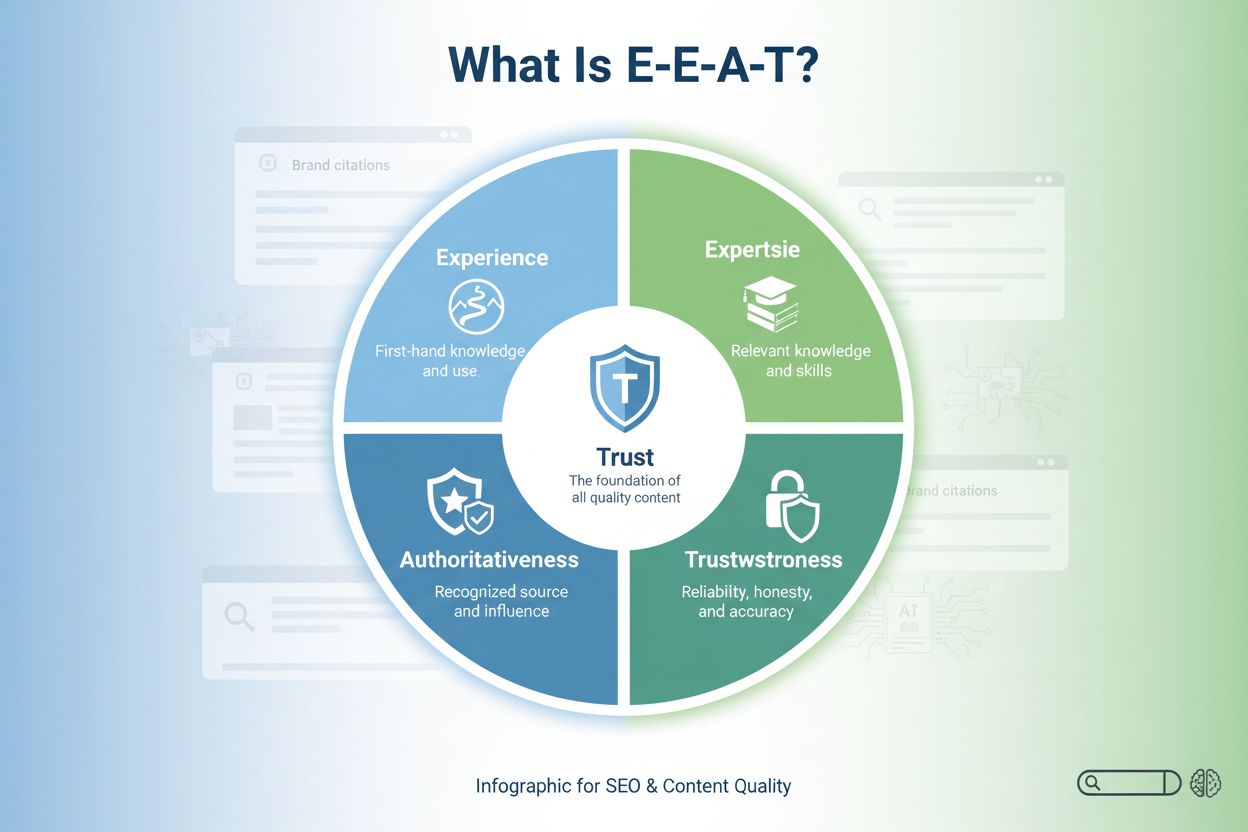
E-E-A-T (Experience, Expertise, Authoritativeness, Trustworthiness) is Google's framework for evaluating content quality. Learn how it impacts SEO, AI citations...

Understand E-E-A-T (Experience, Expertise, Authoritativeness, Trustworthiness) and its critical importance for visibility in AI search engines like ChatGPT, Per...