

How to Prevent Content from Losing AI Visibility in AI Search Engines
Learn proven strategies to maintain and improve your content's visibility in AI-generated answers across ChatGPT, Perplexity, and Google AI Overviews. Discover ...
11 min read

Learn proven strategies to improve your brand’s visibility in AI search engines like ChatGPT, Perplexity, and Gemini. Discover content optimization, entity consistency, and monitoring techniques.
Fix low AI visibility by creating prompt-friendly content with clear structure, establishing entity consistency across platforms, building topical authority, using schema markup, and monitoring your brand mentions in AI tools like ChatGPT, Perplexity, and Gemini.
AI visibility refers to how frequently and prominently your brand, products, and content appear in responses generated by large language models (LLMs) like ChatGPT, Perplexity, Google Gemini, and Claude. Unlike traditional search engine optimization that focuses on ranking positions in search results, AI visibility optimization is about becoming part of the model’s internalized knowledge and being selected as a relevant source when users ask questions. This represents a fundamental shift in how brands are discovered online, as AI systems synthesize answers from multiple sources rather than displaying ranked lists of links. The importance of AI visibility has grown exponentially, with AI referrals to top websites increasing 357% year-over-year, making it critical for brands to understand and optimize for this new discovery channel.
The foundation of improving AI visibility lies in creating content that AI systems can easily understand and extract. Unlike traditional web pages designed for human readers, AI-optimized content must be structured in ways that language models can parse, comprehend, and reuse in generated responses. Your content should directly answer questions that users might ask AI tools, using natural language that mirrors how people actually search. Start by identifying the specific questions your audience asks about your products, services, or industry, then create dedicated content sections that provide clear, concise answers to these questions.
Structural clarity is essential for AI systems to identify and extract relevant information. Use descriptive H2 and H3 headings that function as natural questions rather than vague labels. For example, instead of “Overview,” use “What makes this product different from competitors?” This approach helps AI systems understand content boundaries and extract relevant information with confidence. Each section should be self-contained and make sense even when pulled out of context, as AI systems often lift individual paragraphs or sections to incorporate into their responses. Additionally, keep paragraphs focused and concise—typically 4-6 sentences—to make information more digestible for both AI systems and human readers.
Entity consistency is how AI systems recognize and understand your brand across the entire internet. When your brand information is inconsistent across different platforms, AI models become confused about your identity, which directly impacts your visibility in AI-generated responses. Your brand name, description, location, contact information, and other key details should be identical across all platforms where you maintain a presence. This includes your official website, Wikipedia (if applicable), Wikidata, Crunchbase, LinkedIn, Google Business Profile, industry directories, and social media platforms.
Start by auditing your current presence across major platforms and documenting any inconsistencies. Update your brand information on Wikidata, which serves as a foundational knowledge base that many AI systems reference. Ensure your LinkedIn company page contains accurate, detailed information about your organization, including a clear description of what you do, your industry, and your value proposition. Maintain consistency in how you describe your business across all platforms—use the same tagline, mission statement, and key differentiators. This consistency signals to AI systems that your information is reliable and authoritative, making them more likely to cite your brand when relevant. Additionally, claim and optimize your Google Business Profile, as this information is frequently used by AI systems to provide accurate details about businesses.
Topical authority demonstrates to AI systems that your brand has deep expertise in specific subject areas. Rather than creating scattered, disconnected content, organize your content into thematic clusters where multiple pieces of content reinforce each other around core topics. This approach helps AI systems understand the breadth and depth of your knowledge, making them more confident in citing your content as an authoritative source. Identify 3-5 primary topics that are central to your business, then create comprehensive content around each topic that includes multiple supporting articles, guides, and resources.
For example, if you operate an AI monitoring platform, your primary topics might include “AI search engine optimization,” “brand monitoring in AI systems,” “content optimization for LLMs,” and “measuring AI visibility.” Create a pillar page for each topic that provides a comprehensive overview, then develop 5-10 supporting articles that explore specific aspects of each topic in depth. Interlink these articles strategically using descriptive anchor text that helps both users and AI systems understand the relationships between different pieces of content. This interconnected structure signals to AI systems that you have comprehensive expertise in these areas, increasing the likelihood that they’ll cite your content when users ask related questions. Additionally, ensure that your content covers the full spectrum of questions users might ask about each topic, from beginner-level explanations to advanced technical details.
Schema markup provides AI systems with machine-readable information about your content, making it easier for them to understand and extract relevant details. Implement schema.org markup using JSON-LD format to identify key information on your pages, including your organization details, product specifications, FAQs, how-to guides, and reviews. This structured data helps AI systems quickly identify the type of content on your page and extract specific information with confidence.
Start by adding Organization schema to your homepage, which tells AI systems who you are, what you do, and how to contact you. Include your company name, logo, description, contact information, and social media profiles. For product or service pages, implement Product schema that includes detailed specifications, pricing, availability, and customer reviews. If you have FAQ pages, use FAQPage schema to mark up questions and answers, making it easy for AI systems to extract this information. For how-to content, implement HowTo schema that breaks down steps in a structured format. Validate all your schema markup using Google’s Rich Results Test to ensure it’s correctly formatted and doesn’t contain errors. Properly implemented schema markup significantly increases the likelihood that AI systems will cite your content, as it provides clear, structured information that’s easy to extract and incorporate into responses.
| Optimization Strategy | Implementation | Expected Impact |
|---|---|---|
| Question-Based Headers | Use H2s that mirror natural user queries | Increases AI extraction likelihood by 40-60% |
| Concise Answers | Provide 1-2 sentence direct answers before elaboration | Improves snippet selection in AI responses |
| Structured Lists | Use bullet points for key features or steps | Enhances content parsing and extraction |
| Schema Markup | Implement FAQ, Product, and Organization schema | Increases visibility in AI-generated answers |
| Entity Consistency | Maintain identical brand info across platforms | Improves brand recognition in AI systems |
| Topical Authority | Create interconnected content clusters | Establishes expertise and citation frequency |
| Content Freshness | Update content regularly with current information | Signals relevance to AI systems |
| Multimodal Content | Include high-quality images and videos | Enables visibility in multimodal AI searches |
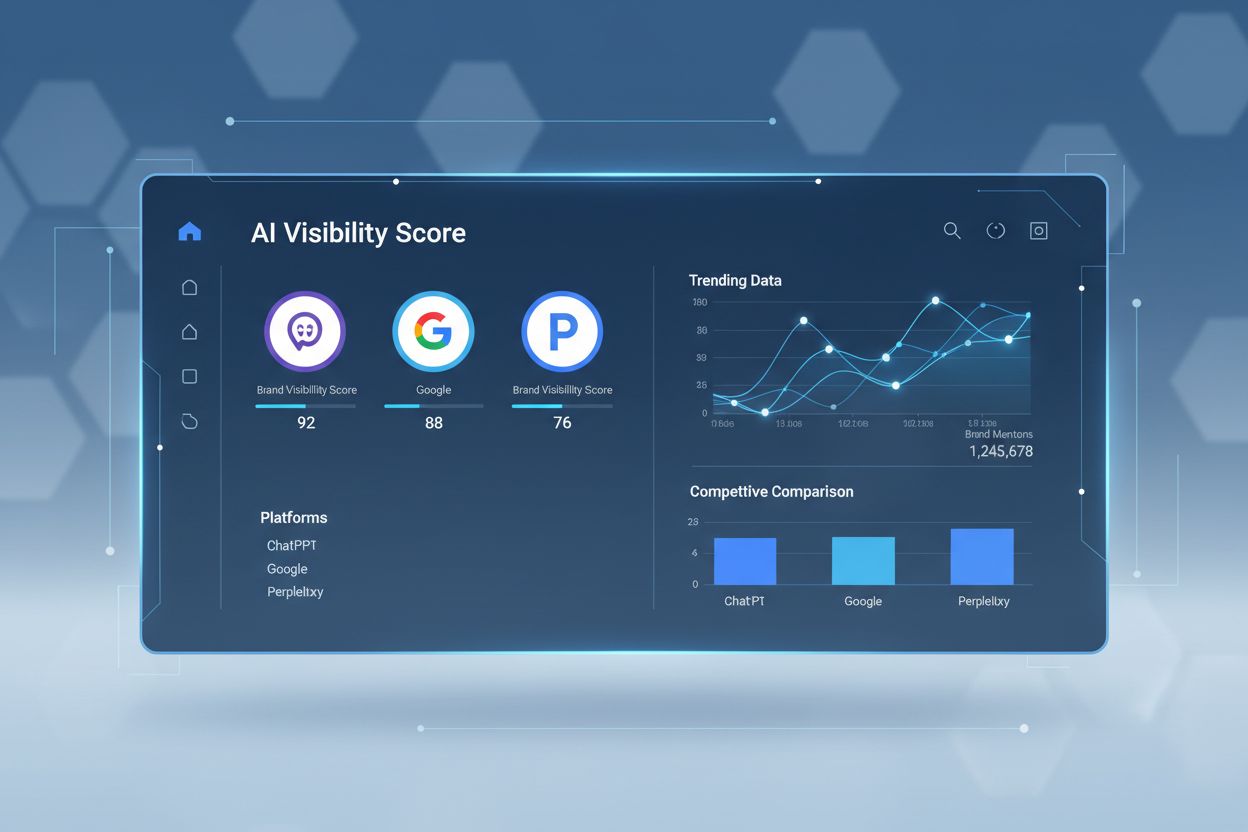
Monitoring AI visibility is essential for understanding how effectively your optimization efforts are working. Traditional SEO tools like Google Search Console don’t measure visibility in AI systems, so you need specialized tools designed specifically for this purpose. These tools simulate queries in various AI systems and track whether and how your brand appears in the generated responses, providing insights into your visibility trends over time.
Implement a monitoring system that tracks your brand mentions across ChatGPT, Perplexity, Claude, and Google Gemini. Set up monthly audits where you search for key terms related to your business and document how often your brand is mentioned, in what context, and whether the information is accurate. Look for patterns in which types of queries trigger your brand mentions and which competitors are being cited alongside you. Use these insights to refine your content strategy—if you notice that certain topics consistently generate brand mentions, create more content around those topics. Conversely, if you identify gaps where competitors are mentioned but you’re not, develop content specifically designed to address those queries. Additionally, monitor for any misrepresentations of your brand in AI responses and work to correct them by updating your content and entity information across platforms.
The shift toward AI-powered search represents a fundamental change in how people discover information online. By implementing these strategies systematically, you position your brand to be visible and cited in this new search landscape, ensuring that when users ask AI systems questions related to your expertise, your brand is recognized as a trusted, authoritative source.
Start tracking how AI systems mention your brand across ChatGPT, Perplexity, Claude, and Gemini. Get real-time insights into your AI search performance.
Learn proven strategies to maintain and improve your content's visibility in AI-generated answers across ChatGPT, Perplexity, and Google AI Overviews. Discover ...
Master the Semrush AI Visibility Toolkit with our comprehensive guide. Learn how to monitor brand visibility in AI search, analyze competitors, and optimize for...
Compare agency vs in-house AI visibility monitoring. Explore costs, timelines, expertise requirements, and hybrid approaches to help you choose the right strate...