
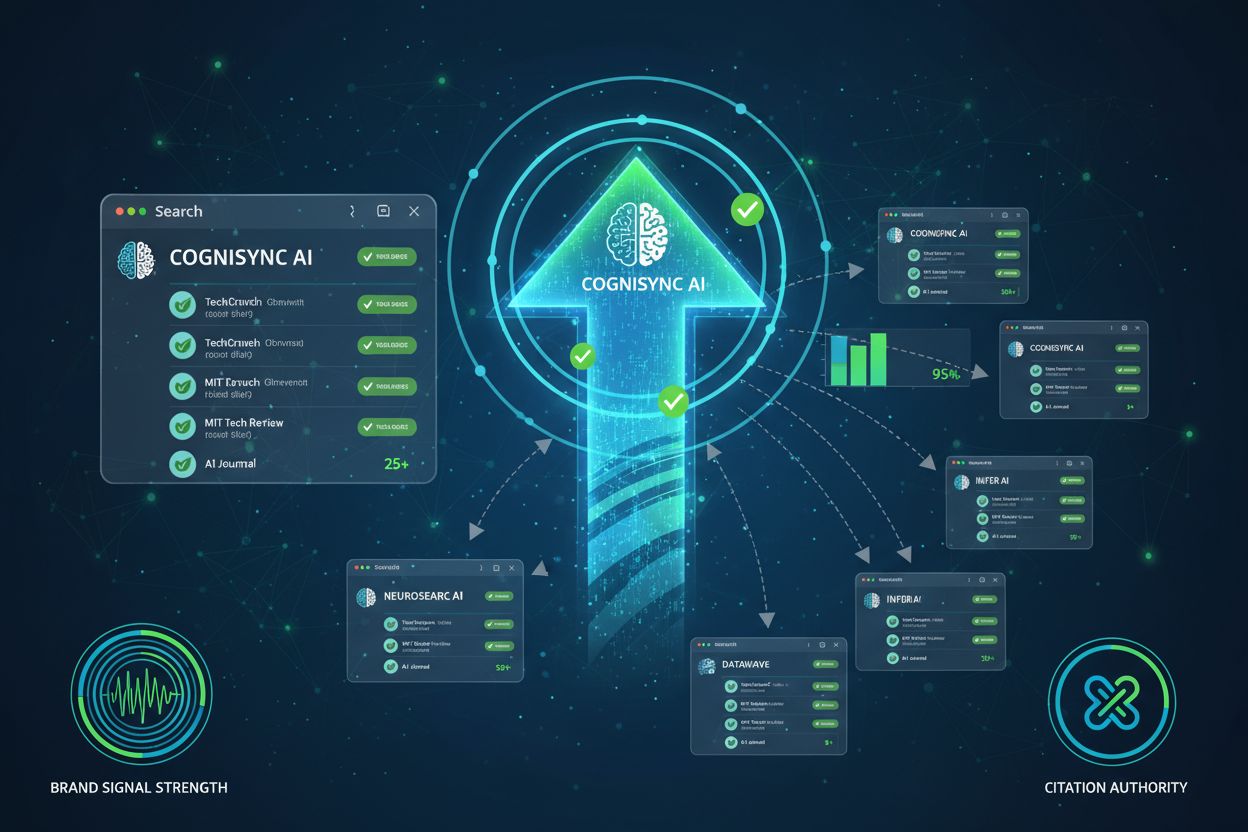
Outranking Competitors in AI Search: Tactical Approaches
Master AI search optimization with proven tactics to outrank competitors in ChatGPT, Perplexity, and Google AI Overviews. Learn brand visibility strategies that...
10 min read

Learn how to adapt your brand for AI search engines. Discover strategies for semantic authority, entity optimization, and visibility in ChatGPT, Perplexity, and other AI tools.
Future-proof your AI search strategy by building semantic authority, creating prompt-friendly content, establishing entity consistency across platforms, optimizing for conversational queries, and monitoring your brand visibility in AI-powered tools like ChatGPT, Perplexity, and Claude.
The way customers discover brands online is undergoing a fundamental transformation. For two decades, success meant ranking on Google’s search results page. Today, that playbook is becoming obsolete as users increasingly turn to AI-powered assistants like ChatGPT, Perplexity, Google Gemini, and Claude for instant, synthesized answers. Unlike traditional search engines that display a ranked list of links, AI search engines generate direct answers by synthesizing information from multiple sources. This shift means your brand must be understood and recognized by AI systems, not just indexed by search algorithms. If your digital strategy focuses exclusively on traditional SEO, your business risks becoming invisible in this new era of AI-driven discovery.
Entity optimization is the foundation of AI search visibility. An entity is any well-defined person, place, organization, or concept. For AI systems, your business is an entity, your products are entities, and your team members are entities. AI engines connect these entities to build knowledge graphs—maps of how everything relates to each other. A strong knowledge graph is essential for AI visibility because it helps language models understand your business comprehensively.
To build your private knowledge graph, start by defining your core entity clearly. Your homepage should be an unambiguous declaration of who you are, what you do, and your primary function. Use structured data markup (Schema.org) to explicitly define your organization type, services, and expertise. Next, establish sub-entities for each service or product you offer. A dedicated page for each offering creates distinct sub-entities that AI can understand and differentiate. Connect these entities through strategic internal linking—when your blog post about a specific topic links to your main service page, you’re showing AI the relationship between informational content and commercial offerings.
| Entity Type | Example | AI Recognition Impact |
|---|---|---|
| Organization | Your company name and industry | Helps AI understand your business scope |
| Person | Executive bios and expertise | Builds E-E-A-T signals for authority |
| Service | Individual product or offering pages | Enables AI to recommend specific solutions |
| Topic | Blog posts and educational content | Establishes topical authority and relevance |
Your team’s expertise is a powerful asset. Create detailed bios for key team members on your About page and attribute content to these individuals. When you connect person-entities (experts) to concept-entities (topics), you significantly boost E-E-A-T signals (Experience, Expertise, Authoritativeness, and Trust) that AI systems use to evaluate credibility.
AI systems don’t read content like humans do. They scan for patterns, structures, and direct answers. To be selected for AI-generated summaries, your content must be formatted for machine consumption. The Generative Engine Answer Format (GEAF) is a framework that structures content to be maximally extractable by AI systems.
The GEAF flow follows this pattern: QUESTION → DEFINITION → WHY IT MATTERS → STEP-BY-STEP → DATA POINTS. Start by reframing your titles as questions. Instead of “A Guide to Enterprise SEO,” use “What Is Included in an Enterprise SEO Strategy?” This aligns with how AI systems interpret queries. Provide immediate, clear definitions at the start of every article—a bolded, one-sentence explanation removes ambiguity for AI. For example: “Content optimization is the process of refining and structuring your website’s content to improve visibility in search results while providing maximum value to readers.”
Convert dense paragraphs into structured units that are easy for AI to parse and extract. Use bulleted lists for benefits and features, numbered lists for processes, data blocks for key statistics, and comparison tables for contrasts. This restructuring is the core of Answer Engine Optimization (AEO)—you’re pre-packaging information for AI consumption rather than just presenting it.
Future-proofing requires addressing the full spectrum of user needs, including questions they haven’t explicitly asked. AI engines understand three layers of intent: primary intent (the explicit question), secondary intent (implied follow-up questions), and tertiary intent (contextual or risk-related questions). For example, someone asking “What is local SEO?” might also wonder “Why do I need it?”, “How much does it cost?”, and “What happens if I get it wrong?”
Build comprehensive content that addresses all three layers. Your main page should define the topic, explain benefits, cover common mistakes, and show how to measure success. Create robust FAQ sections at the end of every service page and blog post—FAQs are literally question-and-answer pairs that AI systems love. Use conversational language with sections like “Most Customers Wonder…” or “What Beginners Need to Know…” This mimics the conversational data AI models are trained on and signals that your content is user-centric.
A critical mistake is assuming all AI engines are identical. Google SGE, ChatGPT, Claude, and Perplexity all have different models, data sources, and parsing methods. A future-proof strategy must optimize for this diversity through Multi-Agent Optimization.
Build content that appeals to all agents by implementing detailed schema markup for Google SGE, using the GEAF framework for ChatGPT, including “Key Stat” blocks for Perplexity, and ensuring FAQs have short, direct answers for voice assistants. This creates a “master asset” capable of performing well across the entire spectrum of AI platforms.
What happens off your website is just as important as on-page optimization. AI engines use off-site signals to determine trustworthiness and authority. High-authority backlinks from respected industry publications remain fundamental—focus on quality and relevance over quantity. User-generated content like reviews, forum mentions, and Q&A contributions help AI gauge public perception and real-world experience. Third-party expert mentions when industry leaders reference your brand on their platforms create powerful authority signals. Local and topical citations across reputable directories establish entity authority, especially for location-based businesses.
Certain content formats consistently outperform others in AI-generated answers because of their utility and structural clarity. Listicles (numbered articles like “Top 10…”) provide digestible structure and semantic clarity. FAQ-driven landing pages with clear answers to common questions boost extractability. Head-to-head comparisons help AI understand competitive positioning. Explainers and definitions are often cited when users ask AI to clarify concepts. How-to guides with structured tutorials are excellent for step-by-step synthesis. Case studies with real-world examples show practical value and support claims in generated answers.
Traditional SEO tools like Google Search Console don’t measure visibility across ChatGPT, Claude, Gemini, or Perplexity because these platforms don’t rely on indexed web results. You need AI-specific monitoring tools to track how your brand appears in AI-generated responses. These tools help you understand:
Run monthly visibility audits and track key prompts tied to your offerings. Over time, these metrics become your AI search equivalent of keyword rankings—critical for long-term brand salience in the AI era.
The rise of AI search is not a distant threat—it’s a present-day reality reshaping how customers discover brands. Businesses that act now to align their digital presence with Generative Engine Optimization (GEO) principles will build sustainable competitive advantages. Those relying on outdated SEO playbooks will find themselves speaking a language that next-generation search can no longer understand. Start by evaluating your key service pages: Do they have clear, entity-defining H1 tags and definitions? Is the content structured in an AI-friendly format? Does it answer multiple layers of user intent? Are pages internally linked to build your knowledge graph? The journey to future-proof your business begins with these foundational steps. By shifting your mindset from ranking to answering, and from keywords to entities, you position your brand not just to survive the AI revolution, but to thrive in it.
Track how your brand appears in ChatGPT, Claude, Perplexity, and other AI search engines. Get real-time insights into your AI visibility and competitive positioning.
Master AI search optimization with proven tactics to outrank competitors in ChatGPT, Perplexity, and Google AI Overviews. Learn brand visibility strategies that...

Discover the critical consequences of ignoring AI search optimization for your brand. Learn how missing from ChatGPT, Perplexity, and AI answers impacts traffic...
Learn how to protect and control your brand reputation in AI-generated answers from ChatGPT, Perplexity, and Gemini. Discover strategies for brand visibility an...