
Generative Engine Optimization (GEO)
Learn what Generative Engine Optimization (GEO) is, how it differs from SEO, and why it's critical for brand visibility in AI-powered search engines like ChatGP...
11 min read

Learn how to get started with Generative Engine Optimization (GEO) today. Discover essential strategies to optimize your content for AI search engines like ChatGPT, Perplexity, and Google AI Overviews.
Start with GEO by understanding your target audience's AI search behavior, conducting keyword research for natural language queries, creating well-structured content that answers user intent, implementing schema markup, and monitoring your performance across AI platforms like ChatGPT, Perplexity, and Google AI Overviews.
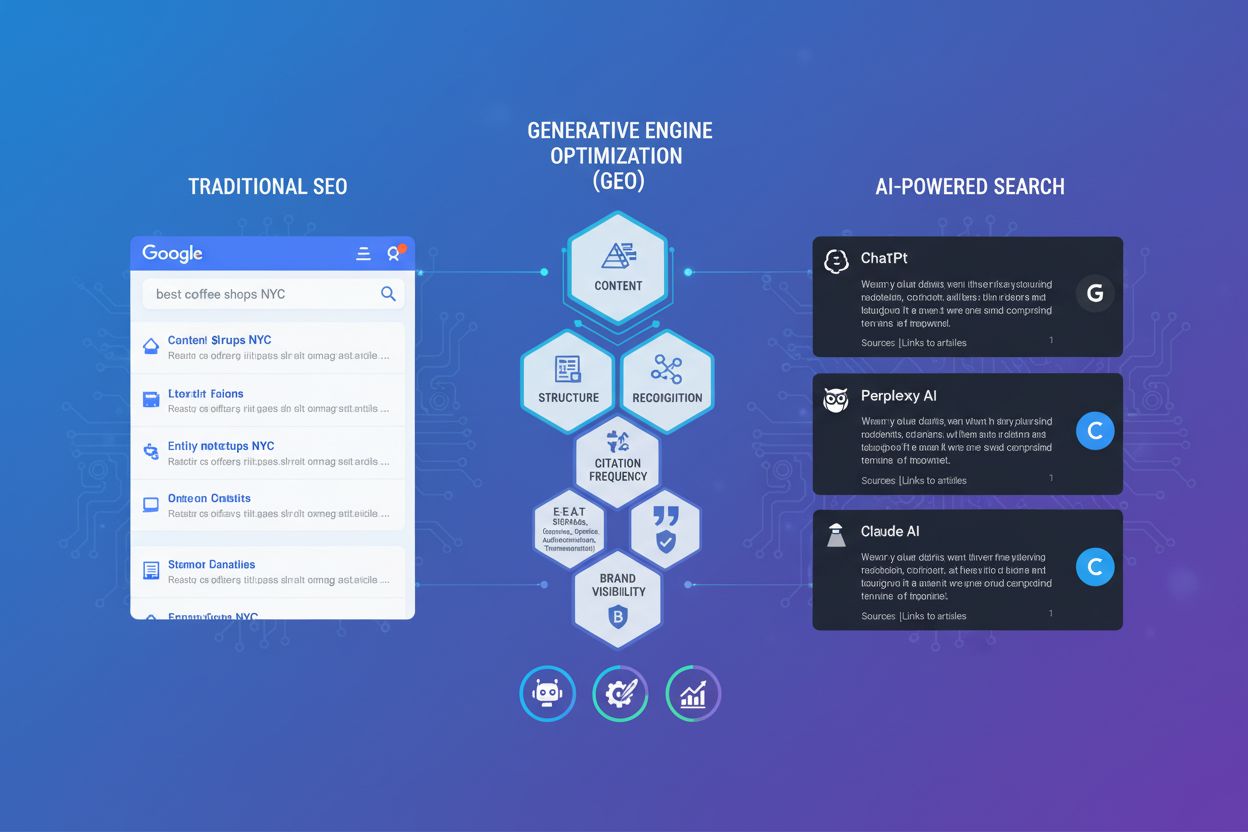
Generative Engine Optimization (GEO) represents a fundamental shift in how content must be optimized for discovery in the modern search landscape. Unlike traditional search engine optimization that focuses on keyword matching and ranking positions, GEO is the practice of designing and structuring your content so that it is favored, cited, and surfaced inside answers produced by AI tools like ChatGPT, Claude, Perplexity, Gemini, and Google’s AI Overviews. This distinction is critical because AI-driven search engines analyze content differently than traditional search engines, prioritizing context, user intent, and content quality over simple keyword frequency.
The transformation from traditional search to AI-powered search has created an urgent need for businesses to adapt their content strategies. With over a billion people now using AI tools, users have developed a muscle memory for having conversations with AI assistants, and organic product discovery is changing as a result. AI prompts tend to be more natural in their expression compared to traditional search queries, often containing multiple different prompts throughout the course of a single conversation. For example, instead of searching “best prototyping tools 2025,” users now ask AI “what are the best prototyping tools for people with little technical knowledge?” This conversational approach means your content must be structured to answer these nuanced, intent-driven questions comprehensively.
The impact of this shift cannot be overstated. Recent data shows that Google’s AI Overviews have led to a massive 61% drop in organic click-through rates, with companies like TripAdvisor experiencing a 34% drop in organic traffic, Netflix losing 23%, and Business Insider cutting 21% of its staff due to organic traffic losses. However, companies that successfully get cited in AI tools experience significant benefits—Vercel’s CEO confirmed that ChatGPT now refers an impressive 10% of all new Vercel sign-ups, with ChatGPT making up almost 80% of the company’s AI referral traffic.
| Aspect | Traditional SEO | Generative Engine Optimization (GEO) |
|---|---|---|
| Focus | Keyword matching and ranking positions | User intent and contextual relevance |
| Content Approach | Keyword-focused, fragmented queries | Natural language, conversational queries |
| Ranking Factors | Backlinks, domain authority, keywords | Content quality, E-E-A-T, expertise |
| User Interaction | Click-through to website | Direct answers in AI interface |
| Content Structure | Optimized for search algorithms | Optimized for AI comprehension and citation |
| Primary Goal | Achieve high SERP position | Get cited in AI-generated answers |
Starting your GEO journey requires a different approach to keyword research than traditional SEO. While the basics remain similar—identifying search volume, competition, and relevance—GEO keyword research demands a shift from exact matches to semantic keywords and natural language queries. You need to focus on how people actually speak to AI assistants, not how they type into search boxes.
Begin by identifying the questions your target audience asks when using AI tools. These questions are typically longer, more conversational, and often contain multiple clauses. For example, instead of targeting “GEO strategy,” you might target “how do I optimize my content for AI search engines like ChatGPT.” Tools like Google Keyword Planner, Semrush, Ahrefs, and LowFruits can help you identify search volume and competition data, but you should specifically look for long-tail keywords and natural language queries that reflect how people interact with AI systems.
When selecting keywords for GEO, balance search volume with competition levels. If you’re just starting out, focus on low-competition keywords where you’re more likely to rank faster. However, take this a step further by creating keyword and topic clusters around your main topics. This approach helps you build topical authority, which AI engines value highly. For instance, if your main topic is “GEO strategies,” create supporting content around related topics like “how to optimize for ChatGPT,” “Perplexity optimization,” and “AI search best practices.” This cluster approach signals to AI systems that you have comprehensive expertise in the subject matter.
Content structure and clarity are absolutely critical for GEO success because AI models thrive on organized, easy-to-navigate content. Unlike traditional SEO where keyword frequency often dominates, GEO emphasizes clarity and structure to deliver user intent-driven results. AI systems need to understand both the context and hierarchy within your article to properly evaluate and cite your content.
Start by breaking up your text into short, digestible paragraphs. Each paragraph should contain complete thoughts and typically range from 3-5 sentences. This makes your content easier for both humans and AI to process. Use descriptive headings and subheadings that clearly indicate what each section covers—this assists AI in determining the relevance of your content for particular queries. Incorporate lists and tables to break up dense text and offer easy-to-read information that AI can quickly scan and understand.
For example, if you’re discussing the benefits of a product or service, listing them in bullet points makes the content more engaging and easier for AI engines to digest. You can also use short paragraphs to describe concepts and a table to compare features or benefits. This multi-format approach ensures that AI systems can extract information from various content types, increasing the likelihood that your content will be cited in AI-generated answers.
One of the core elements of GEO is adhering to Google’s E-E-A-T content guidelines, which stand for Experience, Expertise, Authoritativeness, and Trustworthiness. These principles have become increasingly important for AI-driven search engines because they help determine which sources are most reliable and valuable for generating answers.
Experience means sharing your or your brand’s firsthand knowledge to demonstrate direct experience with the topic. If you’re writing about GEO strategies, share specific examples from your own implementation efforts. Expertise requires that your content is well-researched, comprehensive, and factually accurate. Back up your claims with data, research, and thorough analysis. Authoritativeness involves referencing credible sources, linking to industry experts, and showcasing your authority in your niche. When you cite reputable sources and link to well-established organizations, you signal to AI that your content is grounded in credible information. Trustworthiness means being transparent about your data, privacy policies, and user-friendly practices.
To implement these principles effectively, use citations and references to studies and research from trusted sources. Include statistics and expert quotes from recognized leaders in your field. Create author bios that clearly establish your credentials and experience. Incorporate schema markup to help AI systems understand your author’s expertise and credentials. This comprehensive approach to E-E-A-T signals to AI engines that your content deserves to be ranked highly and cited in generated answers.
While content remains the major pillar of GEO, technical SEO cannot be overlooked because it ensures that AI systems can crawl, index, and understand your pages efficiently. Several technical considerations are critical for GEO success.
Page speed is a critical factor for AI-driven search engines, which prioritize fast-loading websites to deliver seamless experiences to users. Google’s algorithm penalizes slow sites, and this becomes even more critical when dealing with AI-powered engines that focus on delivering high-quality user experiences. Test your site’s performance regularly and optimize images, leverage caching, and minimize code to improve loading times.
Crawlability ensures that AI search engines can navigate your site efficiently to index your content. Enhance your site’s crawlability by ensuring that your website’s structure is clean and intuitive, with a clear hierarchy of pages and links. Use XML sitemaps to help search engines find and index your content quickly. Ensure that important pages are not blocked by robots.txt and that your internal linking structure is logical and comprehensive.
Structured data such as schema markup allows AI to better understand the context and intent of your content. Schema markup provides additional information to search engines, such as product details, reviews, event dates, and article metadata, enabling AI to categorize and display your content more effectively. For instance, using schema for an article ensures that AI knows it’s an informational page, increasing the chances of appearing in rich snippets or being cited in AI-generated answers.
AI-driven search engines don’t just focus on text—they’re analyzing everything, including images, videos, and infographics. Multimedia content plays a crucial role in how AI understands the context and value of your content. If you’re relying solely on text, you’re missing a massive opportunity to engage both your audience and the AI algorithms that power search engines.
Multimedia serves two important functions: it engages users and enhances content value. People are more likely to interact with visuals than long walls of text, and AI engines consider multimedia as additional layers of information, helping them better understand the depth of your content. When you add a video demonstration or explainer, you’re not only giving your readers something more engaging, but you’re also increasing the time users spend on your page—a crucial metric AI-driven engines use to evaluate content quality.
Consider using comparison infographics to explain complex concepts, video demonstrations to show how something works, and interactive elements to increase engagement. The longer visitors stay on your page and the more they interact with your content, the better it performs in AI systems. Multimedia is no longer a “nice-to-have”—it’s a must-have for effective GEO because it provides AI with richer context and signals that your content is comprehensive and valuable.
Getting started with GEO also means establishing a system to monitor how your content performs across AI platforms. Track how your content appears in AI-generated answers across ChatGPT, Perplexity, Google AI Overviews, and other AI search engines. Monitor key metrics including search impressions, click-through rates, average position, and content performance.
Pay attention to which of your pages are ranking highest in AI systems and which are losing visibility. Look for patterns in the types of content that get cited most frequently. Monitor for content decay—the gradual decrease in organic performance—by regularly checking which articles are losing rankings. When you identify underperforming content, update it with fresh information, better structure, and enhanced multimedia elements.
Use tools that integrate with Google Search Console to track your keyword rankings and content performance. Create a baseline of your current performance, then set specific goals for improvement. Review your metrics monthly to see if your GEO strategies are bearing fruit. This data-driven approach ensures that you can make informed adjustments to your strategy and continuously improve your visibility in AI-generated answers.
To get started with GEO today, begin with these foundational steps: First, audit your existing content to understand how it currently performs in AI systems and identify gaps where you could create new content. Second, conduct keyword research focused on natural language queries and conversational phrases that people use when interacting with AI. Third, restructure your top-performing content to improve clarity, add multimedia elements, and implement schema markup. Fourth, create new content specifically designed to answer the questions your audience asks AI assistants. Finally, establish monitoring systems to track your performance and make data-driven optimizations.
The future of organic discovery is shifting toward AI-powered platforms, and companies that adapt their content strategies now will have a significant competitive advantage. By understanding GEO principles, optimizing your content structure, implementing E-E-A-T guidelines, and monitoring your performance, you can ensure that your brand gets cited in AI-generated answers and captures traffic from this rapidly growing discovery channel.
Track how your content appears in AI-generated answers across ChatGPT, Perplexity, and other AI search engines. Get real-time insights into your AI visibility and optimize your presence.
Learn what Generative Engine Optimization (GEO) is, how it differs from SEO, and why it's critical for brand visibility in AI-powered search engines like ChatGP...

Learn Generative Engine Optimization (GEO) fundamentals. Discover how to get your brand cited in ChatGPT, Perplexity, and Google AI Overviews with proven strate...

Learn what Generative Engine Optimization (GEO) is and how to optimize your brand for visibility in AI search engines like ChatGPT, Perplexity, and Gemini. Disc...