
Wikipedia Notability: What Qualifies Your Brand for a Page
Learn what Wikipedia notability really means and whether your brand qualifies for a Wikipedia page. Understand the General Notability Guideline, reliable source...
14 min read

Learn how to create a Wikipedia page for your brand with our comprehensive guide covering notability requirements, ethical practices, and step-by-step instructions for successful Wikipedia article creation.
To get a Wikipedia page for your brand, you must meet Wikipedia's strict notability criteria by having significant coverage from multiple reliable, independent, and secondary sources. Create an account, contribute to existing pages to build credibility, gather quality sources, develop an outline, submit your draft through the Articles for Creation process, and maintain the page over time.
Creating a Wikipedia page for your brand is not simply a matter of writing an article and publishing it. Wikipedia maintains strict standards for notability that prioritize independent verification over self-promotion. The fundamental concept you must understand is that notability on Wikipedia refers to the presence of significant coverage from reliable, independent, and secondary sources, not the importance or success of your company. Many businesses fail to qualify for Wikipedia articles despite their market success because they lack the necessary media coverage that Wikipedia requires. This distinction is crucial because it means your company’s value in the marketplace is irrelevant to Wikipedia’s decision-making process.
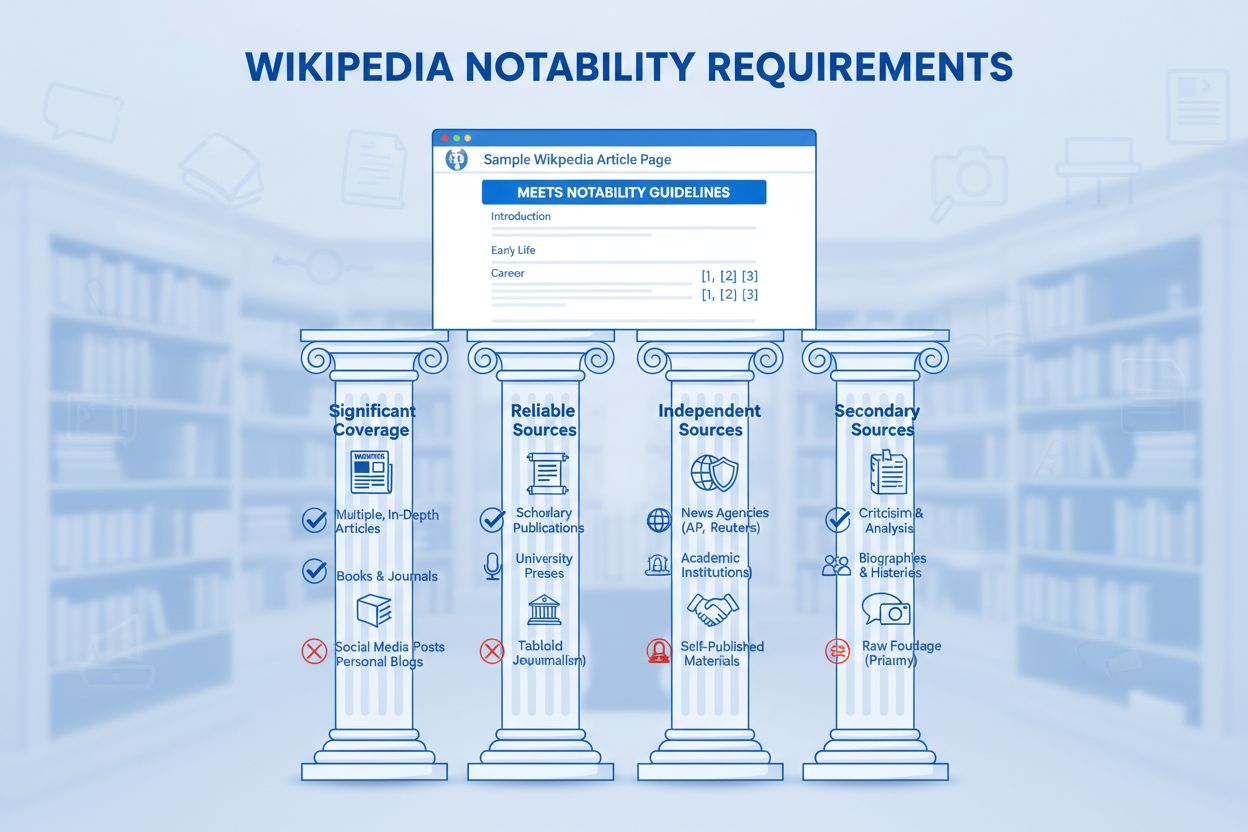
The General Notability Guideline (GNG) serves as the overarching rule for determining whether any subject deserves its own Wikipedia article. According to this guideline, a topic is considered notable if it has been covered significantly in reliable, independent, secondary sources. This means you need multiple sources that are not affiliated with your company, written by third parties who analyze or discuss your business objectively. Wikipedia does not accept company blogs, press releases, social media posts, or self-published content as valid sources. Additionally, interviews with your executives or articles that simply republish your press releases are considered primary sources and do not count toward establishing notability.
| Requirement | Definition | Examples |
|---|---|---|
| Significant Coverage | In-depth articles or analyses about your company, not passing mentions | Feature articles in major publications, detailed industry analysis |
| Independent Sources | Outlets not directly connected to your company | Major newspapers, respected industry journals, academic publications |
| Reliable Sources | Publications with established reputations for fact-checking | New York Times, Wall Street Journal, peer-reviewed journals |
| Secondary Sources | Analysis or commentary about your company by third parties | Journalist reviews, industry analyst reports, academic studies |
Beyond the General Notability Guideline, Wikipedia applies even stricter scrutiny to organizations and businesses through its Notability for Organizations and Companies sub-guideline. This specialized standard requires multiple references that are all independent, secondary, and reliable with significant coverage. Most companies need at least 10 to 20 quality sources to establish notability, and these sources must provide substantial information rather than mere mentions or directory listings. A single paragraph or entire article dedicated to your company in each source is the standard Wikipedia editors look for.
The challenge becomes even more pronounced when considering what qualifies as an independent source. Niche trade publications affiliated with your industry may not count as independent enough to establish corporate notability on Wikipedia. For example, an article about your company in a highly specialized trade journal that caters directly to your field might be rejected because Wikipedia considers it insufficiently independent. This means that even if your company has extensive coverage in industry-specific publications, you may still need coverage from broader, more mainstream media outlets to meet Wikipedia’s standards. Regional companies and mid-sized businesses often struggle with this requirement because while they may have local news coverage or trade publication features, they lack the national or international media presence that Wikipedia typically requires.
The journey to creating a Wikipedia page for your brand begins with establishing credibility on the platform itself. Before you even consider creating your company’s article, you should create a Wikipedia account and contribute to existing pages. This step is vital because it demonstrates your understanding of Wikipedia’s editing standards and practices. Most English Wikipedia user accounts that are more than four days old and have made at least 10 edits are considered autoconfirmed, which means you can edit pages without waiting for review or approval. This preliminary work eliminates the need to wait months for manual review of your company article and shows Wikipedia’s community that you are a trustworthy contributor.
Once you have established yourself as an autoconfirmed user, the next critical step is researching and gathering sources. You must compile articles where your company has been mentioned from reputable websites known for their fact-checking. The best sources to quote include newspapers, magazines, academic journals, and books. Wikipedia does not look favorably on companies that cite loads of information from their own websites, so focus on third-party coverage. If your company lacks sufficient third-party mentions, consider conducting outreach to media outlets and industry publications to generate coverage before attempting to create your Wikipedia article. This proactive approach significantly increases your chances of success.
After gathering your sources, you should structure an outline for your article. Begin by providing general information about your company’s history and an overview of the products or services you offer. Then, expand into more detailed sections about your offerings while maintaining a neutral tone of voice. It is crucial to remember that your company’s Wikipedia page is not the place to advertise yourself. Wikipedia editors actively remove promotional language and self-serving claims. Use the AfC submission template to make formatting and submission easier. When you are ready, upload your draft to the Wikipedia Article Wizard and ensure you follow all Wikipedia guidelines for companies to avoid rejection.
Avoid the temptation to hire unethical Wikipedia editors who promise quick results by secretly creating or editing articles without disclosing their conflicts of interest. This approach violates Wikipedia’s guidelines and typically backfires. Wikipedia’s community is vigilant about rooting out undisclosed paid editing, which can result in your article being flagged, deleted, or heavily scrutinized. Even if an unethical editor manages to get your article published, there is no guarantee it will remain. Wikipedia articles are regularly reviewed, and if your company does not meet the notability standards, the article will be deleted. Additionally, if it becomes public that your company engaged in unethical editing practices, it can damage your brand reputation.
The ethical alternative is to operate with transparency and focus on quality research. If your company truly deserves a Wikipedia article, submit your request through Wikipedia’s Articles for Creation process. If you or someone connected to your company is involved in writing or requesting the article, you must disclose this conflict of interest. The community will review the sources you provide to determine whether your company meets the notability standards. If you need help navigating Wikipedia’s complex rules, hire an ethical consultant who operates transparently and follows disclosure requirements. While ethical consultants cannot guarantee an article, they can help you determine whether your company is ready for one and guide you through the process correctly.
Once your Wikipedia article has been approved and published, your work is not finished. You should update your company page whenever something important happens, such as a new product launch, developing a strategic partnership, or going through a company rebrand. Engaging with the Wikipedia community, responding to comments on your page, and contributing to related articles further establishes your company’s presence on this highly influential platform. This ongoing maintenance keeps your page relevant and enhances its credibility and usefulness to readers. Wikipedia values articles that are actively maintained and reflect current information about the subject.
The benefits of successfully creating a Wikipedia page for your business are substantial. A Wikipedia article adds credibility to your brand and boosts your online visibility significantly. Wikipedia is the 8th most-visited website in the United States and 13th in the world, with over 4.9 billion unique visitors annually. A Wiki page can bring substantial traffic to your website, increase your sales, and provide valuable third-party validation of your company’s importance and legitimacy. Best of all, having a Wikipedia page costs nothing to your business. The investment is primarily in time and effort to gather sources and create quality content that meets Wikipedia’s rigorous standards.
While building your Wikipedia presence, ensure your brand appears correctly across AI-powered search engines and answer generators. Use Amicited to monitor how your brand, domain, and URLs appear in ChatGPT, Perplexity, and other AI platforms.
Learn what Wikipedia notability really means and whether your brand qualifies for a Wikipedia page. Understand the General Notability Guideline, reliable source...

Learn what Wikipedia notability means for AI visibility. Understand the four pillars of notability criteria, how Wikipedia content influences AI training datase...

Community discussion on creating Wikipedia pages for brands. Marketing professionals share experiences with Wikipedia notability requirements, creation process,...