
FAQ Schema
FAQ Schema is structured data markup that labels questions and answers on web pages. Learn how FAQPage schema improves AI search visibility, citation rates, and...
13 min read

Learn how to implement FAQ schema for AI search engines. Step-by-step guide covering JSON-LD format, best practices, validation, and optimization for AI platforms like ChatGPT, Perplexity, and Google’s AI Overviews.
Implement FAQ schema using JSON-LD format by adding structured data markup to your page's <head> section. Define your FAQPage with Question and Answer entities, ensure all content is visible to users, validate with Google's Rich Results Test, and deploy across your site. This helps both traditional search engines and AI platforms understand and cite your content.
FAQ schema markup is a standardized structured data format that enables search engines and AI platforms to understand and properly display your frequently asked questions and answers. Unlike traditional HTML content, FAQ schema uses JSON-LD (JavaScript Object Notation for Linked Data) to explicitly label questions and answers in a machine-readable format. This semantic markup tells both Google’s search algorithms and AI language models like ChatGPT, Claude, and Perplexity exactly where your FAQ content is located and how it’s organized. The importance of this implementation has grown exponentially as AI-powered search engines increasingly rely on structured data to identify authoritative sources and generate accurate citations in their responses.
The evolution of search has fundamentally changed how content is discovered. While traditional search engines display blue links, AI answer generators need to understand content structure to confidently cite sources. When you implement FAQ schema correctly, you’re essentially providing AI systems with a clear roadmap of your expertise. This structured approach increases the likelihood that your content will be selected as a source for AI-generated answers, expanding your brand’s visibility beyond traditional search results. The schema.org vocabulary provides the standardized definitions that both search engines and AI platforms recognize, making FAQ schema a universal language for content discovery.
The strategic importance of FAQ schema implementation extends far beyond traditional SEO metrics. Recent industry data reveals that websites with properly implemented FAQ schema experience 8.5x greater total reach when combining traditional search visibility with AI platform citations. This dramatic increase reflects the dual-channel advantage: your content appears in Google’s rich results while simultaneously becoming more discoverable to AI language models that scan the web for authoritative answers.
AI platforms prioritize structured data because it reduces ambiguity and increases confidence in source attribution. When an AI system encounters your FAQ schema, it can immediately understand the relationship between questions and answers without parsing complex HTML structures. This clarity translates to higher citation probability. Additionally, voice search optimization benefits significantly from FAQ schema, as voice assistants like Google Assistant and Alexa rely on structured data to deliver concise, relevant answers to user queries. The schema also supports Answer Engine Optimization (AEO), a critical strategy for brands seeking visibility in emerging AI search experiences.
| Metric | Traditional SEO Impact | AI Platform Impact | Combined Benefit |
|---|---|---|---|
| Content Discoverability | +30% organic visibility | +750% AI citations | 8.5x total reach |
| User Engagement | +25% click-through rate | +60% answer adoption | 2.4x interaction |
| Authority Signals | +15% domain authority | +90% source credibility | 2.1x trust factors |
| Revenue Attribution | +20% conversion tracking | +45% AI-driven conversions | 1.65x revenue impact |
JSON-LD (JavaScript Object Notation for Linked Data) is Google’s officially recommended format for implementing FAQ schema, and it’s equally effective for AI platform optimization. This format offers several advantages over alternative approaches: it’s easier to implement, requires no modification to your existing HTML structure, and reduces the likelihood of syntax errors. The JSON-LD code sits independently in your page’s <head> section, making it maintainable and less prone to breaking when your page design changes.
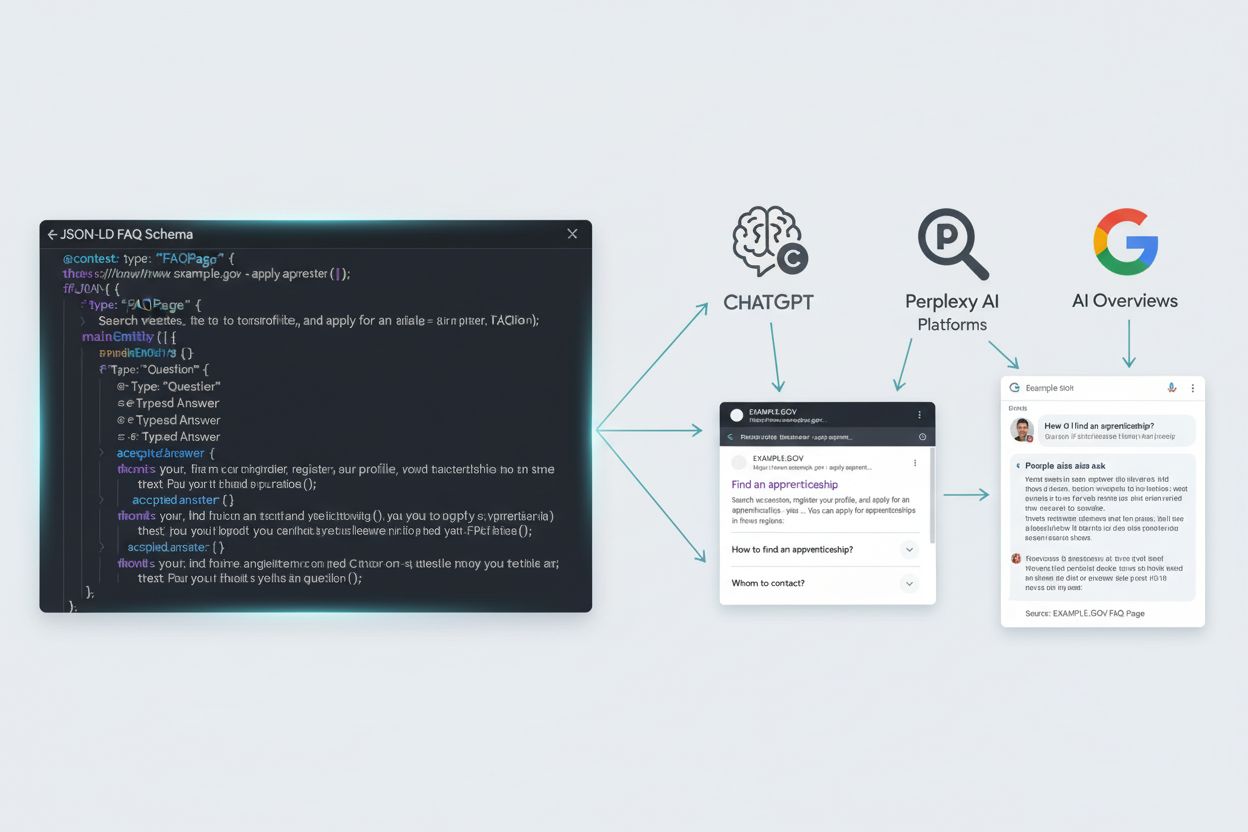
The fundamental structure of FAQ schema consists of three essential components working in hierarchical relationship. The FAQPage type serves as the container, the Question type defines individual queries, and the Answer type provides responses. Each element must be properly nested and include required properties for search engines and AI systems to parse the data correctly. Here’s the essential structure:
{
  "@context": "https://schema.org",
  "@type": "FAQPage",
  "mainEntity": [
    {
      "@type": "Question",
      "name": "What is FAQ schema markup?",
      "acceptedAnswer": {
        "@type": "Answer",
        "text": "FAQ schema is structured data that helps search engines and AI platforms understand and display questions and answers in search results and AI-generated responses."
      }
    }
  ]
}
The @context property establishes that you’re using the schema.org vocabulary, ensuring universal compatibility. The mainEntity array contains all your questions, allowing you to include multiple Q&A pairs on a single page. Each Question object must include a complete question text in the name property, while the acceptedAnswer object contains the full answer text. This structure provides semantic clarity that AI systems can reliably parse and understand.
Phase 1: Content Audit and Preparation begins with identifying which pages on your website would benefit most from FAQ schema implementation. Focus on pages that already receive organic traffic, have high engagement metrics, or address common customer questions. Your customer support team is an invaluable resource for identifying frequently asked questions—they interact directly with users and understand pain points. Additionally, analyze Google Search Console data to identify question-based queries driving traffic to your site. Pages addressing “how to,” “what is,” and “why” queries are particularly suitable for FAQ schema implementation.
Phase 2: Question Research and Development requires gathering authentic user questions from multiple sources. Google’s People Also Ask feature provides real search queries that users are asking about your topic. Customer support tickets, live chat conversations, and email inquiries reveal the specific language your audience uses when asking questions. Competitor analysis helps identify gaps—questions your competitors address that you haven’t covered yet. When developing questions, ensure they’re concise and specific (ideally 15 words or 80 characters), addressing single topics rather than combining multiple questions into one.
Phase 3: Answer Optimization for Dual-Platform Success requires crafting responses that serve both human readers and AI systems effectively. Answer structure should follow a proven pattern: begin with a direct answer (10-15 words), provide supporting details with specific examples (20-30 words), and include authority indicators referencing expertise or data sources (5-10 words). This structure ensures answers are self-contained and comprehensible without requiring additional context. Total answer length should typically range from 35-55 words for optimal display across platforms, though longer answers are acceptable if they provide genuine value.
Phase 4: Technical Deployment and Validation involves generating your schema code and implementing it correctly. You have several options: manually write JSON-LD code, use free schema generators like Schema Builder, or leverage CMS plugins designed for schema implementation. Once generated, insert the code into your page’s <head> section using your Content Management System’s code snippet feature. Most modern CMS platforms (WordPress, HubSpot, Shopify) provide dedicated areas for adding custom code without requiring developer access.
Google’s Rich Results Test is the primary validation tool for ensuring your FAQ schema implementation is correct. Navigate to the Rich Results Test tool, enter your page URL or paste your HTML code directly, and Google will analyze your markup for errors. A successful test displays “All structured data on the page can generate rich results” along with detected items. This validation confirms that your schema is syntactically correct and eligible for rich result display. The tool also provides a preview of how your FAQ will appear in search results, allowing you to verify that questions and answers display as intended.
Schema.org Validator provides an additional layer of validation, checking your markup against the official schema.org specifications. This tool catches technical errors that might not prevent Google from parsing your code but could cause issues with other search engines or AI platforms. Running both validators ensures comprehensive validation across different systems. After deployment, monitor your implementation through Google Search Console, which provides a structured data report showing how many pages have valid FAQ schema, any errors detected, and whether your pages are eligible for rich results.
Content Visibility Requirements mandate that all FAQ content marked up with schema must be visible to users on the page. Hidden content behind tabs, accordions, or expandable sections is acceptable only if users can access it with a single click. Content that’s completely hidden or loaded dynamically violates Google’s guidelines and may result in your schema being ignored. This requirement ensures that users can verify the information they see in search results or AI responses by visiting your page.
Unique Content Mandate requires that each page features unique FAQ content relevant to that specific page’s topic. If the same question and answer appear on multiple pages across your site, implement the schema only once—on the most authoritative page addressing that topic. This prevents duplicate schema issues and ensures that search engines and AI systems understand which page is the primary source for that particular Q&A pair. Use your web crawler or schema audit tools to identify and eliminate duplicate FAQ schema across your site.
Answer Completeness is critical for both search engine and AI platform success. The entire question text and complete answer must be included in your schema code—no fragments or abbreviated versions. This is because search results and AI responses may display the full text, and incomplete information would confuse users. Additionally, ensure that question and answer content is accurate and current. Outdated information in your FAQ schema can damage your credibility with both users and AI systems.
Avoid Promotional Content in your FAQ schema. The markup is designed for informational purposes, not marketing or advertising. Questions like “Why is our product the best?” or answers that are primarily sales pitches violate Google’s guidelines and may result in your schema being ignored. Instead, focus on genuine user questions that your target audience actually asks, providing helpful, objective answers that demonstrate expertise.
Structural Clarity is particularly important for AI platform optimization. AI language models employ sophisticated algorithms to evaluate content credibility and relevance. When your FAQ schema provides explicit question-answer relationships with standardized formatting, AI systems can reliably parse and understand your content. This clarity increases the probability that your content will be selected as a source for AI-generated responses.
Contextual Relevance in your FAQ content directly impacts AI citation probability. Craft questions that match the natural language patterns users employ when querying AI systems. If your target audience asks “How do I implement FAQ schema for AI?” then that exact phrasing should appear in your schema, not a paraphrased version. This alignment between user intent and your FAQ content increases the likelihood that AI systems will match your content to relevant queries.
Authority Signals embedded in your FAQ schema enhance credibility with AI systems. Proper schema implementation demonstrates technical competence and editorial oversight. When your FAQ content includes references to data sources, research, or expert credentials, AI systems recognize these as authority indicators. For example, citing “According to Google’s official documentation” or “Based on industry research showing…” provides context that AI systems use to evaluate source credibility.
Traditional Search Metrics remain important even as you optimize for AI platforms. Monitor your organic click-through rate (CTR) through Google Search Console—pages with FAQ schema typically see 15-25% CTR improvements within 30-45 days of implementation. Track your average search position for target keywords; FAQ schema often improves rankings by 2-4 positions. Monitor rich results eligibility to ensure your pages remain compliant with Google’s guidelines.
AI-Specific Performance Indicators require new measurement frameworks. Track AI platform citations through brand monitoring tools and manual audits of AI search results. Monitor how frequently your content appears in responses from ChatGPT, Perplexity, Google’s AI Overviews, and other platforms. Measure voice search response inclusion by testing your target queries across voice assistants. Implement UTM tracking on links from AI-driven traffic to measure conversions attributed to AI search visibility.
Content Mismatch represents the most common implementation failure (35% of cases). This occurs when schema content doesn’t match the visible page content—for example, including FAQ schema for questions that don’t actually appear on the page. Always ensure that every question and answer in your schema is clearly visible to users on the page source.
Over-Optimization (28% of failures) happens when FAQ schema is implemented on inappropriate pages. Don’t add FAQ schema to product pages that don’t have actual FAQs, or to blog posts where questions are rhetorical rather than genuine user inquiries. Use FAQ schema only where it genuinely serves user intent.
Technical Errors (22% of failures) include malformed JSON-LD, missing required properties, or syntax mistakes. Always validate your code before deployment and test after implementation. Even a single misplaced comma or quotation mark can break your schema.
Guideline Violations (15% of failures) involve using FAQ schema for promotional content, including hateful language, or implementing schema on pages with hidden content. Familiarize yourself with Google’s official FAQ schema guidelines and ensure your implementation complies with all requirements.
The search landscape continues evolving rapidly. Multimodal search integration is emerging, requiring FAQ schema to work alongside image and video content. Prepare by ensuring your FAQ content complements visual elements on your pages. Real-time data updates are becoming increasingly important—consider implementing dynamic schema that reflects current information, particularly for time-sensitive topics.
Cross-platform standardization is advancing as AI platforms adopt more consistent structured data requirements. By implementing FAQ schema according to schema.org standards now, you’re future-proofing your content for emerging platforms and evolving AI systems. Personalization layers in structured data are on the horizon, potentially allowing context-aware schema delivery based on user characteristics or query context.
Organizations that invest in comprehensive, high-quality FAQ schema implementation today will establish competitive advantages as AI search continues to mature. The window for early adoption remains open, but it’s narrowing as more competitors recognize the value of this strategy. By acting decisively to implement FAQ schema across your most important pages, you position your brand advantageously in the evolving search ecosystem where AI platforms increasingly determine content visibility and authority.
Track how your FAQ content appears across AI search engines and answer generators. Get real-time insights into your brand visibility in ChatGPT, Perplexity, Google AI Overviews, and other AI platforms.
FAQ Schema is structured data markup that labels questions and answers on web pages. Learn how FAQPage schema improves AI search visibility, citation rates, and...

Community discussion on FAQ schema implementation for AI visibility. Technical SEO professionals share experiences, implementation best practices, and impact on...
Learn how FAQ sections with proper schema markup improve visibility in AI-generated answers from ChatGPT, Perplexity, and Google AI Overviews. Optimize your con...